BY: JERIC YURKANIN
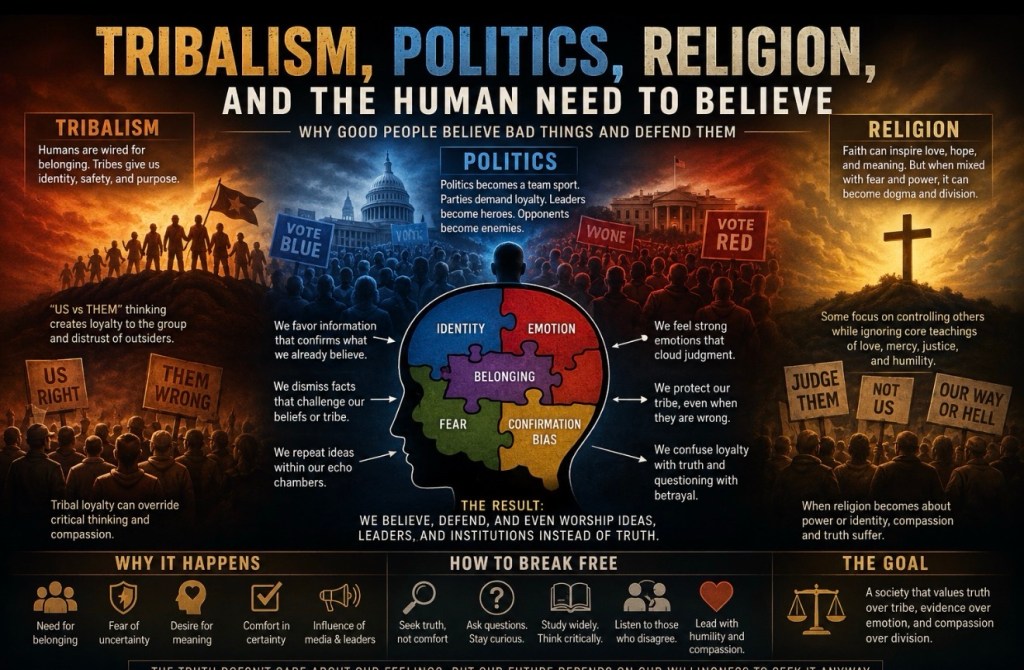
One of the most fascinating and troubling aspects of human behavior is how often people can become deeply attached to ideas, leaders, political parties, religious movements, and media narratives even when evidence challenges those beliefs. Throughout history, human beings have shown a remarkable ability to defend positions that are inconsistent, exaggerated, or even demonstrably false. This is not a problem unique to one political party, one religion, one country, or one era. It appears to be a deeply human tendency.
Many people assume that facts alone determine what people believe. In reality, psychologists have found that identity often plays a much larger role. When a belief becomes connected to a person’s identity, family, community, political tribe, or religious group, changing that belief can feel like losing a piece of themselves. The issue is no longer simply whether something is true or false. The issue becomes belonging.
Human beings evolved as social creatures. For most of human history, survival depended on being accepted by the tribe. Being excluded from the group could mean isolation, danger, or death. While modern society is different, our brains still carry many of those ancient instincts. We often seek acceptance, validation, and belonging from groups that share our values and worldview.
This helps explain why people sometimes defend politicians, media personalities, religious leaders, or public figures long after evidence suggests those figures have been dishonest or wrong. To admit the leader was wrong can feel like admitting the tribe was wrong. To admit the tribe was wrong can feel like admitting that one’s identity is wrong. As a result, people often double down rather than reconsider.
Modern media amplifies this tendency. News organizations, websites, influencers, podcasts, and social media platforms compete for attention. Attention generates advertising revenue, political influence, donations, subscriptions, and power. Outrage, fear, and tribal conflict often attract more engagement than careful analysis. The result is a system that frequently rewards emotional reactions over thoughtful investigation.
Political parties have learned to exploit these realities. Rather than simply persuading voters through policy, many politicians frame politics as a battle between good and evil. Opponents are portrayed not merely as people who disagree but as threats to the nation, freedom, morality, or civilization itself. Once politics becomes a moral crusade, compromise becomes betrayal and critical thinking becomes disloyalty.
The danger arises when people begin treating political leaders the way previous generations treated kings, prophets, or religious authorities. Instead of evaluating each statement on its merits, supporters may assume their preferred leader is correct by default. Critics do the opposite, assuming the leader is wrong regardless of evidence. In both cases, independent thinking disappears.
This phenomenon is not limited to politics. History shows similar patterns in religion. Many people inherit beliefs from parents, communities, cultures, and traditions. Often these beliefs are accepted long before individuals have the opportunity to critically examine them. For some, questioning those beliefs can carry significant emotional and social consequences.
Religious institutions have done tremendous good throughout history through charity, education, healthcare, and community building. Yet history also shows that religious organizations have sometimes been used to justify wars, discrimination, persecution, political power, and financial gain. Human beings are capable of using almost any belief system for both noble and harmful purposes.
One criticism often raised about modern Christianity in America is the perception that some believers focus heavily on certain issues, particularly sexual behavior, while paying less attention to themes that Jesus emphasized repeatedly in the Gospels. In the teachings attributed to Jesus, subjects such as love, mercy, compassion, forgiveness, humility, helping the poor, caring for strangers, and avoiding greed appear frequently.
For example, Jesus spoke often about wealth and the dangers of greed. He taught about feeding the hungry, caring for the sick, welcoming outsiders, and serving those in need. The Parable of the Good Samaritan focused on helping someone from a different group. Matthew 25 describes caring for “the least of these.” Yet public discussions about Christianity often focus disproportionately on sexual issues compared to these broader themes.
This does not mean all Christians ignore those teachings. Millions of believers devote their lives to charity, service, and helping others. However, critics argue that certain religious and political movements have emphasized culture-war issues so heavily that many people now associate Christianity more with political positions than with the ethical teachings found in the Gospels.
The same pattern can occur in any ideology. People tend to highlight evidence that supports their existing beliefs and dismiss evidence that challenges them. Psychologists call this confirmation bias. We naturally seek information that makes us feel right and avoid information that makes us uncomfortable.
Social media intensifies this process. Algorithms are designed to keep users engaged. Often that means showing people content that reinforces their existing views. Over time, individuals may find themselves surrounded by voices that largely agree with them. The result can be an echo chamber where disagreement feels increasingly rare and opposing perspectives seem irrational or malicious.
One consequence is that facts alone often fail to change minds. People do not simply process information objectively. They filter information through emotions, identity, relationships, and prior beliefs. A fact that threatens someone’s worldview may be rejected regardless of how strong the evidence is.
History provides countless examples. Political propaganda has influenced entire nations. Religious movements have spread extraordinary claims. Conspiracy theories have flourished across cultures and centuries. None of this happened because people were necessarily unintelligent. It happened because human beings are emotional creatures who crave meaning, certainty, belonging, and purpose.
The challenge for modern society is learning how to pursue truth while remaining humble. Genuine critical thinking requires the willingness to question not only opposing views but also our own assumptions. It requires recognizing that our preferred politicians can be wrong, our favorite media sources can be mistaken, and our communities can sometimes reinforce false beliefs.
A healthy society depends on people who value evidence more than tribal loyalty, curiosity more than certainty, and truth more than victory. That does not mean abandoning convictions. It means holding those convictions with enough humility to revise them when new evidence emerges.
Perhaps the greatest lesson is that none of us are immune. The temptation to believe what feels good, what reinforces our identity, or what our tribe wants us to believe exists in every human being. The goal is not to become perfectly objective. The goal is to become aware of our biases so they have less control over us.
When facts matter more than tribalism, when compassion matters more than ideology, and when truth matters more than loyalty to parties, personalities, or institutions, society becomes healthier. The search for truth is rarely comfortable, but it remains one of the most important responsibilities of a free and thoughtful people.
TRIBALISM, POLITICS, RELIGION, AND THE HUMAN NEED TO BELIEVE:
Human beings like to think of themselves as rational creatures. We imagine that we carefully examine evidence, weigh competing arguments, and arrive at conclusions based on facts. Yet history tells a very different story. Again and again, entire societies have embraced falsehoods, followed charismatic leaders into disaster, believed extraordinary claims without evidence, and defended ideas long after those ideas were proven wrong. This pattern appears across cultures, religions, political movements, and historical periods. It is not limited to one nation, one ideology, one faith, or one generation. It appears to be a deeply human tendency.
The question is not simply why some people believe things that are false. The more important question is why intelligent, sincere, and otherwise reasonable people often become emotionally attached to beliefs in ways that make those beliefs resistant to evidence. Why do facts sometimes seem powerless? Why do people defend politicians who lie, media outlets that mislead, religious leaders who fail, and conspiracy theories that repeatedly collapse under scrutiny? Why do some people appear to treat political parties almost like religions and political leaders almost like prophets?
The answer begins with understanding that human beings do not merely seek information. We seek meaning, identity, belonging, security, and purpose. Those needs often influence what we believe far more than evidence alone.
THE TRIBE COMES FIRST
For most of human history, survival depended on belonging to a group. Our ancestors lived in tribes where cooperation was essential. Being accepted by the group increased the chances of survival. Being excluded could mean starvation, isolation, or death.
Although modern society is dramatically different, the human brain still carries many of these ancient instincts. We naturally seek communities that make us feel safe and valued. We gravitate toward people who think like us and share our values. We want to belong.
This desire for belonging can be beneficial. It creates families, friendships, neighborhoods, charities, sports teams, and communities. Yet it also creates tribalism. Once a belief becomes connected to a person’s tribe, questioning that belief can feel like betraying the group itself.
A political opinion is no longer just a political opinion. It becomes part of personal identity.
A religious belief is no longer just a belief. It becomes part of family tradition, community acceptance, and self-understanding.
A media source is no longer just a source of information. It becomes the trusted voice of the tribe.
At that point, evidence often becomes secondary. Loyalty becomes primary.
THE POWER OF IDENTITY
Psychologists have long observed that people are more likely to accept information that confirms existing beliefs and reject information that challenges them. This tendency is known as confirmation bias.
Most people assume confirmation bias affects only others. In reality, everyone experiences it.
Liberals can fall victim to it.
Conservatives can fall victim to it.
Religious people can fall victim to it.
Atheists can fall victim to it.
The human brain naturally seeks consistency. When evidence challenges deeply held beliefs, it creates psychological discomfort. Rather than changing beliefs, many people unconsciously search for ways to dismiss the evidence.
The stronger the emotional investment, the stronger the resistance.
This helps explain why some political scandals barely affect supporters. It explains why failed prophecies sometimes strengthen religious movements instead of weakening them. It explains why misinformation can continue spreading even after being thoroughly debunked.
People are often protecting an identity rather than evaluating a claim.
WHEN POLITICS BECOMES RELIGION
Throughout history, religion provided meaning, purpose, identity, morality, community, and explanations for life’s uncertainties. In many societies, political movements have increasingly taken on some of those same functions.
Political rallies can resemble revival meetings.
Political symbols can become sacred objects.
Political slogans can function like creeds.
Political opponents can be treated as heretics.
Political leaders can be viewed as saviors.
When politics becomes intertwined with personal identity, criticism of a political figure may feel like a personal attack. Supporters may defend actions they would condemn if performed by someone on the opposite side.
This phenomenon is not unique to any single political movement. It has appeared throughout history across the ideological spectrum.
The danger emerges when citizens stop evaluating leaders critically and instead view them through a lens of devotion. Democracies depend on accountability. Hero worship undermines accountability.
No politician is infallible.
No political party is always right.
No movement is immune from corruption.
History repeatedly demonstrates these truths.
WHY MEDIA OFTEN REWARDS OUTRAGE
Modern media operates within an attention economy.
Attention generates revenue.
Fear attracts attention.
Anger attracts attention.
Conflict attracts attention.
Outrage attracts attention.
As a result, media organizations frequently emphasize stories that provoke strong emotional reactions. This tendency exists across the political spectrum.
A calm and nuanced discussion rarely generates as many clicks as a dramatic conflict.
A complex explanation rarely spreads as quickly as a simple slogan.
A careful analysis rarely goes viral like a shocking accusation.
Social media algorithms further amplify this problem. People increasingly encounter content specifically designed to reinforce existing beliefs and emotional reactions.
The result is a fragmented information environment where different groups may live in entirely different realities despite sharing the same country.
THE HUMAN NEED FOR CERTAINTY
One reason extraordinary claims are attractive is that certainty feels comforting.
Life is uncertain.
The future is uncertain.
Death is uncertain.
Economic security is uncertain.
Political stability is uncertain.
Relationships are uncertain.
In uncertain times, people often gravitate toward individuals or institutions that promise simple answers.
History’s most successful demagogues understood this principle well.
Rather than acknowledging complexity, they offered certainty.
Rather than encouraging questions, they offered confidence.
Rather than promoting humility, they offered absolute answers.
Many people find certainty emotionally satisfying even when it is unsupported by evidence.
The willingness to say “I don’t know” is often less appealing than the promise of easy answers.
Yet intellectual honesty frequently begins with those three words.
“I don’t know.”
RELIGION, MORALITY, AND SELECTIVE EMPHASIS
One criticism frequently directed toward certain religious movements is that they sometimes emphasize a narrow range of moral issues while giving less attention to others.
In American Christianity, public debates often focus heavily on sexuality, gender, and culture-war issues.
Yet when many people read the Gospels, they notice that Jesus repeatedly discussed subjects such as compassion, forgiveness, humility, generosity, justice, greed, hypocrisy, and caring for the poor.
This observation has led some scholars, pastors, believers, former believers, agnostics, and atheists to ask whether portions of modern Christianity have shifted attention away from some teachings while emphasizing others.
The issue is not whether sexual ethics matter.
The question is whether certain topics have overshadowed broader ethical teachings about love, mercy, justice, and service.
Regardless of one’s theological position, the discussion raises important questions about how religious communities choose which teachings to emphasize and which teachings receive less attention.
HISTORY’S LESSON
One of history’s most important lessons is that human beings are capable of convincing themselves of almost anything when identity, fear, tribal loyalty, and certainty become more important than evidence.
This reality should inspire humility rather than arrogance.
The goal is not to identify which group is deceived.
The goal is recognizing that every group, including our own, can fall into the same traps.
The search for truth requires constant self-examination.
It requires asking difficult questions.
It requires challenging our assumptions.
It requires the courage to follow evidence even when that evidence leads us somewhere uncomfortable.
And perhaps most importantly, it requires recognizing that the desire to belong, while deeply human, should never become more important than the pursuit of truth.
 ANCIENT ECHOES PODCAST: WHY I NO LONGER BELIEVE IN GOD (JESSUP PA)
Leave a comment