By: Jeric Yurkanin
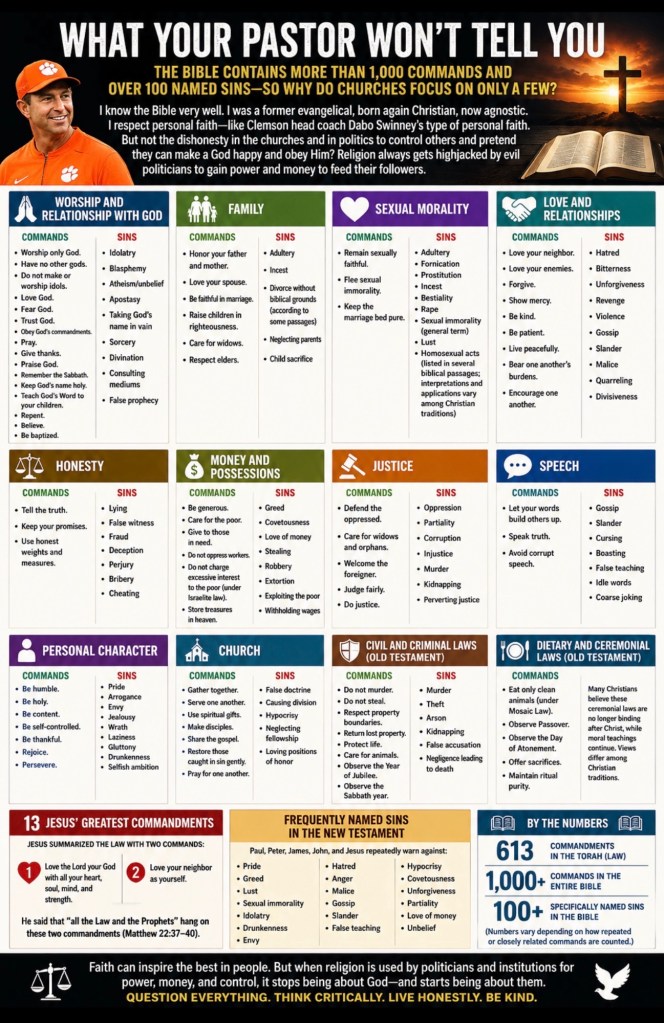
As a former evangelical, born-again Christian who is now agnostic, I often hear people ask, “What does the Bible actually say?” Having spent many years studying Scripture, I know the Bible very well. I respect sincere personal faith, and I have no problem with someone quietly living according to their beliefs. Someone like Clemson football coach Dabo Swinney represents the kind of personal faith I can appreciate. His faith appears to guide his own life rather than being used to control everyone else’s.
What concerns me is not personal faith.
It is when religion becomes intertwined with institutional power, politics, and control.
History repeatedly shows that religion can be used to unite communities and inspire acts of compassion, but it has also been used by governments, political movements, and religious leaders to justify slavery, segregation, wars, persecution, discrimination, and the accumulation of wealth and influence. Those patterns are not unique to Christianity—they have appeared across many religions and civilizations throughout history.
One question continued to bother me as I studied the Bible more deeply:
If the Bible contains over 1,000 commands and well over 100 specifically named sins, why do so many churches repeatedly emphasize only a small number of them?
Most people can quickly name a few sins that churches frequently preach about. But far fewer realize just how much the Bible actually commands.
The Bible addresses nearly every area of human life.
It commands people to worship only God, reject idols, love God, trust Him, pray, give thanks, praise Him, honor the Sabbath, repent, believe, and be baptized. It warns against idolatry, blasphemy, false prophecy, sorcery, divination, and taking God’s name in vain.
It commands husbands and wives to remain faithful, children to honor their parents, families to care for widows and respect elders. It condemns adultery, incest, neglect of parents, and other violations of family relationships.
It teaches sexual faithfulness and warns against adultery, prostitution, lust, sexual immorality, rape, incest, bestiality, and other prohibited sexual behaviors. Different Christian traditions interpret and apply some passages differently, particularly those concerning homosexual acts.
It commands believers to love their neighbors, love their enemies, forgive, show mercy, live peacefully, encourage one another, and bear one another’s burdens. Yet it condemns hatred, bitterness, revenge, violence, gossip, slander, malice, division, and unforgiveness.
The Bible repeatedly commands honesty. It tells people to tell the truth, keep promises, and conduct business fairly. It condemns lying, fraud, deception, bribery, cheating, false witness, and perjury.
One of Jesus’ greatest emphases was wealth and compassion for those in need.
Scripture repeatedly commands generosity, caring for the poor, helping those in need, treating workers fairly, and storing treasures in heaven rather than accumulating earthly wealth. At the same time, it repeatedly condemns greed, covetousness, the love of money, stealing, robbery, extortion, exploiting the poor, and withholding wages.
The Bible also commands justice. It tells believers to defend the oppressed, care for widows and orphans, welcome foreigners, judge fairly, and pursue justice. It condemns oppression, corruption, injustice, partiality, murder, kidnapping, and perverting justice.
It even speaks about everyday speech. Christians are instructed to speak truthfully, build others up, and avoid corrupt speech. Gossip, slander, boasting, coarse joking, false teaching, and harmful words are repeatedly condemned.
Personal character receives enormous attention as well. Scripture encourages humility, holiness, self-control, contentment, thankfulness, perseverance, and joy while warning against pride, arrogance, envy, jealousy, wrath, laziness, gluttony, drunkenness, and selfish ambition.
The New Testament also gives commands to churches themselves. Christians are told to gather together, serve one another, use their spiritual gifts, make disciples, pray for one another, and gently restore those who fall into sin. Churches are warned against hypocrisy, false teaching, division, neglecting fellowship, and seeking positions of honor.
The Old Testament contains hundreds of additional civil, criminal, dietary, ceremonial, agricultural, and religious laws that governed ancient Israel, including commands about murder, theft, property, sacrifices, festivals, clean and unclean foods, the Sabbath year, and the Year of Jubilee. Jewish tradition counts 613 commandments within the Torah alone.
Across the entire Bible there are more than 1,000 commands and well over 100 specifically named sins, depending on how repeated commands are counted.
Yet Jesus summarized the entire law with just two commandments:
Love the Lord your God with all your heart, soul, mind, and strength.
Love your neighbor as yourself.
He said that all the Law and the Prophets hang on those two principles.
As I eventually questioned my own beliefs and became agnostic, I did not lose my respect for people whose faith genuinely motivates kindness, humility, generosity, and service. What I became skeptical of were religious institutions—or political movements—that claim to possess absolute certainty while emphasizing only selected parts of Scripture that reinforce their own priorities.
Throughout history, politicians have often appealed to religion to rally supporters, gain legitimacy, and strengthen their authority. Religious leaders, too, have sometimes aligned themselves with political power. When that happens, faith can become intertwined with identity, loyalty, and influence in ways that make questioning leaders feel like questioning God. History suggests that this combination of religion and political power deserves careful scrutiny.
Whether someone is Christian, agnostic, atheist, or follows another faith, I believe the same principle should apply:
If we are going to claim the Bible is our moral authority, we should be honest about everything it teaches—not only the verses that support our existing beliefs or political preferences.
That is not an argument against faith.
It is an argument for intellectual honesty.
 ANCIENT ECHOES PODCAST: WHY I NO LONGER BELIEVE IN GOD (JESSUP PA)
Leave a comment