FAITH, POWER, MONEY, AND THE HUMAN SEARCH FOR TRUTH:
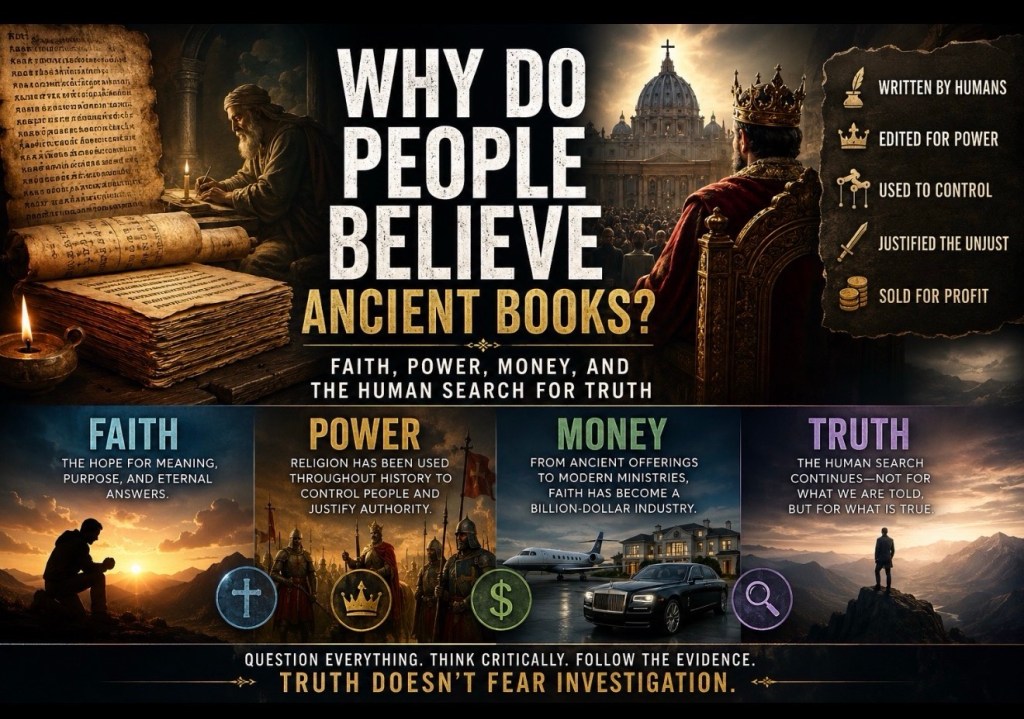
BY: JERIC YURKANIN
For thousands of years, human beings have looked to sacred texts for meaning, purpose, morality, identity, and answers to life’s deepest questions. Among the most influential of these texts is the Bible, a collection of writings that has shaped civilizations, inspired acts of compassion and courage, influenced governments, justified wars, defended slavery, excused segregation, and even helped justify the killing and displacement of thousands upon thousands of Native Americans. It has created denominations, shaped cultures, and generated billions of dollars through religious institutions, publishing, media, ministries, and modern faith-based industries.
Yet for many people in the modern world, an uncomfortable question remains: Why would anyone accept an ancient collection of writings as divine truth when those writings were copied, translated, interpreted, edited, and transmitted by human beings living in cultures vastly different from our own?
The question is not asked merely by atheists or skeptics. It is asked by historians, biblical scholars, former believers, agnostics, and even many Christians. It is a question that emerges naturally whenever people begin examining how religious texts came to exist. Most people would be skeptical if someone handed them a two-thousand-year-old manuscript and claimed it was the direct word of God. Yet millions accept precisely that claim regarding the Bible.
The Bible did not descend from heaven in a leather-bound volume with chapter numbers and verse references. It was written over centuries by many authors living in different times and circumstances. The books that became the Bible were copied by hand for generations before printing presses existed. Mistakes were made. Variations appeared. Disputes arose over which books belonged and which did not. Different Christian traditions accepted different canons. Yet despite this complex history, many believers have been taught that the Bible is a perfect and unchanging revelation.
For skeptics, this raises immediate concerns. If the text passed through countless human hands, how can anyone be certain it remained unchanged? If kings, bishops, emperors, scribes, and religious authorities had influence over the transmission of scripture, how can anyone know where theology ends and politics begins?
History demonstrates that power and religion have often been deeply intertwined. Political rulers quickly learned that religion could unite populations, justify authority, and encourage obedience. Throughout history, kings and emperors have sought religious legitimacy because it strengthened their rule. Religious leaders, in turn, often benefited from political support. The result was a relationship in which power and faith frequently reinforced one another.
When Christianity moved from being a persecuted minority movement to becoming associated with imperial power, the dynamic changed dramatically. What began as a small Jewish movement centered around a teacher from Galilee eventually became connected to governments, armies, wealth, and political institutions. The religion that once existed on the margins of society became one of the most powerful forces in world history.
This does not necessarily mean Christianity itself was false. However, it does raise questions about how religious ideas evolved once they became connected to power. Ideas that survive are not always the most historically accurate. Sometimes they are simply the ideas promoted by the most influential institutions.
Human beings have always possessed a remarkable ability to believe stories. Stories give meaning to suffering. Stories create identity. Stories unite communities. Stories help explain mysteries. Long before scientific understanding existed, stories were often humanity’s primary tool for understanding the world.
The psychological appeal of certainty cannot be underestimated. Most people do not enjoy uncertainty. Questions about death, suffering, morality, and purpose can create enormous anxiety. Religions often provide answers where evidence is limited. Whether those answers are true is a separate question. What matters psychologically is that certainty feels comforting.
This tendency extends far beyond religion. People believe political conspiracies, urban legends, internet rumors, and exaggerated stories told by friends and coworkers. Anyone who has worked in an office, factory, school, or union environment has likely witnessed information change as it passes from person to person. Someone hears a story, adds details, leaves out context, exaggerates events, and soon the final version bears little resemblance to what actually happened.
Human memory is not a video recorder. It is reconstructive. People often remember events inaccurately while remaining completely convinced they are correct. If misunderstandings can occur within days or weeks, skeptics wonder what might happen over decades and centuries.
Religious stories are not immune from these forces. Oral traditions can grow. Legends can develop. Heroes can become larger than life. Followers often attribute extraordinary qualities to people they admire. Throughout history, revered leaders have accumulated stories around them that expanded far beyond historical facts.
Many former believers point to the New Testament itself as an example of this phenomenon. The earliest writings about Jesus were not written by Jesus himself. They were written by followers and communities attempting to interpret his life and significance. The Gospels appeared decades after Jesus’ death. During those decades, stories circulated orally among various groups.
This observation does not automatically disprove Christianity. However, it does create questions about historical reliability. Historians generally distinguish between what can be known with reasonable confidence and what belongs more to theological belief.
One of the most debated subjects in modern scholarship involves the relationship between Jesus and Paul. Jesus was a Jewish teacher who lived and taught within Judaism. Paul never met the historical Jesus during Jesus’ public ministry. Yet Paul became arguably the most influential figure in the development of Christianity.
Some scholars argue that Paul faithfully interpreted Jesus’ significance. Others contend that Paul transformed Jesus’ movement into something fundamentally different. These debates have continued for generations.
When readers compare certain teachings of Jesus in the Gospels with some of Paul’s theological arguments, they sometimes perceive tension. Jesus frequently emphasized love, compassion, forgiveness, care for the poor, and the coming Kingdom of God. Paul often focused on faith, salvation, grace, sin, and theological interpretations of Jesus’ death and resurrection.
Whether these perspectives contradict one another remains disputed. Nevertheless, the debate itself raises important questions. If Jesus is supposed to be the center of Christianity, why do many churches spend more time discussing Paul’s theology than Jesus’ direct teachings?
For many critics, this question becomes even more significant when examining church history. Christianity has inspired hospitals, charities, educational institutions, and humanitarian efforts. At the same time, religion has also been used to justify crusades, inquisitions, persecution, discrimination, colonialism, and countless abuses of power.
The uncomfortable reality is that religion can be used for both noble and destructive purposes. The same Bible has been used to support abolition and slavery, peace and war, equality and oppression. This suggests that interpretation often matters as much as the text itself.
The role of money further complicates matters. Religion has always had economic dimensions. Buildings must be maintained. Organizations require resources. Leaders need support. Yet history also contains countless examples of religious figures accumulating wealth while claiming divine authority.
Ancient prophets warned against religious corruption. Jesus himself criticized religious leaders whom he viewed as exploiting people. Yet history repeatedly demonstrates that religious institutions can become entangled with financial interests.
Modern examples are not difficult to find. Television ministries, prosperity gospel movements, miracle products, paid prophecies, expensive conferences, and celebrity pastors have generated enormous revenues. Some religious leaders live lifestyles that resemble corporate executives more than humble servants.
This reality naturally causes skepticism. If extraordinary claims can generate income, some people will inevitably be tempted to make those claims regardless of whether they are true.
The incentive structure is obvious. If someone claims God spoke directly to them, many people may listen. If someone claims to possess secret spiritual knowledge, followers may gather. If someone claims divine authority, criticism can be dismissed as opposition to God rather than disagreement with a human being.
History shows that charismatic leaders frequently emerge claiming unique access to truth. Some may be sincere. Others may be mistaken. Some may be deliberately deceptive. Distinguishing among these possibilities is often difficult.
The same human tendencies appear outside religion as well. People exaggerate accomplishments. Politicians make promises they cannot keep. Influencers manufacture personas. Business leaders embellish successes. Religious leaders are not immune from the same psychological and social forces affecting everyone else.
One reason religious claims can be particularly powerful is that they often cannot be easily verified. Claims about heaven, hell, angels, demons, visions, miracles, and divine conversations typically rely on personal testimony rather than independent evidence.
This does not prove such experiences are false. However, it does mean that outsiders often have little basis for evaluation beyond trusting the claimant.
Throughout history, people have reported visions from gods, spirits, ancestors, saints, extraterrestrials, and supernatural beings. These reports emerge across cultures and religions. If followers of many religions report supernatural experiences supporting contradictory beliefs, skeptics naturally wonder whether psychological explanations may account for at least some of these experiences.
The challenge becomes even greater when religious claims generate social rewards. Attention, admiration, status, influence, and financial support can all result from extraordinary spiritual stories.
None of this necessarily means every religious claim is false. However, it does suggest caution. Extraordinary claims deserve careful examination regardless of who makes them.
Perhaps the deeper question is not whether religion has been abused. History clearly demonstrates that it has. The more important question is whether abuse invalidates the entire enterprise.
Some believers argue that corruption proves only that humans are flawed. Critics respond that the consistent pattern of manipulation, power struggles, and doctrinal evolution suggests religion is primarily a human creation.
Ultimately, each individual must decide how to evaluate the evidence. Some conclude that faith remains reasonable despite historical complications. Others conclude that the human fingerprints on scripture are too extensive to ignore.
What seems undeniable is that questioning should not be feared. If a belief is true, honest investigation should strengthen it rather than destroy it. If a belief cannot survive examination, perhaps it deserves reconsideration.
History teaches us that authority alone does not establish truth. Tradition alone does not establish truth. Popularity alone does not establish truth. Sincerity alone does not establish truth.
Truth requires evidence, critical thinking, intellectual humility, and a willingness to follow facts wherever they lead.
Whether one ultimately remains religious, becomes agnostic, or embraces atheism, the pursuit of truth should matter more than defending inherited assumptions. Human beings have always searched for meaning. That search continues today.
The challenge for modern people is not simply deciding what to believe. The challenge is learning how to think critically enough to distinguish between truth, tradition, wishful thinking, manipulation, and sincere but mistaken beliefs. That task may be one of the most important responsibilities of any generation.
And perhaps that is where the conversation should begin—not with certainty, but with questions. Not with fear, but with curiosity. Not with blind acceptance, but with a commitment to honestly examine the evidence and let the conclusions follow where they may.
THE LONG HISTORY OF FAILED END-TIMES PREDICTIONS
One of the strongest arguments critics raise against religious certainty is the long history of failed prophecies. For nearly two thousand years, Christians have been told that the end of the world was near. Every generation has had teachers, pastors, prophets, authors, and evangelists who claimed they could interpret current events and determine when Jesus would return. Yet every prediction has failed.
During the last two hundred years alone, there have been dozens of highly publicized end-times predictions. In the nineteenth century, the preacher William Miller convinced thousands of followers that Jesus would return in 1843 and then 1844. People sold possessions, quit jobs, and prepared for the end. When nothing happened, the event became known as the “Great Disappointment.” Despite the failed prediction, many followers continued believing and reorganized into new religious movements.
Throughout the twentieth century, end-times predictions became increasingly common. World Wars, the Cold War, the creation of the state of Israel, economic crises, and technological changes were repeatedly interpreted as signs that the end was imminent. Books, sermons, radio programs, and later television broadcasts warned that the final days were just around the corner.
In 1970, author and evangelist Hal Lindsey published The Late Great Planet Earth, one of the best-selling Christian books of the twentieth century. Many readers believed the events described in the book suggested Jesus would return within their generation. The anticipated events never occurred as predicted.
The pattern continued. Various televangelists, prophecy teachers, and self-proclaimed prophets announced dates or narrowed down timelines. Each time, followers were encouraged to believe that current events perfectly matched biblical prophecy. Each time, history continued.
One of the most famous modern examples was Harold Camping, who predicted the world would end in 1994. When that failed, he later predicted May 21, 2011. Billboards appeared across the world. Millions heard the message. Some followers spent life savings promoting the prediction. When May 21 passed, a revised date was announced. That prediction also failed.
For skeptics, these repeated failures raise an obvious question: If so many religious leaders have confidently claimed divine insight into the future and been wrong every time, why do people continue trusting similar predictions?
Psychologists suggest several reasons. People are naturally drawn to certainty during uncertain times. Predictions about the future create a sense of meaning and urgency. They make believers feel they possess special knowledge unavailable to others. Failed predictions also do not always destroy belief. In many cases, followers reinterpret the failure, move the date, or conclude the prediction was spiritually rather than literally fulfilled.
Critics argue that this pattern should encourage caution whenever religious leaders claim certainty about future events. History shows that confidence is not the same as accuracy. A person may be completely sincere and still be completely wrong.
Interestingly, many Christians themselves reject date-setting. They point out that in the Gospels, Jesus is portrayed as saying that no one knows the day or hour of his return. Despite this, countless teachers throughout history have continued trying to predict exactly what they were warned not to predict.
The history of failed end-times predictions illustrates a broader lesson about human nature. People often see patterns where none exist. They interpret current events through the lens of existing beliefs. Every generation tends to think its own crises are uniquely significant. Wars, disasters, political turmoil, pandemics, and social change repeatedly convince people that the end must be near.
Yet history continues. Empires rise and fall. Predictions come and go. New generations inherit the same expectations. The cycle repeats.
For those examining religion critically, the record of failed prophecies becomes part of a larger question: If religious leaders can be mistaken about major predictions repeatedly over centuries, how should people evaluate other claims those leaders make? The answer may not be simple, but history suggests that skepticism, evidence, and careful investigation are often wiser guides than unquestioning certainty.
 ANCIENT ECHOES PODCAST: WHY I NO LONGER BELIEVE IN GOD (JESSUP PA)
Leave a comment