
By: Jeric Yurkanin
From Jesus’ Jewish Movement to the Religion That Changed the World:
Few individuals have shaped the course of Christianity as profoundly as the Apostle Paul. While Jesus stands at the center of the Christian faith, Paul became the movement’s most influential missionary, theologian, and writer. His letters make up a significant portion of the New Testament, and his teachings have influenced nearly every branch of Christianity for almost two thousand years. Yet Paul remains one of the most debated figures in religious history. To some, he was the faithful messenger who helped spread the teachings of Jesus beyond the borders of Judaism. To others, he was the architect of a new religion that differed significantly from the message preached by Jesus in the Gospels.
Understanding Paul is essential for understanding Christianity itself. Without Paul, Christianity may have remained a small Jewish sect centered in Jerusalem. Instead, it became a global faith that spread throughout the Roman Empire and eventually across the world. The story of Paul’s conversion, his mission to the Gentiles, his teachings about faith and the Law, and the ongoing debate over his influence reveals one of the most important turning points in religious history.
Before becoming the Apostle Paul, he was known as Saul of Tarsus. Born in the city of Tarsus in what is now modern-day Turkey, Saul was both a Jew and a Roman citizen. He was highly educated and deeply committed to Judaism. In his own writings, Paul describes himself as a Pharisee, one of the religious groups dedicated to preserving and teaching the Jewish Law. He was proud of his heritage and believed he was faithfully serving God by defending the traditions of Israel.
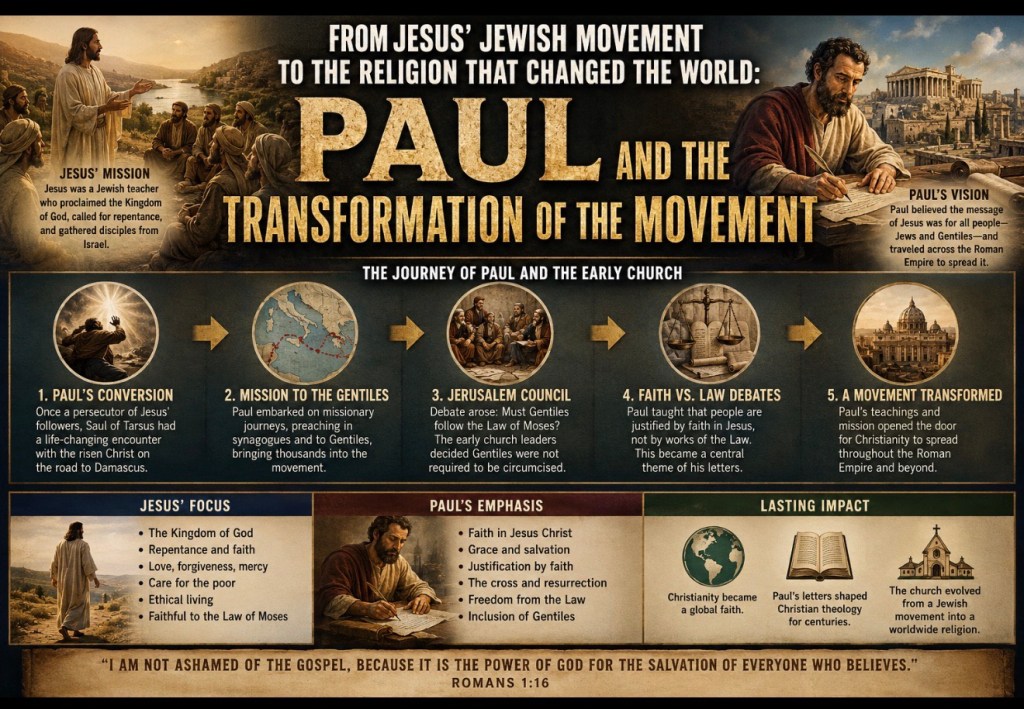
When news began spreading about Jesus of Nazareth and claims that he had been raised from the dead, Saul viewed the movement as a dangerous threat. The earliest followers of Jesus were Jews who believed that Jesus was Israel’s Messiah, but many religious leaders saw these claims as misguided or even blasphemous. According to the Book of Acts, Saul actively participated in efforts to suppress the movement. He approved of the execution of Stephen, one of the earliest followers of Jesus, and sought to arrest others who embraced the new faith. Saul believed he was protecting Judaism from what he considered a false movement.
Everything changed during a journey to Damascus. According to the Book of Acts, Saul was traveling there to arrest followers of Jesus when he experienced a dramatic vision. A bright light surrounded him, knocking him to the ground. He heard a voice asking, “Saul, Saul, why do you persecute me?” When Saul asked who was speaking, the voice replied, “I am Jesus, whom you are persecuting.” The experience left Saul temporarily blind, and he was led into Damascus where he later encountered a disciple named Ananias. After this encounter, Saul’s sight was restored, and he became convinced that Jesus truly was the Messiah.
Paul’s own letters provide fewer details about this event than the Book of Acts, but they clearly affirm that he experienced what he believed was a revelation of the risen Christ. Whatever happened on the road to Damascus, it transformed his life forever. The persecutor became a preacher. The opponent became an advocate. The man who once sought to destroy the movement dedicated the rest of his life to spreading it throughout the Roman world.
After his conversion, Paul embarked on a series of missionary journeys that would permanently alter the course of Christianity. While Jesus and his earliest disciples focused primarily on fellow Jews, Paul became convinced that the message about Jesus was intended for all people, including Gentiles. This conviction would lead to one of the most important debates in early Christianity.
The earliest followers of Jesus remained observant Jews. They attended the Temple, observed Jewish festivals, followed dietary laws, and practiced circumcision. They saw themselves not as founders of a new religion but as Jews who believed that Jesus was the promised Messiah. The question soon arose: If Gentiles wanted to join the movement, did they also need to become Jews?
Many believers thought the answer was yes. After all, Jesus was Jewish, his disciples were Jewish, and the movement itself had emerged from Judaism. Circumcision, dietary laws, and Torah observance had defined Jewish identity for centuries. If Gentiles wished to become followers of Israel’s Messiah, many assumed they should embrace these practices.
Paul disagreed. He argued that Gentiles could become followers of Christ without first becoming Jews. This position sparked intense controversy. Paul believed that faith in Christ was sufficient and that Gentiles did not need to undergo circumcision or fully observe the Torah. His position eventually prevailed and opened the door for Christianity to expand rapidly throughout the Roman Empire.
The debate reached a critical point during what is often called the Jerusalem Council. According to the Book of Acts, leaders such as Peter, James, and Paul gathered to discuss whether Gentile converts should be required to follow Jewish law. The outcome largely supported Paul’s position. Gentiles would not be required to undergo circumcision or adopt the full requirements of the Torah. This decision marked a turning point in Christian history. Had the opposite decision been made, Christianity might have remained a small Jewish sect rather than becoming a worldwide religion.
Central to Paul’s teachings was the relationship between faith and the Law. Throughout his letters, particularly Galatians and Romans, Paul argued that people are justified before God through faith rather than through works of the Law. For Paul, the death and resurrection of Jesus had inaugurated a new covenant. The Law had served an important purpose, but a new era had begun through Christ.
Paul’s teachings on faith and grace would eventually become foundational doctrines within Christianity. He taught that salvation was a gift from God that could not be earned through obedience to religious laws. Instead, salvation came through faith in Jesus Christ. This message resonated with many Gentiles who were unfamiliar with Jewish customs and traditions.
Yet Paul’s teachings also raised difficult questions. In the Gospel of Matthew, Jesus declares, “Do not think that I have come to abolish the Law or the Prophets.” Jesus appears throughout the Gospels as a Torah-observant Jew who celebrated Jewish festivals, attended synagogue, and respected the Scriptures of Israel. While he challenged certain interpretations of the Law, he did not appear to reject it altogether.
This has led many scholars and readers to ask an important question: If Jesus upheld the Torah, why did Paul seem to diminish its role? Christians have answered this question in different ways throughout history. Some argue that Paul was faithfully explaining the deeper meaning of Jesus’ mission. Others believe Paul introduced ideas that moved beyond what Jesus himself taught.
Nowhere is this debate more evident than in Paul’s Letter to the Galatians. In this letter, Paul fiercely opposes those who insist Gentile believers must be circumcised. He argues that Abraham was justified by faith before the Law was given and that faith has always been central to God’s relationship with humanity. Paul describes the Law as a temporary guardian that prepared the way for Christ. Once Christ had come, he believed, the role of the Law had fundamentally changed.
Paul’s influence on Christian theology cannot be overstated. Many doctrines that later became central to Christianity draw heavily from his writings. Concepts such as salvation by grace, justification by faith, the significance of Christ’s death, and the inclusion of Gentiles within God’s people all bear Paul’s unmistakable influence. While Jesus spoke frequently about the Kingdom of God, love, forgiveness, compassion, and justice, Paul often focused on theological explanations of how salvation works and what Christ’s death accomplished.
This difference in emphasis has led some scholars to conclude that Paul transformed the original Jesus movement. They point out that Jesus’ central message was the coming Kingdom of God. In the Gospels, Jesus repeatedly calls people to love their neighbors, care for the poor, forgive their enemies, and practice mercy. His teachings are deeply ethical and practical.
Paul, by contrast, focused heavily on faith, grace, justification, and the theological significance of Jesus’ death and resurrection. Some scholars argue that Christianity gradually shifted from following the teachings of Jesus to believing specific doctrines about Jesus. In their view, the focus moved from the message of Jesus to the message about Jesus.
These scholars do not necessarily deny Paul’s sincerity or importance. Rather, they suggest that Paul interpreted Jesus in ways that significantly reshaped the movement. They note that Jesus rarely discussed topics such as justification by faith, while these themes dominate much of Paul’s writing. According to this perspective, Paul transformed a Jewish reform movement into a universal religion centered on faith in Christ.
Others strongly disagree with this conclusion. They argue that Paul was not creating a new religion but faithfully explaining the significance of Jesus’ life, death, and resurrection. They point out that Paul knew some of Jesus’ closest followers, including Peter and James. If Paul had radically distorted Jesus’ message, they argue, these leaders would have rejected him. Instead, despite disagreements, Paul remained connected to the broader movement.
Supporters of Paul also note that his letters are among the earliest Christian writings that survive. They provide valuable insight into what many believers thought within just a few decades of Jesus’ death. From this perspective, Paul was not changing Christianity but helping it understand its own message.
Another important figure in this discussion is James, the brother of Jesus. The New Testament Letter of James emphasizes the importance of actions and famously states that “faith without works is dead.” Some scholars see tension between James and Paul, suggesting that they represented different streams within early Christianity. Others believe their teachings can be harmonized and that both faith and action were important to the early church.
The debate over Paul ultimately raises larger questions about Christianity itself. Is Christianity primarily about following the ethical teachings of Jesus? Is it primarily about faith in Jesus as Savior? Can both be equally central? Different Christian traditions have answered these questions in different ways throughout history.
What is beyond dispute is that Paul changed the trajectory of the movement. His missionary efforts helped spread Christianity across the Roman Empire. His letters became foundational texts for Christian theology. His teachings shaped debates about salvation, faith, grace, and the role of religious law for centuries. Whether one views him as Christianity’s greatest interpreter or as the figure who redirected the movement, his influence is impossible to ignore.
Nearly two thousand years later, Christians still wrestle with the relationship between Jesus and Paul. Some believe modern churches emphasize Paul at the expense of Jesus. Others see Paul’s writings as essential for understanding Jesus correctly. The discussion continues because both figures occupy central places within the New Testament and within Christian history.
In the end, Paul remains one of the most fascinating and influential figures in religion. His conversion transformed him from a persecutor into a missionary. His teachings helped shape Christian theology. His mission opened the faith to the Gentile world. His writings continue to inspire, challenge, and divide readers. Whether viewed as a faithful apostle or a transformative innovator, Paul’s role in the development of Christianity remains one of the most important subjects in the study of religion and history.

 ANCIENT ECHOES PODCAST: WHY I NO LONGER BELIEVE IN GOD (JESSUP PA)
Leave a comment