BY: JERIC YURKANIN
One of the most important questions in the history of Christianity is whether Jesus of Nazareth intended everything that later developed in his name. Did Jesus see himself as the Messiah? Did he expect books to be written about him decades later? Did he intend to start a new religion called Christianity? Or was he a Jewish teacher whose message was later expanded, interpreted, and transformed by his followers after his death? These questions are not meant to attack faith. They are historical questions that help us understand the difference between Jesus in his original first-century Jewish world and Christianity as it developed over time.
Jesus lived and taught as a Jew. He was not born into Christianity because Christianity did not yet exist. He grew up in a Jewish culture, worshiped the God of Israel, quoted the Hebrew Scriptures, and taught people from within the world of Judaism. His followers were also Jewish. They did not originally think of themselves as Christians in the modern sense. They saw themselves as followers of Jesus within the Jewish story of God, Israel, repentance, justice, mercy, and the coming Kingdom of God.
In Jesus’ time, many Jewish people were waiting for a Messiah. The word Messiah means “anointed one.” Some expected a king like David who would defeat Israel’s enemies. Others expected a prophet, priest, or heavenly figure sent by God. There was not only one view of the Messiah. This matters because when later Christians called Jesus the Messiah, they were interpreting his life, death, and resurrection through their faith. Jesus may have understood himself as having a special mission from God, but many historians debate whether he openly claimed to be the Messiah in the way later Christianity described him.
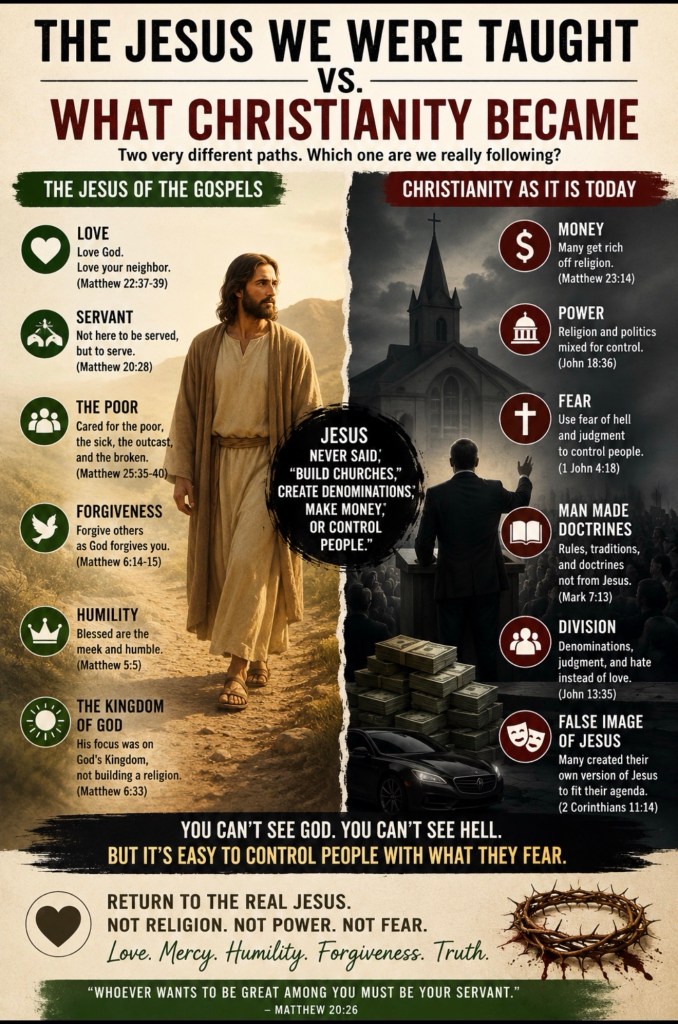
The Gospels show Jesus preaching mostly about the Kingdom of God. He talked about loving God, loving your neighbor, forgiving enemies, caring for the poor, rejecting greed, showing mercy, and living with humility. His message was not centered on building church buildings, creating denominations, forming political power, or writing a new Bible. His message was centered on God’s reign breaking into the world and people living differently because of it.
There is no evidence that Jesus expected a book called the New Testament to be written about him. During Jesus’ life, the New Testament did not exist. The Scriptures Jesus knew were the Jewish Scriptures. Jesus taught orally, like many Jewish teachers of his time. His sayings, parables, healings, and actions were remembered by his followers and passed down by word of mouth before they were written.
The New Testament was written many years after Jesus’ death. Paul’s letters came first, around twenty years after Jesus died. The Gospel of Mark was likely written around thirty-five to forty years after Jesus’ death. Matthew and Luke came later, and John was likely written near the end of the first century. This means the Gospels were written decades after Jesus lived. They preserved memories of Jesus, but they were also shaped by the faith, struggles, and beliefs of the early Christian communities.
This does not mean the New Testament is worthless or fake. It means it must be understood as a collection of writings that came out of the early Jesus movement after his death. These writings were not written by Jesus himself. They were written by followers and communities trying to explain who Jesus was, what his death meant, and how people should follow him in a changing world.
One of the biggest figures in that transformation was Paul. Paul never followed Jesus during Jesus’ earthly life. He came later and claimed to experience the risen Christ. Paul became the most influential missionary in early Christianity. He took the message of Jesus beyond Jewish communities and preached to Gentiles. He argued that non-Jews did not need to fully follow the Jewish law to belong to the people of God through Christ. This was a major turning point.
Because of Paul and other early missionaries, the Jesus movement began spreading throughout the Roman Empire. Over time, more Gentiles joined. The movement became less connected to Jewish law and more separate from Judaism. What began as a Jewish renewal movement eventually became a distinct religion. This process did not happen overnight. It took decades and centuries.
That is why many historians say Jesus probably did not intend to start Christianity as it exists today. He did not call himself a Christian. He did not tell his followers to create a separate religion from Judaism. He did not write a creed, form a denomination, or establish the New Testament canon. Those things came later through the development of the early church.
At the same time, this does not mean Jesus was unimportant to Christianity. He was the center of the movement. His life, teachings, death, and the belief in his resurrection inspired everything that came after. The question is not whether Jesus mattered. The question is whether modern Christianity always reflects the actual priorities of Jesus himself.
If Jesus’ central teachings were love, mercy, forgiveness, humility, care for the poor, and the Kingdom of God, then Christians today should ask whether those teachings are truly at the center of their faith. If the religion built around Jesus focuses more on power, money, politics, fear, and division than on love and compassion, then it may have drifted from the heart of Jesus’ message.
In the end, Jesus was a Jewish teacher, prophet, and spiritual leader whose message changed history. His followers believed he was the Messiah and that God raised him from the dead. After his death, they preached about him, wrote about him, worshiped him, and built communities around him. Over time, those communities became Christianity.
So was Jesus meant to be the Messiah? That depends on faith and interpretation. Did Jesus expect the New Testament to be written about him? Historically, probably not. Did Jesus intend Christianity to become exactly what it is today? Most historians would say probably not. But did Jesus inspire a movement that changed the world? Absolutely.
The challenge today is not only to ask what Christianity became, but to return to what Jesus actually taught. Because if Jesus is supposed to be the center of Christianity, then his teachings should be the center too.
I do not believe Jesus intended Christianity to become what it often is today. I believe much of what Christianity became was shaped by human beings over time. Men built systems, institutions, doctrines, ministries, and power structures around Jesus. Some did this sincerely, but others used religion for control, fear, money, and influence. Over time, many people built their own version of Jesus instead of returning to the Jesus found in the Gospels.
One of the easiest ways to control people is to teach them to fear things they cannot see, question, or prove. When people are told they must believe a certain way or face eternal punishment, fear becomes a powerful tool. Hell, judgment, and invisible spiritual threats have often been used to keep people obedient. Many religious leaders claimed certainty about things no human being can fully prove. Some became wealthy by selling books, building ministries, collecting donations, and presenting themselves as the voice of God.
This is why I believe American Christianity often reflects human power more than the teachings of Jesus. Jesus taught love, mercy, forgiveness, humility, compassion, and care for the poor. Yet many versions of Christianity have focused more on control, money, politics, fear, and defending authority. Instead of following Jesus’ example, people have created a Jesus who supports their beliefs, their culture, their politics, and their power.
To me, the tragedy is not that people believe in Jesus. The tragedy is that many people have replaced the Jesus of the Gospels with a version of Jesus built by religion, fear, and control. If Jesus is truly supposed to be the center of Christianity, then his teachings should matter more than church power, money, doctrines, or fear-based preaching.
 ANCIENT ECHOES PODCAST: WHY I NO LONGER BELIEVE IN GOD (JESSUP PA)
Leave a comment