WRITTEN BY: JERIC YURKANIN
Introduction: Did Jesus Really Abolish the Law?
One of the most common beliefs in modern Christianity is that Jesus came to abolish the Jewish Law and replace it with something entirely new. Many Christians grow up hearing that the Old Testament law was set aside and that Jesus introduced a new covenant where obedience to Torah no longer mattered.
Yet when we look closely at the Gospels, a different picture emerges.
The historical Jesus was a Jew who lived in a Jewish world, taught Jewish audiences, worshiped in Jewish synagogues, celebrated Jewish festivals, and regularly quoted the Jewish Scriptures. He never converted to another religion, never called himself a Christian, and never instructed his disciples to abandon Judaism.
In fact, some of Jesus’ strongest statements suggest the exact opposite of what many modern Christians assume.
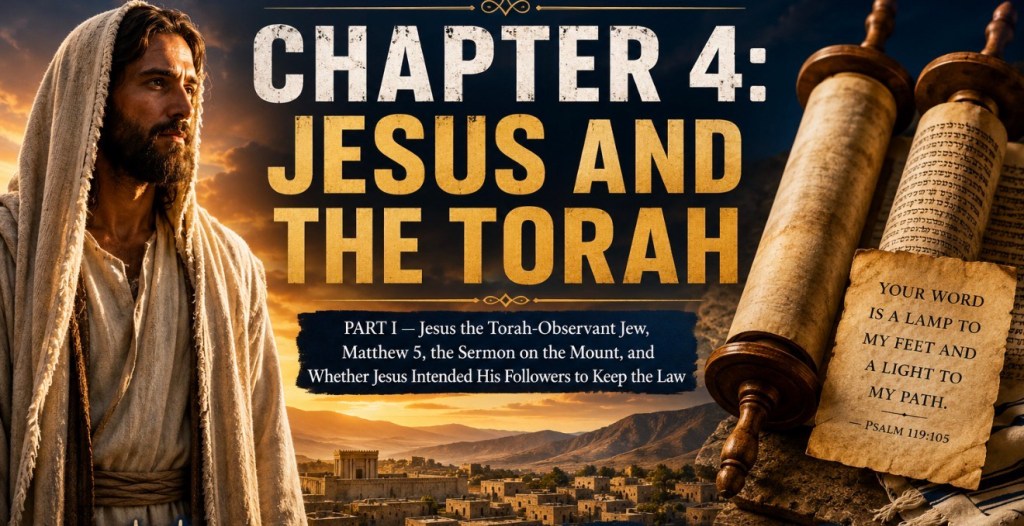
This chapter explores Jesus’ relationship with the Torah, his teachings in the Sermon on the Mount, and whether he intended his followers to continue observing God’s commandments. It also examines one of the most debated questions in Christian history:
Did Jesus teach people to abandon Jewish law, or was that development something that emerged later?
Understanding the Torah in Jesus’ World
To understand Jesus, we must first understand the central role Torah played in first-century Judaism.
The Torah—the first five books of the Hebrew Bible—was much more than a religious text. It served as the foundation of Jewish identity, worship, ethics, and community life.
For Jewish people in the first century, Torah provided guidance on:
- Worship and sacrifice
- Dietary practices
- Marriage and family life
- Holy days and festivals
- Justice and business ethics
- Community responsibilities
- Ritual purity
Keeping Torah was not generally viewed as a burden. It was seen as a way of honoring the covenant between God and Israel.
Many modern Christians assume Judaism in Jesus’ day was obsessed with legalism. However, historical evidence paints a more complex picture. Most Jews viewed obedience to Torah as a response to God’s grace rather than a way to earn salvation.
Jesus entered this world as a Jewish teacher participating in ongoing debates about how God’s law should be interpreted and applied.
Jesus Was a Torah-Observant Jew
The Gospel accounts consistently present Jesus as someone who practiced Judaism rather than rejected it.
Luke tells us Jesus was circumcised according to Jewish custom. His parents brought him to the Temple and offered sacrifices required by the Law of Moses. Throughout his life, Jesus attended synagogue services, celebrated Jewish festivals, and regularly taught from the Hebrew Scriptures.
When Jesus faced temptation in the wilderness, he responded by quoting the Torah.
When he debated religious leaders, he appealed to the Torah.
When he summarized God’s will, he quoted directly from the Torah.
Nothing in the historical record suggests Jesus viewed himself as outside Judaism. Instead, he appears as a Jewish prophet and teacher calling his people back to what he believed was the true heart of God’s covenant.
Jesus’ Conflicts with Religious Leaders
One reason many Christians assume Jesus opposed the Law is because of his frequent conflicts with religious leaders.
However, disagreement about Torah interpretation was common within Judaism.
The Pharisees debated one another.
Rabbis challenged one another’s interpretations.
Different Jewish groups disagreed about purity laws, Sabbath observance, and Temple practices.
These debates did not mean participants rejected Judaism. They meant they cared deeply about understanding God’s will.
Jesus’ arguments with religious leaders were usually not about whether Torah mattered. They were about how Torah should be understood and applied.
Again and again, Jesus criticized hypocrisy, religious pride, and traditions that overshadowed compassion and justice. His criticism was aimed at certain interpretations of the Law, not necessarily the Law itself.
The Most Important Passage: Matthew 5:17
No discussion of Jesus and Torah can avoid one of the most important statements in the entire New Testament.
In Matthew 5:17, Jesus declares:
“Do not think that I have come to abolish the Law or the Prophets; I have not come to abolish them but to fulfill them.”
This statement appears near the beginning of the Sermon on the Mount and has generated centuries of theological debate.
Many Christians interpret “fulfill” to mean “bring to an end.”
According to this interpretation, Jesus fulfilled the Law so believers no longer need to follow it.
Yet the verses that immediately follow make the issue far more complicated.
Jesus continues:
“For truly I tell you, until heaven and earth disappear, not the smallest letter, not the least stroke of a pen, will by any means disappear from the Law until everything is accomplished.”
He then adds:
“Anyone who sets aside one of the least of these commandments and teaches others accordingly will be called least in the kingdom of heaven.”
These are remarkably strong statements.
Far from sounding like someone abolishing Torah, Jesus appears to be affirming its continuing significance.
What Did Jesus Mean by “Fulfill”?
The debate centers on one key word: fulfill.
Throughout Christian history, different interpretations have emerged.
Some theologians argue that fulfill means Jesus completed the Law, making further observance unnecessary.
Others argue that fulfill means bringing something to its fullest meaning.
Under this interpretation, Jesus is not abolishing Torah but revealing its deepest purpose.
Many biblical scholars point out that throughout the Sermon on the Mount, Jesus consistently intensifies the ethical demands of Torah rather than relaxing them.
This suggests that “fulfill” may mean correctly interpreting and fully embodying God’s intentions.
If so, Jesus is not replacing Torah. He is calling people to understand it more deeply.
The Sermon on the Mount: Deepening the Law
Immediately after affirming the Law, Jesus presents a series of teachings often called the Antitheses.
Repeatedly he says:
“You have heard that it was said…”
followed by:
“But I say to you…”
Many readers assume Jesus is replacing Torah with a new teaching.
However, a closer look suggests something different.
Murder and Anger
The Torah prohibits murder.
Jesus agrees.
But he pushes deeper, teaching that anger, hatred, and contempt are the roots from which violence grows.
Instead of lowering the standard, Jesus raises it.
The issue is no longer merely avoiding murder. It is cultivating reconciliation and peace.
Adultery and Lust
The Torah forbids adultery.
Jesus again intensifies the command.
He teaches that lustful intent reflects the same brokenness that eventually leads to adultery.
The command remains, but the focus expands to the condition of the heart.
Oaths and Honesty
Rather than relying on elaborate vows, Jesus encourages radical honesty.
His followers should be people whose words are trustworthy without needing special promises.
Revenge and Mercy
The Torah’s principle of “an eye for an eye” originally served to limit excessive revenge.
Jesus moves beyond legal retaliation and encourages forgiveness, mercy, and reconciliation.
Again, he is not lowering ethical expectations. He is raising them.
The Greatest Commandments
When Jesus was asked which commandment mattered most, his answer came directly from Torah.
He quoted Deuteronomy:
“Love the Lord your God with all your heart.”
Then he quoted Leviticus:
“Love your neighbor as yourself.”
Jesus declared that all the Law and the Prophets hang on these two commandments.
This is a crucial point.
Jesus did not replace Torah with love.
He taught that Torah itself points toward love.
Love is not an alternative to God’s commandments. Love is their ultimate purpose.
Jesus and the Sabbath
The Sabbath provides another important example.
Many Christians believe Jesus broke Sabbath law.
Yet the Gospel accounts tell a more nuanced story.
Jesus healed on the Sabbath.
He allowed acts of mercy on the Sabbath.
He defended helping those in need on the Sabbath.
However, he never taught that the Sabbath should be abolished.
Instead, he declared:
“The Sabbath was made for man, not man for the Sabbath.”
Jesus appears to be arguing that God’s commandments exist for human flourishing, not oppression.
His concern was not eliminating Sabbath observance but restoring its original purpose.
Jesus and Ritual Purity
Several Gospel passages involve disputes about ritual purity and handwashing traditions.
Some Christians interpret these passages as evidence that Jesus abolished dietary laws.
However, many scholars note that the debates often involve oral traditions rather than the Torah itself.
Jesus repeatedly challenged situations where human traditions overshadowed compassion, justice, and mercy.
The issue was not whether God’s commandments mattered.
The issue was whether people had lost sight of the deeper principles those commandments were meant to serve.
The Rich Young Ruler
One encounter highlights Jesus’ attitude toward obedience.
When a wealthy young man asked how to inherit eternal life, Jesus pointed him toward the commandments.
Rather than dismissing Torah, Jesus referenced it.
He then challenged the man to go further by giving generously to the poor and following him.
This pattern appears repeatedly throughout the Gospels.
Jesus calls people beyond minimum compliance toward radical devotion, generosity, and love.
The Historical Jesus and Torah
Most historians agree on several important points.
Jesus was Jewish.
His ministry took place within Judaism.
His teachings were rooted in Jewish Scripture.
His followers were initially Jewish.
The earliest Jesus movement functioned as a Jewish movement rather than a separate religion.
These historical realities make it difficult to argue that Jesus intended to create a non-Jewish faith detached from Torah.
Instead, Jesus appears to have been a reforming Jewish teacher who sought to renew Israel by emphasizing the heart of God’s commandments.
Did Jesus Teach People to Abandon Jewish Law?
When the Gospel evidence is examined as a whole, the answer appears far less straightforward than many modern Christians assume.
Jesus challenged religious leaders.
He criticized hypocrisy.
He confronted legalism.
He emphasized mercy.
He elevated love.
But nowhere in the Gospels does Jesus explicitly announce that God’s commandments no longer matter.
Instead, he repeatedly points people back to the deepest purposes behind those commandments.
The debate is not whether Torah is important.
The debate is how Torah should be understood and lived.
Conclusion
The historical Jesus was not a Christian rejecting Judaism.
He was a Jewish teacher speaking to fellow Jews about covenant faithfulness, justice, mercy, and love.
His words in Matthew 5 remain among the most important in the entire New Testament:
“I have not come to abolish the Law.”
The Sermon on the Mount does not appear to weaken Torah. It deepens it.
Murder becomes anger.
Adultery becomes lust.
Justice becomes mercy.
Neighbor expands toward enemy.
The focus shifts from external rule-keeping to internal transformation.
Whether later Christianity preserved this vision or moved in a different direction is one of the most important questions in religious history.
In the next chapter, we will explore the teachings of the Apostle Paul and examine how his views on circumcision, dietary laws, justification by faith, and Gentile inclusion dramatically shaped the future of Christianity.
There we will encounter a question that scholars, theologians, and historians continue to debate:
Did Paul faithfully extend the message of Jesus, or did Paul create a new interpretation that ultimately transformed the Jewish movement of Jesus into something very different?
 ANCIENT ECHOES PODCAST: WHY I NO LONGER BELIEVE IN GOD (JESSUP PA)
Leave a comment