Written by: Jeric Yurkanin
When most people think about Jesus, they picture the founder of Christianity.
They imagine churches, pastors, crosses, worship services, Christmas celebrations, Easter Sunday, and a religion that now spans the globe.
But there is one historical fact that is often overlooked:
Jesus was never a Christian.
That statement may sound shocking to many people, especially those raised in evangelical churches. Yet from a historical perspective, it is undeniably true.
Jesus was born a Jew.
He lived as a Jew.
He worshipped as a Jew.
He taught as a Jew.
He celebrated Jewish festivals.
He quoted Jewish scriptures.
He debated Jewish interpretations of the Law.
And he died as a Jew.
The religion we now call Christianity would not emerge until decades after his death.
To understand the historical Jesus, we must first strip away nearly two thousand years of church tradition and attempt to see Jesus within his own time and culture.
Before Christianity existed, before church buildings, before creeds, before denominations, before theological debates about the Trinity, heaven, hell, salvation, and eternal punishment, there was a Jewish man from Galilee living under Roman occupation.
Understanding that world is essential if we hope to understand who Jesus truly was.
The Ancient World of the First Century:
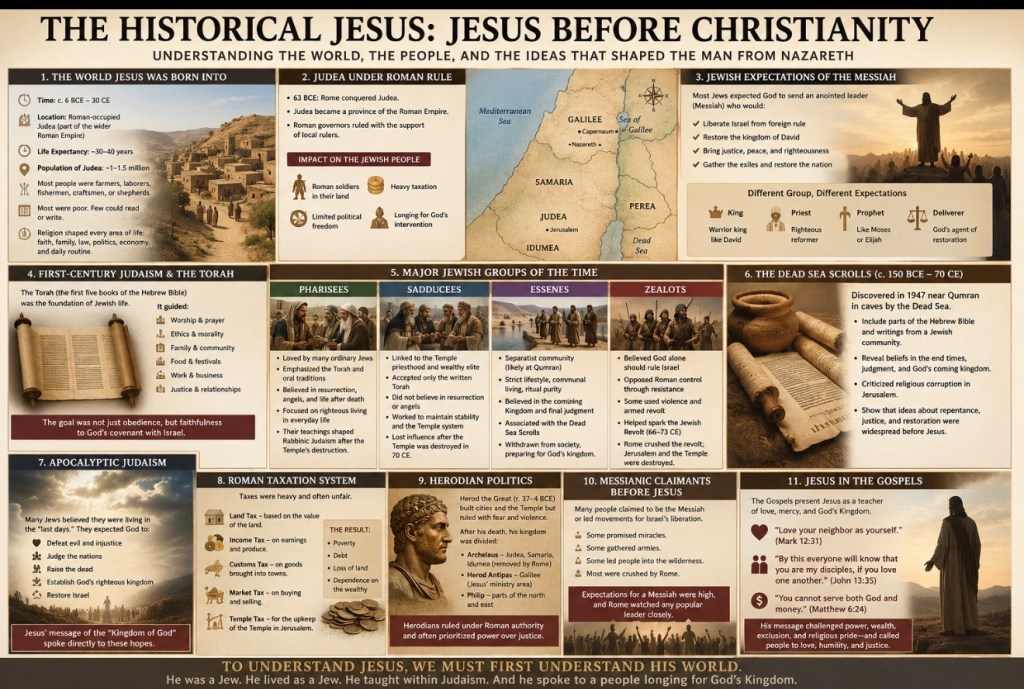
Jesus was born sometime between 6 and 4 BCE, during a period historians call the Second Temple Era.
This was a world vastly different from our own.
There were no democracies.
No electricity.
No modern medicine.
No internet.
No social media.
No nation-states as we know them.
Most people lived in small villages and worked as farmers, laborers, fishermen, craftsmen, or shepherds.
Life expectancy was dramatically lower than today.
Disease, famine, and poverty were constant realities.
Many children died before adulthood.
The vast majority of people were illiterate.
Only a tiny percentage of the population could read or write.
Knowledge was passed down primarily through storytelling and oral tradition.
Religion was not merely a personal belief system.
It shaped every aspect of life.
Politics, economics, law, culture, identity, family structure, and daily routines were deeply intertwined with religious beliefs.
To understand Jesus, we must understand this world.
Judea Under Roman Rule
By the time Jesus was born, Judea was living under the shadow of one of history’s greatest empires.
The Roman Empire stretched across much of Europe, North Africa, and the Middle East.
Rome controlled vast territories through military power, taxation, and political authority.
To many Jews living in Judea, Roman occupation was deeply painful.
They viewed themselves as God’s chosen people.
Their scriptures told stories of liberation from oppression.
Their national memory was shaped by events such as the Exodus from Egypt.
Yet now they found themselves ruled by pagan foreigners.
Roman soldiers patrolled their streets.
Roman governors controlled their politics.
Roman taxes burdened their economy.
Roman authority determined their future.
Many Jews longed for freedom.
Many believed God would intervene.
Many hoped a divinely appointed leader would arrive and restore Israel.
This hope became one of the most powerful forces shaping the world into which Jesus was born.
Herod the Great:
At the time of Jesus’ birth, Judea was ruled by Herod the Great.
Herod is one of the most fascinating and controversial figures in ancient history.
He was not fully Jewish by ancestry.
His family came from Idumea, a region south of Judea.
Yet Rome appointed him king over the Jewish people.
Herod was a brilliant builder.
He constructed cities, fortresses, theaters, palaces, and monuments.
One of his greatest achievements was expanding the Jerusalem Temple into one of the most magnificent religious structures in the ancient world.
Yet despite these accomplishments, many Jews despised him.
He was seen as a puppet of Rome.
He maintained power through political maneuvering, violence, and fear.
Ancient sources describe him as paranoid and ruthless.
Several members of his own family were executed because he suspected them of plotting against him.
The world Jesus entered was therefore marked by political tension, social inequality, and widespread uncertainty.
The Temple: Center of Jewish Life
Nothing was more important to first-century Judaism than the Temple in Jerusalem.
For Jews, the Temple represented God’s dwelling place on earth.
Pilgrims traveled from across the region to worship there.
Sacrifices were offered daily.
Priests performed sacred rituals.
Festivals drew enormous crowds.
The Temple served not only religious functions but also political and economic ones.
It was the heart of Jewish identity.
Many Jews believed God’s presence uniquely resided there.
The destruction of the First Temple centuries earlier by Babylon remained one of the deepest wounds in Jewish history.
The Second Temple symbolized hope, restoration, and covenant.
Jesus would spend much of his ministry interacting with Temple authorities and discussing its role in Israel’s future.
To understand his teachings, we must first understand the central importance of the Temple in Jewish life.
Jewish Expectations of the Messiah
One of the most misunderstood concepts in modern Christianity is the idea of the Messiah.
Today many Christians assume Jews in Jesus’ day expected a divine savior who would die for sins and rise from the dead.
Historically, that was not the common expectation.
The Hebrew word “Messiah” simply means “anointed one.”
Kings were anointed.
Priests were anointed.
Certain leaders were anointed.
The Messiah was generally expected to be a future leader chosen by God.
However, different Jewish groups envisioned this figure differently.
Some expected a warrior king like David.
Some expected a priestly reformer.
Some expected a prophet like Moses.
Some expected multiple messianic figures.
Others focused more on God’s direct intervention than on any individual person.
What united these expectations was the hope that God would restore Israel.
Most Jews anticipated political liberation, national renewal, justice, and peace.
They were not waiting for the founder of a new religion.
They were waiting for God’s kingdom to arrive.
This distinction is crucial.
When Jesus began preaching about the Kingdom of God, his audience already had ideas about what that kingdom might mean.
Their expectations shaped how they understood his message.
The Different Jewish Groups
First-century Judaism was not a single unified movement.
It contained diverse schools of thought.
Several major groups appear in both historical sources and the New Testament.
The Pharisees
The Pharisees emphasized strict observance of the Torah and oral traditions.
They sought to apply Jewish law to everyday life.
Many modern portrayals depict them negatively, but historical evidence suggests they were respected by many ordinary Jews.
Their influence would eventually help shape Rabbinic Judaism after the destruction of the Temple.
The Sadducees.
The Sadducees were closely associated with the Temple priesthood.
They tended to be wealthier and more politically connected.
They accepted only the written Torah as authoritative and rejected certain beliefs such as resurrection.
The Essenes.
The Essenes were a separatist movement.
Many scholars associate them with the Dead Sea Scrolls community.
They withdrew from mainstream society and awaited divine intervention.
The Zealots.
The Zealots advocated resistance against Roman rule.
Some supported armed rebellion.
They believed God desired Israel’s liberation from foreign domination.
These groups often disagreed with one another.
Yet all existed within the broader world of Judaism.
Jesus interacted with several of these traditions throughout his ministry.
The Torah and Daily Life:
At the center of Jewish life stood the Torah.
The Torah consisted of the first five books of the Hebrew Scriptures.
For Jews, these writings represented God’s covenant with Israel.
The Torah shaped every aspect of life.
It influenced:
● Worship
● Ethics
● Family relationships
● Food practices
● Business dealings
● Festivals
● Community life
The goal was not merely obedience.
The goal was faithfulness.
Observing Torah was understood as participating in the covenant God had established with Israel.
When Jesus taught about the Law, he was entering conversations that had existed for centuries.
His debates with religious leaders were not arguments against Judaism.
They were internal Jewish discussions about how best to interpret and apply God’s commandments.
Galilee: Jesus’ Home Region.
Jesus grew up in Galilee, a region north of Jerusalem.
Galilee was often viewed differently from Judea.
Its population was diverse.
It contained rural villages, fishing communities, and areas influenced by Greek culture.
Nazareth, Jesus’ hometown, was small and relatively insignificant.
It likely contained only a few hundred residents.
Most people there lived modest lives.
Archaeological evidence suggests many homes were simple structures built from stone.
The people of Galilee worked hard to survive.
Taxes imposed by Rome and local rulers created economic pressures.
Many historians believe Jesus’ teachings about debt, poverty, wealth, and justice reflect these realities.
He was not speaking abstractly.
He was addressing conditions his neighbors experienced every day.
Why History Matters
For many believers, faith begins with theology.
History begins elsewhere.
Historians ask different questions.
What can we know?
What evidence exists?
What did words mean in their original context?
How did people understand events at the time?
The historical Jesus and the Christ of later Christian theology are related, but they are not identical subjects.
One belongs primarily to history.
The other belongs primarily to faith.
Both matter.
But confusing them can prevent us from understanding either one clearly.
When we place Jesus back into first-century Judaism, we begin to see him through the eyes of his contemporaries rather than through centuries of later interpretation.
The result is often surprising.
Jesus becomes more Jewish.
More historical.
More rooted in his culture.
And in many ways, more fascinating.
Conclusion: Meeting Jesus Before Christianity
Before there were churches, there was a Jewish teacher from Galilee.
Before there were creeds, there was a preacher announcing the Kingdom of God.
Before there were denominations, there was a people longing for liberation under Roman occupation.
Jesus emerged from this world.
He spoke its language.
He shared its hopes.
He engaged its debates.
He inherited its scriptures.
He participated in its traditions.
To understand Jesus historically, we must begin there.
Not with later doctrines.
Not with modern politics.
Not with centuries of theological development.
But with the world that shaped him.
The journey toward the historical Jesus begins not in a church building, but in first-century Judea—a land occupied by Rome, filled with competing visions of God’s future, and waiting for the arrival of the kingdom that many believed was just around the corner.
The Jesus We Meet in the Gospels:
As we begin exploring the historical Jesus, it is important to remember that the Jesus presented in the Gospels was not primarily known for building institutions, creating denominations, accumulating wealth, or seeking political power. Instead, the Gospel writers portray a teacher whose message centered on a few profound and transformative principles. At the heart of his teaching was a call to love God wholeheartedly, to love one’s neighbor, to love one another, to show mercy, to care for the poor, to forgive others, to seek justice, and to live with humility. Again and again, Jesus is depicted calling people away from religious pride, greed, the pursuit of power, and exclusion, and inviting them into a life marked by compassion, humility, and love.
When asked about the greatest commandment, Jesus summarized the entire Law and the Prophets with two foundational instructions: “Love the Lord your God with all your heart, soul, mind, and strength” and “Love your neighbor as yourself.” According to the Gospel accounts, these two commands formed the foundation upon which everything else rested. They were not presented as merely important teachings among many others, but as the central principles that gave meaning and direction to all the rest.
The Gospels also portray Jesus as someone who consistently crossed social and cultural boundaries. He spoke with Samaritans despite longstanding divisions between Jews and Samaritans. He welcomed tax collectors, who were often despised by their communities. He touched lepers, defended those condemned by society, and shared meals with sinners and outsiders. Rather than reinforcing barriers between people, Jesus often appeared intent on breaking them down. His actions reflected a vision of human dignity and inclusion that challenged many of the social norms of his day.
One of Jesus’ most famous teachings appears in the Gospel of John: “By this everyone will know that you are my disciples, if you love one another.” This statement is striking not only for what it says but also for what it does not say. Jesus did not teach that people would recognize his followers by their political beliefs, their wealth, their religious institutions, their denominational affiliations, or their ability to win arguments. According to the Gospel narrative, the defining characteristic of his followers was meant to be love.
The teachings of Jesus also contain repeated warnings about wealth and materialism. In an age when many religious leaders emphasize prosperity and financial success as evidence of divine blessing, Jesus’ words can seem surprising. He taught, “You cannot serve both God and money.” He warned that wealth could become a spiritual obstacle, challenged the rich young ruler to give to the poor, praised generosity, condemned exploitation, and repeatedly emphasized caring for “the least of these.” Throughout the Gospels, Jesus appears far less concerned with accumulating wealth than with transforming hearts, restoring relationships, and building compassionate communities.
His vision of God’s kingdom was not founded on power, status, or riches. Instead, it was built upon love, mercy, justice, forgiveness, and service to others. Whether one approaches Jesus from a perspective of faith, history, or simple curiosity, these teachings remain among the most influential ethical ideas in human history. They have shaped cultures, inspired reform movements, guided individuals, and continued to resonate across centuries and continents.
As we continue this journey through the historical Jesus, we will explore how these teachings emerged from the world of first-century Judaism and why they continue to inspire millions of people around the globe today. Understanding the historical setting helps us better understand the man.
Yet understanding his teachings helps us understand why his influence has endured for nearly two thousand years and why his message continues to speak to people in every generation.

 ANCIENT ECHOES PODCAST: WHY I NO LONGER BELIEVE IN GOD (JESSUP PA)
Leave a comment