By: Jeric Yurkanin
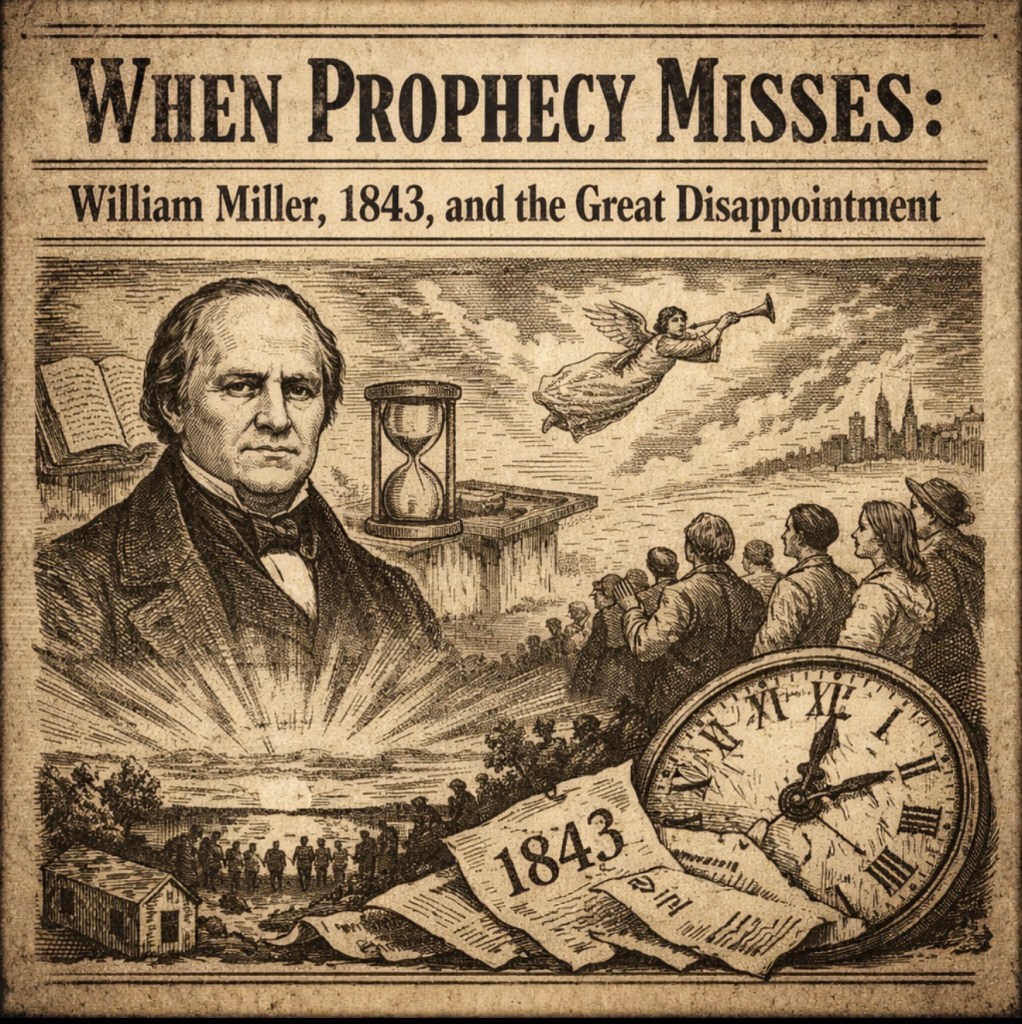
William Miller’s “1843” end-time prophecy didn’t start as a carnival-barker claim that the world would end on a single day; it grew into a defined time window that he believed the Bible itself demanded, and then—when nothing happened—spiraled into recalculations, mass expectation, public backlash, and what history remembers as the Great Disappointment. Miller was a self-educated farmer and Baptist lay preacher (later widely called a clergyman) born February 15, 1782, in Pittsfield, Massachusetts, and raised in Low Hampton, New York; he served in the War of 1812 and returned home in 1815. After the war he moved back into Baptist life, but what made him famous was his intense, methodical study of prophecy—especially Daniel 8:14 (“Unto two thousand and three hundred days; then shall the sanctuary be cleansed”)—which he interpreted through a popular Protestant framework that treated apocalyptic “days” as symbolic “years.” In his mind, the “cleansing of the sanctuary” meant nothing less than the final purification of the world at Christ’s return, so the prophetic clock wasn’t abstract theology; it was a countdown.
The logic behind “1843” came from a chain of assumptions that—if you accept each link—feels almost mathematically inevitable. The first big link was the day-year principle, the interpretive idea that prophetic time periods in Daniel and Revelation represent years rather than literal days. The second link was the identification of Daniel 8:14’s “2,300 days” with 2,300 years and the conviction that this period should be anchored to a specific starting point connected with the restoration of Jerusalem. Many historicist interpreters (Millerites included) tied that starting point to the decree associated with Artaxerxes in 457 BC, a date often discussed in connection with Daniel 9’s “restore and rebuild Jerusalem” language. Once you place the start at 457 BC and count forward 2,300 years (accounting for the lack of a “year zero”), you land in the early-to-mid 1840s, which is why Miller came to believe the Second Coming would occur “about” 1843. That’s the core: not a random guess, but an internally consistent system—so long as the interpretive premises are granted.
Miller didn’t begin by trying to build a movement. By multiple historical accounts, he reached his basic conclusion by 1818, then spent years checking and re-checking the argument before speaking publicly. He wrote down his beliefs in a more formal way in the early 1820s (including a “twenty-point” statement), and he didn’t deliver his first public lecture until August 1831, when invitations and public interest began pulling him out of private study and into wider preaching. In the 1830s, Miller also published material summarizing his argument, including a widely circulated 1836 work titled Evidence from Scripture and History of the Second Coming of Christ, about the Year 1843. Even that title shows how the target date functioned at first: a year-range conclusion (“about the year 1843”), not a precise appointment.
So why do many people remember it as “Miller predicted 1843” with such certainty? Because by early 1843, under pressure from followers and the rising excitement of the broader revival culture, the message narrowed from “about 1843” into a specific prophetic window tied to a Jewish calendar year. In January 1843, Miller announced that the Hebrew year running from March 21, 1843 to March 21, 1844 “must see the end of time,” while still urging humility about exact precision. That March-to-March window matters because it shows how the “1843” claim really worked: it wasn’t “December 31, 1843,” but a defined religious year that overlapped two Gregorian years. It also explains the emotional whiplash that followed: you could spend months thinking you were still “inside the time,” right up until the closing boundary passed.
The movement’s rapid growth is hard to understand without the broader American setting. Miller’s preaching surged during the tail end of the Second Great Awakening, when populist revivalism, itinerant preaching, and a booming religious print culture made it easier than ever for a compelling message to go national. The moment that supercharged Millerism was his partnership with Joshua V. Himes, a Boston minister and energetic organizer. Himes met Miller in late 1839, brought him to lecture in Boston starting December 8, 1839, and then used his publishing and promotional skill to spread the message far beyond upstate New York. Himes initiated major Millerite periodicals (including Signs of the Times and later Advent Herald under evolving titles), turning the movement into an information network: sermons, charts, rebuttals, testimonies, schedules, and updates moved across states with an intensity that feels modern. That machinery matters because it changed the psychology: once you have a movement that can synchronize expectations across regions, the “countdown” becomes a shared national event rather than a local eccentricity.
Millerites also adopted the era’s mass methods for mass persuasion. Camp meetings—huge outdoor religious gatherings—were already a staple of American revivalism, and Millerites leaned into them as the time approached. One scholarly overview notes that Millerites began using camp meetings in June 1842; within about three years they held around 125 camp meetings, sometimes drawing crowds in the thousands and claiming total attendance in the hundreds of thousands (even “close to a million” across events, by their estimates). Those numbers don’t mean “a million Millerites,” but they do show the scale of exposure and the way the message could feel like a wave rolling through communities. Meanwhile, print distribution was massive for the time; primary-source runs of Millerite periodicals survive in archives today, reflecting how central publishing was to the movement’s reach. Put simply: Millerism wasn’t just a date on a chalkboard. It was a communications system that amplified urgency.
As the March 21, 1844 deadline approached, the movement also collided with established churches. Many denominations resisted Millerite preaching or disciplined members who promoted it, and that opposition fed an “us versus them” dynamic: when authority figures call you deceived, it can either puncture the excitement or harden it into a test of faith. Charles Fitch’s famous July 26, 1843 sermon “Come Out of Her, My People” framed “Babylon” not merely as Rome but as corrupt religious systems more broadly, and it helped legitimize separation from churches that rejected the Advent message. This isn’t a small footnote; it shows how a failed prophecy can be buffered by social realignment. If leaving “Babylon” becomes part of obedience, then rejection by mainstream institutions stops being evidence against you and becomes evidence that you’re right.
When March 21, 1844 came and went, the “1843” claim failed in the most obvious way: the predicted event—Christ’s return—did not occur within the stated window. This is the point where a movement either collapses or adapts. Some people quietly walked away. Others did what humans often do when reality contradicts a cherished system: they tried to locate the error in the calculation rather than in the system itself. The disappointment was real, but it didn’t instantly dissolve the expectation; instead, many interpreted the delay through biblical patterns of waiting, including the “tarrying time” language that would become common in the summer of 1844, as believers searched Scripture for why the Bridegroom seemed late. The important historical point is that “failure” didn’t immediately feel like failure to everyone; for many, it felt like a painful test inside a still-true story.
That adaptive phase is how the “1843” prophecy flowed into the most famous date of all: October 22, 1844. In August 1844, at a camp meeting in Exeter, New Hampshire, a preacher named Samuel S. Snow presented what became known as the “seventh-month” message, tying the expectation to the tenth day of the seventh month (connected in their typological reading to the Day of Atonement imagery) and arguing that this pointed to October 22, 1844. Whether one agrees with Snow’s reasoning or not, historically it functioned as a lightning bolt: it turned a disappointed movement into a re-energized one with a single, focal date that could be preached as the “true midnight cry.” Notice what changed: instead of a year-window that could stretch your nerves for months, you now had a day around which you could sell property, sew ascension robes, settle debts, reconcile with neighbors, and gather with fellow believers to watch the sky. It concentrated emotion and decision-making—and that concentration made the eventual crash even more traumatic.
October 22, 1844 came, and again, Christ did not return. The shock, grief, and humiliation that followed is what historians call the Great Disappointment. Contemporary and later accounts describe ridicule from outsiders and deep spiritual crisis for insiders; in some places, Millerites reported harassment or even violence from hostile crowds, which compounded the sense of public shame. This is where the movement’s human story becomes impossible to ignore: you’re not just watching a failed prediction; you’re watching people who reorganized their lives around a promised rescue, only to wake up on October 23 to an unchanged world and the realization that everyone knows what you expected. In that kind of moment, some rebuild their lives outside the movement, some reinterpret the event, and some double down by setting new dates.
William Miller himself did not live long after these events; he died December 20, 1849. Historically, he’s often portrayed as either a gullible fanatic or a sincere man swept up by his own logic and the spiritual currents of his time. The record supports the latter more than the former: Miller’s approach was genuinely systematic, and he was not initially eager to name an exact day, even if he did commit publicly to the March 21, 1843–March 21, 1844 window. His tragedy—if we can call it that—is that a rigorous method can still be wrong if the foundational assumptions are wrong, and once a method starts producing an electrifying conclusion, social forces can push it from “about” to “definite,” from “study” to “campaign,” and from “hope” to “certainty.”
So what, precisely, made the 1843 prophecy “false”? In the simplest historical sense, it was falsified by the non-occurrence of the predicted event within the proclaimed timeframe. But if you’re asking why it failed—why a sincere reader could be so confident and still be wrong—the answer lies in how many interpretive judgments were treated as if they were arithmetic facts. The day-year principle is an interpretive choice, not a universally agreed rule. The identification of the “sanctuary” in Daniel 8:14 with the earth’s final cleansing is an interpretive choice. The selection of 457 BC as the correct starting anchor (and the linking of Daniel 8 and Daniel 9 in that specific way) is an interpretive choice. Each choice can be defended within certain theological traditions, but none of them is “just math” in the way Millerite preaching often made it feel. When you stack interpretive choices, small uncertainties multiply, and the final date can look precise even though it’s built on debatable premises.
There’s also a social and psychological layer that historians emphasize: in eras of anxiety and rapid change, apocalyptic messages can feel like clarity itself. The early-to-mid 1800s in the United States were filled with upheaval—market revolutions, new transportation, reform movements, and volatile religious competition—and revival culture trained people to interpret current events as spiritually significant. Millerism offered an overarching storyline that made suffering temporary and history purposeful: the confusion of the age wasn’t random; it was the final chapter. Once people tasted that kind of meaning, counterevidence could be reframed as persecution, delay, or divine testing, especially when preaching and print networks reinforced the same interpretation week after week. The community dynamics could be powerful too: if your friends, neighbors, and fellow believers are all sacrificing together, the social cost of doubt rises, and certainty can become a badge of faithfulness.
After the Great Disappointment, the Millerite world splintered into multiple streams rather than simply evaporating. Some believers abandoned date-setting and tried to salvage a more general Advent hope. Others formed or fed later Adventist bodies; historians commonly note that major Adventist traditions trace part of their origins to this crisis, even as they reinterpreted what “October 22” meant. One influential reinterpretation argued that the prophecy pointed not to Christ’s visible return to earth but to a heavenly phase of judgment or atonement, a move that preserved the date while changing the event. Whatever one thinks of those later doctrines, historically they show a consistent pattern: when a prophecy fails, groups often survive by revising the interpretation in a way that maintains continuity—“we weren’t wrong about the time; we were wrong about what would happen at that time.”
It’s also worth being honest about the memory of “1843” in American religious storytelling. The Millerites are frequently referenced as a cautionary tale about end-times speculation—people selling possessions, gathering on hills, and waking up devastated. Some of those images are based on real behaviors, but they can be exaggerated in popular retellings. A more accurate summary is that Miller estimated tens of thousands of committed believers (with far more curious onlookers), the movement cut across denominational lines, and its strength came from networks of preaching, print, and gatherings that made the expectation feel mainstream in certain regions rather than fringe everywhere. The point isn’t to mock people from the past; it’s to see how easily certainty can be manufactured when a system claims biblical inevitability, is repeated through mass media, and is insulated by a community that turns doubt into spiritual failure.
If you’re writing this as a blog meant to be teachable, the Miller story gives you several grounded historical takeaways without needing to insult anyone. First, Millerism shows that “Bible prophecy charts” can feel objective while quietly resting on interpretive scaffolding. Second, it shows how movements drift: a leader may begin with a cautious “about the year,” but followers and organizers—especially when publicity mechanisms are working—can push the message toward greater precision and higher stakes. Third, it shows how disappointment doesn’t automatically end belief; it can intensify it, producing recalculation, “tarrying time” explanations, and fresh certainty—exactly what happened between March 21, 1844 and October 22, 1844. And finally, it shows why the phrase “false prophecy” isn’t just a theological insult; historically, it’s a description of a specific claim about reality that did not materialize on the timeline asserted.
The most striking thing about William Miller’s failed 1843 prophecy may be how modern it feels. The tools have changed—today it’s livestreams, podcasts, and social media instead of itinerant lecturers and penny papers—but the mechanics rhyme: choose a set of interpretive rules, map them onto current events, produce a compelling date-range, build a community that repeats it, and treat doubt as compromise. Millerites had real newspapers, real schedules, real camp meetings, and real regional excitement; they weren’t simply a handful of isolated eccentrics. That’s why the story endures: it’s not just a quirky episode from 1843–1844; it’s a case study in how certainty is built, how movements respond when prophecy fails, and how sincere faith can slide into a kind of time-bound claim that history can test—and, in this case, history did.
 ANCIENT ECHOES PODCAST: WHY I NO LONGER BELIEVE IN GOD (JESSUP PA)
Leave a comment