Over a week ago, a murder in Minnesota became what too many tragedies become in America now: a political Rorschach test.
An evangelical Christian man has been reported as the perpetrator—an act that violates one of the most basic moral boundaries many Christians claim to uphold: “You shall not murder.” A mother. A daughter. An aunt. A wife. A human being with a name, a story, and people who will carry grief for the rest of their lives. And yet, instead of a shared moment of clarity—murder is murder, and the loss is real—we slide straight into team loyalty. People don’t follow evidence first. They follow narratives first: Republican narratives or Democratic narratives. “My side” or “your side.” That’s not an accident. That’s the system working exactly as designed.
Because when everything becomes partisan, nobody has to sit in the uncomfortable place where truth lives: the facts, the accountability, the complexity, the human cost. Politicians and media outlets benefit from keeping us emotionally mobilized—outraged, fearful, loyal. Tragedy becomes content. Human suffering becomes a tool. And the public becomes predictable: we “care” in ways that reinforce our tribe, not in ways that honor the victim.
I used to support the Republican Party—before 2021. Now I’m not a Democrat either. I’m tired of the game. Both sides play it. Both sides spin. Both sides have media ecosystems that selectively amplify certain stories, downplay others, and frame reality to keep audiences loyal. The result is a country where many people follow political leaders more faithfully than they follow the truth.
That’s why I can’t ignore the deeper contradiction that keeps showing up—especially in American evangelicalism. Many people want the label “Christian” like it’s fire insurance. But far fewer want the Jesus of the Gospels—the one who said love your enemies, who taught mercy, and who identified himself with the hungry, the sick, the stranger, and the poor (Matthew 25). He said love your neighbor. That’s a costly path. It demands humility, restraint, courage, and compassion. It’s easier to build a faith that mirrors your politics than to let your faith confront your politics.
And here’s the part a lot of people don’t want to admit: many pastors and Christian voices on the right have manufactured an “enemy”—as if Democrats are coming to destroy Christianity. But Christianity rarely collapses because of pressure from the outside. Historically, it corrodes from the inside: hypocrisy, greed, abuse, dishonesty, cover-ups, and leaders who protect institutions more than they protect people. The bible even supports institutions and people are destroyed by what’s in the inside..Peter emphasizes the danger to the church from within. And the dangers from within are more serious and more hazardous than the dangers from without.
What we’re witnessing now looks like an internal unraveling—built by the very people who claim to be defending the faith. The credibility of American Christianity is being damaged by what happens behind pulpits, by turning politicians into idols, and by the moral compromises that come with chasing power. Churches aren’t closing in large numbers because “the world is persecuting them.” Many are closing because people are waking up to what’s happening within them.
And Donald Trump has accelerated that crisis. Over the past decade, countless people have walked away from evangelicalism because of how openly it aligned itself with him—because it revealed what many churches truly worship when the stakes are political. He didn’t need to be a sincere believer to be embraced; he only needed to use the label. Many politicians do. It wins votes, influence, money, and loyalty. And many American evangelicals fell for it—again.
The deeper issue is this: when pastors and Christians excuse cruelty, dishonesty, and authoritarian behavior because it advances “their side,” they aren’t defending Christianity—they’re dismantling its credibility in real time. And people notice. Especially now. We live in an era where information moves faster than institutions can control it. The internet, books, podcasts, documentaries, and even AI have made it harder to hide patterns of abuse and corruption. People compare notes. They ask questions. They find receipts. Spin only works for so long.
That’s why I believe the American evangelical church will continue to harm itself from the inside. If it doesn’t become more honest, more accountable, and more aligned with the ethics of Jesus, I wouldn’t be surprised if, 20 to 40 years from now, many megachurches decline dramatically or close altogether. Not because outsiders “won”—but because the movement refused to confront what was rotting within it.
So no—Christianity isn’t being destroyed from the outside. In many places, it’s being hollowed out by what’s inside: scandal, hypocrisy, greed, political idolatry, and the refusal to repent when harm is done.
And that’s where the hypocrisy becomes impossible to ignore: Jesus calls people to love. Trump speaks openly in the language of enemies, payback, and dominance—yet many Christian supporters applaud it. Jesus centers care for the vulnerable. Many pastors and Christian commentators obsess over issues Jesus barely mentions, while neglecting the ones he won’t stop talking about—greed, injustice, cruelty, oppression, and how we treat “the least of these.”
When it comes to reports of aggressive immigration enforcement and escalating confrontation—whatever your politics, accountability matters. If a person is dead, the first question shouldn’t be, “How can I use this to prove my side is right?” It should be: What happened, exactly? What does the evidence show? Who made what decisions? Were there opportunities to de-escalate? Because escalation has consequences, and badges don’t replace responsibility. Power always needs oversight. Always.
It’s also worth saying plainly: a “family man” narrative doesn’t erase harm. Being called a Christian doesn’t make someone Christlike. Character isn’t proven by a uniform, a title, or a testimony—it’s proven by actions, patterns, and truthfulness when it costs you something. That doesn’t mean every officer or agent is abusive or corrupt. I’ve known good men in law enforcement—steady, respectful people who did the job with restraint and never harmed anyone. But the fact that some do harm, and that systems sometimes protect them, is exactly why evidence and accountability must matter more than loyalty.
And this is why people are leaving the evangelical church—not because they hate Jesus, but because they’re exhausted watching a movement trade the teachings of Jesus for power, cruelty, and tribal identity. They see churches that can quote Scripture while ignoring suffering. They see leaders calling everything “spiritual warfare” except the fear and harm happening right in front of them. They see a Christianity that looks less like the Sermon on the Mount and more like a political rally.
Murder is murder. A dead mother is not a headline. A life is not a talking point. If we can’t agree on that without checking which party benefits, then the real crisis isn’t only in politics—it’s in what we’ve allowed politics to do to our conscience.
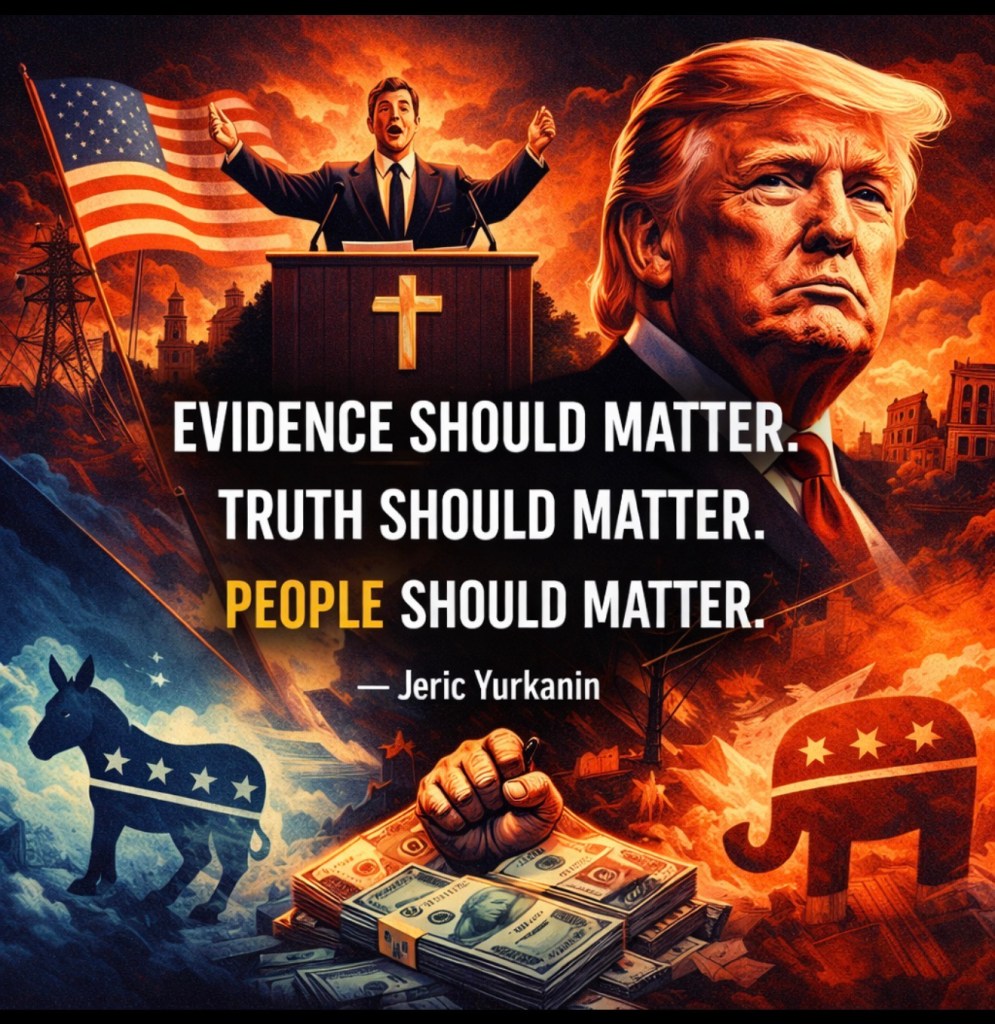
Evidence should matter. Truth should matter. People should matter.
 Agape Freedom Community
Leave a comment