By: Rev. Jeric Yurkanin
Mainstream Protestant Christianity talks about “sin” like it’s a clear, fixed object—like a list you can point to, a line you can cross, a boundary you can mark with tape on the floor. The language is confident: don’t sin, obey God, live holy, repent, surrender, deny yourself, stop living in sin. The sermons often sound like the moral universe is clean and organized. But the lived reality is messier, because the tradition isn’t one tradition. “Protestant” contains a whole ecosystem of competing frameworks—Reformed and Arminian, Baptist and Pentecostal, holiness and charismatic, fundamentalist and evangelical, conservative and progressive—each with different assumptions about what salvation is, how it works, what “repentance” proves, whether grace can be lost, whether the Spirit can be “lost,” whether assurance is possible, whether certain behaviors invalidate faith, and whether ongoing struggle means you’re human or means you’re doomed. The moment you ask a concrete question—“What exactly counts as sin, and what exactly happens if I don’t stop?”—you discover that much of the certainty is rhetorical. Under the bold statements is a constant negotiation between Bible texts, inherited traditions, modern culture, institutional survival, and the human need for control.
If you set out to build a consistent “sin doctrine” using the Bible alone, you run into an unavoidable problem: the Bible does not hand you one neat, universally-applicable catalog with a stable penalty chart. It gives you layers of moral reasoning and legal material across different eras and covenants, written to different communities, with different rhetorical purposes. The Torah contains laws that regulate worship, diet, purity, economics, sexuality, property, courts, slavery, war, festivals, and community boundaries, and it sometimes attaches extreme penalties to violations that modern Christians would never consider “hell-worthy” or even spiritually serious. The prophets blast Israel not primarily for private sexual behavior but for oppression, exploitation, idolatry intertwined with injustice, neglect of widows and orphans, rigged courts, and wealthy comfort built on poor people’s suffering. Wisdom literature frames “sin” as folly, arrogance, laziness, dishonest scales, violent speech, and the slow rot of pride. Jesus in the Gospels confronts hypocrisy, religious performance without mercy, spiritual pride, public prayer to be seen, contempt for outsiders, and systems that “tie up heavy burdens” and put them on others while refusing to lift a finger. Paul’s letters include vice lists and ethical instructions, but they are pastoral interventions, not systematic law codes, and they are written into messy real-life communities with specific conflicts, questions, and power struggles. James sounds like a prophet with a New Testament accent—greed, favoritism toward the rich, hypocrisy, the tongue that destroys people, a faith that claims belief but refuses embodied compassion. So when modern Protestantism preaches “sin” as if it’s simple, it has already made dozens of interpretive choices before the first sentence. It has already decided which parts are universal, which parts were “for Israel,” which parts were ceremonial, which parts were fulfilled, which parts were culturally conditioned, which parts were timeless moral law, and which parts can quietly fade into the background without threatening anybody’s identity.
That interpretive gatekeeping is where the goalposts start moving, because the Bible’s complexity forces churches to pick a method, and most churches do not teach their method transparently. They teach conclusions. They teach the finished product as if it dropped from heaven. They rarely say, “Here are the hermeneutical principles we’re using; here’s why we treat Sabbath law one way and sexual ethics another; here’s why we spiritualize some commandments and literalize others; here’s where Christians disagree; here’s what we know and what we don’t.” Instead they preach, “The Bible says,” which is often shorthand for, “My tradition has decided.” And traditions decide based on more than text. They decide based on identity, fear, social cohesion, political alignment, donor comfort, denominational boundaries, and what will keep the crowd nodding rather than questioning.
In that environment, “sin” becomes less like a consistent moral diagnosis and more like a culturally curated set of trigger topics—what many people have experienced as “culture sins.” These are the sins that get the microphone. They become the proof texts, the warning signs, the markers that distinguish “us” from “them.” In many conservative Protestant contexts, you can predict the lineup: sex outside marriage, cohabitation, porn, modesty, “worldliness,” certain kinds of entertainment, and—very often—LGBTQ+ identity and relationships. Sometimes alcohol is included, depending on the tradition. Sometimes “rebellion” is included in vague ways that conveniently cover anything a leader doesn’t like. Sometimes “submission” is preached in ways that land harder on women than men. The sermon cadence becomes familiar: God is holy, the world is dark, sin is everywhere, don’t compromise, don’t be deceived, narrow is the way, the devil is prowling, be set apart, if you love Jesus you’ll obey, if you are truly saved you won’t live like that. And while those messages are blasting the same few areas, other sins are treated like wallpaper: greed, gossip, slander, pride, contempt, racism, exploitative business practices, cruelty, indifference to suffering, dishonesty, abuse of power, hyper-consumerism, nationalism baptized as faith, the love of money, the worship of success, the scapegoating of outsiders, the refusal to forgive, the constant lack of empathy. Those sins do appear in sermons occasionally, but they rarely function as identity markers. They rarely carry the same social consequences as the “culture sins.” They rarely provoke the same fear. They rarely lead to public discipline. And that imbalance isn’t accidental. It reflects what a community is willing to confront in itself versus what it prefers to condemn in others.
When you say “the goalposts keep changing,” that’s not just a feeling; it’s baked into the competing salvation frameworks within mainstream Protestantism. One pastor tells you salvation is secure the moment you believe; another tells you salvation is secure only if your belief produces visible behavioral change; another tells you salvation can be lost; another tells you salvation cannot be lost but your sin proves you were never saved; another tells you you can lose the Holy Spirit; another tells you you can grieve the Spirit but He won’t leave; another tells you you can have assurance; another tells you assurance is dangerous because it makes people complacent; another tells you that doubt is rebellion; another tells you doubt can be part of faith. Some traditions emphasize justification by faith alone and treat sanctification as growth; others emphasize holiness and treat certain behaviors as disqualifying. Some emphasize God’s sovereignty and election; others emphasize human choice and perseverance; others emphasize spiritual warfare and deliverance; others emphasize discipline and accountability as the proof of regeneration. You can listen to ten mainstream Protestant voices and get ten different answers to the same question: “If I struggle with sin, am I saved?” The fact that the answers vary exposes something important: the system is not anchored in a single, universally agreed logic. It is anchored in authority structures and inherited frameworks that communities defend because they hold the community together.
That’s why “Jesus saves you except…” becomes such a common lived experience even when people verbally insist on grace. They’ll say, “Salvation is a free gift,” and then attach an invisible contract underneath it: free gift, but you must prove you really meant it; free gift, but you must stop these behaviors; free gift, but if you keep struggling, you’re in danger; free gift, but if you don’t produce fruit, you were never saved; free gift, but if you fall away, you never belonged; free gift, but if you do this particular sin, it’s evidence you’re reprobate; free gift, but if you vote wrong or affirm the wrong people you’re deceived; free gift, but if you question the system you’re proud; free gift, but if you don’t submit you’re rebellious; free gift, but if you don’t keep showing up and tithing you’re drifting. So the “free gift” can feel like an anxious treadmill: you are accepted, now perform; you are forgiven, now prove it; you are loved, now don’t mess up; you are secure, but don’t you dare relax. The gospel becomes a revolving door that keeps people close to the altar because the altar is where the system has power.
The “willful sin” category is one of the most effective tools in this environment precisely because it is vague. It sounds biblical because it borrows biblical language from warning passages, but in practice it can be stretched to cover anything a leader wants it to cover. If willful sin means “sin you knew was sin,” then almost all sin is willful, because most people are not ignorant of their own conscience. If willful sin means “sin you keep doing,” then any long-term struggle becomes proof you are lost. If willful sin means “sin you plan,” then many human behaviors qualify, because humans are complicated and often act out patterns they didn’t choose and can’t easily break. But sermons often flatten that complexity into a binary: either you repent and stop, or you’re rebellious and doomed. That binary is emotionally powerful because it turns the messy middle—the place where most humans actually live—into a place of fear. And fear is useful. Fear makes people easier to steer. Fear keeps them tethered to the institution for reassurance, guidance, and ritual “reset” moments.
Romans 1 is often weaponized in this space as a kind of theological sledgehammer, especially in debates about sexuality, but it also functions more broadly as a warning passage that can be aimed at any “outsider.” The phrase “God gave them over” becomes a threat: keep sinning and God will hand you over. The problem is that Romans 1 is part of a larger argument in Romans, where Paul is setting up the universality of sin so that religious people don’t get to stand above others. The rhetorical trap in Romans is that if you read Romans 1 like it’s only about “those people,” you miss that Paul turns around and says, in effect, “You who judge do the same things.” Yet in mainstream preaching, Romans 1 is frequently used to create a moral hierarchy: there are respectable sinners inside the church and there are vile sinners outside it; there are tame sins we can tolerate and there are gross sins that prove depravity; there are sins that threaten donor comfort and there are sins we can ignore. And then a passage designed to humble moral arrogance becomes a passage used to inflate it.
Your Sabbath example is one of the clearest ways to expose moving goalposts without even raising modern hot-button issues. In the Old Testament legal tradition, Sabbath is not treated like a minor suggestion. It is a covenant marker, a sign of Israel’s identity, a weekly practice of trust, rest, and resistance to endless production. In some law texts, violating Sabbath is treated as severe. Yet most modern Protestant Christians ignore Sabbath with remarkable ease. Not just accidentally, but structurally. They work, shop, travel, schedule sports, treat Sunday as a second Saturday, and build lifestyles that cannot accommodate a strict Sabbath even if they wanted to. And the church often adapts to that rather than confronting it, because confronting it would cost people something. It would interfere with the economy, with convenience, with American productivity, with sports culture, with corporate schedules, with the way modern life is built. So Sabbath becomes “fulfilled in Christ,” or “a principle not a command,” or “every day is a Sabbath,” or “it was ceremonial,” or “it was for Israel,” or “we meet on Sunday not Saturday so it’s different,” or “don’t be legalistic.” Now, some of those arguments can be made thoughtfully, but the point is this: the same communities that are able to apply flexibility, nuance, and covenant transition logic to Sabbath are often unwilling to apply the same flexibility, nuance, and covenant transition logic to other contested areas. The interpretive method shifts depending on what the community is already comfortable with. That is the goalpost movement. And when the goalposts move based on comfort and culture, “sin” stops functioning like a stable moral category and starts functioning like a social boundary system.
Once you notice that, you notice it everywhere. Old Testament laws about diet, clothing, menstruation, mixed seeds, and ritual purity are dismissed as “old covenant,” but certain Old Testament sexual texts are treated as timeless moral law. Commands about caring for the poor, prohibitions of exploitation, warnings about wealth, and prophetic condemnation of unjust economies are often spiritualized, minimized, or reframed as “personal charity,” while private sexual behavior is treated as the definitive proof of holiness. Jesus’ obsession with hypocrisy, greed, and public religiosity without mercy is often preached in abstract, while the church creates elaborate programs to police behavior it can see. Teachings about peacemaking, enemy-love, and non-retaliation are often treated as idealistic, while teachings about “being set apart” are applied in ways that heighten suspicion of outsiders. The Bible becomes a buffet, but not a random buffet; a patterned buffet, where the selections tend to protect the institution and punish the vulnerable.
The “gay and acting on it—straight to hell” line that you described is an example of how mainstream conservative Protestantism often uses sexuality as a salvation litmus test. Even among those who say salvation is by grace through faith, sexual behavior becomes the place where grace is suddenly treated as fragile. You can be greedy and be called “imperfect.” You can be cruel and be called “rough around the edges.” You can be prideful and be called “strong.” You can be judgmental and be called “bold.” But if you are gay and in a committed relationship, many churches treat that as inherently disqualifying, as if it automatically cancels the cross. The theological claim is often framed as “behavior matters,” but the social reality is that the behavior being policed is disproportionately about certain bodies and relationships. It creates an underclass inside the faith: the people who must be perpetually corrected, perpetually celibate, perpetually on probation, perpetually treated as a public threat. And it gets justified by fear: fear of moral collapse, fear of cultural change, fear of losing identity, fear of losing power. When fear is the engine, theology becomes the paint job.
In that context, the question “Which sins should I avoid?” becomes devastating, because it exposes that the church’s warnings are often not actionable. People are told, “Stop sinning,” but they are not told, in a consistent way, what counts as sin, why it counts, how to weigh conflicting texts, how to deal with gray areas, how to handle conscience, how to account for trauma, how to interpret ancient contexts, and how to live with humility when Christians disagree. They are told to obey God, but “obey God” becomes a slogan that can be attached to whatever the pastor is currently emphasizing. They are told to please God, but “please God” becomes a moving finish line that no one can measure, which keeps people in a permanent posture of insecurity. And insecurity is not a side effect; in many systems, it is the product.
When you ask, “Explain to me exactly step by step how I can make God happy,” you are asking for something many pastors cannot give without collapsing their own framework. If they give a strict step-by-step, they risk creating a visible legalism that people will call out. If they give a loose step-by-step, it becomes meaningless. If they say “love God and love neighbor,” people will notice that this doesn’t support the heavy policing systems they’ve built. If they say “avoid these sins,” people will notice the selectivity and ask why greed and gossip aren’t treated with the same intensity as sexuality. If they admit Christians disagree, they lose the aura of certainty that keeps the system stable. So the safe move is the sermon move: bold statements, vague application, emotional altar call, and a return to the authority of the preacher. That’s why so many church experiences feel like motivational speeches with threats: the language is strong, the details are fuzzy, and the result is dependence.
The dependence is reinforced by how Protestantism often makes pastors into gatekeepers of “true Christianity.” In theory, Protestantism was supposed to decentralize authority: priesthood of all believers, access to Scripture, direct relationship with God. In practice, many evangelical cultures recreate priesthood through personality and platform. The pastor becomes the interpreter-in-chief, the truth distributor, the moral referee, the one who decides what counts as real repentance, the one who discerns whether you are sincere, the one who can label you deceived, rebellious, backslidden, or dangerous. If you agree, you are teachable. If you disagree, you are proud. If you ask questions, you are “leaning on your own understanding.” If you challenge inconsistencies, you are “bitter.” The system is self-protecting because it spiritualizes disagreement as sin. And when disagreement becomes sin, the pastor becomes immune to accountability, because any critique can be dismissed as spiritual failure.
That dynamic becomes even more obvious when money is involved, because churches—like all institutions—need resources to survive, and the need for survival can quietly shape theology. You don’t have to believe every pastor is consciously manipulative to see that systems tend to preserve themselves. Sermons that keep people afraid of leaving keep people present. People who are present are more likely to give. People who give sustain programs. Programs justify staff. Staff justify expansion. Expansion becomes a sign of “God’s blessing.” And then the institution becomes invested in never admitting uncertainty, never admitting historical complexity, never admitting that Christian doctrine has developed and shifted, never admitting that many of the moral emphases are culturally shaped. Because once you admit that, people might breathe. They might think. They might leave. They might stop paying for a machine that runs on their anxiety. So the machine prefers simple binaries: saved or lost, truth or deception, obedient or rebellious, holy or worldly, God’s way or Satan’s way. Binaries are easy to market. Nuance is hard to monetize.
The goalposts move not only between churches but within the same church over time, because culture changes and churches must respond. There was a time when many Protestant churches treated dancing as a major moral threat. There was a time when playing cards was preached as sinful. There was a time when movie theaters were treated like gateways to hell. There was a time when interracial marriage was condemned by many Christians using the Bible. There was a time when segregation was defended as “biblical order.” There was a time when women speaking in church was treated as rebellion; in many places it still is. There was a time when divorce was treated as almost always disqualifying; now many churches quietly adapt because divorce is common in the pews. There was a time when the church preached against consumerism more loudly; now consumerism funds many church lifestyles. There was a time when Sunday was guarded more strictly in some communities; now sports and travel took over and many churches adjusted their schedule rather than confronting the idol. The fact that these shifts happen shows that moral certainty is often retrospective. The church often discovers later that what it preached with confidence was culturally conditioned, and then it quietly reframes without apology.
This reframing is rarely honest. Churches seldom say, “We were wrong.” They say, “We have new understanding.” They say, “God is doing a new thing.” They say, “Culture has changed so we must be wise.” They say, “We must focus on the essentials.” And that last phrase—“the essentials”—becomes another set of moving goalposts. What counts as “essential”? For some, it’s the Trinity, the resurrection, the authority of Scripture. For others, it’s inerrancy, substitutionary atonement, heterosexual marriage, male leadership. For others, it’s social justice, inclusion, peace. Each group calls their set “biblical,” and the labels become weapons. “Progressive” becomes a slur. “Fundamentalist” becomes a slur. “Compromised” becomes a slur. “Heretic” becomes a slur. The Bible is treated like a courtroom exhibit, but the judge changes from church to church.
Even the idea of “living in sin” is a goalpost that moves depending on who is being judged. In many churches, a straight couple cohabiting might be privately counseled but still welcomed if they’re likable and conforming. A wealthy man who exploits employees might be honored because he gives a large donation. A gossip might be called “concerned.” A bully might be called “bold.” A person struggling with addiction might be treated as a project rather than a person. A person who asks too many questions might be treated as a threat. Meanwhile, LGBTQ+ people are often treated as a public emergency, as if their existence is the primary moral crisis of the age. So “living in sin” is not consistently applied; it is often applied to whatever the community is most anxious about and least willing to understand.
This is why asking for “all the sins in the Bible” exposes the emptiness of the preaching. If a pastor tried to teach “all the sins,” it would be impossible without either creating a legalistic monster or admitting interpretive selection. The Bible contains sins of omission and commission, inner dispositions and outward actions, personal morality and communal injustice. It condemns dishonest weights, withholding wages, exploiting the poor, perverting justice, showing favoritism, sexual exploitation, violent speech, false witness, pride, arrogance, cruelty, lack of hospitality, loveless religion, hypocrisy, greedy leadership, abusive shepherds, and endless other things. It also contains ancient covenant boundary markers that most Christians do not follow. So pastors choose. And the choosing is the point. The choosing reveals what a tradition truly worships: sometimes it worships holiness defined as sexual conformity; sometimes it worships respectability; sometimes it worships control; sometimes it worships growth metrics; sometimes it worships political power; sometimes it worships certainty. And then it calls that worship “God.”
When challenged, many pastors do exactly what you described: they shift, dodge, spiritualize, and eventually ignore. Not always because they are evil, but because the questions threaten the structure that gives them authority. If they admit the goalposts have moved, they must admit fallibility. If they admit fallibility, they must loosen control. If they loosen control, the system becomes harder to manage. And if the system becomes harder to manage, the institution risks losing its grip on the narrative. So instead of answering, many will retreat to slogans: “The Bible is clear.” “God’s Word is true.” “Don’t lean on your understanding.” “You just want to justify sin.” “You’re being deceived.” “You need to humble yourself.” These are not arguments; they are control phrases. They shut down inquiry by framing inquiry as moral failure. They keep the pastor as the gatekeeper and the questioner as the suspect.
The tragedy is that many sincere Christians are trapped in this cycle without realizing it. They want to love God. They want to be good people. They want community. They want meaning. And they are told that the way to get those things is to submit to an institution that constantly moves the standard, constantly warns of danger, constantly demands proof, constantly uses fear as fuel. They may feel guilty even when they are trying their best. They may feel anxious because they can’t tell whether they’re “safe.” They may interpret that anxiety as “conviction,” because that’s what they were trained to do. They may confuse dread with holiness. They may confuse conformity with righteousness. They may confuse obedience to a pastor with obedience to God. And then they pass that fear along, believing they are protecting others from hell, when they are actually keeping the machine running.
Your point about “who wants to be part of that” is ultimately a moral and psychological question, not just a theological one. If the system produces fear, control, dishonesty, moving goalposts, and selective enforcement, then even if it uses Bible language, it functions like an institution more than a path of liberation. Jesus’ harshest words in the Gospels were not aimed at outsiders who didn’t have the right doctrine. They were aimed at religious leaders who used religion to burden people, control people, exploit people, and protect themselves. That doesn’t automatically mean every pastor is a villain, but it does mean that the structure of religious power can become its own form of sin—especially when it refuses transparency and demands submission while moving the standards behind the scenes.
The simplest way to name what you’re describing is this: in much of mainstream Protestant culture, “sin” is not merely a spiritual category; it is a social tool. It marks insiders and outsiders. It protects identity. It justifies authority. It channels fear. It distracts from deeper injustices. It provides certainty where life is uncertain. It creates a perpetual need for the institution: you need the preacher to tell you whether you’re okay, you need the altar to reset your status, you need the church to reassure you, you need the system to interpret your conscience. And because the goalposts move, you can never fully graduate. You can never fully rest. You can never fully be sure. That keeps you coming back. That keeps you giving. That keeps you quiet. That keeps the machine alive.
If “please God” can never be clearly defined, if “don’t sin” can never be consistently applied, if “Jesus saves” always has an unspoken asterisk, if the sins that get punished are mostly the sins that make conservative culture uncomfortable, if the sins that get excused are the sins that keep the donors comfortable, if the interpretive method changes depending on convenience, and if the leadership refuses honest accountability when challenged, then the honest conclusion is not that God is confusing but that the system is. The confusion is functional. It keeps authority intact. It keeps people dependent. It keeps the narrative controlled by gatekeepers. And when a person finally says, “Show me the step-by-step, show me the consistent logic, show me the stable goalposts,” the system often has only two moves left: shame the questioner or ignore them. That’s not truth defending itself; that’s power preserving itself.
What makes the whole “sin” conversation in mainstream Protestantism feel unstable isn’t simply that Christians disagree—plenty of healthy traditions disagree on details. It’s that the disagreement is often hidden behind a performance of certainty. The average church doesn’t say, “Here are the major Protestant frameworks for salvation, here are the scriptures each side emphasizes, here are the tensions, here is what we can’t fully reconcile, and here’s how we’re going to treat people who land differently.” Instead, it speaks in absolutes, and then shifts those absolutes depending on who is preaching, what the congregation already accepts, and what the institution needs at that moment. That produces a kind of spiritual whiplash. One year you’re told that if you truly prayed the prayer you’re secure. The next year you’re told that if you keep struggling you were never saved. One conference says you can’t lose salvation but you can lose “fellowship.” Another says you can lose salvation but you can get it back. Another says you’re secure, but if you leave the church you’re proving you’re deceived. The surface message is “God is consistent,” but the lived message is “your safety depends on which teacher has the microphone.”
Take the classic divide: eternal security versus conditional security. In many evangelical and Baptist circles, the refrain is “once saved always saved,” meaning if you are truly regenerated by God, you will persevere; if someone appears to fall away, it proves they were never truly saved. In many Wesleyan, holiness, Pentecostal, and other Arminian-leaning circles, the refrain is that a person can genuinely believe, genuinely be saved, and then later reject faith and fall away. Both views claim biblical support. Both views cite passages with confidence. Both views are presented to congregations not as theological models but as “what the Bible clearly says.” That presentation is where the manipulation enters, because it sets up a situation where the pastor’s framework becomes the definition of reality. If you live under one framework, your fears and your self-understanding are shaped accordingly. If you live under the other, they’re shaped differently. And if you move between churches, you discover how much of your spiritual anxiety was not produced by “the Holy Spirit” but by a theological system that needs you emotionally dependent.
In “once saved always saved” cultures, the control lever often becomes the phrase “you were never truly saved.” It’s the perfect double-bind. If you struggle, you’re told to repent. If you keep struggling, you’re told you might not be saved. If you show fear, you’re told that fear proves you lack faith. If you seek assurance, you’re told assurance comes by examining your fruit. If you don’t see enough fruit, you’re told you’re self-deceived. So the believer is placed in a psychological loop: you must believe you’re saved, but you must constantly prove you’re saved, and the proof is judged by the very people who benefit from you staying anxious and compliant. This is why “fruit inspection” becomes a surveillance tool. “You’ll know them by their fruit” gets ripped from its context as wisdom about teachers and used as a microscope against the average person’s interior life. The fruit becomes whatever the leader wants it to be: did you stop drinking, did you stop cussing, did you stop watching that show, did you break up with that person, did you stop doubting, did you stop asking those questions, did you submit, did you serve, did you attend, did you tithe. Then “fruit” quietly becomes “compliance,” and “compliance” becomes evidence of salvation. It’s a system that can never let you rest, because rest is dangerous to control.
In conditional security cultures, the control lever is different but equally powerful: fear of losing what you have. Instead of “maybe you were never saved,” the threat is “you might lose your salvation,” or “you can lose the Holy Spirit,” or “you can be cut off,” or “God will hand you over.” This produces a different loop: you must keep yourself safe by remaining in a state of repentance, submission, and spiritual vigilance. You are taught to monitor your thoughts, your temptations, your entertainment, your relationships, your emotions—because any slip might be evidence of backsliding. Then the church offers the remedy it controls: altar calls, rededications, deliverance sessions, accountability, “getting right with God,” and constant re-commitment. Again, the person is kept in a posture of dependence. The emotional pattern becomes similar to an abusive relationship: security is conditional, love is threatened, fear is framed as care, and the solution is always to come back under the one who holds the authority.
Now layer in the texts that get used for fear. Hebrews is a prime example. Many Protestant sermons use Hebrews warning passages like a spiritual gun to the head. “It is impossible…” gets preached as if the author is describing the average Christian who struggles with sin, rather than dealing with a specific community facing apostasy pressures and the temptation to abandon faith under social cost. People hear these warnings and conclude that any repeated struggle means they’re doomed. Yet the same sermons often ignore other parts of Hebrews that emphasize endurance, encouragement, mutual support, and the complexity of faith under pressure. Hebrews becomes not a pastoral letter to help a suffering community persevere, but a fear text used to keep the congregation in line. This is especially damaging because it turns a text meant to strengthen weary people into a text that crushes them.
First John is another fear factory when handled poorly. Many churches preach 1 John as if it’s a simple statement: real Christians do not sin; therefore if you sin, you are not a real Christian. But the letter itself contains tensions about ongoing sin, confession, advocacy, growth, community, and the difference between willful harm and stumbling. Instead of treating 1 John as a call to integrity and love—and a critique of those who claim spirituality while hating others—church culture often turns it into a behavioral litmus test. And because the test is framed by the culture-sins, the letter becomes a blunt instrument aimed disproportionately at certain people: the teenager with sexual shame, the cohabiting couple, the person with addiction, the LGBTQ+ person, the deconstructing believer. Meanwhile, the proud, the greedy, the cruel, and the slanderous can remain socially safe because their sins fit inside respectable church culture.
This is why the phrase “stop sinning” is functionally empty in many churches. It sounds powerful because it’s delivered with intensity. It feels true because it triggers fear. But it’s empty because it avoids the real question: which sins are we talking about, and why are those the ones we treat as decisive? If someone “willfully sins” by working on the Sabbath, is that disqualifying? If someone “willfully sins” by withholding wages, by exploiting employees, by lying to get ahead, by slandering others, by hoarding wealth while ignoring suffering, by despising immigrants, by mocking the poor, by living in resentment, by refusing reconciliation, by feeding their ego through power—are those treated as salvation threats with the same volume? Usually not. The volume is the giveaway. The church often preaches sin not in proportion to the harm but in proportion to the cultural anxiety.
The “willful sin” phrase itself becomes a theological trap because it refuses to account for human complexity. It collapses trauma into rebellion. It collapses addiction into defiance. It collapses mental illness into moral failure. It collapses nervous system patterns into spiritual weakness. It collapses the slow work of healing into “you just need to surrender.” The result is not holiness; it’s shame. And shame is extremely useful to institutions because shame keeps people small. Shame makes people self-distrustful. Shame makes people eager for external approval. Shame makes them vulnerable to the person who claims to have the cure. So sermons will say, “You know what you’re doing,” because shame thrives on secrecy. But many people do know what they’re doing—and they also know they can’t just flip a switch. They need support, safety, and compassion. They need practical tools. They need truth without condemnation. A system that only knows how to threaten them cannot actually heal them; it can only control them.
This is where the “Holy Spirit can leave you” concept becomes especially damaging. In some Pentecostal and holiness traditions, people are taught that if they sin, they grieve the Spirit, and if they continue, the Spirit may depart. That creates an inner world of panic: every mistake becomes a sign of abandonment. People interpret anxiety as spiritual warning. They interpret intrusive thoughts as demonic attack. They interpret depression as lack of faith. They interpret doubt as rebellion. The human psyche gets mapped onto spiritual warfare, and then the institution becomes the interpreter of your mind. This can be profoundly destabilizing. The person loses trust in themselves. They become easier to manipulate because the pastor can claim access to invisible realities they can’t verify. “The Spirit is telling me…” becomes a trump card. “God is dealing with you…” becomes a trump card. “You’re under conviction…” becomes a trump card. And if you disagree, you’re resisting God. That is an authority structure built not on love but on uncheckable claims.
The thing that makes it all feel dishonest is that these frameworks are used selectively. When a pastor wants to motivate people to evangelize, the message is “salvation is urgent, hell is real, people are dying without Jesus.” When a pastor wants to comfort someone, the message becomes “God understands, God is patient, God loves you.” When a pastor wants to protect the institution, the message becomes “don’t touch God’s anointed, don’t sow discord, don’t be divisive.” When a pastor wants to enforce sexual norms, the message becomes “holiness, obedience, living in sin.” When a pastor wants donations, the message becomes “God blesses givers, you can’t outgive God, sow a seed, prove your faith.” When a pastor wants to avoid accountability, the message becomes “leave it with God, don’t be bitter, don’t judge.” The theology shifts to meet the institutional need. That’s goalpost movement. And when you see it, you realize that “sin” is less a stable moral category and more a lever that can be pulled in different directions.
Church discipline is another area where the selectivity exposes the system. Many mainstream Protestant communities claim to take sin seriously, but discipline tends to happen in predictable categories: sexual behavior, public “scandal,” overt disagreement with leadership, or anything that threatens the church’s image. A couple living together might be confronted publicly. A teenager might be shamed for pregnancy. A divorced person might be sidelined. A LGBTQ+ person might be excluded. But a wealthy donor who treats employees poorly, or a charismatic leader who is manipulative, or a respected member who gossips and destroys reputations may never face discipline. Why? Because those sins don’t threaten the brand. They may even fund it. The institution tells on itself by who it’s willing to confront. “Holiness” becomes less about protecting people from harm and more about protecting the church from embarrassment.
This selective discipline is why people start asking, “Is this about God, or is this about managing a social club?” The more a church behaves like a brand, the more its moral system behaves like brand management. Certain issues become “PR disasters” and therefore “serious sin.” Other issues become “normal human stuff” and therefore “covered by grace.” But that line is not drawn by Scripture; it’s drawn by the institution’s interests. Once you see that the moral seriousness of an issue is often proportional to its threat level to the organization, it becomes hard to keep believing that the sermons are simply about truth.
Now consider how identity politics shapes sin. In modern evangelicalism, “sin” often becomes entangled with tribal identity. Certain moral positions become markers of belonging to a political-cultural tribe. You’re not just “biblical”; you’re one of us. You’re not just “holy”; you’re aligned. That’s why some sins get inflated into existential threats: they symbolize cultural change, and cultural change threatens group identity. LGBTQ+ inclusion becomes a lightning rod not only because of biblical interpretation debates, but because it symbolizes a broader shift in authority: who gets to define morality? who gets to define family? who gets to define community? who gets to define what “Christian” means? When the church has built its identity around being the moral center, any shift that reduces its power feels like an attack. So sin-talk becomes culture-war talk. It becomes “standing for truth” rather than “seeking justice and mercy.” The church becomes more reactive than reflective. And the people who get caught in the middle are real humans whose lives become abstract symbols in somebody else’s tribal battle.
This tribalization also explains why pastors can preach with such confidence while contradicting one another. They aren’t only defending an interpretation; they’re defending an identity. Admitting complexity can feel like betrayal. Admitting uncertainty can feel like weakness. So instead of modeling humility—“here are the debates, here’s why Christians differ, here’s the pastoral posture we should take”—leaders often double down. The pulpit becomes a place where doubt is mocked, questions are framed as rebellion, and empathy is treated as compromise. Then “sin” functions as a fence: it keeps the tribe pure, distinct, and obedient. But purity here doesn’t mean moral integrity; it means ideological conformity.
The “unforgivable sin” conversation often becomes another lever. The New Testament’s “blasphemy against the Spirit” is a complex concept tied to attributing the work of God to evil, hardening oneself against truth, and refusing the very means of repentance. But in church culture, it often gets simplified into “rejecting Jesus is the unforgivable sin.” Sometimes that simplification is offered as a pastoral explanation—if you refuse grace, you can’t receive forgiveness. But often it becomes a fear tool: believe the correct doctrine or you are beyond forgiveness. And then the definition of “rejecting Jesus” subtly expands to include rejecting the pastor’s framework, questioning inerrancy, disagreeing on moral issues, leaving the church, or refusing to accept the culture-sins narrative. The boundary of what counts as “rejecting Jesus” becomes elastic. That’s where it stops being theology and becomes a mechanism of control. If a church can define “rejecting Jesus” broadly, it can label almost any dissent as damnation-adjacent. That keeps people quiet.
The same elasticity appears in how “repentance” is used. Biblically, repentance involves turning, reorientation, honesty, and transformation over time. But in many church systems, repentance gets reduced to a performance: cry at the altar, say the right words, confess in the approved way, demonstrate immediate change, and promise to never do it again. If you do it again, your repentance is questioned. If you struggle for years, your salvation is questioned. And the deeper problem is that leaders often define “real repentance” not by love, humility, and repair but by behavioral conformity to the church’s favored norms. It’s easy to create a repentance culture that looks spiritual but actually functions like surveillance. People confess to stay in good standing. People “repent” to avoid shame. People apologize to avoid being ostracized. People learn to say what leaders want to hear. The result is not holiness; it’s an ecosystem of fear and dishonesty.
This is why you’re right to call the statements “bold but empty.” “Obey God” is not a plan. “Stop sinning” is not a plan. “Please God” is not a plan. These phrases work as rhetoric because they invoke a moral authority without having to operationalize it. If someone operationalizes it, they immediately face impossible questions: How do we translate ancient laws into modern contexts? How do we weigh Jesus’ teachings against Paul’s vice lists? How do we handle texts that reflect ancient social structures that we now find immoral? How do we account for historical development in doctrine? How do we apply ethical reasoning in complicated human situations? How do we prevent leaders from cherry-picking? How do we avoid using shame as a tool? How do we protect vulnerable people from moral policing? How do we define “sin” in a way that is consistent, compassionate, and honest? Those are hard questions. Most churches do not want those questions asked publicly, because those questions relocate authority from the pulpit to the community’s shared reasoning and conscience.
So instead, many systems prefer a perpetual fog. They keep the congregation in a state of “I’m not sure if I’m okay,” because that feeling drives attendance, drives compliance, and drives giving. It’s not that every pastor consciously thinks, “I’m going to manipulate people for money.” It’s that systems evolve toward what sustains them. If fear keeps people engaged, fear becomes spiritualized. If certainty keeps people loyal, certainty becomes moralized. If outsiders are needed as a cautionary tale, outsiders become demonized. If donors are needed, donor-friendly theology becomes normalized. This is how institutions operate, religious or not. The church is not immune to institutional gravity.
If a person wants to see the moving goalposts clearly, all they have to do is compare how different churches treat the same behaviors. In some churches, drinking a beer is treated as compromise; in others, it’s irrelevant. In some churches, therapy is seen as faithlessness; in others, it’s encouraged. In some churches, women leading is forbidden; in others, it’s celebrated. In some churches, divorce disqualifies leadership permanently; in others, it’s treated as a painful life event. In some churches, tattoos and piercings are treated as rebellion; in others, nobody cares. In some churches, music style is spiritual warfare; in others, it’s preference. And in many churches, the strictness fluctuates not only by doctrine but by who you are. A well-liked person gets patience. A marginal person gets scrutiny. A wealthy person gets grace. A poor person gets lectured. A straight couple gets compassion for “struggling.” A queer couple gets treated as a theological crisis. The goalpost isn’t just moving; it’s moving differently depending on who’s kicking the ball.
It’s also important to name how the evangelical imagination often treats sin as contagion. Certain behaviors are framed not as moral issues that require pastoral care but as threats to the purity of the community. This is why some churches respond to LGBTQ+ inclusion like it’s infectious, or respond to deconstruction like it’s a virus, or respond to certain political views like they’re demonic. The fear is that if the boundary softens, the tribe will dissolve. So sin-talk becomes about containment rather than healing. People are not treated as complex humans; they’re treated as gateways for corruption. That mindset creates cruelty while claiming righteousness. It justifies exclusion as love. It calls harm “discipline.” It calls fear “wisdom.” And it often feels holy precisely because it is harsh.
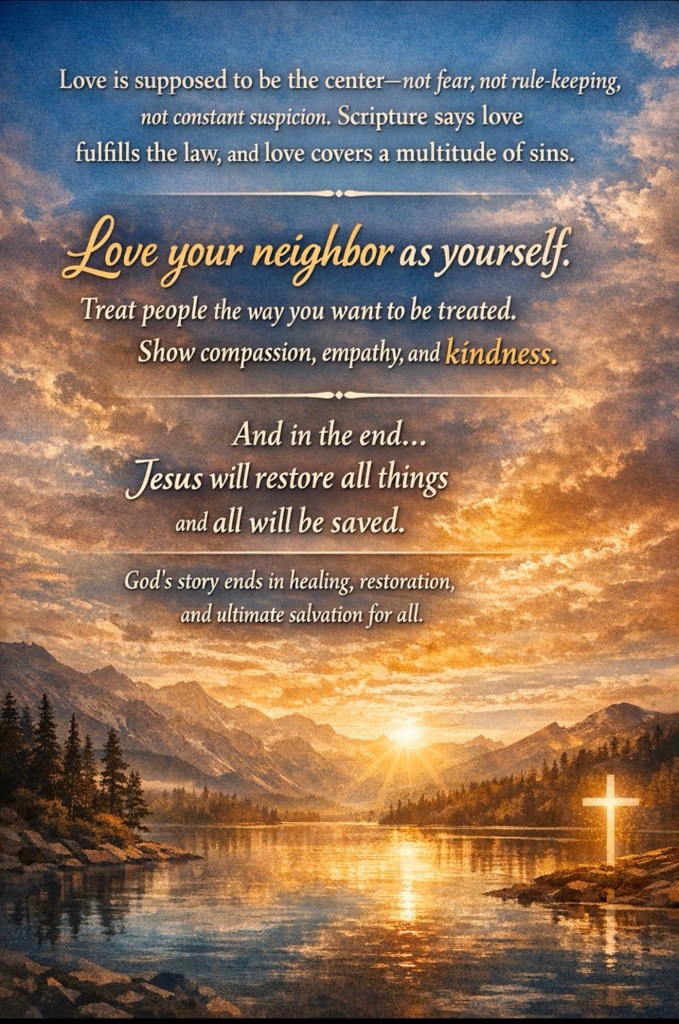
Love is supposed to be the center—not fear, not rule-keeping, not constant suspicion. Scripture says love fulfills the law, and that love covers a multitude of sins. If I’m trying to follow Jesus, the clearest path isn’t obsessing over a shifting “sin list”—it’s living what He taught: love your neighbor as yourself, treat people the way you want to be treated, and choose compassion over condemnation. Love looks like empathy when someone is hurting, understanding when someone’s different, patience when someone’s struggling, and kindness when it would be easier to judge. It’s being sympathetic instead of harsh, truthful without being cruel, and committed to doing no harm. And I believe Jesus’ mission is bigger than fear-based religion: He came to reconcile and restore all things in the end—so God’s story doesn’t end in eternal loss, but in healing, restoration, and ultimate salvation for all.
 Agape Freedom Community
Leave a comment