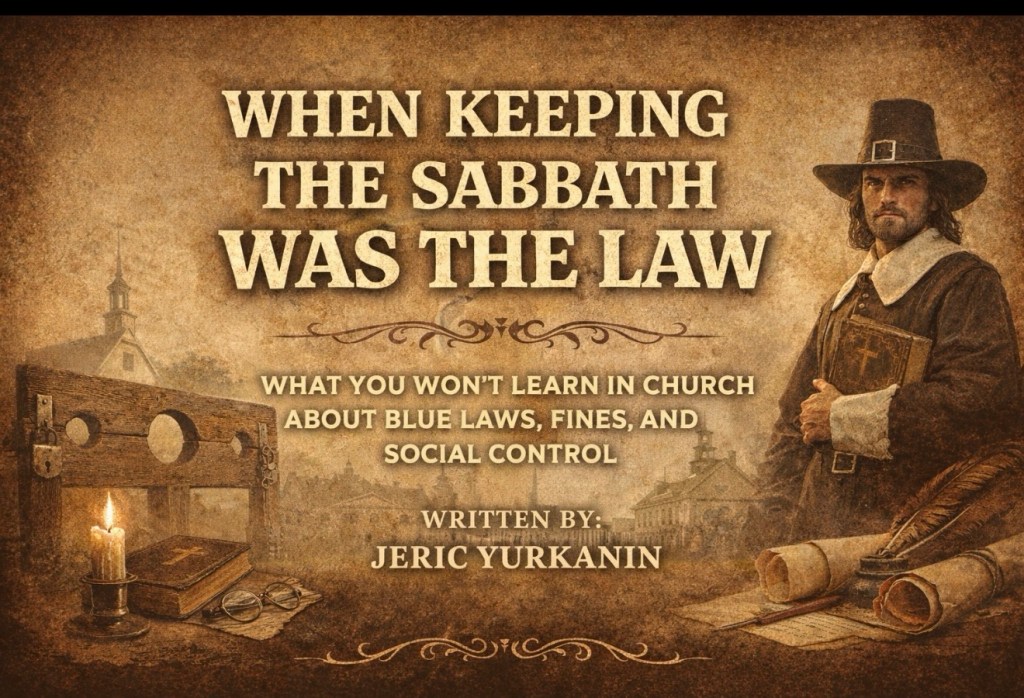
There was a time in America when “keeping the Sabbath” wasn’t a personal choice — it was enforced like a town rule. Constables. Courts. Fines. Even the stocks.
WRITTEN BY: JERIC YURKANIN
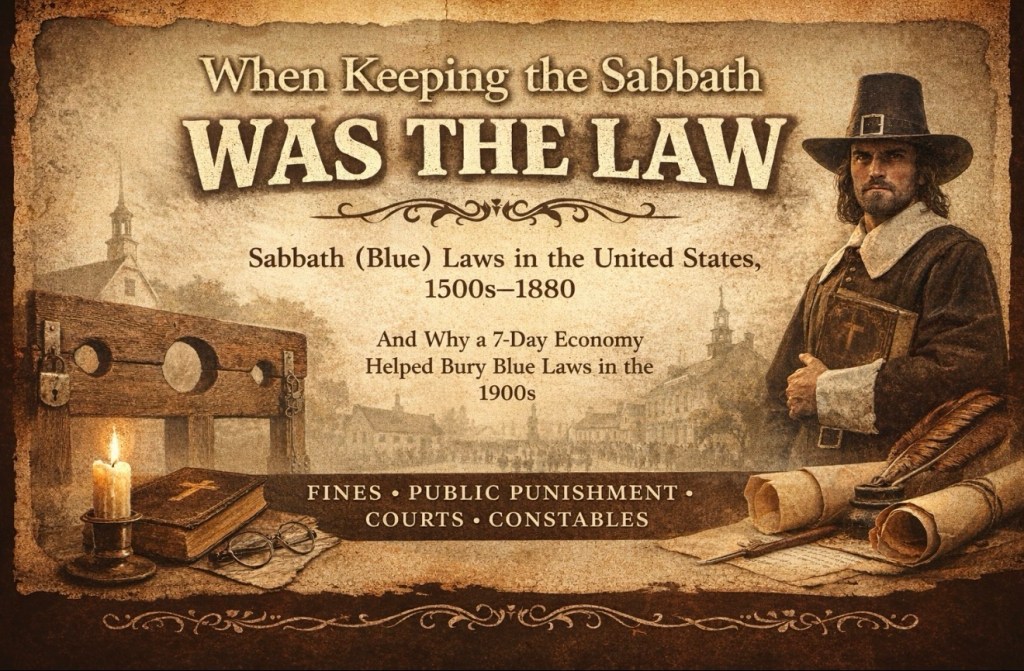
Sunday laws didn’t fade because everyone suddenly got “less holy.” They faded because a 7-day economy makes more money — and corporate/retail pressure created so many loopholes that the laws eventually became a messy patchwork.
Here’s the full breakdown (1500s–1880 + why it unraveled in the 1900s). 👇
When “Keeping the Sabbath” Was the Law
Sabbath Laws (“Blue Laws”) in what became the United States (1500s–1880) — and how business culture helped bury them in the 1900s
Most people today think of “Sabbath” as a church word. A spiritual practice. A personal conviction.
But for a big stretch of American history, it was something else:
It was government policy — enforced locally the same way towns enforced “no fighting,” “pay your taxes,” or “keep public order.”
And yes, depending on the place and time, you could be fined, publicly punished (stocks), or even spend a short time in jail.
Why Sunday became a “law” in the first place
When people talk about “Sabbath laws” in American history, they usually mean Sunday observance rules — laws that treated Sunday as a protected day for worship, rest, and public order.
These rules weren’t enforced only by churches. In many places they were enforced by town officers, constables, and local courts.
And that’s the key: from the 1600s through the 1800s, Sunday law wasn’t only about private belief. It was also about controlling community behavior:
• keeping people in the meetinghouse
• limiting public drinking, travel, entertainment, and “disorder”
• signaling what kind of society authorities wanted
So “Sabbath” wasn’t just preached. In many towns, it was policed.
The Modern Contradiction: “Sabbath Isn’t for Today”… Until It’s Time to Police Someone Else
Here’s where the conversation gets uncomfortable — and honestly, where a lot of people start waking up.
In many churches today, you’ll hear pastors say something like:
“The Sabbath isn’t for Christians anymore.”
“Jesus fulfilled it.”
“That was Old Covenant.”
“That command was for Israel, not the Church.”
And to be fair: there are Christian traditions that sincerely argue the Sabbath command is fulfilled in Christ, or that Sunday worship replaced Sabbath as a practice, or that the principle is “rest,” not a literal day. You can debate that theology all day.
But here’s the thing that exposes the deeper issue:
Even when pastors say “Sabbath doesn’t apply,” history shows it was treated like it absolutely did.
For centuries in early America, Sabbath/Sunday rules weren’t just “a nice spiritual habit.” They were treated as serious public law — enforced by towns with fines and punishment. Whole communities built systems around it. Constables enforced it. Courts handled it. People got penalized for violating it.
So if Sabbath was “clearly obsolete,” why did Christian society keep enforcing it so aggressively for so long?
Because the real issue often isn’t theology. It’s selective morality.
The Bigger Pattern: Some laws get retired… others get weaponized
What a lot of people notice is this:
Pastors will dismiss Sabbath law as “not for today.” They’ll dismiss dietary laws (shellfish, mixed fabrics, etc.). They’ll dismiss countless other commands that would inconvenience modern life.
But then, with intense confidence, they’ll zero in on:
premarital sex LGBTQIA people existing openly gender roles who’s “pure” and who’s “sinful”
And suddenly the Old Testament becomes very relevant again — but only in the places where it can be used to control bodies, relationships, and identity.
That’s the double standard people are reacting to:
“Jesus did away with the Sabbath… but not the rules I want to enforce on you.”
Why this hits people so hard
Because it shows that “Biblical authority” often functions like a buffet:
Keep the verses that support your culture. Drop the ones that don’t. Then call it “God’s truth” when you enforce it on others.
Meanwhile, the same pastors who say “Sabbath isn’t required” will shame someone’s sexuality or identity as if that’s the hill Christianity must die on — even though the Bible contains thousands of commands, regulations, and ethical instructions that rarely get preached with the same intensity.
And here’s the punchline:
The church often says “we’re not under law” — until it wants to put someone else under law.
What this reveals (and why it matters)
Historically, Sabbath laws show how religion can become policy — enforced by power structures.
Modern selective preaching shows how religion can become a spotlight — pointed at certain people while ignoring everything else.
That’s why so many people don’t feel like they’re hearing “good news.” They feel like they’re hearing control dressed up as holiness.
And for many LGBTQIA people (and anyone raised under purity culture), it’s not just theology — it’s lived experience:
shame fear exclusion being treated like a political issue instead of a human being
A simple question that cuts through the noise
If pastors are going to say, “Jesus fulfilled the law, we’re not under Sabbath commands,” then consistency matters:
Why is the default response compassion and “context” for the laws we don’t want to follow… but condemnation and certainty for the people we want to police?
That’s not spiritual maturity. That’s selective enforcement.
And people are noticing.
 Ancient Echoes Podcast
Leave a comment