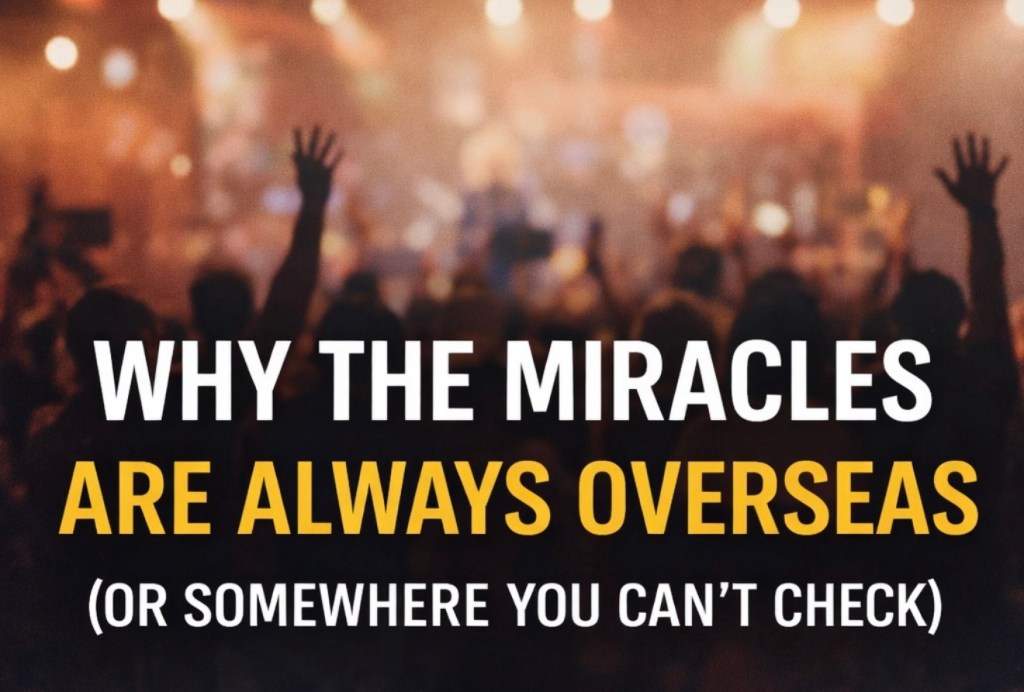
BY REV. JERIC YURKANIN
By someone who’s been in the room, heard the hype, and finally started asking the questions
I’ve been there.
I’ve sat under the teaching.
I’ve watched the performances.
And I’ve known pastors — personally — who claimed they healed someone overseas through prayer.
I knew they were lying.
Think about it for a moment.
If people were actually being healed — blind eyes opened, cancer erased, terminal illnesses reversed —
why aren’t those pastors running to the nearest American hospital and going room to room?
Why aren’t they walking into pediatric cancer units, hospice wings, or nursing homes, praying for those diagnosed with death?
You’d think people who claim to be God’s healing vessels would go where the suffering is undeniable and documented.
But they don’t.
Because they know what would happen next:
Hospitals require evidence. Records. Proof. Follow-up.
And they don’t have any.
Because they aren’t healing anyone.
Yet in ministry, telling stories is acceptable — even if they aren’t true. It’s to attract a crown, grow their church or a church and bring in the money.
Meanwhile, according to many of these same preachers, God is outraged over:
Being gay Watching porn Having sex before marriage
But lying from the pulpit?
Fabricating miracles in God’s name?
That’s fine, apparently.
Let’s not forget — according to their own Bible,
lying is called an abomination, and “all liars shall have their part in the lake of fire.”
I don’t believe in any hell anymore.
I now use the Bible as literature, metaphor, and context.
But by their own standards —
these miracle-peddlers are the ones violating their gospel.
Because at the end of the day, it’s all about who controls the story, who owns the platform, and who acts as the gatekeeper of “truth.” Jesus said freely you receive freely you give.
And for many, ministry isn’t about miracles.
It’s a business.
You’ve heard the stories a hundred times…
“I was preaching in Uganda, and a man who was blind from birth suddenly could see!”
“At a revival in rural Texas, a woman jumped out of her wheelchair and started dancing!”
The crowd gasps.
Hands go up.
Worship swells.
And right as emotions peak… the offering bucket goes around.
But something doesn’t sit right.
Because if you’ve been in church culture long enough, you start to notice:
The biggest miracles — the blind seeing, the dead raised, the legs regrown —
always happen somewhere else.
Usually in another country.
Sometimes in another state.
But never right here.
Never where you can verify it.
Never in front of the people actually suffering, sitting in the room.
And definitely not with medical records, clear video, or follow-up a year later.
1. Because Distance Protects the Claim
If a miracle happened 3,000 miles away — in a remote village with no names, no documentation, and no way to follow up —
you can’t verify it.
You can’t interview the person. You can’t check medical scans. You can’t confirm the story ever happened.
It’s the perfect setting for spiritual storytelling.
No accountability.
No paper trail.
No risk.
Just an emotional high dressed up in holy language.
And in many churches, that’s exactly the point.
2. Because Power Is Measured by Performance
In many charismatic and evangelical circles, leaders are taught — directly or indirectly — that:
Miracles prove spiritual authority Spectacle confirms divine favor Doubt is disobedience Questions are rebellion Asking for evidence “quenches the Spirit”
So instead of praying for the chronically ill woman sitting in the third row every Sunday,
they tell dramatic stories from crusades, conferences, or revivals “far away.”
Why?
Because silence — when the miracle doesn’t come — is terrifying.
And silence doesn’t sell books.
Silence isn’t good business and doesn’t bring in more money.
So the stories get recycled.
Exaggerated.
Migrated.
From across oceans to the microphone,
from pulpits to podcasts and from fiction to “faith.”
3. Because the Feeling Matters More Than the Truth
In emotionally hyped worship services:
People are desperate for hope They’ve been taught to suppress doubt They want so badly to believe
And pastors — knowingly or not — exploit that vulnerability.
They repeat secondhand stories.
They spiritualize lack of proof.
They declare what they cannot verify.
Because the story doesn’t need to be true —
It just needs to be felt.
And in the moment, surrounded by raised hands, fog machines, and music,
it’s easier to cry than to question.
4. Meanwhile, Back in the Real World…
While miracle stories are told from distant stages, here’s what’s happening in real life:
Chronically ill believers are told to “believe harder” Parents of sick children are guilted into giving more People with disabilities are blamed for “lacking faith” When nothing happens, the failure is never on the system — it’s on the sufferer
That’s not faith.
That’s manipulation.
Wrapped in scripture.
Backed by power.
Felt as shame.
And it’s everywhere.
5. So Where Are the Real Miracles?
If they exist, they don’t need:
A spotlight A stadium A sermon A passport Or a staged testimony.
Real healing happens:
In trauma survivors finding their voice In people walking away from religious shame In recovering addicts rebuilding their lives In exhausted souls choosing love over fear In those finally saying: “No more guilt. I’m choosing truth.”
That’s sacred.
That’s human.
That’s enough.
Final Word:
If supernatural power is real,
it should show up where people are actually hurting and in hospitals or just where the audience is already gullible— not just in stories no one can check.
If healing is real,
it shouldn’t require hype, fog, and applause.
And if God exists,
they aren’t impressed by emotional manipulation and miracle marketing.
They’re found in truth.
In integrity.
In compassion.
Not in lies that grow a brand.
Me personally I don’t believe these miracle are real.
 Agape Freedom Community
Leave a comment