• By: Jeric Yurkanin

    As a former evangelical, born-again Christian who is now agnostic, I often hear people ask, “What does the Bible actually say?” Having spent many years studying Scripture, I know the Bible very well. I respect sincere personal faith, and I have no problem with someone quietly living according to their beliefs. Someone like Clemson football coach Dabo Swinney represents the kind of personal faith I can appreciate. His faith appears to guide his own life rather than being used to control everyone else’s.

    What concerns me is not personal faith.

    It is when religion becomes intertwined with institutional power, politics, and control.

    History repeatedly shows that religion can be used to unite communities and inspire acts of compassion, but it has also been used by governments, political movements, and religious leaders to justify slavery, segregation, wars, persecution, discrimination, and the accumulation of wealth and influence. Those patterns are not unique to Christianity—they have appeared across many religions and civilizations throughout history.

    One question continued to bother me as I studied the Bible more deeply:

    If the Bible contains over 1,000 commands and well over 100 specifically named sins, why do so many churches repeatedly emphasize only a small number of them?

    Most people can quickly name a few sins that churches frequently preach about. But far fewer realize just how much the Bible actually commands.

    The Bible addresses nearly every area of human life.

    It commands people to worship only God, reject idols, love God, trust Him, pray, give thanks, praise Him, honor the Sabbath, repent, believe, and be baptized. It warns against idolatry, blasphemy, false prophecy, sorcery, divination, and taking God’s name in vain.

    It commands husbands and wives to remain faithful, children to honor their parents, families to care for widows and respect elders. It condemns adultery, incest, neglect of parents, and other violations of family relationships.

    It teaches sexual faithfulness and warns against adultery, prostitution, lust, sexual immorality, rape, incest, bestiality, and other prohibited sexual behaviors. Different Christian traditions interpret and apply some passages differently, particularly those concerning homosexual acts.

    It commands believers to love their neighbors, love their enemies, forgive, show mercy, live peacefully, encourage one another, and bear one another’s burdens. Yet it condemns hatred, bitterness, revenge, violence, gossip, slander, malice, division, and unforgiveness.

    The Bible repeatedly commands honesty. It tells people to tell the truth, keep promises, and conduct business fairly. It condemns lying, fraud, deception, bribery, cheating, false witness, and perjury.

    One of Jesus’ greatest emphases was wealth and compassion for those in need.

    Scripture repeatedly commands generosity, caring for the poor, helping those in need, treating workers fairly, and storing treasures in heaven rather than accumulating earthly wealth. At the same time, it repeatedly condemns greed, covetousness, the love of money, stealing, robbery, extortion, exploiting the poor, and withholding wages.

    The Bible also commands justice. It tells believers to defend the oppressed, care for widows and orphans, welcome foreigners, judge fairly, and pursue justice. It condemns oppression, corruption, injustice, partiality, murder, kidnapping, and perverting justice.

    It even speaks about everyday speech. Christians are instructed to speak truthfully, build others up, and avoid corrupt speech. Gossip, slander, boasting, coarse joking, false teaching, and harmful words are repeatedly condemned.

    Personal character receives enormous attention as well. Scripture encourages humility, holiness, self-control, contentment, thankfulness, perseverance, and joy while warning against pride, arrogance, envy, jealousy, wrath, laziness, gluttony, drunkenness, and selfish ambition.

    The New Testament also gives commands to churches themselves. Christians are told to gather together, serve one another, use their spiritual gifts, make disciples, pray for one another, and gently restore those who fall into sin. Churches are warned against hypocrisy, false teaching, division, neglecting fellowship, and seeking positions of honor.

    The Old Testament contains hundreds of additional civil, criminal, dietary, ceremonial, agricultural, and religious laws that governed ancient Israel, including commands about murder, theft, property, sacrifices, festivals, clean and unclean foods, the Sabbath year, and the Year of Jubilee. Jewish tradition counts 613 commandments within the Torah alone.

    Across the entire Bible there are more than 1,000 commands and well over 100 specifically named sins, depending on how repeated commands are counted.

    Yet Jesus summarized the entire law with just two commandments:

    Love the Lord your God with all your heart, soul, mind, and strength.

    Love your neighbor as yourself.

    He said that all the Law and the Prophets hang on those two principles.

    As I eventually questioned my own beliefs and became agnostic, I did not lose my respect for people whose faith genuinely motivates kindness, humility, generosity, and service. What I became skeptical of were religious institutions—or political movements—that claim to possess absolute certainty while emphasizing only selected parts of Scripture that reinforce their own priorities.

    Throughout history, politicians have often appealed to religion to rally supporters, gain legitimacy, and strengthen their authority. Religious leaders, too, have sometimes aligned themselves with political power. When that happens, faith can become intertwined with identity, loyalty, and influence in ways that make questioning leaders feel like questioning God. History suggests that this combination of religion and political power deserves careful scrutiny.

    Whether someone is Christian, agnostic, atheist, or follows another faith, I believe the same principle should apply:

    If we are going to claim the Bible is our moral authority, we should be honest about everything it teaches—not only the verses that support our existing beliefs or political preferences.

    That is not an argument against faith.

    It is an argument for intellectual honesty.

  • By: Jeric Yurkanin

    The Fourth of July celebrates freedom.

    But for Native American nations, the rise of America often meant something very different.

    It meant broken treaties.

    It meant stolen land.

    It meant soldiers, settlers, politicians, missionaries, forced removals, boarding schools, and a government that kept finding new ways to say: Your land is ours now.

    Long before Europeans arrived, North America was not empty. It was not waiting to be “discovered.” It was filled with Native nations, languages, governments, trade systems, farms, villages, spiritual traditions, and cultures that had existed for thousands of years.

    But European colonization brought disease, warfare, land seizure, and a worldview that often treated Native people as obstacles instead of human beings.

    That mindset became even stronger in the 1800s under an idea called Manifest Destiny — the belief that the United States was destined, and often understood as divinely chosen, to spread across North America. The National Museum of the American Indian describes Manifest Destiny as the idea that all of North America would inevitably belong to the United States. (National Museum of the American Indian⁠)

    That word “destiny” matters.

    Because when people believe God gave them land, they stop seeing theft as theft.

    They call it blessing.

    They call it progress.

    They call it civilization.

    They call it America.

    In 1830, Congress passed the Indian Removal Act. The law gave the president power to negotiate removal treaties with Native nations east of the Mississippi River. In reality, it helped force Native peoples away from ancestral homelands so white settlers could take the land. (Research Guides⁠)

    The Trail of Tears became one of the most shameful chapters in American history. In 1838, the United States government forcibly removed more than 16,000 Cherokee people from their homelands in Tennessee, Alabama, North Carolina, and Georgia to Indian Territory, now Oklahoma. Hundreds died on the journey, and thousands more died from the consequences of removal. (National Park Service⁠)

    But the Cherokee were not alone.

    The Choctaw, Muscogee Creek, Seminole, Chickasaw, and other Native nations were also pushed from their lands. The National Park Service notes that after the Indian Removal Act, many southeastern tribes were forced to give up their homelands in exchange for territory west of the Mississippi. (National Park Service⁠)

    This was not just policy.

    This was human suffering.

    Mothers walked with children.

    Elders were forced from homes they would never see again.

    Families buried loved ones along the road.

    And America kept moving west.

    Some white Christians saw this expansion as God’s blessing. Some missionaries believed Native people needed to be “civilized” by replacing their languages, traditions, and spiritual practices with white Christian culture. Some sincerely believed they were helping. Others were part of a system that erased Native identity while claiming to save Native souls.

    That is the tragedy.

    Religion was often wrapped around conquest.

    The cross traveled with the flag.

    The Bible traveled with the soldier.

    The sermon traveled with the land deed.

    And Native people paid the price.

    Later, the assault moved from land to children.

    For generations, Native children were taken from families and placed in boarding schools designed to erase their languages and cultures. The National Native American Boarding School Healing Coalition states there were more than 526 government-funded, often church-run Indian boarding schools across the United States during the 19th and 20th centuries. (Boarding School Healing⁠)

    Children were punished for speaking their own languages.

    Their hair was cut.

    Their names were changed.

    Their cultures were attacked.

    The goal was not just education.

    The goal was assimilation.

    America wanted Native land first.

    Then it wanted Native children remade in America’s image.

    This is why history hurts.

    Because the story of America is not only George Washington, Thomas Jefferson, fireworks, and freedom.

    It is also forced removal.

    It is also dead children in boarding schools.

    It is also treaties broken by the same government that claimed to value law.

    It is also white settlers believing God had blessed them with land that already belonged to someone else.

    That does not mean every Christian supported these things. Some missionaries and reformers defended Native rights. Some Christians opposed removal. Some Americans recognized the injustice even in their own time.

    But the larger system moved forward anyway.

    And that system was often defended with religious language.

    That is what makes this history so dangerous.

    When greed wears religion, it becomes harder to challenge.

    When conquest sounds like destiny, people stop asking who is being crushed.

    When a nation believes God is on its side, it can excuse almost anything.

    Manifest Destiny was not just expansion.

    It was a theology of possession.

    It taught many Americans to look at Native land and see opportunity instead of people.

    It taught settlers to see themselves as chosen and Native nations as temporary.

    It taught the country to confuse power with providence.

    And the consequences are still with us.

    Native nations are still here.

    Their cultures survived.

    Their languages survived.

    Their communities survived removal, warfare, boarding schools, broken treaties, and centuries of erasure.

    That survival is powerful.

    It is one of the most important truths America must face.

    Native people were not simply victims of history.

    They resisted.

    They rebuilt.

    They preserved.

    They endured.

    And they are still here.

    So on the Fourth of July, when America celebrates independence, we should also remember the people whose independence was taken.

    The people whose homelands were invaded.

    The people whose treaties were broken.

    The people whose children were taken.

    The people who were told that their suffering was part of God’s plan for America.

    That was not God.

    That was empire.

    That was greed.

    That was racism.

    That was America refusing to see Native people as fully human.

    A better country does not hide that truth.

    A better country tells it.

    Because fireworks are not enough.

    Flags are not enough.

    Patriotic songs are not enough.

    If America wants to celebrate freedom, it must also remember the people it denied freedom to.

    It must remember the Native nations who were here first.

    It must remember that land is not holy just because powerful people claim God gave it to them.

    It must remember that progress built on stolen land is not innocent.

    And it must finally be honest enough to say:

    Manifest Destiny was not destiny.

    It was conquest.

  • By Jeric Yurkanin

    Every Fourth of July, Americans gather beneath brilliant fireworks, wave flags, sing patriotic songs, and celebrate the birth of the United States.

    It is a day filled with pride, gratitude, family traditions, and remembrance.

    For many Americans, it represents the beginning of freedom.

    But every nation has more than one story.

    The United States is no exception.

    Alongside the remarkable achievements that deserve recognition are chapters of history that are painful to read, difficult to discuss, and impossible to erase. They are not separate from the American story—they are part of it.

    Some believe that discussing these chapters on Independence Day diminishes patriotism.

    I believe the opposite.

    I believe remembering America’s hardest truths is one of the deepest forms of patriotism.

    Real patriotism is not pretending a nation has always been right.

    It is loving a country enough to expect it to live up to its highest ideals.

    America’s founding documents expressed extraordinary principles. The Declaration of Independence proclaimed that all people are created equal and possess inherent rights. Those ideals have inspired democratic movements around the world.

    Yet at the same time those words were written, slavery continued. Native American nations faced displacement from their ancestral lands through warfare, forced removal, and broken treaties. Women lacked many legal and political rights. For generations, many Americans were excluded from the freedoms the nation celebrated.

    As American history continued, new groups found themselves fighting for equal dignity and protection under the law.

    African Americans struggled through slavery, segregation, voter suppression, and racial violence before achieving major civil rights victories.

    Women fought for the right to vote, own property, pursue careers, and participate equally in public life.

    Native American communities fought to preserve their lands, cultures, languages, and sovereignty despite centuries of displacement and forced assimilation.

    During the twentieth century, LGBTQ Americans also faced widespread discrimination. In many states, same-sex relationships were criminalized. Many people lost jobs, housing, military careers, or family relationships because of their sexual orientation or gender identity. Some churches welcomed LGBTQ people, while others rejected them or taught that they should be excluded from full participation in church life. Over time, LGBTQ Americans and their allies organized for legal protections, equal treatment, and greater social acceptance, while religious communities continued to hold differing theological views about sexuality and marriage.

    These histories are different.

    Each has its own context.

    Yet they share something important in common.

    They remind us that America’s promise of liberty has often expanded because ordinary people challenged injustice and asked the nation to become more consistent with its own ideals.

    Throughout our history, people have challenged the nation to become better.

    Abolitionists confronted slavery.

    Women’s rights advocates challenged legal inequality.

    Labor organizers fought for safer working conditions.

    Civil rights activists demanded equal treatment under the law.

    Many Native American leaders defended their nations, cultures, and treaty rights.

    LGBTQ Americans advocated for equal protection, recognition, and the freedom to live openly without fear of criminalization or discrimination.

    Countless ordinary citizens worked quietly within their own communities to expand opportunity, justice, and compassion.

    Their efforts helped shape the America we know today.

    The country’s greatest moments have often come when people refused to accept injustice as inevitable.

    Remembering those struggles should not weaken our appreciation for America.

    It should deepen it.

    Because progress did not happen automatically.

    It happened because people believed this country could be better than it was.

    History also reminds us to be humble.

    Every generation tends to believe it has solved the moral failures of the past.

    Yet future generations often recognize blind spots that earlier Americans failed to see.

    Learning history is not about assigning collective guilt.

    It is about understanding how decisions, beliefs, institutions, and laws affected real people.

    It helps us celebrate genuine progress while recognizing where improvement is still needed.

    For me, Independence Day is not only a celebration.

    It is also a day of reflection.

    I think about those whose voices were overlooked.

    I think about those whose freedoms arrived later than others.

    I think about the Americans who challenged injustice, often at great personal cost, because they believed the nation’s highest ideals were worth fighting for.

    That reflection does not lessen my respect for America.

    It strengthens it.

    Because my respect is rooted not in the belief that America has always been perfect, but in the belief that America has repeatedly shown the capacity to confront injustice, expand liberty, and continue growing.

    Patriotism does not require forgetting difficult history.

    It requires the courage to remember it.

    As America moves beyond its 250th anniversary, I hope we tell a fuller national story—one that celebrates remarkable achievements while also acknowledging painful chapters with honesty.

    A mature nation should be able to hold both truths at the same time.

    It can celebrate freedom while remembering those who fought to extend it.

    It can honor its founders while recognizing their imperfections.

    It can take pride in its progress while remaining committed to doing better.

    That, to me, is not a rejection of America.

    It is an expression of hope.

    Hope that the nation’s highest ideals continue to inspire each new generation.

    Hope that liberty becomes more inclusive with time.

    Hope that honesty and patriotism can stand side by side.

    Because remembering America’s hardest truths is not the opposite of loving this country.

    Sometimes, it is one of the clearest ways to show that you do.

  • By Jeric Yurkanin

    Every year on the Fourth of July, fireworks fill the night sky. Families gather for cookouts. American flags wave from front porches, and millions celebrate freedom, liberty, and independence.

    It is a day that tells one story of America.

    But there is another story.

    It is the story of people who were never invited to the celebration.

    It is the story of enslaved Africans who remained in chains while the Founding Fathers declared that “all men are created equal.”

    It is the story of Native American nations who watched settlers move farther west onto lands their families had lived on for thousands of years.

    It is the story of Black Americans who, after slavery ended, endured nearly another century of legalized segregation.

    It is the story of churches that courageously opposed these injustices—but also churches, pastors, theologians, and religious institutions that defended them.

    History is rarely simple.

    America has produced extraordinary ideas about liberty, democracy, and human rights. It has also committed terrible injustices while claiming those same ideals. Loving a country should never require ignoring its failures. If anything, loving a country means being honest enough to confront them.

    Freedom for Some

    On July 4, 1776, the Continental Congress adopted the Declaration of Independence.

    Its most famous words remain among the greatest political statements ever written:

    “We hold these truths to be self-evident, that all men are created equal…”

    Yet for hundreds of thousands of enslaved Africans living in the colonies, those words did not apply.

    Many of the nation’s founders spoke passionately about liberty while simultaneously participating in a system of human bondage. Several owned enslaved people. Others criticized slavery while continuing to benefit from it.

    The contradiction was impossible to ignore.

    How could a nation proclaim freedom while denying it to so many?

    That contradiction would define American history for generations.

    The Growth of Slavery

    The first enslaved Africans arrived in English Virginia in 1619.

    Over the next two centuries, slavery expanded into one of the largest economic systems in North America.

    Millions of African men, women, and children were captured, sold, transported across the Atlantic under horrific conditions, and treated as property.

    Families were separated.

    Children were sold.

    Women were abused.

    Human beings were bought and sold at auctions.

    Their labor built enormous wealth through tobacco, rice, sugar, and eventually cotton.

    By the mid-1800s, slavery had become deeply intertwined with the Southern economy.

    When Christianity Was Used to Defend Slavery

    One of the darkest chapters in American religious history is not that Christians owned slaves.

    It is that many sincerely believed God approved of slavery.

    Throughout the eighteenth and nineteenth centuries, numerous white pastors, theologians, church leaders, and Christian colleges argued that slavery was ordained by God.

    They pointed to biblical passages where slavery existed in the ancient world.

    They quoted verses telling servants to obey masters.

    Some claimed Abraham owned servants.

    Others argued that Jesus never explicitly condemned slavery.

    Perhaps the most infamous interpretation involved the so-called “Curse of Ham.”

    Although the biblical text actually speaks of Noah cursing Canaan—not Ham—and never mentions Black people, generations of theologians falsely connected this story to Africans.

    That interpretation became one of the most influential religious justifications for slavery in American history.

    It was bad theology.

    It was historically unsupported.

    Yet it shaped sermons, denominational statements, books, and public opinion for generations.

    The Bible was being used to defend an institution that treated people created in God’s image as property.

    Christians Who Said “No”

    That is not the entire story.

    Many Christians fiercely opposed slavery.

    Quakers condemned it.

    Black churches became centers of resistance.

    Abolitionists such as Frederick Douglass challenged churches that preached obedience instead of justice.

    Harriet Tubman repeatedly risked her life to lead enslaved people to freedom.

    Many ministers argued that the central message of Jesus—loving your neighbor—was incompatible with human bondage.

    The Bible became both a weapon used to defend slavery and a source of hope for those fighting against it.

    History contains both truths.

    The Civil War Changed the Law—Not Hearts

    The Civil War ended legal slavery.

    But racism did not disappear.

    After Reconstruction, Southern states enacted Jim Crow laws that enforced segregation in schools, transportation, restaurants, neighborhoods, and voting.

    Black Americans often faced intimidation, violence, lynching, and systemic discrimination.

    Many churches remained segregated.

    Some pastors openly defended segregation from their pulpits.

    Religious Defenses of Segregation

    Just as slavery had once been defended with Scripture, segregation also found defenders within parts of American Christianity.

    Bob Jones Sr. argued that racial segregation reflected God’s design.

    Later, Bob Jones University maintained policies prohibiting interracial dating for decades.

    Jerry Falwell Sr., during the early years of his ministry, opposed federal civil rights efforts and preached that God intended racial separation, though he later acknowledged that many of his earlier positions had been wrong.

    These views were not shared by every Christian.

    Many pastors marched alongside Martin Luther King Jr.

    Others opened their churches to integration.

    Black churches became the backbone of the Civil Rights Movement.

    But history requires acknowledging that many white churches resisted equality.

    Native America Before Colonization

    Long before Europeans arrived, North America was home to hundreds of Indigenous nations.

    They possessed sophisticated governments, trade networks, agricultural systems, languages, cultures, and spiritual traditions.

    These civilizations were not empty wilderness waiting to be discovered.

    They were thriving societies.

    European settlement changed everything.

    Disease devastated Indigenous populations.

    Wars erupted.

    Treaties were repeatedly broken.

    Communities were displaced.

    Entire nations were forced from ancestral lands.

    Manifest Destiny

    During the nineteenth century, many Americans embraced an idea later known as Manifest Destiny.

    Supporters believed the United States was destined—some argued divinely destined—to expand from the Atlantic Ocean to the Pacific.

    Many believed expansion represented God’s blessing upon the nation.

    This belief encouraged westward settlement.

    It also contributed to the removal of Native nations from lands that settlers wanted.

    The result was enormous human suffering.

    The Trail of Tears became one of the most tragic examples, as thousands of Cherokee people and members of other southeastern tribes were forced west under brutal conditions. Thousands died along the journey.

    Faith and Expansion

    Religion often accompanied expansion.

    Some missionaries sincerely cared for Indigenous communities.

    Others believed Native cultures should be replaced with European customs and Christianity.

    Some government leaders and settlers interpreted territorial expansion as evidence of divine approval.

    Others challenged those ideas and defended Native rights.

    History was complicated.

    Faith inspired both compassion and conquest.

    Learning From History

    The Fourth of July should remain a celebration of America’s ideals.

    But ideals become meaningful only when they are honestly measured against reality.

    America has achieved remarkable progress.

    Slavery ended.

    Segregation became illegal.

    Voting rights expanded.

    Many churches publicly repented of their earlier support for racism.

    Yet remembering those victories requires remembering what had to be overcome.

    Ignoring history does not honor America.

    Learning from history does.

    A Better Patriotism

    Real patriotism is not pretending our country has always been right.

    Real patriotism is believing our nation can become better.

    It is celebrating freedom while acknowledging those who were denied it.

    It is honoring the courage of abolitionists alongside the Founders.

    It is remembering enslaved families as well as presidents.

    It is remembering Native nations alongside pioneers.

    It is remembering civil rights marchers alongside generals.

    History is not about choosing heroes or villains.

    It is about telling the truth.

    The Fourth of July reminds us of America’s greatest promise—that all people are created equal.

    For much of our history, that promise remained unfulfilled.

    Generation after generation struggled to make those words real.

    The work is not finished.

    Perhaps the most meaningful way to celebrate Independence Day is not simply by watching fireworks, but by asking whether we are still striving to build a nation that lives up to its own ideals.

    Freedom is not only something to celebrate.

    It is something every generation must continue to pursue—for everyone.

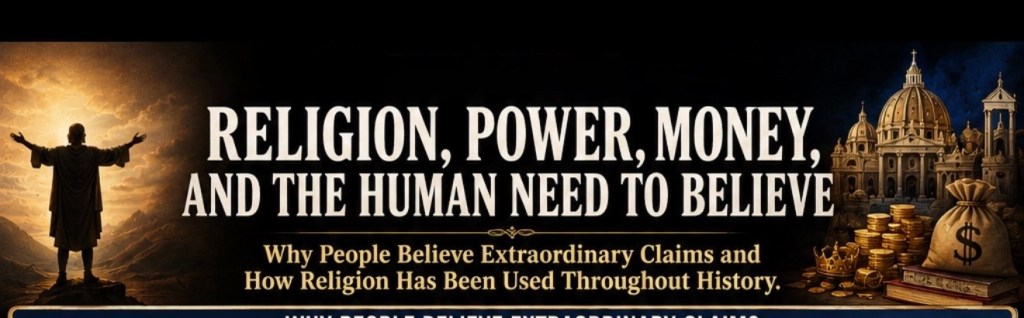
  • Throughout history, countless people have found hope, compassion, purpose, and meaning in the teachings of Jesus. Hospitals, orphanages, charities, abolition movements, civil rights efforts, disaster relief organizations, and humanitarian missions have often been inspired by faith. However, history also shows that when religious movements become closely tied to political power, nationalism, wealth, tribal identity, or the pursuit of control, the image of Jesus can become distorted.

    Many historians argue that one of the greatest dangers facing religion is not atheism, skepticism, or secularism, but the tendency of religious communities to reshape their founder into their own image. Every generation faces the temptation to create a version of Jesus that supports its existing beliefs, political loyalties, cultural prejudices, economic interests, or desire for power. When this happens, religion can become less about transformation and more about validation.

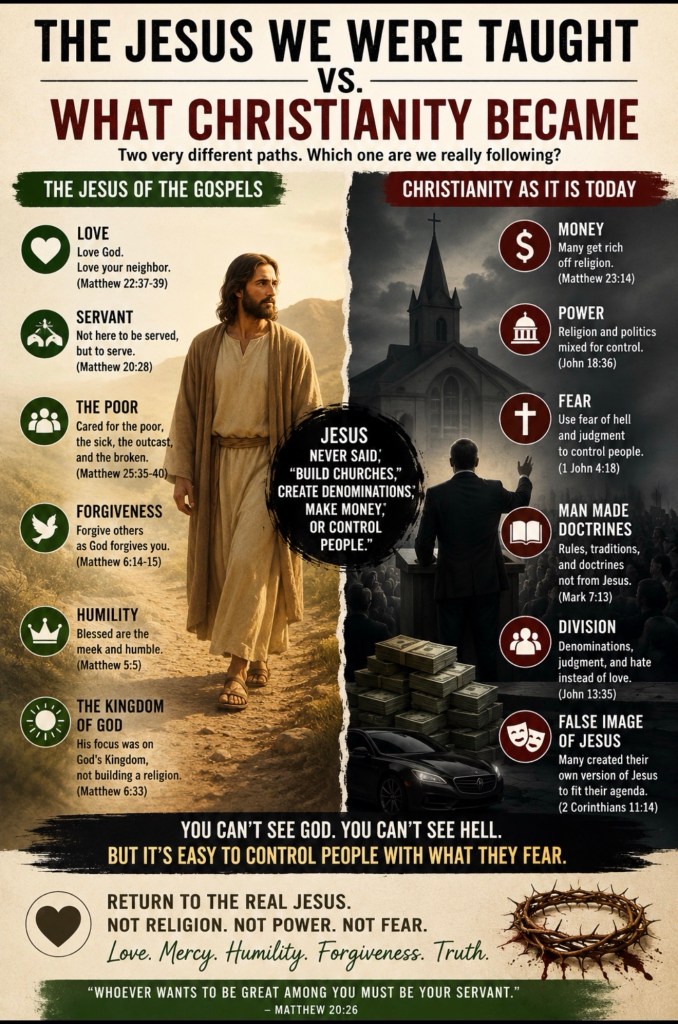
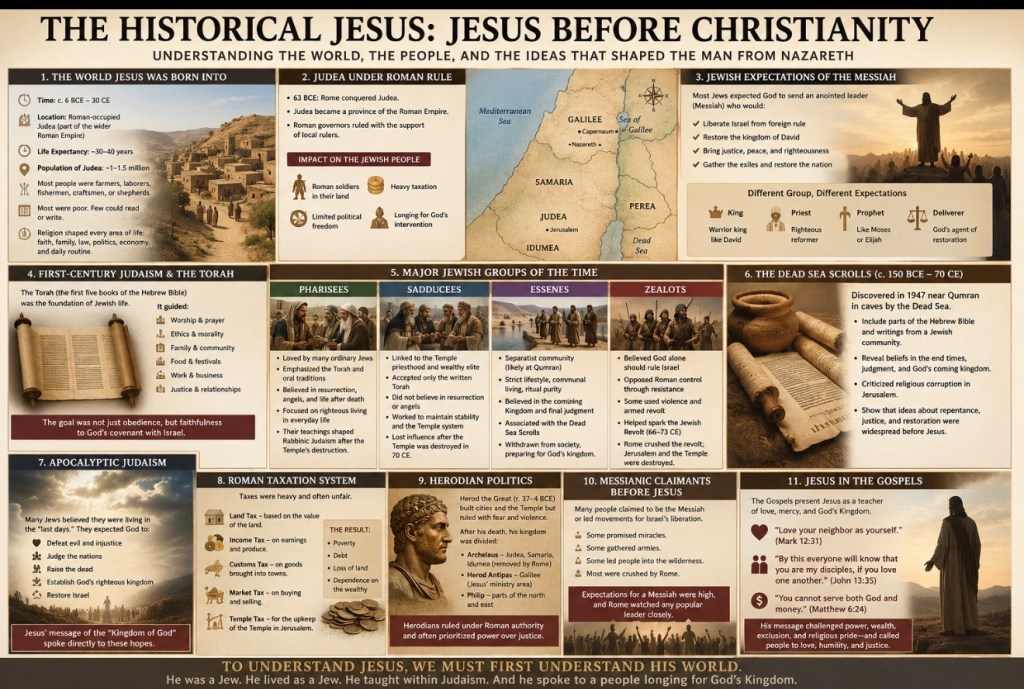
    The historical Jesus presented in the Gospels spent much of his time among the poor, the sick, widows, laborers, outsiders, and those rejected by society. He taught people to love their enemies, forgive those who harmed them, care for the hungry, welcome strangers, and show compassion toward the vulnerable. He warned repeatedly about greed, hypocrisy, religious pride, and the pursuit of status. He challenged both religious and political authorities when they neglected justice and mercy.

    Yet throughout history, many Christians have embraced versions of Jesus that seemed to prioritize power over compassion, tribal loyalty over human dignity, and religious identity over love of neighbor. When Christianity became connected to empire following Constantine, the church gained influence, stability, and resources. At the same time, some historians argue that Christianity increasingly became entangled with political authority. The faith of a man executed by the state gradually became associated with states themselves.

    This does not mean Constantine ruined Christianity or that everything after the fourth century was negative. The church preserved knowledge, built hospitals, founded universities, cared for the poor, and inspired countless acts of kindness. However, the alliance between church and empire also created new dangers. Religious disagreements could become political conflicts. Political conflicts could become religious wars. Loyalty to institutions sometimes overshadowed loyalty to the ethical teachings found in the Gospels.

    Throughout European history, religious divisions contributed to wars, persecutions, forced conversions, inquisitions, and violence. Catholics and Protestants fought one another. Governments sometimes punished dissenters. Religious identity became intertwined with political allegiance. In many cases, people who followed the same Jesus viewed one another as enemies.

    Colonization provides another example. Some missionaries sincerely sought to help Indigenous peoples, learn their languages, and defend them from exploitation. Others participated in systems that displaced native populations and undermined traditional cultures. Christianity was sometimes used to justify conquest and expansion, even though the teachings of Jesus emphasized humility and service rather than domination.

    The history of slavery reveals perhaps one of the clearest examples of how religion can be distorted. Many slaveholders considered themselves devout Christians. They attended church, quoted scripture, and viewed themselves as moral people. Yet they participated in a system that denied freedom and dignity to millions of human beings. Rather than allowing the teachings of Jesus to challenge slavery, many interpreted scripture in ways that defended it. The problem was not merely the existence of religious belief. It was the way that belief was interpreted and applied.

    The same pattern appeared during segregation. Churches often reflected the racial divisions of society. Some ministers defended racial separation using biblical language, while others fought for equality using the same scriptures. Again, the issue was not simply religion itself but how religious teachings were understood. Human beings often bring their own fears, biases, cultural assumptions, and political loyalties to the texts they read.

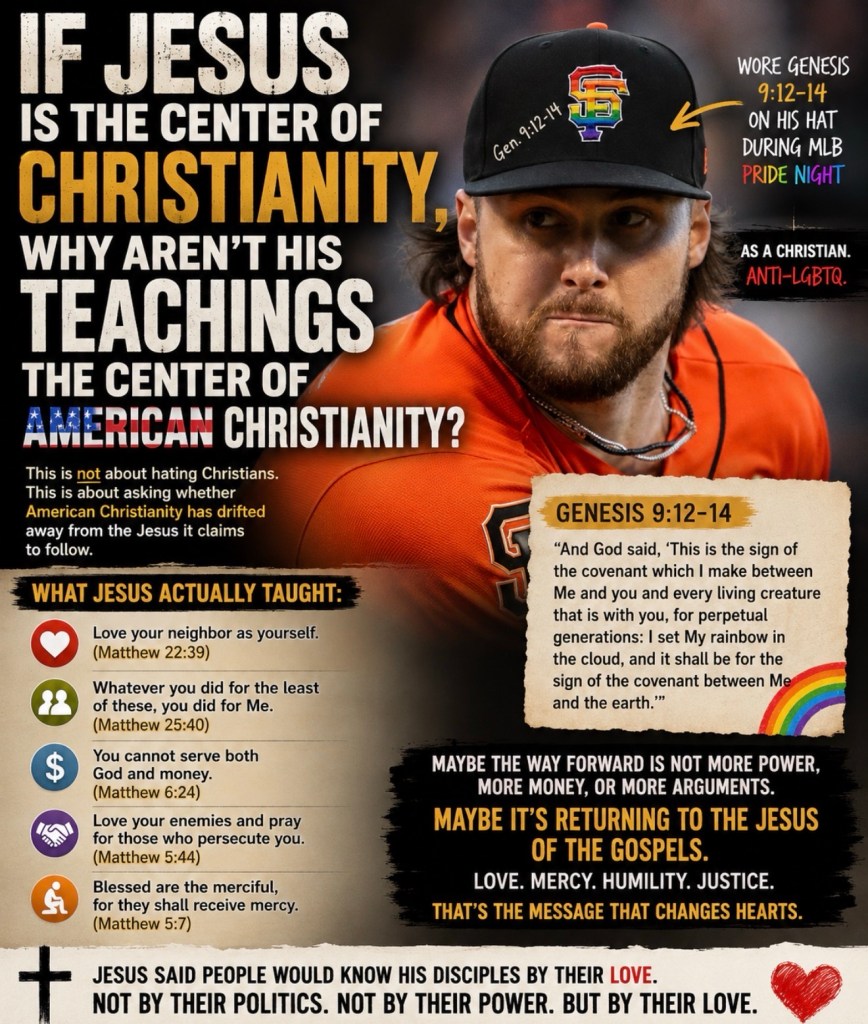
    In the modern world, similar concerns continue. Critics argue that some forms of Christianity have become more focused on culture wars, political influence, and ideological battles than on caring for the poor, welcoming outsiders, and serving vulnerable people. Some churches devote significant attention to controversial political issues while giving less attention to homelessness, poverty, hunger, healthcare, addiction, loneliness, or economic hardship. Others actively engage in social outreach and community support. The contrast highlights the diversity within Christianity itself.

    Family division can also occur when religious identity becomes intertwined with fear, certainty, or tribalism. Throughout history, people have sometimes cut off relationships, rejected family members, or treated loved ones as enemies because of theological disagreements. While many religious communities emphasize love and reconciliation, others have struggled with exclusion and judgment. When religious identity becomes more important than human relationships, division often follows.

    Historians frequently observe that the most destructive periods in religious history tend to occur when people become absolutely convinced that they alone possess truth and that everyone else is a threat. Such certainty can make dialogue difficult and compassion secondary. It can encourage an “us versus them” mentality that divides communities, nations, and even families. This tendency is not unique to Christianity; it appears in many ideologies, religions, and political movements throughout history.

    At the same time, it would be historically inaccurate to blame all wars, hatred, or social problems on Christianity. Human beings have fought wars for power, territory, resources, nationalism, ethnicity, ideology, and countless other reasons. Religious language is sometimes used to justify these conflicts, but the underlying causes are often more complex. Likewise, many Christians have dedicated their lives to peacebuilding, humanitarian work, civil rights, education, healthcare, and serving the poor.

    The deeper historical lesson may be that any belief system—religious or secular—can become harmful when it is used to justify power, suppress dissent, or dehumanize others. The question is not simply whether people believe something. It is how those beliefs shape their treatment of other human beings.

    Many scholars argue that the most reliable way to evaluate religious movements is not by their claims but by their fruits. Do they produce compassion or cruelty? Humility or arrogance? Generosity or greed? Reconciliation or division? Care for the vulnerable or neglect of those in need? These questions are relevant regardless of one’s religious beliefs.

    The tension between the historical Jesus and later interpretations of Jesus remains one of the most important conversations in religious history. The Jesus of the Gospels repeatedly emphasized love, mercy, forgiveness, humility, and concern for the marginalized. Whenever Christianity has embodied those values, it has often become a force for healing and hope. Whenever it has prioritized power, tribal identity, wealth, or domination, it has often contributed to division and harm.

    History suggests that the greatest danger is not necessarily religion itself but the human tendency to reshape religious teachings around our own desires, fears, and ambitions. The challenge facing every generation is to ask whether its understanding of faith promotes compassion, justice, and human dignity—or whether it serves other interests. That question remains as important today as it was two thousand years ago.

    When Christianity Becomes Power

    Part II: Fear, Tribalism, and the Creation of an “Us vs. Them” Faith

    One of the most significant criticisms raised by historians, former believers, and even many Christians themselves is that some forms of modern Christianity have drifted far from the values taught by Jesus in the Gospels. The concern is not that Christianity exists, but that certain versions of Christianity have become centered around fear, tribal identity, political power, and cultural dominance rather than compassion, humility, and service.

    The historical Jesus rarely divided the world into good people and bad people. Instead, he repeatedly challenged people to examine their own hearts. He criticized religious leaders who were quick to judge others while ignoring their own shortcomings. He taught that loving one’s neighbor included people from different backgrounds, beliefs, and cultures. He even taught people to love their enemies—one of the most radical teachings found anywhere in ancient literature.

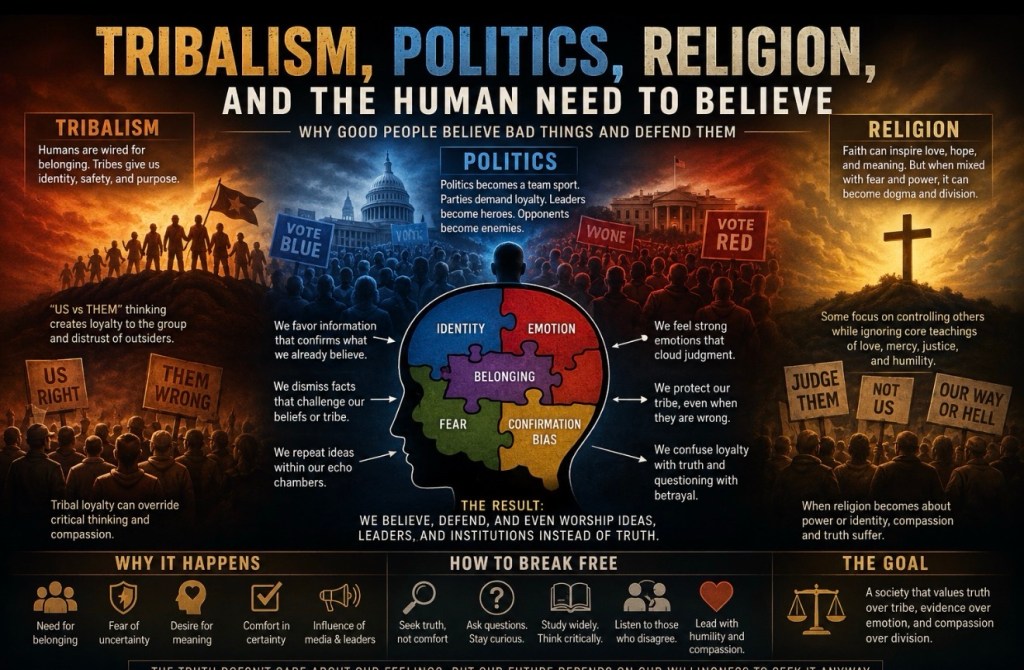
    Yet throughout history, religious institutions have often struggled with this teaching. Human beings naturally form tribes. We divide ourselves into groups. We create categories of “us” and “them.” We seek security in belonging. Religion can become part of that tribal identity. When it does, faith can sometimes shift from being about spiritual transformation to being about defending a group, culture, nation, denomination, or ideology.

    This pattern appears repeatedly throughout history. During the Crusades, Christians viewed Muslims as enemies. During the Reformation, Catholics and Protestants viewed one another as threats. During the era of slavery, many white Christians viewed Black people as inferior. During segregation, churches often mirrored racial divisions found in society. In each case, religious language was sometimes used to justify exclusion rather than challenge it.

    The problem is not unique to Christianity. It is a human tendency. People often use beliefs—whether religious, political, or ideological—to reinforce group identity. Once a group becomes convinced that it alone possesses truth, compassion for outsiders can diminish. Loyalty becomes more important than empathy. Certainty becomes more important than understanding.

    Modern media has amplified these tendencies. Social media algorithms often reward outrage, fear, and conflict. Religious content that generates strong emotional reactions spreads quickly. Messages about enemies, threats, conspiracies, and cultural decline often receive more attention than messages about compassion, patience, and humility. As a result, many people encounter versions of Christianity that seem focused primarily on fighting battles rather than serving others.

    Some critics argue that fear has become one of the most powerful tools within certain religious environments. Fear of hell. Fear of outsiders. Fear of other religions. Fear of social change. Fear of questioning authority. Fear can be an effective motivator, but it can also create anxiety, division, and hostility. When fear becomes central to religious identity, people often become defensive and suspicious of those who think differently.

    The teachings of Jesus frequently moved in the opposite direction. The Gospels repeatedly portray Jesus telling people not to be afraid. He encouraged trust, compassion, forgiveness, and generosity. His message often focused on liberation from fear rather than the cultivation of it. This contrast has led many scholars and former believers to ask whether some modern religious movements have become more fear-driven than Gospel-driven.

    Another consequence of tribal religion is the neglect of social responsibility. Throughout the Gospels, Jesus consistently focused attention on the poor, the hungry, the sick, the imprisoned, and the marginalized. According to Matthew 25, caring for vulnerable people was one of the clearest ways of demonstrating faithfulness. Yet critics often point out that some religious communities devote enormous energy to political disputes while giving comparatively little attention to poverty, homelessness, healthcare, hunger, and economic inequality.

    History shows that whenever religious movements become preoccupied with protecting power, they often lose sight of the vulnerable. This occurred in portions of the Medieval Church. It occurred in societies that defended slavery. It occurred during segregation. It continues to be a risk whenever institutions prioritize self-preservation over service.

    Family division is another consequence of extreme tribal thinking. Throughout history, people have been shunned, rejected, or alienated because they questioned beliefs, changed denominations, left religions, or adopted different worldviews. Parents have been separated from children. Siblings have stopped speaking to one another. Friendships have ended. While disagreement is a normal part of life, treating people as enemies because of differences often contradicts the principles of compassion and reconciliation emphasized by Jesus.

    Some former Christians describe feeling that they were loved only as long as they believed the right things. Once they questioned doctrine or expressed doubts, relationships changed. Whether these experiences are universal or not, they highlight an important concern: Is faith based on unconditional love, or is it based on conformity and agreement?

    The relationship between religion and politics creates additional challenges. When faith becomes closely tied to political identity, criticism of political leaders can feel like criticism of religion itself. Likewise, religious disagreement can become political conflict. This fusion makes it difficult to separate spiritual values from partisan loyalties. Historians often note that similar dynamics emerged whenever religion and political power became deeply intertwined.

    Perhaps the greatest danger is that people begin worshipping a version of Jesus created by their culture rather than the Jesus described in the earliest sources. Every generation faces this temptation. Americans may create an American Jesus. Europeans created a European Jesus. Political movements create political versions of Jesus. Nationalists create nationalist versions. Prosperity movements create wealthy versions. Each reflects the concerns of its culture.

    The historical Jesus remains difficult to control precisely because he challenges everyone. He challenged religious leaders. He challenged political authorities. He challenged the wealthy. He challenged the poor. He challenged insiders and outsiders alike. His teachings often resisted simple categorization. This makes him far more complex than the versions of Jesus often presented by modern ideologies.

    The history of Christianity demonstrates that religion can either expand compassion or narrow it. It can encourage people to see humanity as one family or divide humanity into competing tribes. It can motivate service or justify domination. It can promote humility or encourage arrogance. The difference often depends on which aspects of the tradition receive the greatest emphasis.

    Ultimately, the question is not whether religion exists, but what kind of religion people practice. Does it encourage empathy or hostility? Does it care for the vulnerable or ignore them? Does it build bridges or walls? Does it challenge prejudice or reinforce it? Does it inspire generosity or greed? These questions have shaped Christian history for two thousand years.

    The historical record suggests that whenever faith becomes centered on power, fear, tribal identity, or cultural dominance, it often contributes to division. When it becomes centered on compassion, humility, service, and human dignity, it often contributes to healing. The tension between these two paths remains one of the defining challenges facing Christianity—and humanity—as a whole.

  • Few chapters in American history reveal the power—and danger—of religious interpretation more clearly than the history of slavery and segregation. For centuries, Christians on both sides of these issues appealed to the Bible to support their positions. Some argued that scripture justified slavery, racial separation, and unequal treatment of people based on race. Others pointed to the teachings of Jesus, the prophets, and broader biblical themes of justice, compassion, and human dignity to condemn those same practices. The result is one of the most important and often uncomfortable stories in American religious history.

    When Europeans first established colonies in North America, slavery gradually became embedded within the economic and social systems of the colonies. By the seventeenth and eighteenth centuries, millions of Africans had been forcibly transported across the Atlantic Ocean through the transatlantic slave trade. Families were separated, cultures disrupted, and countless individuals subjected to brutal conditions. Yet many of the societies that practiced slavery also considered themselves deeply Christian. Churches were built throughout the colonies, ministers preached weekly sermons, and colonists frequently described themselves as followers of Jesus. This created a profound contradiction between the ideals many Christians claimed to uphold and the realities of slavery.

    Those who defended slavery often relied upon specific biblical passages. Some pointed to laws regarding slavery found in the Old Testament. Others cited references to servants and masters in the New Testament. One of the most commonly misused interpretations involved the so-called “Curse of Ham” found in the Book of Genesis. Although the biblical text never mentions race or African peoples, some interpreters falsely claimed that people of African descent were divinely destined for servitude. This interpretation became one of the most influential religious justifications for slavery in the Western world, despite lacking support from the actual biblical text.

    Supporters of slavery also pointed to passages in the letters of the Apostle Paul that instructed servants to obey their masters. They argued that because the New Testament did not explicitly call for the abolition of slavery, the institution itself must be acceptable. These interpretations were widely promoted in parts of the United States, particularly in the South before the Civil War. Ministers, theologians, and church leaders often preached sermons defending slavery as part of God’s plan for society.

    At the same time, many Christians strongly opposed slavery. Abolitionists frequently argued that slavery violated the fundamental message of the Gospel. They pointed to Jesus’ teachings about love, compassion, and treating others as one would wish to be treated. They emphasized passages such as Galatians 3:28, where Paul wrote that there is neither Jew nor Greek, slave nor free, male nor female, for all are one in Christ Jesus. They also highlighted the story of the Exodus, in which God delivers the Israelites from bondage in Egypt. For many abolitionists, this story became a powerful symbol of liberation and freedom.

    One of the most important Christian voices against slavery was Frederick Douglass. Douglass, who escaped slavery and became one of the leading abolitionists of the nineteenth century, sharply criticized churches that supported slavery. He distinguished between what he called the Christianity of Christ and the Christianity practiced by many American churches. Douglass argued that the teachings of Jesus stood in direct opposition to the cruelty and injustice of slavery. His writings remain some of the most powerful critiques of religious hypocrisy in American history.

    The Civil War brought slavery to an end in the United States, but it did not end racial discrimination. Following the war, Southern states implemented laws and social systems that became known as Jim Crow segregation. African Americans faced discrimination in education, housing, employment, transportation, voting, and public accommodations. Churches often reflected these divisions. Many white churches remained segregated, and some religious leaders continued to use scripture to defend racial separation.

    Supporters of segregation frequently argued that God intended different races to remain separate. They cited isolated biblical passages while ignoring broader themes of justice, equality, and human dignity. These interpretations were used to justify discriminatory laws and social customs throughout much of the twentieth century. Once again, scripture became a battleground in debates over race and justice.

    At the same time, the Black Church emerged as one of the most important institutions in African American communities. Churches served not only as places of worship but also as centers of education, leadership, social support, and political activism. African American Christians often interpreted the Bible through the lens of their own experiences with oppression and discrimination. Stories such as the Exodus, the prophets’ calls for justice, and Jesus’ concern for the marginalized took on special significance.

    The Civil Rights Movement of the 1950s and 1960s was deeply influenced by Christian faith. Leaders such as Martin Luther King Jr. drew heavily upon biblical teachings in their calls for equality and justice. King frequently referenced the prophets of the Old Testament, the teachings of Jesus, and the principle that all people are created in the image of God. His vision of nonviolent resistance was inspired in part by Jesus’ teachings about loving one’s enemies and overcoming evil with good.

    King often challenged churches to live up to their own beliefs. He criticized religious institutions that remained silent in the face of injustice and urged Christians to support civil rights efforts. In his famous “Letter from Birmingham Jail,” he expressed disappointment with many moderate white church leaders who urged patience rather than action. Yet he continued to appeal to Christian principles as a foundation for racial equality and social reform.

    The history of slavery and segregation demonstrates that religious texts do not interpret themselves. Human beings interpret them. Throughout history, people have approached scripture with different assumptions, cultural influences, political interests, and moral frameworks. As a result, the same Bible has been used to defend both oppression and liberation, segregation and integration, slavery and abolition.

    This reality raises important questions about biblical interpretation. How should ancient texts be understood in modern contexts? Should individual verses be read in isolation, or should they be understood within broader themes and historical settings? How do cultural assumptions influence the way people interpret scripture? These questions remain relevant not only for Christianity but for all religious traditions.

    The story of slavery, segregation, and biblical interpretation is ultimately a reminder of both the power and responsibility that come with religious belief. Scripture has inspired acts of extraordinary compassion, courage, and justice. It has also been used to justify systems of inequality and oppression. Understanding this history requires honesty, humility, and a willingness to confront uncomfortable truths.

    Perhaps the most important lesson is that faith alone does not guarantee moral clarity. Religious people, like all people, can be influenced by cultural norms, economic interests, political ideologies, and personal biases. The challenge for every generation is to examine whether its interpretations of scripture promote justice, compassion, and human dignity—or whether they serve to protect existing systems of power.

    The history of slavery and segregation in America reveals both the best and worst of religious influence. It shows how faith can be used to maintain injustice, but it also demonstrates how faith can inspire individuals and communities to challenge oppression and work toward a more just society. In that sense, the story remains unfinished, continuing to raise questions about equality, morality, and the responsibilities of people who claim to follow the teachings of Jesus.

    Part II: The Civil Rights Movement, Modern Christianity, and the Ongoing Debate Over Scripture and Justice:

    The end of legal segregation in the United States did not bring an end to debates about race, Christianity, and biblical interpretation. In many ways, the struggles that shaped the nineteenth and twentieth centuries continue to influence churches and religious communities today. While the Civil Rights Movement achieved significant legal victories, it also exposed deep divisions within American Christianity regarding justice, equality, and the role of the church in confronting social problems.

    During the 1950s and 1960s, the Civil Rights Movement became one of the most important social movements in American history. African Americans and their allies challenged segregation laws, discriminatory voting practices, unequal educational opportunities, and widespread racial injustice. Churches played a central role in this movement. Many civil rights meetings were held in churches because they provided safe gathering places for organizers and activists. Ministers often served as leaders, speakers, and strategists. The Black Church became the spiritual and organizational heart of the movement.

    Among the most influential leaders was Martin Luther King Jr., a Baptist minister whose vision of justice was deeply rooted in Christian theology. King frequently quoted scripture in speeches and sermons. He drew inspiration from the Hebrew prophets, who condemned oppression and called for justice. He also relied heavily on the teachings of Jesus, especially the command to love one’s enemies and the belief that every person possesses inherent dignity as a child of God.

    King’s famous “I Have a Dream” speech reflected both American ideals and biblical imagery. His vision was not simply political; it was profoundly religious. He believed that racial equality was not only a constitutional issue but also a moral and spiritual issue. For King, segregation violated the teachings of Jesus because it denied the full humanity of other people.

    Despite the moral clarity many people now associate with the Civil Rights Movement, not all churches supported it. Some ministers openly opposed integration. Others remained silent. Many white congregations feared social change and viewed civil rights activism as political rather than spiritual. King often expressed disappointment with religious leaders who preferred stability and order over justice and equality.

    In his famous “Letter from Birmingham Jail,” King wrote that he had expected more support from fellow Christians. He argued that many churches had become too comfortable with the status quo. Rather than challenging injustice, they often accommodated it. King warned that history would remember not only the actions of those who promoted segregation but also the silence of those who failed to oppose it.

    The Civil Rights Movement illustrates an important truth about biblical interpretation. Throughout history, Christians have often disagreed not because they read different Bibles but because they emphasized different passages and approached scripture with different assumptions. Segregationists focused on passages they believed supported separation. Civil rights activists focused on themes of justice, liberation, equality, and human dignity. The debate revealed how culture, tradition, and personal experiences can influence religious interpretation.

    The struggle over biblical interpretation did not end with civil rights. During the late twentieth and early twenty-first centuries, Christians continued debating issues involving race, poverty, immigration, gender, politics, and social justice. Different groups often appealed to scripture to support opposing viewpoints. These disagreements demonstrated that interpretation remains one of the most important aspects of religious life.

    Another important development was the growing recognition of the role Christianity played in supporting slavery and segregation. Many denominations began formally acknowledging their historical involvement in racial injustice. Churches issued apologies, commissioned historical studies, and sought reconciliation with communities harmed by past discrimination. While these efforts could not undo the damage caused by centuries of inequality, they represented attempts to confront history honestly.

    Scholars also began reexamining how biblical texts had been interpreted throughout American history. Many pointed out that defenders of slavery and segregation often ignored the historical context of scripture. Ancient forms of servitude were not identical to race-based chattel slavery in the Americas. Likewise, many passages used to support segregation reflected cultural assumptions rather than explicit biblical commands. This scholarly work helped many Christians reconsider longstanding interpretations.

    At the same time, critics of Christianity argued that the religion itself had contributed to systems of oppression. They pointed to centuries of religious support for slavery, segregation, colonialism, and discrimination. Some questioned whether Christianity had done more harm than good in certain historical contexts. Others responded by emphasizing the role Christian activists played in abolition, civil rights, education, healthcare, and humanitarian efforts. The historical record contains evidence supporting both critiques and accomplishments.

    One of the most significant lessons from this history is that scripture alone does not automatically produce moral consensus. People bring their own experiences, assumptions, biases, and cultural influences when reading sacred texts. This reality helps explain why sincere believers can arrive at dramatically different conclusions while reading the same passages. Understanding this dynamic is essential for understanding religious history.

    Many historians note that some of the strongest arguments against slavery and segregation came from deeply religious individuals who believed they were acting in obedience to their faith. Abolitionists, civil rights activists, and social reformers frequently appealed to biblical principles. They argued that justice, compassion, mercy, and equality reflected the heart of Jesus’ teachings. Their efforts demonstrate that religion can serve as a powerful force for positive social change.

    At the same time, history also shows how religion can be used to justify inequality when interpreted through the lens of political power, economic interests, or cultural prejudice. The same Bible that inspired abolitionists was used by slaveholders. The same scriptures that motivated civil rights activists were cited by defenders of segregation. This paradox remains one of the most important challenges for anyone seeking to understand Christianity’s role in American history.

    Today, most major Christian denominations officially reject slavery, segregation, and racial discrimination. Yet conversations about race and religion continue. Churches still wrestle with questions involving diversity, inclusion, historical responsibility, and social justice. Many congregations are working to build relationships across racial and cultural lines while acknowledging the difficult history that often divided them.

    The history of slavery, segregation, and biblical interpretation is ultimately a story about the power of ideas. It reveals how religious beliefs can shape societies, influence laws, inspire movements, and affect the lives of millions of people. It also reminds us that sacred texts do not exist in a vacuum. They are interpreted by human beings who are influenced by the world around them.

    Perhaps the most important lesson from this history is the need for humility. Every generation tends to assume its interpretations are correct, yet history repeatedly demonstrates that people can sincerely believe they are following God’s will while supporting harmful systems. This realization should encourage careful reflection, honest self-examination, and a willingness to learn from the mistakes of the past.

    The story of slavery, segregation, and biblical interpretation is not simply a historical topic. It remains relevant because it raises enduring questions about justice, morality, faith, and human dignity. How should scripture be interpreted? What responsibilities do religious communities have when confronting injustice? How can people ensure that faith promotes compassion rather than oppression?

    These questions remain as important today as they were during the eras of slavery and segregation. The answers continue to shape churches, communities, and societies around the world. The history reminds us that religion possesses tremendous power—for good or for harm—and that how people choose to interpret and apply their beliefs can have consequences that last for generations.

    Part III: Evangelical Christianity, the Culture Wars, and the Legacy of Race in Modern America:

    The end of the Civil Rights Movement did not end debates about race, Christianity, and biblical interpretation. Instead, those debates evolved into new forms. Throughout the late twentieth and early twenty-first centuries, churches across America continued wrestling with questions involving racial equality, political identity, historical accountability, and the relationship between faith and social justice. The legacy of slavery and segregation remained deeply embedded within American society, and many Christian communities found themselves divided over how to respond.

    One of the most significant developments following the Civil Rights era was the rise of modern evangelical Christianity as a major political and cultural force. Evangelical churches experienced tremendous growth during the second half of the twentieth century. Many emphasized personal salvation, biblical authority, evangelism, and conservative social values. Millions of Americans found meaning, purpose, and community within these churches. Evangelical ministries established schools, universities, charities, mission organizations, radio programs, television networks, and publishing companies that influenced American culture on a massive scale.

    However, historians have noted that the relationship between evangelical Christianity and racial issues remained complicated. While many evangelical believers supported racial reconciliation and opposed discrimination, others resisted social changes associated with integration and civil rights reforms. In some regions, churches remained largely segregated long after legal segregation ended. Sunday morning was often described as one of the most segregated hours in America because many congregations remained divided along racial lines.

    The reasons for this division were complex. Some reflected historical patterns established during slavery and segregation. Others involved cultural differences, economic realities, neighborhood demographics, and theological disagreements. Yet the result was that many churches struggled to reflect the racial diversity of the communities around them.

    Throughout the late twentieth century, scholars increasingly examined the role religion played in shaping attitudes toward race. Many researchers discovered that churches often mirrored the broader society. When society embraced segregation, many churches did as well. When society began moving toward integration, churches often followed. This observation challenged the common assumption that religious institutions always lead social progress. Sometimes they did. Other times they lagged behind it.

    The rise of the Religious Right during the 1970s and 1980s further transformed American Christianity. Political issues became increasingly connected with religious identity. Questions involving abortion, school prayer, religious liberty, family values, and government policy became central concerns for many evangelical organizations. While these issues dominated public attention, conversations about racial justice often received less emphasis in some churches. Critics argued that many congregations focused heavily on personal morality while paying less attention to systemic inequality and historical injustices.

    Supporters of evangelical movements often responded that the church’s primary mission was spiritual transformation rather than political activism. They emphasized individual responsibility, personal conversion, and moral reform. According to this perspective, changing hearts would eventually change society. Critics countered that genuine faith should also address social structures that contribute to injustice. These differing viewpoints continue to shape discussions within Christianity today.

    The debate frequently centered on how Christians interpret scripture. Some believers emphasized passages focusing on personal behavior, repentance, and individual salvation. Others highlighted biblical themes involving justice, compassion, care for the poor, and opposition to oppression. Both groups appealed to scripture, yet they often arrived at very different conclusions regarding the church’s responsibilities in society.

    The teachings of Jesus remained central to these debates. Many scholars note that Jesus consistently showed concern for marginalized people, including the poor, the sick, foreigners, women, and those excluded by society. He challenged religious hypocrisy, criticized abuses of power, and emphasized love of neighbor. At the same time, Jesus did not provide detailed political programs for addressing every social problem. This reality has allowed Christians of different perspectives to claim support for their positions.

    During the late twentieth and early twenty-first centuries, many churches began confronting their own histories. Some denominations formally apologized for supporting slavery or segregation. Historical investigations revealed that churches, seminaries, colleges, and religious organizations had often benefited financially from systems of racial inequality. These discoveries prompted difficult conversations about responsibility, repentance, and reconciliation.

    Many Christian leaders argued that acknowledging historical wrongdoing was necessary for healing. Others worried that focusing too heavily on past failures could overshadow positive contributions made by religious communities. The resulting debates demonstrated how difficult it can be for institutions to confront uncomfortable aspects of their history.

    The emergence of multicultural and multiethnic congregations represented one of the most significant developments in modern American Christianity. Increasing numbers of churches intentionally sought to bring together people from different racial and ethnic backgrounds. These congregations often viewed diversity as a reflection of the biblical vision of humanity united before God. While challenges remained, such efforts represented attempts to overcome divisions that had characterized much of American church history.

    At the same time, broader cultural debates increasingly entered church life. Discussions about systemic racism, economic inequality, immigration, policing, voting rights, and historical memory often generated disagreement among believers. Some Christians viewed these issues as essential expressions of biblical justice. Others feared that churches were becoming overly political. These tensions revealed continuing disagreements regarding the relationship between faith and public life.

    Social media further intensified these debates. Unlike previous generations, modern Christians can instantly access countless interpretations of scripture and theology. Pastors, scholars, activists, politicians, and influencers all compete for attention online. As a result, many believers encounter dramatically different understandings of Christianity depending on the voices they follow. This environment has made questions of interpretation even more important.

    One of the enduring lessons from the history of slavery and segregation is that sincere religious belief does not automatically prevent injustice. Throughout American history, many individuals who considered themselves faithful Christians supported systems that modern society now recognizes as deeply wrong. This reality serves as a cautionary reminder that every generation must examine its assumptions carefully.

    The challenge is not merely identifying the mistakes of previous generations. It is recognizing that future generations may also evaluate the moral blind spots of the present. History teaches that people often struggle to recognize injustices while they are occurring. Practices that seem normal in one era may later be viewed as unacceptable. This lesson encourages humility in interpreting both scripture and society.

    At its best, Christianity has inspired extraordinary movements for human dignity, equality, education, healthcare, charity, and civil rights. At its worst, it has been used to justify exclusion, discrimination, and oppression. The same religious tradition has produced both slaveholders and abolitionists, segregationists and civil rights activists, oppressors and reformers. Understanding this complexity is essential for understanding American history.

    The story of slavery, segregation, and biblical interpretation ultimately reveals the enormous influence religion can have on society. Scripture has shaped laws, inspired movements, motivated reformers, comforted the oppressed, and challenged the powerful. Yet it has also been interpreted through the lens of culture, politics, economics, and human bias. The question has never simply been what the Bible says, but how people understand and apply what they believe it says.

    As America continues grappling with issues of race, justice, and equality, the lessons of history remain relevant. The experiences of slavery and segregation remind us that faith can be a force for liberation or a tool of oppression depending on how it is interpreted and practiced. They also remind us that religious communities have a responsibility to examine their beliefs honestly, learn from history, and strive to ensure that their actions reflect the highest values they claim to uphold.

    The story is not merely about the past. It continues today in churches, communities, and conversations across the nation. The challenge facing modern Christians is the same challenge that confronted earlier generations: whether they will use their faith to reinforce existing systems of power or to pursue justice, compassion, and human dignity for all people. History suggests that the answer to that question may shape the future as profoundly as it shaped the past.

    Part IV: The Historical Jesus, Modern Christianity, and the Challenge of Honest Faith:

    As historians examine the history of slavery, segregation, and Christianity in America, one question repeatedly emerges: How could so many people who claimed to follow Jesus support systems that denied freedom, equality, and dignity to others? This question has troubled scholars, theologians, pastors, and ordinary believers for generations. The answer is complex, but many historians point to a growing gap that developed over time between the teachings of Jesus found in the Gospels and the religious institutions that claimed to represent him.

    The Jesus presented in the earliest Gospel accounts lived in a world dominated by empire, inequality, and social division. He spent much of his ministry among fishermen, laborers, widows, the sick, the poor, and those considered outsiders. He challenged religious hypocrisy, criticized leaders who burdened ordinary people, and repeatedly emphasized compassion, mercy, forgiveness, and love of neighbor. The Gospel writers portray Jesus as someone who crossed social boundaries, interacted with people from different backgrounds, and placed human dignity above religious status.

    Yet as Christianity became increasingly connected with political power, wealth, and social influence, many believers found ways to reconcile systems of inequality with their religious convictions. Throughout American history, slavery and segregation were often defended not because Jesus explicitly endorsed them, but because people interpreted scripture through the cultural assumptions of their time. In many cases, Christians inherited beliefs about race from society and then searched for biblical passages that appeared to support those beliefs. Rather than allowing their faith to challenge the culture around them, they often allowed culture to shape their understanding of faith.

    This pattern is not unique to slavery or segregation. Throughout history, religious communities have frequently interpreted sacred texts in ways that reflect prevailing social norms. Medieval Christians often accepted monarchy as part of God’s design because monarchy dominated their world. Colonial Christians often accepted social hierarchies because hierarchy shaped their societies. Nineteenth-century Christians frequently accepted racial inequality because it was deeply embedded in the culture around them. History demonstrates that religious people are not immune from the influence of their own times.

    One of the most significant lessons from the history of slavery and segregation is that biblical interpretation is never completely neutral. Every reader brings assumptions, experiences, traditions, and cultural influences to the text. Two people may read the same passage and arrive at entirely different conclusions. This reality helps explain why the same Bible was used by slaveholders and abolitionists, segregationists and civil rights activists, defenders of inequality and advocates for justice.

    Many modern scholars emphasize the importance of understanding scripture within its historical context. They argue that isolated verses should not be removed from their broader literary, historical, and cultural settings. Instead, passages should be interpreted in light of the larger themes found throughout scripture. For many Christians, these themes include justice, mercy, compassion, reconciliation, and the belief that all human beings possess inherent value because they are created in the image of God.

    The Civil Rights Movement highlighted this tension in powerful ways. Leaders such as Martin Luther King Jr. frequently appealed not only to American ideals but also to biblical principles. King argued that segregation violated both democratic values and Christian ethics. He challenged churches to examine whether their practices reflected the teachings of Jesus or merely the traditions of society. His message forced many Christians to confront uncomfortable questions about the relationship between faith and racial injustice.

    At the same time, King’s experience revealed how difficult such self-examination can be. Many churches resisted change. Some opposed civil rights efforts directly. Others remained silent. The history of the period demonstrates that religious institutions often struggle when confronted with challenges to long-standing beliefs and social arrangements. Change rarely occurs without conflict.

    In recent decades, increasing numbers of historians and theologians have called for a more honest examination of Christianity’s role in American history. They argue that acknowledging failures does not require rejecting the faith itself. Rather, it allows believers and nonbelievers alike to understand the past more accurately. Honest history recognizes both the good and the bad. It celebrates those who used their faith to fight injustice while also acknowledging those who used religion to defend harmful systems.

    This approach challenges simplistic narratives. Christianity was neither solely responsible for slavery and segregation nor entirely innocent of involvement. Churches sometimes resisted injustice and sometimes supported it. Religious leaders sometimes acted courageously and sometimes failed morally. The historical record contains examples of both. Understanding this complexity is essential for anyone seeking an accurate picture of the past.

    The legacy of slavery and segregation continues to influence American society. Many of the inequalities created during those eras did not disappear overnight. Questions involving education, housing, economics, criminal justice, and political representation remain subjects of ongoing debate. Churches continue wrestling with how to respond to these issues and what role faith should play in addressing them.

    For some Christians, this means emphasizing reconciliation and healing. For others, it means confronting structural inequalities and advocating for reform. Still others focus primarily on personal spiritual transformation. These differing approaches reflect continuing disagreements about how religious beliefs should influence public life. Yet nearly all acknowledge that the history of slavery and segregation remains an important part of understanding modern America.

    Perhaps the most important lesson from this history is the importance of humility. Every generation tends to assume that it sees moral issues more clearly than those who came before. Yet history repeatedly demonstrates that societies often fail to recognize their own blind spots. Practices once considered normal can later be viewed as deeply unjust. This realization should encourage careful reflection and a willingness to question assumptions.

    The story of slavery, segregation, and biblical interpretation ultimately reminds us that religion is powerful. It can inspire extraordinary acts of compassion, courage, sacrifice, and justice. It can also be used to justify inequality, exclusion, and oppression. The difference often lies not in the text itself but in how people choose to interpret and apply it.

    As Americans continue discussing race, justice, faith, and history, the lessons of the past remain relevant. The challenge facing modern society is not merely to remember what happened but to learn from it. Honest engagement with history requires acknowledging both achievements and failures. It requires recognizing the humanity of those who suffered as well as the complexity of those who participated in unjust systems.

    The history of slavery and segregation within Christianity is ultimately a cautionary tale about the dangers of confusing cultural assumptions with divine truth. It reminds us that faith should challenge people to examine their beliefs, question their prejudices, and treat others with dignity and compassion. Whether one approaches these questions as a believer, skeptic, agnostic, or atheist, the historical lessons remain significant.

    The story continues because each generation must decide how it will interpret its values, understand its history, and apply its beliefs. The past cannot be changed, but it can be studied honestly. In doing so, we may gain a deeper understanding not only of American Christianity but also of ourselves and the society we hope to build for future generations.

    Part V: American Evangelicalism, Christian Nationalism, and the Future of Faith:

    As the twentieth century gave way to the twenty-first, Christianity in America entered a new era. The major battles over slavery and legal segregation had been won, yet new questions emerged about religion, politics, culture, and national identity. Increasingly, historians began examining how Christianity had become intertwined not only with race but also with political power. The result was a growing debate over whether American Christianity was remaining faithful to the teachings of Jesus or becoming shaped by cultural and political movements that often reflected other priorities.

    One of the most significant developments was the rise of modern evangelical Christianity as a powerful cultural and political force. Evangelical churches experienced tremendous growth throughout the latter half of the twentieth century. Megachurches emerged across the country. Christian publishing became a multi-billion-dollar industry. Religious broadcasting reached millions of homes through television, radio, and eventually the internet. Large ministries, conferences, universities, and organizations expanded the influence of evangelical Christianity far beyond local congregations.

    For many believers, these developments brought positive opportunities. Churches provided community, charitable outreach, educational programs, disaster relief, addiction recovery ministries, and support for families. Millions of people found purpose, friendship, and spiritual meaning through evangelical congregations. Yet critics began questioning whether the growing relationship between Christianity and political power resembled earlier periods in history when the church became closely connected to governments and ruling authorities.

    Historians often point out that one of the recurring themes in Christian history is the tension between spiritual influence and political power. This tension can be traced from Constantine and the Roman Empire through the Medieval Church, the Protestant Reformation, colonial America, slavery, segregation, and into modern politics. Again and again, Christians have wrestled with the question of whether the church should seek influence within political systems or remain primarily focused on spiritual and moral concerns.

    The rise of what many scholars call Christian nationalism became a major topic of discussion in recent decades. Christian nationalism is not simply religious belief. Rather, it is the idea that Christianity and national identity should be closely connected and that the nation possesses a unique religious mission or destiny. Supporters often argue that America’s values and institutions were heavily influenced by Christianity and that preserving those influences is important. Critics argue that Christian nationalism can blur the line between religious faith and political ideology, potentially leading people to confuse loyalty to a nation with loyalty to religious teachings.

    This debate has deep historical roots. Throughout American history, many political leaders and religious figures have described the United States as a special nation with a divine purpose. Such language can inspire unity and patriotism. However, historians also note that similar claims have sometimes been used to justify policies that excluded minorities, marginalized dissenters, or overlooked injustices committed in the name of national progress.

    Questions about race continued to play an important role in these discussions. Many scholars observed that some of the same biblical interpretation debates that once surrounded slavery and segregation reappeared in conversations about immigration, criminal justice, voting rights, economic inequality, and social justice. Once again, Christians often found themselves reading the same Bible yet reaching different conclusions about what faith required in response to contemporary challenges.

    One of the most striking realities of modern American Christianity is the increasing diversity of perspectives among believers. Some Christians emphasize personal salvation, evangelism, and spiritual growth. Others focus heavily on social justice, poverty relief, racial reconciliation, and community development. Many attempt to balance both concerns. These differences often reflect varying understandings of what Jesus emphasized during his ministry.

    The historical Jesus portrayed in the Gospels spent much of his time among people living on the margins of society. He healed the sick, fed the hungry, welcomed outsiders, challenged religious hypocrisy, and consistently emphasized compassion. Many modern Christians view these actions as central to understanding Jesus’ message. Others emphasize personal morality, repentance, and spiritual transformation. The result is an ongoing conversation about which aspects of Jesus’ teachings should receive the greatest emphasis.

    The growth of social media further transformed these debates. Previous generations primarily learned theology from local pastors, churches, and denominational leaders. Today, believers can access thousands of voices online. Scholars, influencers, pastors, activists, politicians, and commentators all compete for attention. This has created unprecedented opportunities for learning but has also contributed to division and misinformation. Competing interpretations of Christianity can spread rapidly, often reinforcing existing political and cultural beliefs.

    Many historians argue that modern Christians face challenges remarkably similar to those encountered by previous generations. The question is not simply what the Bible says, but how it is interpreted and applied. Throughout history, believers have often struggled to separate timeless spiritual principles from cultural assumptions. This challenge existed during the era of slavery. It existed during segregation. It existed during the Civil Rights Movement. It continues today.

    Another important development has been the growing number of Americans who identify as religiously unaffiliated. Many former Christians cite historical concerns as one reason for leaving organized religion. Some point to the church’s involvement in slavery, segregation, colonialism, or political controversies. Others express disappointment with hypocrisy they perceive among religious leaders. These concerns have prompted many churches to engage in deeper self-reflection regarding their history and public witness.

    At the same time, countless Christians continue working to address social problems, support marginalized communities, and promote reconciliation. Churches remain among the largest providers of charitable services in the United States. Religious organizations operate food pantries, homeless shelters, schools, hospitals, addiction recovery programs, and disaster relief efforts. These ministries represent another important part of Christianity’s modern legacy.

    The history of slavery, segregation, and biblical interpretation teaches an important lesson: sincere faith does not guarantee moral certainty. Good intentions alone are not enough. Every generation must carefully examine whether its beliefs and practices align with its highest moral principles. History repeatedly demonstrates that people can be deeply religious while still supporting systems later recognized as unjust.

    This reality calls for humility. It reminds us that future generations may evaluate our own assumptions and blind spots just as we evaluate those of the past. The challenge is not simply to criticize previous generations but to learn from them. Honest history helps societies recognize patterns, avoid repeating mistakes, and better understand the consequences of their actions.

    Ultimately, the story of slavery, segregation, and biblical interpretation is not only about race. It is about power, authority, morality, and the responsibility that comes with religious belief. It is about how people interpret sacred texts and how those interpretations shape society. It is about the choices individuals and communities make when confronted with questions of justice and human dignity.

    As this series has shown, Christianity has played a profound role in shaping American history. It has inspired both extraordinary acts of courage and troubling examples of injustice. It has motivated reformers who fought for freedom and individuals who defended oppression. Its history is neither entirely noble nor entirely shameful. It is a deeply human story filled with complexity, contradiction, hope, and struggle.

    Perhaps the most important lesson is that history should not be feared. Honest examination of the past does not weaken truth—it strengthens it. By understanding how slavery, segregation, and biblical interpretation shaped American Christianity, we gain a clearer picture of both the achievements and failures of those who came before us. More importantly, we are challenged to consider how our own beliefs and actions will be judged by future generations.

    The story remains unfinished. Every generation writes its own chapter. The question is whether we will learn from the past or repeat it.

    Part VI: What Would Jesus Have Thought? The Historical Jesus and the Challenge to Modern Christianity:

    As we conclude this series on slavery, segregation, and biblical interpretation, we arrive at perhaps the most important question of all: What would Jesus himself have thought about these issues? While historians cannot place words into the mouth of a first-century Jewish teacher, we can examine the earliest sources available—the Gospels—and ask what themes consistently appear throughout Jesus’ teachings and actions.

    One of the remarkable aspects of the historical Jesus is that he rarely focused on maintaining social hierarchies. Instead, the Gospel writers repeatedly portray him crossing boundaries that many people in his society considered untouchable. He spoke with Samaritans, interacted with Gentiles, welcomed tax collectors, touched lepers, associated with the poor, and showed compassion toward those whom society often rejected. Again and again, Jesus directed attention toward people living on the margins.

    In first-century Judea, society was deeply divided. There were distinctions between Jew and Gentile, rich and poor, men and women, religious elites and ordinary people. Yet Jesus frequently challenged assumptions about who was worthy of dignity, compassion, and inclusion. The Parable of the Good Samaritan shocked many listeners because the hero belonged to a group often despised by many Jews of that era. Jesus intentionally used the story to challenge prejudice and expand people’s understanding of neighborly love.

    This historical context has led many scholars to argue that the teachings of Jesus stand in significant tension with systems built upon racial superiority or inequality. Although modern concepts of race did not exist in the same way during the first century, Jesus consistently emphasized the value of people who were excluded, marginalized, or considered outsiders. His teachings focused on mercy, compassion, humility, and love rather than domination, status, or power.

    This reality raises difficult questions when examining the history of slavery and segregation. If Jesus consistently reached out to marginalized people, how did so many Christians come to support systems that oppressed others? Historians generally point to a combination of cultural influences, economic interests, political realities, and selective interpretation of scripture. In many cases, Christians interpreted biblical passages through the lens of their societies rather than allowing the broader message of the Gospels to challenge existing assumptions.

    Throughout American history, religious leaders often found themselves choosing between protecting established social systems and embracing principles that challenged those systems. During slavery, some Christians defended the institution because it benefited economic interests and reflected accepted cultural norms. During segregation, others defended racial separation because it aligned with long-standing traditions. In both cases, individuals believed they were acting faithfully even as future generations would come to view those positions as morally wrong.

    The history of biblical interpretation reveals an important lesson: scripture has often been read differently depending upon the questions people bring to it. Those seeking to defend existing power structures frequently focused on passages about obedience, order, and authority. Those seeking reform often emphasized justice, mercy, liberation, and compassion. The debate was rarely about whether scripture mattered. It was about which parts of scripture were emphasized and how they were understood.

    Many modern Christians believe the central message of Jesus can be summarized by two commands: love God and love your neighbor. According to the Gospels, Jesus described these principles as the foundation upon which all other commandments rested. If this interpretation is correct, then questions about race, equality, and human dignity cannot be separated from questions about faith itself. How people treat one another becomes a reflection of how they understand and practice their religion.

    At the same time, historians caution against oversimplifying the past. Not every Christian supported slavery. Not every church defended segregation. Religious communities were often deeply divided. Throughout American history, Christians could be found on both sides of major moral debates. Some became abolitionists, civil rights activists, reformers, and advocates for justice. Others resisted change and defended existing systems. The historical record contains examples of both courage and failure.

    One of the most encouraging aspects of this history is that many of the strongest movements for reform emerged from within religious communities themselves. Churches helped organize abolitionist efforts. Black churches became centers of resistance against segregation. Civil rights leaders frequently drew inspiration from biblical teachings. Faith communities often provided the moral language and organizational structure necessary to challenge injustice. This demonstrates that religion can be a powerful force for positive change when interpreted through principles of compassion and human dignity.

    The story also reminds us that no generation possesses perfect moral clarity. People living in the future may identify blind spots in our own society that we fail to recognize today. Just as previous generations often accepted practices that later came to be viewed as unjust, our generation may also be influenced by cultural assumptions that future historians will question. This realization should encourage humility rather than self-righteousness.

    Modern Christianity continues to wrestle with many of the same challenges that existed in earlier eras. Questions about race, inequality, immigration, poverty, criminal justice, political polarization, and social responsibility remain subjects of debate. Christians frequently disagree about how their faith should influence their responses to these issues. Yet the historical lessons of slavery and segregation remain relevant. They remind believers to examine whether their interpretations of scripture promote justice, compassion, and human dignity—or whether they simply reinforce existing systems of power.

    For historians, the study of slavery, segregation, and biblical interpretation is ultimately about more than religion. It is about how human beings use ideas, beliefs, and institutions to shape society. It is about the power of interpretation. It is about the choices individuals make when confronted with moral challenges. Most importantly, it is about understanding how good people can sometimes participate in harmful systems while believing they are doing what is right.

    The legacy of this history remains visible today. Churches continue to confront difficult questions about their past. Communities continue seeking reconciliation. Scholars continue debating how scripture should be interpreted. Citizens continue discussing the role religion should play in public life. These conversations are not signs of failure. They are evidence that history remains alive and relevant.

    As we look back upon the history of slavery, segregation, and Christianity in America, we find a story filled with contradiction. The same faith inspired both oppression and liberation. The same scriptures were used to defend injustice and challenge it. The same churches sometimes failed morally and at other times became instruments of remarkable social change. Such complexity can be uncomfortable, but it is also deeply human.

    Perhaps the most important lesson from this entire journey is that truth is not strengthened by ignoring difficult history. Honest examination of the past allows us to learn, grow, and avoid repeating mistakes. Whether one approaches these topics as a Christian, atheist, agnostic, historian, or simply a curious reader, the value of historical honesty remains the same.

    The story of slavery, segregation, and biblical interpretation is not merely a story about what happened. It is a story about what happens whenever people possess power, interpret sacred texts, and attempt to shape society according to their beliefs. It challenges every generation to ask difficult questions about justice, compassion, and human dignity. And it reminds us that the pursuit of truth requires both courage and humility.

    The history is finished, but the conversation is not. Every generation must decide what lessons it will carry forward and what kind of society it hopes to build. In that sense, the final chapter has not yet been written.

    How Culture, Politics, and Religion Have Shaped Different Images of Christ:

    One of the most fascinating questions in religious history is whether the Jesus many people encounter in modern American Christianity is the same Jesus presented in the New Testament. Historians, theologians, believers, agnostics, and atheists have debated this issue for generations. While millions of Christians sincerely strive to follow Jesus, scholars often point out that every culture tends to create an image of Jesus that reflects its own values, priorities, fears, and hopes. As a result, the Jesus found in many modern churches sometimes looks very different from the historical Jewish teacher who lived in first-century Roman Palestine.

    The historical Jesus was born into a world dramatically different from modern America. He lived in a small corner of the Roman Empire under military occupation. Most people were poor. Wealth was concentrated among a small elite. Disease was common, literacy was limited, and life expectancy was short. Jesus was not a wealthy businessman, politician, or celebrity. He was a Jewish teacher from Galilee, a rural region often looked down upon by urban elites. He spent much of his time among fishermen, laborers, widows, beggars, the sick, and those considered social outsiders.

    The Jesus presented in the New Testament consistently focused on the poor, the marginalized, and those excluded by society. He spoke about caring for the hungry, helping the vulnerable, forgiving enemies, and loving neighbors. According to the Gospels, he challenged religious leaders who prioritized rules over compassion and criticized those who used religion for status, power, or personal gain. He warned repeatedly about the dangers of wealth and often taught that greatness was found in service rather than domination.

    By contrast, many critics argue that modern American culture has sometimes created a different image of Jesus. In some churches, Jesus is portrayed primarily as a defender of political ideologies, national identity, economic systems, or cultural values. Rather than being known for challenging power, he is sometimes presented as supporting existing power structures. Rather than emphasizing the poor, discussions may focus more heavily on personal success, prosperity, or cultural influence. Historians often note that this reflects a broader tendency throughout history: people frequently reshape religious figures in their own image.

    The historical Jesus never lived in a democracy. He never voted in an election. He never discussed capitalism, socialism, political parties, constitutional rights, or modern culture-war issues. These concepts simply did not exist in his world. Yet modern Christians often assume Jesus would support their particular political positions. Conservatives, liberals, progressives, libertarians, and nationalists have all claimed Jesus as an ally. The result is that many competing versions of Jesus exist within contemporary society.

    Another significant difference involves wealth. The Jesus of the Gospels frequently warned about the spiritual dangers of wealth and repeatedly emphasized generosity toward the poor. He taught that one cannot serve both God and money. He instructed a wealthy man to sell his possessions and give to the poor. He praised those who sacrificed for others and criticized religious leaders who accumulated status while neglecting justice. Yet in some corners of modern Christianity, especially within certain prosperity gospel movements, wealth is sometimes portrayed as evidence of God’s favor or blessing. Critics argue that this message stands in tension with many of Jesus’ teachings.

    The historical Jesus also lived as part of a minority population under foreign occupation. He understood life from the perspective of people without political power. Many of his teachings focused on how communities should treat outsiders, strangers, and those living on society’s margins. In contrast, much of modern American Christianity developed within a culture where Christians often held significant political and social influence. This difference in context can dramatically affect how religious teachings are understood and applied.

    Race and ethnicity provide another important example. The historical Jesus was a first-century Jewish man from the Middle East. He did not resemble the European images that became common in Western art centuries later. Yet many cultures have portrayed Jesus in ways that reflect their own appearance and identity. European artists often painted him as European. African artists frequently depict him with African features. Asian artists portray him within Asian cultural contexts. These images reveal more about the cultures creating them than about Jesus’ actual appearance.

    Historians often point out that the New Testament itself does not provide a physical description of Jesus. The focus of the Gospels is not on what he looked like but on what he taught and how he treated people. Nevertheless, artistic depictions have profoundly shaped how generations of Christians imagine him.

    The relationship between Jesus and political power represents another major contrast. The historical Jesus was executed by the Roman state. He possessed no army, held no political office, and controlled no government. His movement began among ordinary people living under imperial rule. Yet as Christianity became intertwined with governments—first under Constantine and later throughout Europe and America—the image of Jesus often became associated with political authority. Some historians argue that this transformation fundamentally changed how many people understood Christianity.

    This does not mean modern Christians are intentionally distorting Jesus. Rather, it reflects a common human tendency. Every generation interprets religious figures through the lens of its own experiences. Medieval Europeans saw Jesus through the world of kings and feudalism. Reformers viewed him through debates about church authority. Colonial settlers interpreted him through frontier experiences. Modern Americans often understand him through contemporary political, cultural, and economic concerns.

    The challenge for historians is to distinguish between the historical Jesus and later interpretations. While complete certainty is impossible, scholars generally agree that Jesus emphasized compassion, humility, service, forgiveness, and concern for the vulnerable. These themes appear consistently across the earliest Gospel traditions. They form the foundation of what historians believe can reasonably be known about his message.

    The challenge for believers is somewhat different. It involves asking whether their understanding of Jesus is shaped primarily by the Gospels or by cultural assumptions. Are modern Christians following the teachings of Jesus, or are they creating a version of Jesus that supports beliefs they already hold? This question has been asked throughout Christian history and remains relevant today.

    Perhaps the most important lesson is that every generation must be willing to examine its assumptions honestly. History shows that religious communities sometimes confuse cultural traditions with divine truth. Practices once defended in the name of Christianity—including slavery, segregation, and various forms of discrimination—were later recognized as inconsistent with broader themes found in the teachings of Jesus. This history serves as a reminder that faith requires continual self-examination.

    The contrast between the modern American Jesus and the historical Jesus does not necessarily mean one must reject Christianity. Rather, it invites deeper reflection about how religious beliefs are formed and how cultural influences shape spiritual understanding. Whether one approaches these questions as a believer, skeptic, agnostic, or atheist, the historical evidence encourages a careful distinction between the Jesus of the first century and the many versions of Jesus that later cultures have created.

    Ultimately, the question is not whether people have interpreted Jesus differently throughout history—they clearly have. The question is whether modern individuals are willing to examine those interpretations honestly and ask whether they reflect the earliest sources or the values of their own time. That conversation continues today and will likely continue for generations to come.

    The Modern American Jesus vs. The Historical Jesus

    Part II: From the Teachings of Jesus to the Religion About Jesu

    One of the most significant observations made by historians and biblical scholars is that there is a difference between the teachings of Jesus and the religion that eventually developed about Jesus. This distinction does not mean Christianity is false, nor does it mean the early church intentionally abandoned Jesus’ message. Rather, it recognizes that religious movements naturally evolve as they spread across cultures, languages, nations, and centuries.

    The historical Jesus spent most of his ministry talking about what he called the Kingdom of God. According to the Gospels, this was the central theme of his preaching. He spoke about loving enemies, forgiving others, helping the poor, caring for the sick, welcoming outsiders, and transforming human relationships. Much of his teaching focused on how people should live and treat one another.

    After Jesus’ death, however, the focus of Christianity gradually expanded beyond what Jesus taught to include questions about who Jesus was. Early Christians debated whether he was divine, how he related to God the Father, whether he was fully human, fully divine, or both, and what his death and resurrection meant for salvation. These debates became increasingly important as Christianity spread throughout the Roman Empire.

    By the fourth century, church councils were debating theological questions that Jesus himself never directly addressed in the Gospels. Discussions centered on concepts such as the Trinity, the nature of Christ, original sin, and church authority. These theological developments became defining features of Christianity, yet they were often far removed from the practical teachings about compassion, mercy, forgiveness, and justice that dominated Jesus’ ministry.

    Some scholars have summarized this transition by saying that Jesus preached the Kingdom of God, while later Christianity often preached Jesus himself. In other words, the focus shifted from the message Jesus proclaimed to theological claims about his identity. Both became central parts of Christian tradition, but the balance between them has varied throughout history.

    The influence of the Apostle Paul is particularly important in understanding this development. Paul’s letters are the earliest surviving Christian writings, predating the Gospels themselves. Paul emphasized faith in Christ, the significance of Jesus’ death and resurrection, and the inclusion of Gentiles within the Christian movement. His writings became foundational to Christian theology and continue to shape Christianity today.

    Some historians argue that Paul expanded Christianity beyond its original Jewish context and helped transform it into a global religion. Others contend that Paul remained faithful to Jesus’ core message while adapting it for a broader audience. Regardless of one’s perspective, Paul’s influence is undeniable. Modern Christianity owes much of its theology to Paul as well as to the teachings found in the Gospels.

    As Christianity spread through the Roman Empire, additional changes occurred. The movement that began among ordinary people living under occupation gradually became associated with political authority and institutional power. After Constantine legalized Christianity in the fourth century, churches received imperial support, bishops gained influence, and Christianity became increasingly intertwined with government. The religion of a crucified teacher eventually became the religion of emperors.

    This transformation created new opportunities and new challenges. Christianity gained stability, resources, and influence. At the same time, critics argue that it also became vulnerable to corruption, political manipulation, and the pursuit of power. The teachings of Jesus often challenged authority, while institutional Christianity sometimes became part of the very power structures Jesus confronted.

    Throughout the Middle Ages, Christianity became deeply woven into European society. Churches owned land, collected taxes, crowned kings, and influenced nearly every aspect of life. Religious leaders often wielded enormous political authority. Cathedrals rose above cities, monasteries preserved learning, and Christian institutions shaped Western civilization. Yet many reformers questioned whether this powerful church still reflected the simplicity of Jesus and his earliest followers.

    The Protestant Reformation of the sixteenth century represented one attempt to return Christianity to what reformers believed were its original foundations. Martin Luther and other reformers criticized corruption within the church and emphasized scripture as the primary source of authority. Yet even the Reformers disagreed among themselves regarding doctrine and interpretation. As a result, Christianity became increasingly diverse, producing hundreds and eventually thousands of denominations.

    When Christianity arrived in North America, it encountered a new cultural environment. Colonists brought European religious traditions with them, but those traditions gradually adapted to American society. Over time, American Christianity developed unique characteristics influenced by democracy, individualism, capitalism, frontier expansion, and political freedom. These cultural influences shaped how many Americans understood both the Bible and Jesus.

    By the nineteenth and twentieth centuries, American Christianity often emphasized individual salvation, personal morality, and evangelism. These themes reflected important aspects of Christian tradition. However, some historians note that broader social teachings found in the Gospels sometimes received less attention. Questions about poverty, economic inequality, war, racial injustice, and treatment of outsiders often generated disagreement among Christians.

    The rise of consumer culture further transformed religion. Churches increasingly operated within a marketplace of competing ideas, denominations, and ministries. Religious organizations adopted marketing techniques, built large campuses, expanded media outreach, and developed recognizable brands. Megachurches emerged with thousands of attendees, professional production teams, bookstores, cafes, and sophisticated organizational structures.

    Critics sometimes ask whether these developments reflect the values of modern culture more than the values of first-century Galilee. They point out that Jesus traveled on foot, owned few possessions, and spent most of his time among ordinary people. The contrast between the historical setting of Jesus and the environment of some modern churches is difficult to ignore.

    The prosperity gospel provides another example. Certain preachers teach that faithfulness to God often leads to financial success, material blessings, and personal prosperity. While this message appeals to many people, critics argue that it conflicts with Jesus’ repeated warnings about wealth and his emphasis on serving the poor. The debate illustrates how different interpretations of Christianity can emerge from the same religious tradition.

    Another major difference involves national identity. The historical Jesus never belonged to a nation-state in the modern sense. He lived under Roman occupation and frequently emphasized loyalty to God’s kingdom rather than political institutions. Yet in modern America, Christianity is sometimes closely connected to patriotism, national identity, and political movements. Supporters view this connection as natural and beneficial. Critics worry that it can blur the distinction between religious faith and political ideology.

    The question facing modern Christians is not whether culture influences religion. History clearly shows that it does. The more important question is whether believers are willing to recognize those influences and examine them critically. Every generation inherits traditions, assumptions, and interpretations shaped by its historical circumstances. Honest faith requires asking whether those traditions remain faithful to the earliest sources.

    The historical Jesus remains a challenging figure because he does not fit neatly into modern categories. He challenged both religious and political authorities. He criticized hypocrisy. He associated with outsiders. He emphasized compassion over status and service over power. His teachings continue to provoke questions that transcend political parties, denominations, and cultural boundaries.

    Perhaps that is why debates about Jesus continue more than two thousand years after his death. The historical Jesus often resists attempts to be claimed by any single ideology or movement. Instead, he challenges every generation to reconsider its assumptions and examine whether its values truly align with the principles of love, mercy, justice, humility, and compassion that stand at the heart of the Gospel traditions.

    The story of the modern American Jesus versus the historical Jesus is therefore not merely a debate about history. It is a conversation about identity, culture, power, and faith. It asks whether religious communities are willing to distinguish between the teachings of Jesus and the cultural influences that shape how those teachings are understood. The answer to that question continues to shape Christianity today, just as it has throughout its long and complicated history.
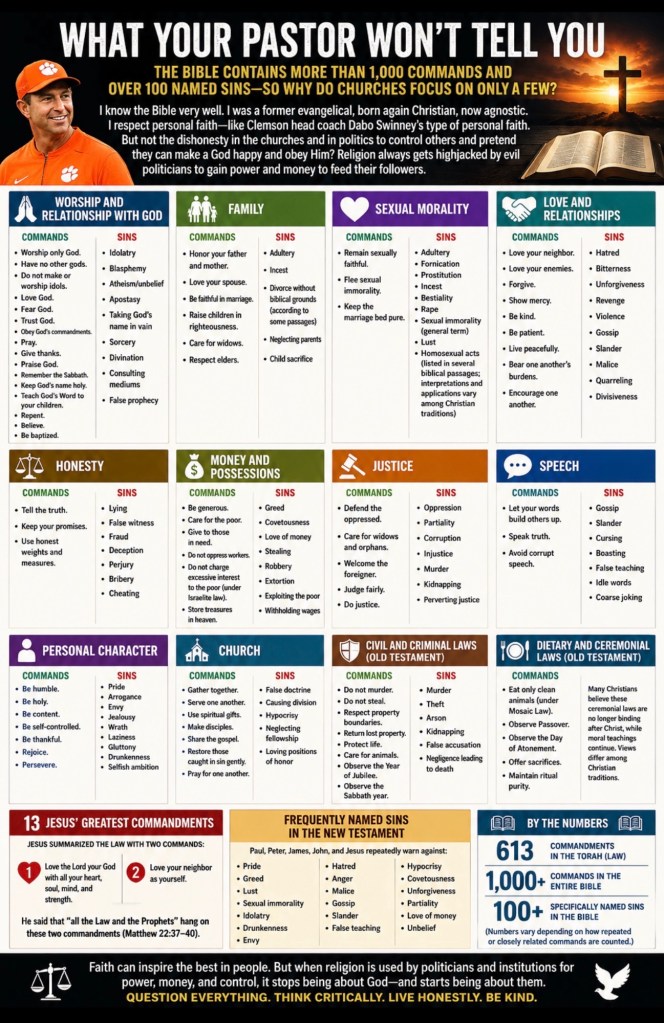
  • By: Jeric Yurkanin

    The story of Christianity in Colonial America is one of the most important and complicated chapters in American history. For many Americans, the traditional narrative is simple: religious settlers came to the New World seeking freedom from persecution, established communities built upon Christian values, and laid the foundations of what would eventually become the United States. While there is truth in this story, the historical reality is far more complex. Christianity helped shape colonial society, influenced laws and education, inspired charitable efforts, and provided spiritual guidance to millions of settlers. At the same time, colonial America was also marked by religious intolerance, slavery, violence against Native Americans, and social systems that often contradicted the teachings of Jesus. Understanding Christianity’s role in Colonial America requires looking honestly at both its accomplishments and its failures.

    Before European colonists arrived in North America, Europe had already been shaped by Christianity for more than a thousand years. Following the Protestant Reformation of the sixteenth century, Europe experienced significant religious conflict between Catholics and Protestants. Governments often enforced religious conformity, and those who belonged to minority religious groups frequently faced discrimination, fines, imprisonment, or exile. Many settlers who crossed the Atlantic carried with them both their religious convictions and their experiences with religious persecution. For some, America represented an opportunity to worship according to their beliefs without interference from governments or established churches.

    The first permanent English settlement in North America was Jamestown, Virginia, founded in 1607. The settlers were members of the Church of England, and religion played an important role in colonial life. Church attendance was expected, and religious observance was closely connected to civic responsibility. However, the harsh realities of survival often overshadowed religious ideals. Disease, starvation, conflict, and economic hardship dominated the colony’s early years. While religion remained important, settlers were often focused simply on staying alive.

    One of the most famous groups associated with colonial Christianity was the Pilgrims, a group of English Separatists who believed the Church of England remained too closely tied to Catholic traditions. Seeking greater religious freedom, they first fled to the Netherlands before sailing aboard the Mayflower and establishing Plymouth Colony in 1620. The Pilgrims hoped to create a society where they could worship according to their convictions. Their story became an enduring symbol of religious liberty in American culture. However, while the Pilgrims desired freedom for themselves, they did not necessarily support complete religious freedom for everyone. Like many people of their time, they believed their interpretation of Christianity was the correct one.

    A larger migration followed in the 1630s when thousands of Puritans settled in Massachusetts Bay Colony. The Puritans hoped to build what Governor John Winthrop described as a “city upon a hill,” a model Christian society that would inspire the world. Religion influenced nearly every aspect of Puritan life. Church attendance was expected, laws reflected religious principles, and community members were often judged according to strict moral standards. The Puritans placed great value on education and literacy because they believed individuals should be able to read the Bible. This emphasis helped contribute to the establishment of schools and eventually institutions such as Harvard College. Yet Puritan society was also marked by intolerance toward dissenters. Those who challenged accepted religious beliefs could face punishment, banishment, or social exclusion.

    One of the most significant advocates for religious liberty in colonial America was Roger Williams. A minister who challenged Puritan authorities in Massachusetts, Williams argued that government should not interfere with matters of conscience and that religious belief should be voluntary. He also criticized the treatment of Native Americans and questioned the fairness of colonial land claims. His views led to his banishment from Massachusetts. In 1636, Williams founded Rhode Island, which became one of the first places in the modern world to embrace broad religious freedom. People of different faiths could live there without fear of persecution, making Rhode Island an important milestone in the development of American religious liberty.

    The relationship between Christianity and Native Americans remains one of the most controversial aspects of colonial history. Many missionaries sincerely believed they were helping Indigenous peoples by introducing Christianity. Some learned Native languages, defended Indigenous communities from exploitation, and advocated for their rights. Others viewed Native cultures as inferior and sought to replace traditional beliefs and customs with European religious practices. Christianity often arrived alongside colonization, military expansion, and cultural disruption. Native communities faced disease, displacement, warfare, and the loss of traditional lands. The historical record reveals examples of both compassion and oppression, making this chapter of history especially complex.

    Perhaps the greatest contradiction in colonial Christianity involved slavery. Many colonists considered themselves devout Christians. They attended church, prayed regularly, and claimed to follow biblical teachings. Yet slavery became deeply entrenched within colonial society. Beginning in the seventeenth century, millions of Africans were forcibly transported to the Americas through the transatlantic slave trade. Enslaved men, women, and children endured unimaginable suffering. Some Christian leaders defended slavery using passages from the Bible, arguing that the institution was acceptable. Others condemned slavery as a violation of Christian principles and human dignity. The same religious text was used to support both sides of the debate, illustrating how scripture can be interpreted in different ways depending on social, political, and economic interests.

    During the eighteenth century, a series of religious revivals known as the Great Awakening transformed colonial Christianity. Preachers such as Jonathan Edwards and George Whitefield attracted enormous crowds and emphasized personal conversion, emotional religious experiences, and individual relationships with God. The revivals challenged traditional religious authority and encouraged people to think independently about faith. Many historians believe the Great Awakening contributed to ideas about individual liberty and personal responsibility that later influenced the American Revolution.

    As tensions between the American colonies and Great Britain increased, religious ideas became intertwined with political debates. Some ministers supported independence and argued that resisting tyranny was consistent with biblical principles. Others remained loyal to Britain and urged obedience to established authority. Churches often became centers for political discussion, and religious language influenced revolutionary rhetoric. Although Christianity did not cause the American Revolution, it helped shape the moral and philosophical framework through which many colonists understood their struggle.

    The history of Christianity in Colonial America is neither entirely heroic nor entirely shameful. Christian communities established schools, cared for the poor, promoted literacy, and provided moral guidance. At the same time, Christians participated in slavery, supported systems of inequality, and sometimes denied religious freedom to those who believed differently. The same faith inspired both acts of compassion and acts of injustice. This tension reflects a broader truth about human history: religious institutions are shaped not only by their beliefs but also by the people who lead them.

    Understanding Christianity’s role in Colonial America requires honesty about both its successes and failures. The story is ultimately one of faith, hope, contradiction, and human imperfection. It reminds us that religious ideals and human behavior do not always align. The lessons of this history remain relevant today as Americans continue to debate questions about religion, freedom, justice, and the role of faith in public life. By examining the past with honesty and humility, we gain a deeper understanding of both the achievements and shortcomings that helped shape the nation we know today.

  • By: Jeric Yurkanin

    The Protestant Reformation was one of the most important events in world history. It transformed Christianity, challenged the authority of the Roman Catholic Church, reshaped governments, influenced education, inspired new religious movements, and helped lay foundations for the modern world. At the center of this movement stood a German monk named Martin Luther, whose actions in the early sixteenth century sparked a religious revolution that continues to influence billions of people today.

    By the beginning of the 1500s, the Roman Catholic Church was the dominant religious institution in Western Europe. For centuries, the Church had exercised tremendous influence over politics, education, law, and everyday life. Popes crowned kings, bishops advised rulers, and churches stood at the center of nearly every community. Most Europeans could not imagine a society without the Church. However, beneath the surface, concerns were growing. Many Christians believed the Church had drifted away from the simplicity and humility taught by Jesus and the apostles.

    One of the most common criticisms involved corruption among some church leaders. Certain bishops and clergy accumulated significant wealth and political power. Some held multiple church offices at the same time. Others were accused of living lifestyles that appeared inconsistent with the spiritual teachings they preached. While many priests, monks, and nuns sincerely served their communities, reformers argued that serious problems existed within the institution.

    A major source of controversy involved the sale of indulgences. An indulgence was a document issued by church authorities that reduced the temporal punishment associated with sin according to Catholic teaching. Church officials taught that indulgences could be granted under certain conditions, including acts of charity, prayer, and repentance. However, some preachers presented indulgences in ways that gave people the impression they could purchase spiritual benefits with money. This practice alarmed many Christians, including Martin Luther.

    Martin Luther was born in 1483 in Eisleben, Germany. His father hoped he would become a lawyer, but Luther eventually entered a monastery after a profound spiritual experience during a thunderstorm. As a monk, Luther became deeply concerned about questions of sin, forgiveness, and salvation. He studied scripture extensively and eventually became a professor of theology at the University of Wittenberg.

    While studying the writings of the Apostle Paul, Luther became convinced that salvation was a gift from God received through faith rather than something earned through human effort. He believed many church practices had obscured this message. As concerns about indulgences increased, Luther decided to challenge what he viewed as abuses.

    On October 31, 1517, Luther reportedly posted his famous Ninety-Five Theses on the door of the Castle Church in Wittenberg. The document was intended as an invitation to academic debate rather than a declaration of rebellion. In these theses, Luther criticized the sale of indulgences and questioned certain church practices. Thanks to the recently invented printing press, his ideas spread rapidly throughout Germany and beyond.

    The printing press, developed by Johannes Gutenberg around the mid-fifteenth century, played a crucial role in the Reformation. Before printing, books had to be copied by hand, making them expensive and rare. Printing allowed Luther’s writings to circulate quickly and reach audiences across Europe. For the first time in history, ideas could spread on a massive scale within a relatively short period.

    Initially, Luther hoped church leaders would address his concerns. Instead, the conflict escalated. Church authorities condemned many of his teachings, and in 1521 Luther was summoned before the Diet of Worms, an assembly of political and religious leaders within the Holy Roman Empire. There, he was asked to recant his writings. According to tradition, Luther responded that he could not reject teachings he believed were supported by scripture and conscience. Whether he spoke the exact words later attributed to him remains debated, but his refusal marked a turning point in the Reformation.

    After being declared an outlaw, Luther received protection from sympathetic German princes. During this period, he translated the New Testament into German. This translation helped make scripture accessible to ordinary people who could not read Latin. Luther believed that Christians should be able to read the Bible in their own language rather than relying entirely upon clergy for interpretation. His translation influenced not only religion but also the development of the German language itself.

    As Luther’s movement grew, other reformers emerged throughout Europe. In Switzerland, figures such as Huldrych Zwingli and John Calvin developed their own theological systems. While they agreed with Luther on some issues, they disagreed on others. As a result, Protestantism quickly became diverse rather than unified.

    The Reformation transformed Europe politically as well as religiously. Many rulers saw opportunities to gain independence from papal authority. Some embraced Protestant ideas out of genuine conviction, while others were motivated by political or economic considerations. Entire regions and kingdoms eventually adopted Protestant forms of Christianity. This shift weakened the religious unity that had characterized Western Europe for centuries.

    The Roman Catholic Church responded through what became known as the Counter-Reformation. Church leaders acknowledged certain abuses and implemented reforms. The Council of Trent, which met between 1545 and 1563, clarified Catholic doctrine, improved clergy education, and addressed various criticisms raised by reformers. New religious orders, including the Jesuits, played important roles in renewing Catholic life and expanding missionary efforts around the world.

    Unfortunately, the Reformation also contributed to conflict and violence. Religious disagreements fueled wars, persecutions, and political struggles throughout Europe. Catholics and Protestants often viewed one another as threats to both religious truth and social stability. Some governments enforced religious conformity, while dissenters faced discrimination or persecution. The ideal of religious freedom that many people value today would take centuries to develop fully.

    The influence of the Reformation extended far beyond theology. Protestant emphasis on literacy encouraged education because believers were urged to read scripture for themselves. Schools expanded. Bible translations multiplied. The idea that individuals should engage directly with sacred texts helped promote broader literacy throughout many regions.

    The Reformation also influenced later movements advocating freedom of conscience, representative government, and individual rights. Historians continue to debate the extent of these influences, but few dispute that the Reformation helped shape the development of the modern Western world.

    Martin Luther himself remains a complex historical figure. He challenged powerful institutions, promoted access to scripture, and transformed Christianity. At the same time, some of his writings—particularly certain statements about Jews and other groups—have been widely criticized and condemned by modern scholars and Christians alike. Like many historical figures, Luther’s legacy includes both achievements and flaws.

    Today, Christianity is divided into thousands of denominations and traditions, many of which trace their origins to the Protestant Reformation. Lutheran, Reformed, Presbyterian, Anglican, Baptist, Methodist, Pentecostal, and many non-denominational churches all emerged directly or indirectly from the movement Luther helped launch.

    The Protestant Reformation was more than a dispute about theology. It was a revolution in religion, politics, education, culture, and society. It challenged old assumptions, redistributed authority, and transformed the relationship between individuals and religious institutions. Whether viewed as a necessary reform, a tragic division, or a mixture of both, its impact upon world history is impossible to overstate.

    More than five hundred years after Luther posted his Ninety-Five Theses, the questions raised during the Reformation continue to resonate. Who has authority to interpret scripture? What is the relationship between faith and institutions? How should religious communities respond to corruption and calls for reform? These questions remain relevant today, reminding us that the story of the Reformation is not merely a chapter from the past but an ongoing conversation about faith, truth, and the pursuit of religious integrity.

  • By: Jeric Yurkanin

    The fall of the Western Roman Empire in 476 CE marked the beginning of a new era in European history. While Roman emperors disappeared from Western Europe, one institution remained standing and continued to grow in influence: the Christian Church. Over the next thousand years, the Church would become the most powerful institution in Europe. It shaped governments, influenced kings, preserved knowledge, educated future leaders, inspired magnificent works of art and architecture, and guided the daily lives of millions. At the same time, the Medieval Church would also become entangled with wealth, politics, corruption, and power struggles that often stood in tension with the teachings of Jesus found in the Gospels.

    Following the collapse of Roman authority in the West, Europe entered a period often referred to as the Early Middle Ages. Roads fell into disrepair, trade declined, cities shrank, and political authority became fragmented. Amid this instability, the Church provided continuity. Bishops and priests often became some of the few educated leaders remaining in local communities. Monasteries preserved books, copied manuscripts, cared for the poor, and served as centers of learning. In many regions, the Church became the primary institution connecting scattered communities across Europe.

    As Christianity spread, the Bishop of Rome gradually gained greater authority. Over time, this position became known as the Pope. Christians believed Rome held special significance because of its connection to the apostles Peter and Paul, both of whom were traditionally believed to have been martyred there. By the early Middle Ages, the Pope had become one of the most influential religious leaders in Europe. Although other Christian centers existed in places such as Constantinople, Alexandria, Antioch, and Jerusalem, Rome increasingly claimed a unique position of authority within Western Christianity.

    The relationship between church and state continued to grow after Constantine. Kings often sought the support of church leaders to legitimize their rule, while church leaders relied on kings and nobles for protection and financial support. This partnership brought stability to many regions, but it also created opportunities for corruption. Religious offices sometimes became political appointments. Wealthy families competed for church positions, and rulers frequently attempted to influence church affairs.

    One of the most significant developments during the medieval period was the rise of monasticism. Men and women seeking a deeper spiritual life withdrew from ordinary society and formed religious communities known as monasteries and convents. Among the most influential monastic leaders was Benedict of Nursia, who established a rule of life emphasizing prayer, work, discipline, and community. Benedictine monasteries spread across Europe and became centers of education, agriculture, charity, and scholarship. Without these monasteries, many ancient writings from Greece, Rome, and early Christianity might have been lost forever.

    As centuries passed, Christianity spread beyond the former boundaries of the Roman Empire. Missionaries traveled throughout Ireland, Scotland, England, Germany, Scandinavia, and parts of Eastern Europe. Figures such as Patrick helped establish Christianity in Ireland, while other missionaries carried the faith to various Germanic and Slavic peoples. In many cases, conversion occurred gradually through preaching and cultural exchange. In other instances, political rulers encouraged or even required conversion among their subjects.

    One of the most important events of the medieval period occurred on Christmas Day in the year 800 CE when Pope Leo III crowned Charlemagne as Emperor of the Romans. This event symbolized the growing alliance between church and state. Charlemagne sought to unite much of Western Europe under Christian rule, while the Church benefited from imperial protection and support. His reign helped spread education, standardize church practices, and strengthen Christianity throughout his empire.

    By the High Middle Ages, roughly between 1000 and 1300 CE, the Church had become the dominant institution in Europe. Nearly every aspect of life revolved around religion. Churches stood at the center of towns. Religious festivals shaped the calendar. Priests oversaw baptisms, marriages, and funerals. The Church influenced laws, education, morality, and politics. For most Europeans, religion was not merely a private belief but a central part of everyday life.

    This period also witnessed the construction of some of the most impressive buildings in human history. Massive cathedrals rose across Europe, including famous structures such as Notre-Dame Cathedral and Canterbury Cathedral. These buildings required decades, and sometimes centuries, to complete. They reflected the devotion, wealth, artistic skill, and engineering achievements of medieval society. For many people, cathedrals served as visible symbols of heaven on earth.

    The Medieval Church also played a major role in the development of education. Many of Europe’s earliest universities emerged from church-sponsored schools. Institutions such as University of Bologna, University of Paris, and University of Oxford began during the medieval period. Theology was considered the “queen of the sciences,” and many scholars sought to reconcile faith with reason.

    Yet alongside these achievements came serious problems. Wealth accumulated within church institutions. Some bishops and clergy lived luxurious lifestyles. Political influence often overshadowed spiritual concerns. The selling of church offices, known as simony, became widespread in some regions. Questions about corruption and moral decline increasingly concerned reform-minded Christians.

    The relationship between Christianity and military conflict also became more complicated. Beginning in 1095, a series of military campaigns known as the Crusades sought to reclaim Jerusalem and other holy sites from Muslim control. Participants were promised spiritual rewards, including forgiveness of sins. While some Crusaders believed they were serving a sacred cause, the Crusades also resulted in widespread violence, suffering, and the loss of countless lives. Historians continue to debate their causes, motivations, and legacy. What remains clear is that the Crusades illustrate how closely religion and politics had become intertwined during the medieval era.

    Another major event occurred in 1054 with the Great Schism, which formally divided Christianity into two major branches: the Roman Catholic Church in the West and the Eastern Orthodox Church in the East. Disagreements over theology, authority, culture, and politics contributed to the split. Although both traditions shared many beliefs, the separation remains one of the most significant divisions in Christian history.

    By the late Middle Ages, criticism of the Church became increasingly common. Some Christians questioned the wealth of church leaders. Others criticized moral failures among clergy. Reform movements emerged seeking a return to simplicity, humility, and the teachings of Jesus. These concerns would eventually help pave the way for the Protestant Reformation in the sixteenth century.

    The Medieval Church left a complicated legacy. It preserved learning during difficult times, established schools and universities, cared for the poor, inspired magnificent art and architecture, and provided spiritual guidance to millions. At the same time, its close relationship with political power sometimes led to corruption, coercion, and practices that many later Christians believed contradicted the message of Jesus.

    Understanding the Medieval Church requires acknowledging both sides of its history. It was neither entirely a force for good nor entirely a force for harm. Rather, it was a powerful human institution shaped by the same strengths and weaknesses found throughout history. Its leaders often sought to serve God, but they were also influenced by politics, wealth, culture, and the pursuit of power.

    The story of the Medieval Church is ultimately the story of how Christianity evolved after becoming the dominant religion of Europe. It reveals both the extraordinary influence of faith upon civilization and the challenges that arise whenever religious institutions become deeply connected with political authority. The lessons of that history continue to shape conversations about religion, power, and society to this day.

  • By: Jeric Yurkanin

    Few figures outside of Jesus, the Apostle Paul, and Martin Luther have had a greater impact on Christianity than Constantine the Great. Before Constantine, Christianity was a small and often persecuted religious movement scattered throughout the Roman Empire. Christians met in homes, catacombs, and private gathering places. They had no political power, no government protection, and no guarantee of safety. After Constantine, Christianity became one of the most powerful institutions in the world. Churches were built openly, bishops gained influence, and imperial support transformed the faith. Within a few generations, Christianity moved from the margins of society to the center of Roman power.

    When Jesus lived during the first century, the Roman Empire controlled much of Europe, North Africa, and the Middle East. Rome was the dominant military and political force of the ancient world. The emperor was viewed not only as a political leader but often as a semi-divine figure deserving loyalty and honor. Most Romans practiced traditional pagan religions, and temples dedicated to various gods and goddesses filled cities throughout the empire. Religious diversity was common, but refusing to honor the emperor could be viewed as political rebellion. This created tension for Christians because they worshipped only one God and many refused to participate in emperor worship. As a result, Christians were often viewed with suspicion.

    Contrary to popular belief, Christians were not constantly persecuted during the first three centuries, but several major persecutions did occur. The most famous began under Emperor Nero around 64 CE after the Great Fire of Rome. Later, other emperors periodically targeted Christians, especially when Christians refused to sacrifice to Roman gods. The largest persecution occurred under Emperor Diocletian beginning in 303 CE. Church buildings were destroyed, Christian scriptures were burned, clergy were arrested, and many believers suffered for their faith. Few Christians at that time could have imagined that within a generation Christianity would receive imperial support.

    Constantine was born around 272 CE. His father was a Roman military officer who later became emperor in the western portion of the empire. Constantine grew up within Roman political and military circles. When his father died in 306 CE, Constantine’s troops proclaimed him emperor. This led to years of civil war as several rivals competed for control of Rome. The most important conflict occurred in 312 CE, when Constantine prepared to face Maxentius at the Battle of the Milvian Bridge outside Rome.

    According to later Christian accounts, Constantine experienced a vision before the battle. Some sources claim he saw a cross in the sky with the words, “By this sign, conquer.” Other accounts describe a dream instructing him to place a Christian symbol on his soldiers’ shields. Constantine won the battle and emerged as the ruler of the western empire. Whether the vision happened exactly as later writers described remains debated by historians, but it is clear that after this victory Constantine increasingly connected himself with Christianity.

    In 313 CE, Constantine and Licinius issued what became known as the Edict of Milan. This decree granted religious tolerance throughout the empire. For Christians, it was a historic turning point. Christianity was no longer illegal. Confiscated church property was returned. Believers could worship openly. Persecution officially ended. After nearly three centuries of uncertainty, Christianity could finally exist publicly. The church moved from survival mode to expansion mode almost overnight.

    Historians still debate how sincere Constantine’s conversion was. He clearly favored Christianity, donated money to churches, supported bishops, granted privileges to clergy, and promoted Christian symbols. However, his religious life was complicated. He retained some traditional Roman titles connected to pagan religion and delayed baptism until shortly before his death in 337 CE. Some scholars believe his conversion was genuine, while others argue political motives played a major role. The truth may be a mixture of both. Ancient rulers often combined religion and politics, and Constantine was no exception.

    Constantine invested heavily in Christian institutions. He funded the construction of major churches throughout the empire, including the Church of the Holy Sepulchre in Jerusalem, Old St. Peter’s Basilica in Rome, and the Church of the Nativity in Bethlehem. For the first time, Christianity had large public buildings dedicated to worship. The faith gained visibility, prestige, and power. Bishops increasingly became important civic leaders, and imperial support helped Christianity grow rapidly.

    One of Constantine’s most important actions occurred in 325 CE when he called the Council of Nicaea. Christian leaders were divided over a major theological controversy involving a priest named Arius. Arius taught that Jesus was created by God and therefore not fully equal with God the Father. Many church leaders strongly disagreed. Constantine feared that religious division could create political instability, so he summoned bishops from across the empire to meet in Nicaea. The council debated the nature of Christ and eventually affirmed that Jesus was of the same essence as God the Father. The Nicene Creed became one of Christianity’s most influential statements of faith.

    A common myth says the Council of Nicaea created the Bible, but that is not historically accurate. The main focus of the council was the nature of Christ, not the New Testament canon. However, Nicaea did show how deeply church leadership and imperial power were becoming connected. The emperor now had a role in bringing church leaders together to settle religious disputes. This marked a major shift in Christianity’s history.

    Before Constantine, Christianity generally existed outside political power. After Constantine, the church became increasingly connected to government. Supporters argue that Constantine protected Christians and allowed the faith to flourish. Critics argue that Christianity lost something important when it became associated with empire. Jesus had taught humility, yet the church now possessed wealth. Jesus had been executed by the state, yet the church now cooperated with the state. Jesus held no political office, yet bishops now advised emperors. This tension between faith and power would shape Christian history for centuries.

    Constantine’s reign laid the foundation for what historians call Christendom, a period when Christianity became closely intertwined with political authority throughout Europe. In the centuries that followed, kings ruled with church support, churches received government protection, and Christian identity became connected with citizenship. This system helped spread Christianity across Europe, but it also blurred the line between genuine faith and political loyalty.

    The legacy of Constantine remains deeply debated. To some Christians, he was a hero who ended persecution and allowed Christianity to thrive. To others, he represents the beginning of Christianity’s entanglement with wealth, government, and empire. Both views contain truth. Without Constantine, Christianity may not have spread as rapidly across Europe. Yet Constantine also helped create a relationship between church and state that often produced corruption, coercion, and abuse of power.

    The story of Constantine is ultimately the story of transformation. During his lifetime, Christianity moved from being a persecuted minority religion to becoming one of the most influential forces in the Roman world. The emperor who once marched under Roman military banners helped bring Christianity into the halls of power. Whether viewed as a blessing, a compromise, or a mixture of both, Constantine’s impact on Christianity is impossible to ignore. He did not create Christianity, but he changed Christianity forever.

  • Written By: Jeric Yurkanin

    Bible not viewed as a single book directly inspired by God, preserved perfectly through history, and handed down unchanged from the first century.

    Historically, however, the story is much more complex.

    The New Testament did not descend from heaven as a completed book. It was not written all at once. Jesus himself never wrote a gospel, a letter, or any portion of what would eventually become the Christian Bible.

    Instead, the New Testament emerged gradually over several centuries through a process involving oral traditions, handwritten manuscripts, theological debates, church leaders, political influences, and countless ordinary believers who preserved stories about Jesus and the earliest Christian movement.

    Understanding how the New Testament was formed does not require someone to abandon faith. Rather, it helps us appreciate the remarkable and often complicated journey through which Christianity’s most sacred writings came into existence.

    To understand the New Testament, we must begin before a single word was written.


    A Religion Without a New Testament

    One of the most surprising facts for many Christians is that the earliest followers of Jesus did not possess a New Testament.

    The first Christians gathered for worship, prayer, meals, and teaching without Matthew, Mark, Luke, John, Acts, Romans, Revelation, or any other New Testament book.

    For decades after Jesus’ death, no New Testament existed.

    The earliest Christians relied primarily upon:

    • Oral teachings
    • Eyewitness testimony
    • Hebrew Scriptures (Old Testament)
    • Community traditions
    • Apostolic preaching

    The movement spread throughout Judea, Galilee, Syria, Asia Minor, Greece, Egypt, and eventually Rome without possessing the twenty-seven books recognized today.

    For approximately twenty years after Jesus’ death, Christianity existed entirely as an oral movement.


    The Oral Tradition

    Ancient societies relied heavily upon memory.

    Most people could not read or write.

    Stories were transmitted verbally.

    Teachers often used repetition, rhythm, and memorable sayings to help students retain information.

    Jesus himself appears to have taught in this manner.

    Many of his sayings contain memorable patterns:

    “Love your enemies.”

    “The last shall be first.”

    “Blessed are the peacemakers.”

    “A tree is known by its fruit.”

    These statements were easy to remember and repeat.

    The earliest followers likely preserved collections of Jesus’ teachings long before written gospels emerged.

    Some historians believe these oral traditions circulated for decades throughout Christian communities before being written down.

    This helps explain why the gospels sometimes tell similar stories with slightly different wording.

    Different communities remembered and transmitted traditions in different ways.


    The Earliest Christian Writings Were Not the Gospels

    Many assume the Gospel of Matthew was the first Christian document.

    Historically, that is unlikely.

    Most scholars believe the earliest surviving Christian writings are the letters of Paul.

    These letters were written approximately twenty to thirty years after Jesus’ death.

    Paul never met Jesus during Jesus’ earthly ministry.

    Instead, Paul claimed to have experienced a vision of the risen Christ.

    Beginning around 50 CE, Paul wrote letters to churches throughout the Roman Empire.

    His writings addressed issues such as:

    • Church leadership
    • Theology
    • Ethics
    • Community disputes
    • Worship practices

    These letters eventually became a major portion of the New Testament.

    Ironically, Christianity’s earliest surviving documents are not biographies of Jesus but letters written to congregations struggling with practical problems.


    The Gospel of Mark: The First Gospel

    Most scholars identify Mark as the earliest gospel.

    It was likely written around 65–70 CE.

    This places its composition approximately thirty-five to forty years after Jesus’ crucifixion.

    Mark’s gospel is shorter and simpler than the others.

    It presents Jesus as a powerful teacher and miracle worker while emphasizing suffering, sacrifice, and discipleship.

    Many scholars believe Matthew and Luke later used Mark as one of their primary sources.

    This explains why large portions of Matthew and Luke closely resemble passages found in Mark.

    Mark therefore occupies a unique position in Christian history.

    It became the foundation upon which later gospel writers built.


    Matthew and Luke

    Around 80–90 CE, two additional gospels emerged.

    The authors of Matthew and Luke appear to have used Mark while also incorporating other traditions.

    Matthew was written primarily for a Jewish-Christian audience.

    It emphasizes Jesus as the fulfillment of Jewish prophecy.

    Luke, meanwhile, focuses heavily on compassion, inclusion, and concern for marginalized people.

    Luke also authored Acts, which describes the growth of the early church after Jesus’ death.

    Together, Luke and Acts form one of the most significant historical sources for understanding early Christianity.


    The Gospel of John

    The Gospel of John differs substantially from the other three gospels.

    Written near the end of the first century, around 90–100 CE, John presents a more developed theological portrait of Jesus.

    The language, structure, and themes differ noticeably from Matthew, Mark, and Luke.

    While the Synoptic Gospels often emphasize Jesus’ teachings and parables, John focuses heavily on Jesus’ identity and relationship with God.

    John would eventually become one of the most influential books in Christian theology.


    The Explosion of Christian Literature

    By the second century, Christian communities were producing numerous writings.

    Not all of these became part of the New Testament.

    Examples included:

    • Gospel of Thomas
    • Gospel of Peter
    • Gospel of Mary
    • Gospel of Judas
    • Shepherd of Hermas
    • Epistle of Barnabas
    • Didache
    • Apocalypse of Peter

    Some churches considered these texts valuable.

    Others rejected them.

    Different Christian communities often disagreed regarding which writings were authoritative.

    For generations, there was no universally accepted Christian Bible.


    Heresy and the Need for a Canon

    As Christianity expanded, theological disagreements increased.

    Various groups promoted competing interpretations of Jesus.

    Some emphasized secret knowledge.

    Others rejected the Hebrew Scriptures.

    Still others developed unique teachings about creation, salvation, and the nature of Christ.

    Church leaders increasingly recognized the need to define which writings represented authentic apostolic teaching.

    This challenge helped inspire the gradual development of a canon.

    The word “canon” comes from a Greek term meaning “rule” or “standard.”

    A biblical canon refers to the collection of books recognized as authoritative scripture.


    The Influence of Marcion

    One of the most controversial figures in early Christianity was Marcion.

    Around 140 CE, Marcion proposed his own Christian canon.

    He rejected the Old Testament entirely and accepted only a limited selection of Christian writings.

    Although church leaders condemned his views, Marcion’s challenge forced Christianity to clarify which books it considered authoritative.

    Many historians believe Marcion’s actions accelerated the process of canon formation.


    The Long Road to the Twenty-Seven Books

    Contrary to popular belief, no single church council instantly created the New Testament.

    The process unfolded gradually.

    By the late second century, many churches already accepted:

    • Matthew
    • Mark
    • Luke
    • John
    • Acts
    • Paul’s letters

    However, disagreement remained regarding other books.

    Questions surrounded:

    • Hebrews
    • James
    • 2 Peter
    • Jude
    • Revelation

    Some churches accepted them.

    Others did not.

    Consensus emerged slowly over generations.


    Constantine and Christianity

    In the fourth century, Christianity experienced dramatic change when Emperor Constantine legalized the faith.

    Christianity moved from being a persecuted minority religion to becoming increasingly connected with imperial power.

    This transformation helped create greater organizational unity.

    Church leaders now possessed greater ability to communicate and cooperate across the empire.

    Although Constantine did not personally determine the New Testament canon, the new political environment helped accelerate standardization.


    Athanasius and the First Complete List

    In 367 CE, Bishop Athanasius of Alexandria issued a letter listing the exact twenty-seven books recognized today as the New Testament.

    This is the earliest surviving document containing the complete modern New Testament canon.

    His list included:

    • Four Gospels
    • Acts
    • Pauline Letters
    • General Epistles
    • Revelation

    The books were not newly invented.

    Most had been widely used for generations.

    However, Athanasius provided the first surviving list that matches today’s New Testament exactly.


    Why Some Books Were Rejected

    Not every Christian writing became scripture.

    Church leaders generally evaluated books using several criteria:

    1. Apostolic connection.
    2. Consistency with accepted doctrine.
    3. Widespread usage among churches.
    4. Historical reliability.

    Books failing to meet these standards were excluded.

    Some were considered useful for reading but not scripture.

    Others were regarded as theological innovations.


    Manuscripts and Copying

    Before the invention of the printing press, every New Testament manuscript had to be copied by hand.

    Thousands of copies were produced across centuries.

    Human scribes inevitably introduced mistakes.

    Most variations are minor spelling differences.

    Some involve missing words or phrases.

    A few passages remain debated among scholars today.

    Because thousands of manuscripts survive, textual critics can compare versions and reconstruct the earliest attainable text with remarkable accuracy.


    What This Means Today

    The history of the New Testament reveals a process far more human and complex than many people realize.

    The books emerged through generations of preservation, debate, copying, interpretation, and communal discernment.

    For believers, this story may demonstrate God’s work through human history.

    For skeptics, it illustrates how religious traditions develop over time.

    Either way, understanding the formation of the New Testament provides valuable insight into one of the most influential collections of writings ever assembled.


    Conclusion

    The New Testament was not written in a day, a year, or even a generation.

    It emerged from centuries of faith, memory, debate, and preservation.

    Behind every page stands a fascinating story involving apostles, missionaries, scribes, bishops, emperors, martyrs, and ordinary believers.

    Whether one approaches these writings as sacred scripture, historical documents, or literary masterpieces, their influence upon civilization is undeniable.

    The story of the New Testament is ultimately the story of how a small movement centered around a Jewish teacher from Galilee became one of the most influential forces in human history.

  • By: Jeric Yurkanin

    Few individuals in human history have had a greater impact on civilization than Jesus of Nazareth. His teachings have influenced billions of people, shaped empires, inspired charitable movements, and altered the course of world history. Yet despite his enormous influence, many people know more about the theological claims surrounding Jesus than they do about the historical figure himself.

    Who was Jesus before centuries of church traditions, theological debates, denominational divisions, political movements, and cultural interpretations?

    This question has fascinated historians, archaeologists, theologians, and skeptics for generations.

    The “Historical Jesus” refers to the effort to understand Jesus of Nazareth as a real person who lived in first-century Palestine. Rather than beginning with questions about doctrine or miracles, historians ask what can be reasonably known about Jesus through historical evidence, ancient documents, archaeology, and the social context of his time.

    Virtually all mainstream historians agree that Jesus of Nazareth was a real historical person.

    While scholars debate many details of his life and teachings, there is broad agreement that Jesus lived in the Roman province of Judea during the first century and was crucified under the authority of the Roman governor Pontius Pilate around 30–33 CE.

    Evidence for Jesus comes not only from the New Testament but also from several non-Christian sources written within decades of his life. These include references from the Jewish historian Josephus and the Roman historian Tacitus.

    Although these references are brief, they confirm that Jesus was known as a historical figure and that his followers had become a recognizable movement within the Roman Empire.

    To understand Jesus, we must understand his world.

    Jesus was born into a Jewish society living under Roman occupation. The Roman Empire controlled the region politically and militarily, while local rulers governed under Roman authority.

    Life for most people was difficult. Poverty was widespread. Many families survived through farming, fishing, or manual labor. Disease, high infant mortality, and political instability were common realities.

    Religious identity was central to daily life. The Jewish people maintained strong traditions rooted in the Hebrew Scriptures while navigating the challenges of foreign rule.

    Many Jews hoped for divine intervention and anticipated the arrival of a messiah who would restore justice and freedom.

    It was within this environment that Jesus began his public ministry.

    While scholars differ on many details, several facts are accepted by most historians:

    • Jesus was a Jewish teacher from Galilee.
    • He was baptized by John the Baptist.
    • He gathered followers and taught publicly.
    • He preached about the Kingdom of God.
    • He became known as a healer and teacher.
    • He came into conflict with some religious and political authorities.
    • He was crucified under Roman authority.
    • His followers believed he rose from the dead and continued spreading his teachings after his death.

    These points form the foundation of historical study regarding Jesus.

    One challenge historians face is that Jesus left behind no known writings of his own.

    Most information about him comes from the four canonical Gospels—Matthew, Mark, Luke, and John.

    Scholars generally believe these accounts were written several decades after Jesus’ death. The earliest, the Gospel of Mark, is commonly dated around 65–70 CE, while the others were likely written later.

    This does not mean the Gospels are worthless as historical sources. Ancient historians frequently rely on documents written years or even decades after events occurred.

    However, historians recognize that the Gospels are both historical narratives and theological documents. They were written by believers seeking to communicate religious meaning, not merely record facts.

    Because of this, scholars compare Gospel accounts with archaeology, historical records, cultural context, and other ancient sources to reconstruct what can reasonably be known about Jesus.

    One of the most striking features of the Gospel accounts is Jesus’ concern for ordinary people.

    He spent much of his time among fishermen, laborers, widows, tax collectors, and those considered outsiders by society.

    His teachings frequently emphasized compassion, mercy, forgiveness, generosity, and concern for the vulnerable.

    Whether one approaches Jesus as a believer or as a historian, these themes appear repeatedly throughout the earliest sources.

    Studying the Historical Jesus does not require a person to be Christian.

    Historians, Jews, Muslims, agnostics, atheists, and Christians all participate in scholarly discussions about Jesus.

    For believers, historical study can provide deeper understanding of the world in which Jesus lived.

    For skeptics, it offers an opportunity to examine one of history’s most influential figures through evidence and scholarship.

    For everyone else, it helps separate what can be known historically from later traditions, assumptions, and cultural interpretations.

    Understanding the Historical Jesus is not about attacking faith or defending it. It is about asking honest questions and examining the evidence as carefully as possible.

    More than two thousand years after his death, Jesus of Nazareth remains one of the most studied individuals in human history—a figure whose life continues to inspire debate, devotion, criticism, and curiosity around the world.

  • By Jeric Yurkanin

    Walk into many churches across America in 2026 and you may encounter a version of Jesus that would have seemed unfamiliar to the historical figure who walked the roads of first-century Galilee.

    The Jesus often presented in modern American evangelical culture is frequently portrayed as a defender of political movements, national identities, economic systems, and cultural values that developed nearly two thousand years after his death. Yet when we return to the earliest Gospel accounts, we encounter a very different figure—a Jewish teacher from Roman-occupied Palestine who preached humility, generosity, forgiveness, nonviolence toward enemies, care for the poor, and a radical vision of God’s kingdom.

    This raises an important question:

    Have modern Christians remained faithful to the Jesus of the Gospels, or have many created a version of Jesus that reflects their own culture, politics, and personal preferences?

    The answer is not simple, but history provides important clues.

    The Historical Jesus

    Nearly all historians—whether Christian, Jewish, agnostic, or atheist—agree that Jesus of Nazareth was a real historical figure who lived during the first century in the Roman province of Judea.

    Jesus was not an American.

    He was not a Republican or Democrat.

    He was not an evangelical Protestant.

    He was not a capitalist, nationalist, or culture warrior.

    He was a Jewish teacher living under Roman occupation.

    His world looked dramatically different from ours. Most people were poor. Political oppression was common. Disease was widespread. Literacy rates were low. Life expectancy was short. Religion and daily life were deeply intertwined.

    The earliest Gospel accounts portray Jesus spending much of his time among fishermen, laborers, widows, tax collectors, outcasts, and the poor. He repeatedly challenged religious authorities and warned against wealth, hypocrisy, and the pursuit of power.

    In the Gospel of Matthew, Jesus taught:

    “Blessed are the poor in spirit.”

    “Love your enemies.”

    “Do good to those who hate you.”

    “Whatever you did for the least of these, you did for me.”

    These teachings often stand in sharp contrast to modern religious movements focused primarily on wealth, political influence, and cultural dominance.

    Were the Gospels Written by Eyewitnesses?

    One of the most debated questions in Christianity concerns how the New Testament was written.

    Jesus himself left no writings.

    According to mainstream scholarship, the earliest Gospel, Mark, was likely written around 35–40 years after Jesus’ death. Matthew and Luke followed later, while John was likely written near the end of the first century.

    This does not automatically make the Gospels unreliable, but it does mean that they were written decades after the events they describe.

    The stories were transmitted orally before being written down.

    As with all ancient historical sources, historians must examine how traditions developed, how communities remembered events, and how theological beliefs may have influenced the final texts.

    Many Christians are never taught this history.

    Instead, they are often told a simplified story that ignores the complex process through which the biblical canon emerged.

    How the Bible Was Compiled

    Many people imagine the Bible descending from heaven as a complete book.

    Historically, that is not what happened.

    The biblical canon developed gradually over centuries.

    Early Christians possessed numerous writings, including letters, gospels, sermons, apocalypses, and theological works.

    Some books that were widely read in early Christian communities eventually became part of the New Testament. Others were excluded.

    Church leaders debated which writings should be considered authoritative.

    The process was influenced by theology, tradition, church leadership, and historical circumstances.

    The New Testament canon recognized by most Christians today was largely established during the fourth century, more than 300 years after Jesus lived.

    Understanding this history does not necessarily destroy faith. However, it challenges simplistic claims that every Christian throughout history has interpreted scripture in exactly the same way.

    Christianity and Political Power

    For its first few centuries, Christianity was often a persecuted minority faith.

    This changed dramatically during the reign of the Roman Emperor Constantine in the fourth century.

    Following Constantine’s conversion and the Edict of Milan in 313 CE, Christianity gained increasing political influence throughout the Roman Empire.

    Eventually, Christianity became closely connected with imperial power.

    This relationship transformed the faith.

    The movement that had begun among marginalized communities now found itself allied with emperors, kings, armies, and governments.

    Over the following centuries, political leaders frequently used religion to strengthen their authority.

    Likewise, religious institutions often benefited from state support.

    The result was a complicated relationship between faith and power that continues to shape Christianity today.

    Forced Conversions and Religious Violence

    Many Christians emphasize the message of love found in the Gospels.

    Yet history shows that Christian institutions have not always lived according to those ideals.

    Throughout parts of European history, rulers sometimes used political and military force to encourage or compel religious conformity.

    Examples include certain medieval campaigns, forced baptisms in some regions, persecution of religious minorities, and religious wars following the Protestant Reformation.

    These events do not represent every Christian community or every period of Christian history.

    Nevertheless, they are part of the historical record.

    Recognizing these realities allows us to distinguish between the teachings attributed to Jesus and the actions of institutions acting in his name.

    Christianity, Slavery, and Racism in America

    When European settlers arrived in North America, many brought deeply held Christian beliefs.

    Some settlers sought religious freedom.

    Others hoped to build societies organized around their own religious convictions.

    At the same time, European colonization contributed to the displacement of Native American peoples and the expansion of systems of slavery.

    Many churches and religious leaders opposed these practices.

    Others defended them using biblical interpretations.

    During the nineteenth century, both defenders and opponents of slavery quoted scripture to support their positions.

    This historical reality demonstrates an important truth:

    The Bible has often been interpreted in dramatically different ways depending on cultural, political, and economic interests.

    The existence of these competing interpretations raises difficult questions about authority, morality, and religious certainty.

    The Challenge for Modern Christians

    The central challenge facing Christianity may not be whether people believe in Jesus.

    It may be whether people are willing to honestly confront the gap between Jesus’ teachings and Christian history.

    The Gospels present a teacher who emphasized compassion, forgiveness, humility, generosity, and concern for society’s most vulnerable people.

    History reveals that Christian institutions have sometimes embodied those values and sometimes failed to do so.

    Understanding that tension is essential for anyone seeking an honest examination of Christianity.

    Whether one remains a committed believer, becomes an agnostic, or embraces atheism, historical inquiry invites us to ask difficult questions and follow evidence wherever it leads.

    Perhaps the most important question is not whether Jesus fits our modern worldview.

    Perhaps it is whether we have reshaped Jesus to fit our own.

  • BY JERIC YURKANIN

    One of the questions that eventually emerged during the deconstruction journeys of many former Christians was surprisingly simple: If Jesus of Nazareth returned today and walked through modern Christianity, what would he think? More specifically, would he recognize the religion that developed in his name over the past two thousand years?

    For many people, this question began after reading the Gospels with fresh eyes. They noticed that the Jesus portrayed in Matthew, Mark, Luke, and John often seemed different from the version of Christianity they experienced in churches. They encountered a teacher who spent much of his time among ordinary people rather than powerful religious leaders. They found someone who spoke repeatedly about caring for the poor, serving others, forgiving enemies, rejecting greed, and loving neighbors. They encountered someone who criticized religious hypocrisy more frequently than outsiders.

    As they continued reading, some former Christians became increasingly aware of the contrast between those teachings and aspects of modern church culture. They saw churches arguing over politics while Jesus emphasized love. They saw ministries accumulating wealth while Jesus warned about riches. They saw leaders pursuing influence while Jesus spoke about humility and service.

    This does not mean all churches ignore Jesus’ teachings. Many Christians devote their lives to serving others, helping communities, feeding the hungry, supporting families, and caring for those in need. Yet critics argue that institutional Christianity often appears far more concerned with power, growth, attendance, fundraising, and cultural influence than the priorities Jesus emphasized.

    The issue becomes particularly visible when examining wealth. Jesus frequently warned about the dangers of money. He told stories about wealthy individuals missing what truly mattered. He instructed followers to help the poor and share with those in need. Yet some modern ministries operate enormous campuses, generate substantial revenue, and invest heavily in expansion projects.

    Former Christians often ask whether Jesus would be impressed by these accomplishments. Would he celebrate the size of buildings, the sophistication of production systems, and the growth of religious brands? Or would he focus his attention on the struggling families, homeless individuals, mentally ill neighbors, and forgotten people living nearby?

    The question becomes even more challenging when churches exist in communities facing significant social problems. Critics frequently point out that some congregations spend millions on facilities while surrounding neighborhoods struggle with addiction, poverty, mental health crises, food insecurity, and inadequate access to healthcare.

    Many former believers began wondering whether the priorities seemed backward. If Jesus spent much of his time helping vulnerable people, why do some churches devote such a large percentage of their resources to maintaining institutions?

    Another issue involves political identity. In many countries, Christianity has become closely associated with political movements, parties, and ideologies. Some churches appear deeply engaged in culture wars and political conflicts. Former Christians often compare this reality with the Gospel accounts and notice that Jesus rarely fit neatly into modern political categories.

    Instead, he frequently challenged people across the social and religious spectrum. He criticized powerful religious authorities. He challenged social norms. He associated with outsiders. He often seemed less interested in controlling society than in transforming individuals and communities through compassion and ethical behavior.

    This contrast causes some people to wonder whether Christianity gradually shifted from a movement centered on Jesus’ teachings into an institution focused on protecting doctrine, power, identity, and influence.

    The history of Christianity adds another layer to the discussion. Over the centuries, Christianity became intertwined with governments, kings, emperors, political systems, and economic interests. Religious institutions accumulated wealth, land, and authority. Some church leaders gained extraordinary influence over societies.

    For critics, this historical development raises an important question. How much of modern Christianity comes directly from Jesus, and how much developed later through human institutions?

    Some scholars argue that Christianity evolved significantly after Jesus’ death. As the movement spread across cultures and centuries, new doctrines emerged, organizations formed, hierarchies developed, and theological debates reshaped the religion. What began as a small Jewish movement eventually became one of the world’s largest religious traditions.

    Former Christians who study this history often conclude that the religion appears far more human and evolutionary than they were taught. They see adaptation, conflict, compromise, interpretation, and institutional development. Instead of a perfectly preserved system, they see a religion changing over time.

    This realization frequently affects how they view certainty. If Christianity evolved historically, then many doctrines that seem obvious today may have developed gradually. Questions that once appeared settled suddenly become open for investigation.

    Some begin asking whether Christianity has always reflected cultural values as much as it has shaped them. Throughout history, Christians defended slavery and opposed slavery. Christians supported segregation and opposed segregation. Christians justified wars and promoted peace. Christians endorsed monarchies, democracies, and various political systems.

    These contradictions lead some people to wonder whether religion often follows culture rather than leading it.

    The treatment of outsiders becomes another area of concern. Jesus was often portrayed as engaging compassionately with people considered outsiders by society. Yet many former Christians describe experiences where churches seemed more focused on drawing boundaries than building relationships.

    Some recall being taught to fear people from other religions, different political backgrounds, or different lifestyles. Others remember being warned about questioning, doubting, or exploring alternative viewpoints. Over time, these experiences led them to question whether exclusion had become more important than compassion.

    Many former Christians eventually reach a point where they separate Jesus from the institution built around him. They may continue admiring many of his teachings while becoming skeptical of organized religion. They see value in principles such as love, forgiveness, humility, generosity, and compassion while rejecting doctrines or institutions they believe conflict with those values.

    Others continue identifying as Christians but advocate significant reform. They argue that churches should return their focus to caring for the poor, supporting vulnerable populations, investing in mental health services, addressing homelessness, promoting compassion, and building stronger communities.

    Regardless of where people ultimately land, the question remains powerful.

    If Jesus walked into a modern megachurch, what would capture his attention?

    Would it be the building?

    Would it be the technology?

    Would it be the attendance numbers?

    Would it be the annual budget?

    Or would it be the people who are suffering outside the doors?

    No one can know the answer with certainty. Yet for many former Christians, asking that question changed how they viewed faith, churches, and religious institutions.

    The question forced them to compare what they saw in the Gospels with what they saw in the modern world. In some cases, the comparison strengthened their faith. In others, it contributed to deconstruction.

    Either way, it highlighted a tension that continues to shape conversations about Christianity today: the difference between the teachings attributed to Jesus and the institutions that developed in his name.

    For many former Christians, that tension became impossible to ignore. And once they saw it, they could never look at religion in quite the same way again.

    WHEN CHRISTIANITY WAS WRONG — DEMON POSSESSION, MENTAL ILLNESS, SCIENCE, AND THE PROBLEM OF CHANGING CERTAINTY:

    One of the most significant issues that contributed to deconstruction for many former Christians was not a single Bible verse, a scientific discovery, or a philosophical argument. It was the realization that throughout history, Christians have often been completely convinced they were right about things that later turned out to be wrong.

    This realization raises an uncomfortable question. If Christians were so confident about certain beliefs in the past and were mistaken, how can anyone be completely certain they are not mistaken about some beliefs today?

    History provides many examples. For centuries, illnesses that modern medicine can explain were often attributed to supernatural causes. Conditions such as epilepsy, schizophrenia, severe depression, bipolar disorder, Tourette syndrome, dementia, developmental disabilities, and other neurological or psychological disorders were frequently interpreted through religious frameworks.

    People who experienced seizures were sometimes believed to be possessed by demons.

    People hearing voices were sometimes believed to be influenced by evil spirits.

    People experiencing severe mental distress were sometimes viewed as spiritually oppressed.

    Individuals with developmental disabilities were often misunderstood because the scientific knowledge needed to understand their conditions simply did not exist.

    To be fair, this was not unique to Christianity. Nearly every culture throughout history attempted to explain unusual behaviors using the knowledge available at the time. The problem is not that ancient people lacked modern science. The problem, critics argue, is that many religious leaders presented these explanations with absolute certainty.

    They were not saying, “We are doing our best to understand.”

    They were often saying, “We know exactly what this is.”

    And in many cases, they were wrong.

    As medical knowledge advanced, many supernatural explanations gradually disappeared. Conditions once attributed to demons became understood through neurology, psychology, psychiatry, genetics, and medicine.

    The same pattern appears repeatedly throughout history.

    There was a time when disease was often viewed primarily as divine punishment.

    There was a time when natural disasters were frequently interpreted as direct judgments from God.

    There was a time when many Christians believed mental illness was primarily spiritual rather than medical.

    There was a time when various social and scientific ideas now considered mainstream were strongly resisted by religious authorities.

    Yet over time, beliefs changed.

    This pattern creates a difficult challenge for claims of certainty. Many former Christians began noticing that Christianity often seemed to adapt after new information became impossible to ignore. Once scientific evidence became overwhelming, interpretations changed. Once cultural attitudes shifted, theological explanations often shifted as well.

    Critics argue that this suggests religion frequently follows human knowledge rather than leading it.

    One example often discussed is mental health.

    Today, many churches openly support counseling, therapy, psychiatric care, autism awareness, trauma recovery, and evidence-based mental health treatment. Many Christian counselors and psychologists perform valuable work helping people.

    Yet only a few generations ago, many of these same conditions were frequently misunderstood or viewed primarily through spiritual lenses.

    This raises an uncomfortable question: If God was guiding the church, why did the church often lag behind scientific understanding?

    Why did so many people suffer under mistaken explanations before better knowledge emerged?

    Former Christians sometimes compare this pattern to a student repeatedly changing answers after seeing the correct solution. If a religious system consistently revises its understanding only after evidence becomes overwhelming, some begin wondering whether the system possesses special knowledge at all.

    Another issue involves biblical interpretation itself. Many Christians today hold positions very different from those held by Christians centuries ago. Teachings regarding slavery, women’s roles, psychology, science, government, economics, and human rights have often evolved dramatically.

    Yet each generation frequently claims its understanding is the correct one.

    This creates a fascinating historical pattern. Christians in one century are often confident. Christians in the next century are also confident. Yet their conclusions may be completely different.

    Who was right?

    For many former believers, this question became difficult to answer.

    The issue is not simply that people make mistakes. Everyone makes mistakes. The issue is the confidence with which those mistakes were often defended.

    Religious leaders sometimes spoke as though they possessed divine certainty.

    Books were written.

    Sermons were preached.

    Warnings were issued.

    Doubters were criticized.

    Yet later generations quietly moved on from the beliefs that had once been treated as unquestionable truth.

    This process led some former Christians to become suspicious of certainty itself.

    Whenever someone claimed, “God clearly says,” they found themselves asking another question:

    “How many times have people said that before and been wrong?”

    The answer, historically speaking, is quite often.

    This does not necessarily prove Christianity is false. Many believers would argue that human beings misunderstand God’s message, not that God himself is mistaken.

    However, critics respond that if human misunderstanding is so widespread and persistent, confidence should be replaced with humility.

    Instead of claiming certainty, perhaps people should acknowledge uncertainty.

    Instead of insisting that every answer is known, perhaps they should admit that some questions remain unresolved.

    Many former Christians eventually discovered that they were more comfortable with uncertainty than they had been taught to be. They stopped feeling obligated to have answers for everything.

    They no longer needed to explain every tragedy.

    They no longer needed to defend every biblical passage.

    They no longer needed to pretend they understood mysteries that have puzzled humanity for thousands of years.

    For some, this was frightening at first.

    Religion had provided certainty.

    Religion had provided explanations.

    Religion had provided a framework that appeared complete.

    Letting go of that framework often felt like stepping into the unknown.

    Yet many describe a surprising sense of freedom once they accepted uncertainty.

    Instead of defending conclusions they found unconvincing, they could simply say, “I don’t know.”

    Instead of forcing every question into predetermined answers, they could investigate openly.

    Instead of assuming ancient explanations were automatically correct, they could evaluate evidence wherever it led.

    The story of Christianity’s relationship with science, medicine, and mental health continues to evolve. Many churches today support scientific research, medical treatment, and psychological care. In many ways, this represents genuine progress.

    At the same time, the historical record remains. There were periods when religious certainty delayed understanding. There were periods when supernatural explanations replaced evidence. There were periods when sincere people suffered because mistaken ideas were defended as divine truth.

    For many former Christians, recognizing this history became a turning point.

    They realized that being sincere does not guarantee being correct.

    They realized that confidence does not equal truth.

    They realized that large numbers of believers can be mistaken.

    Most importantly, they realized that questioning certainty is not the same thing as rejecting truth.

    Sometimes questioning certainty is exactly how people move closer to it.

    And that realization changed the way they viewed faith, authority, religion, and knowledge forever.

  • BY JERIC YURKANIN

    One of the most difficult questions many former Christians eventually ask is not whether God exists. It is whether organized religion behaves the way one would expect if it were being directed by an all-knowing, all-loving, all-powerful God. The question emerges after years of observing churches, denominations, ministries, scandals, fundraising campaigns, leadership failures, theological divisions, and institutional priorities.

    Many people begin their faith journey believing that Christianity is fundamentally different from every other human institution. They are taught that churches are guided by God, that pastors are called by God, that ministries exist to serve God’s purposes, and that Christianity represents divine truth revealed to humanity. Yet as some people spend years inside these systems, they begin noticing patterns that look remarkably similar to patterns found everywhere else.

    They see competition.

    They see politics.

    They see power struggles.

    They see image management.

    They see fundraising campaigns.

    They see branding efforts.

    They see leaders protecting their reputations.

    They see organizations trying to grow, expand, and maintain influence.

    In other words, they see behavior that looks very human.

    This observation does not automatically disprove God. Many believers would argue that imperfect people inevitably create imperfect institutions. However, critics often respond that if God is actively guiding these organizations, one might expect them to look substantially different from ordinary human organizations.

    Instead, some churches appear to struggle with many of the same problems found in corporations, political parties, nonprofits, and businesses. There are leadership conflicts, financial disputes, public relations concerns, internal rivalries, and institutional self-preservation.

    For many former Christians, this realization becomes difficult to ignore.

    The issue becomes even more significant when scandals occur. Over the past several decades, numerous churches and ministries have faced allegations involving financial misconduct, abuse of authority, sexual misconduct, cover-ups, misuse of donations, and leadership failures. Each individual case is different, and many churches operate ethically and responsibly. Yet critics argue that the frequency of these scandals raises questions about the claim that these organizations possess unique divine guidance.

    Some former believers ask why institutions supposedly guided by God often seem to require the same accountability mechanisms as secular organizations. Why do churches need audits? Why do they need investigative journalism? Why do they need whistleblowers? Why do scandals frequently come to light through outside pressure rather than internal transparency?

    These questions lead some people to wonder whether religion functions more like a human institution than a supernatural one.

    Another issue involves theological disagreement. Christianity has existed for nearly two thousand years, yet Christians continue to disagree about many fundamental doctrines. They disagree about salvation, baptism, communion, hell, end-times prophecy, spiritual gifts, gender roles, church governance, biblical interpretation, and countless other issues.

    Entire denominations have formed because believers reading the same Bible reached different conclusions.

    For some former Christians, this diversity creates an uncomfortable problem. If God intended Christianity to communicate a clear and unified message, why do sincere believers disagree so frequently? Why are there thousands of denominations? Why do churches split? Why do theological debates continue century after century?

    Believers often respond that human beings are imperfect interpreters. Critics respond that a message intended for all humanity should perhaps be clearer than one that generates endless disagreement among its own followers.

    The question of prayer creates another challenge.

    Many Christians believe God answers prayer. Yet former believers often notice that prayers appear to succeed and fail at rates similar to what one might expect through chance and circumstance. Sick people recover after prayer, but sick people also recover without prayer. Tragedies are prevented after prayer, but tragedies also occur despite prayer.

    This does not prove prayer is ineffective. However, some former Christians conclude that the evidence does not clearly distinguish divine intervention from ordinary events.

    The issue becomes particularly painful when people pray desperately for healing, protection, or relief and receive no obvious answer. Parents pray for sick children. Families pray during crises. Individuals pray through depression, addiction, grief, and trauma.

    Sometimes outcomes improve.

    Sometimes they do not.

    For many former Christians, the inconsistency becomes difficult to reconcile with claims about a loving and active God.

    The problem of suffering often pushes these questions even further. If God is all-powerful and all-loving, why does immense suffering continue? Why do children die from preventable diseases? Why do natural disasters devastate communities? Why does abuse occur? Why does extreme poverty exist?

    Christianity has offered many responses to these questions over the centuries. Yet for some former believers, the answers eventually felt insufficient.

    What makes the issue more difficult is that churches often claim God is involved in relatively small events while remaining silent about much larger tragedies. Someone finds a parking spot and thanks God. A sports team wins and thanks God. A person receives a promotion and thanks God.

    Meanwhile, children die from hunger.

    Wars destroy families.

    Mental illness devastates lives.

    Natural disasters kill thousands.

    Critics argue that this creates a troubling picture of divine priorities.

    Again, these observations do not necessarily disprove God. They do, however, lead some people to question whether traditional explanations adequately account for reality.

    Many former Christians eventually reach a point where they begin comparing religious claims with ordinary human behavior. They notice that churches seek growth the way businesses seek growth. They notice that religious leaders seek influence the way political leaders seek influence. They notice that institutions protect themselves the way institutions throughout history have protected themselves.

    The similarities begin to outweigh the differences.

    At this stage, some people conclude that religion appears to be primarily a human creation developed to provide meaning, identity, community, morality, and answers to life’s biggest questions.

    Others reach a more moderate position. They continue believing in God but become skeptical of religious institutions. They separate spirituality from organized religion. They conclude that human organizations may not accurately represent the divine.

    Still others remain committed Christians while acknowledging many of the criticisms. They argue that the failures of churches reveal human weakness rather than the absence of God.

    The conclusions vary, but the questions remain remarkably similar.

    Why do religious institutions often look so human?

    Why do churches struggle with the same problems found everywhere else?

    Why does power seem to influence religion so strongly?

    Why do leaders sometimes behave in ways that contradict their teachings?

    Why do institutions often prioritize survival and growth?

    Why do sincere believers disagree so dramatically?

    For many former Christians, these questions became impossible to dismiss. They did not lose faith overnight. The process was often gradual. One question led to another. One contradiction led to another. One disappointment led to another.

    Eventually, some reached a conclusion they never expected to reach: perhaps the strongest evidence against certain religious claims was not science, philosophy, or history.

    Perhaps it was simply observing how religious institutions actually function.

    The more they looked, the more human the system appeared.

    And the more human the system appeared, the more difficult it became for them to believe it was operating under the direct guidance of a perfect and all-powerful God.

    THE HUMAN NEED TO BELIEVE, THE FEAR OF DEATH, AND WHY RELIGION PERSISTS:

    One of the most important questions former Christians often ask is not whether religion is true, but why religion exists in nearly every human civilization. Long before modern science, psychology, astronomy, medicine, and technology, human beings were already creating stories about gods, spirits, ancestors, heavens, hells, and supernatural realms. Across continents and cultures, people developed religious systems that attempted to explain existence, suffering, death, morality, and the mysteries of the universe.

    This observation leads some skeptics to a different conclusion than many believers. Instead of seeing religion as evidence that God revealed himself to humanity, they see religion as evidence that humanity has always searched for answers to questions it could not answer.

    For most of human history, people had little understanding of how the natural world worked. They did not know what caused earthquakes, disease, mental illness, droughts, floods, or eclipses. When something frightening or mysterious occurred, supernatural explanations often filled the gap left by limited knowledge.

    Thousands of years ago, people attributed lightning to gods. Illness was often blamed on spirits, demons, curses, or divine punishment. Mental health conditions that modern medicine recognizes as neurological or psychological were frequently interpreted as possession or spiritual warfare. What we understand today through science was often understood then through religion.

    Former Christians sometimes point to this pattern as evidence that religion evolved alongside human attempts to explain reality. As knowledge increased, many supernatural explanations were replaced by natural ones. The gods responsible for storms disappeared. Demons responsible for seizures disappeared. Curses causing disease disappeared. Scientific explanations increasingly replaced supernatural explanations.

    This creates an uncomfortable question for some believers. If religion has repeatedly been wrong about so many things in the past, how can anyone be certain it is correct about subjects such as heaven, hell, angels, demons, or the afterlife?

    The fear of death often becomes central to this discussion. Death is perhaps the greatest uncertainty every human being faces. No matter how wealthy, intelligent, successful, or powerful someone becomes, death eventually comes for everyone. Human beings are uniquely aware of their mortality, and that awareness can create profound anxiety.

    Religion often offers relief from that anxiety.

    Instead of death being the end, religion frequently promises continuation. Instead of uncertainty, religion offers answers. Instead of finality, religion offers hope. Loved ones are not truly gone. Justice will ultimately prevail. Suffering will eventually end. Life has meaning beyond the grave.

    Critics argue that these promises are emotionally powerful precisely because they address some of humanity’s deepest fears. The desire for something to be true, however, does not necessarily make it true.

    Many former Christians eventually reach a point where they ask themselves a difficult question: Do I believe because the evidence is convincing, or because I desperately want the promise to be true?

    For some, that question becomes life-changing.

    The appeal of certainty cannot be underestimated. Human beings dislike ambiguity. We want answers. We want explanations. We want certainty about our future. Religion often provides certainty in areas where certainty may be impossible.

    What happens after death?

    Why are we here?

    Does life have purpose?

    Will justice ultimately prevail?

    Many religions answer these questions confidently. Yet former believers often become skeptical of certainty itself. They begin noticing that different religions offer different answers with equal confidence.

    Christians often claim certainty.

    Muslims often claim certainty.

    Hindus often claim certainty.

    Countless other faith traditions claim certainty as well.

    The existence of competing certainties causes some people to wonder whether certainty itself may be a human psychological need rather than evidence of truth.

    Many former Christians also begin recognizing how powerful community can be in sustaining belief. Religion is rarely just about theology. It is about belonging. It is about family, friendships, traditions, rituals, identity, and shared experiences.

    Leaving a religion often means risking much more than changing an opinion. It may mean losing relationships, community support, family approval, or social identity. This reality makes religious belief different from many other beliefs. The cost of questioning can be extremely high.

    As a result, some people remain within belief systems long after doubts emerge. They fear disappointing parents. They fear losing spouses. They fear alienating friends. They fear social isolation. In some communities, they fear being viewed as morally deficient or spiritually lost.

    Critics argue that these pressures can make religious belief self-reinforcing. The social cost of leaving becomes so significant that many people avoid examining difficult questions altogether.

    Another factor that former Christians frequently discuss is confirmation bias. Human beings naturally notice information that supports existing beliefs while overlooking information that challenges them. This tendency affects everyone regardless of worldview.

    A believer may interpret positive events as evidence of God’s presence while viewing negative events as mysterious aspects of God’s plan. Because every possible outcome can be interpreted through the same framework, the belief becomes difficult to test objectively.

    When prayers appear answered, faith is strengthened.

    When prayers appear unanswered, faith is often still preserved through alternative explanations.

    This ability to explain every outcome can make a belief system resistant to falsification.

    For some former Christians, recognizing these psychological mechanisms becomes a turning point. They begin realizing that sincere conviction does not necessarily guarantee truth. People throughout history have sincerely believed many things that were later shown to be mistaken.

    The realization can be unsettling because it forces individuals to examine not only what they believe but why they believe it.

    Some discover that fear played a larger role than they previously realized.

    Some discover that community played a larger role than they realized.

    Some discover that habit, identity, and upbringing played larger roles than they realized.

    Others examine the same factors and remain committed believers.

    The conclusions differ, but the process of questioning often leads to greater self-awareness.

    Ultimately, many former Christians conclude that religion persists not necessarily because its claims have been proven beyond doubt, but because it fulfills powerful human needs. It offers meaning in a confusing world. It offers hope in the face of death. It offers community in the face of loneliness. It offers certainty in the face of uncertainty.

    Whether those benefits point to a divine reality or a human creation remains the central debate.

    For believers, religion persists because it is true.

    For skeptics, religion persists because it addresses deep psychological and social needs.

    For many former Christians, the answer may involve some combination of both.

    What remains undeniable is that the human desire for meaning, belonging, purpose, hope, and answers is extraordinarily powerful. Understanding that desire may be one of the most important steps toward understanding why religion continues to influence billions of people around the world.

  • WRITTEN BY: JERIC YURKANIN

    One of the most common criticisms raised by former Christians, skeptics, and even some believers is not aimed primarily at God. It is aimed at religious institutions. Many people look at large churches with massive campuses, professional production systems, coffee shops, bookstores, marketing departments, and annual budgets worth tens of millions of dollars and ask a difficult question: If Christianity is supposed to be about serving others, why do some churches appear to invest so much in themselves?

    This question becomes even more uncomfortable when those churches exist in communities struggling with poverty, addiction, homelessness, food insecurity, mental illness, and inadequate access to counseling services. Critics often wonder why some churches can raise millions of dollars for buildings, technology upgrades, and expansion projects while local families struggle to pay rent or obtain mental health care.

    For many former Christians, this contradiction became one of the reasons they began questioning the faith they inherited. They read stories about Jesus feeding the hungry, caring for the poor, healing the sick, and warning about the dangers of wealth. Then they looked at modern religious institutions and saw something very different. They saw organizations accumulating property, wealth, influence, and resources while many of the most vulnerable people in their communities continued to suffer.

    The issue becomes even more difficult when churches actively ask struggling members for financial contributions. A person living paycheck to paycheck may be encouraged to tithe faithfully while church leaders oversee multi-million-dollar facilities. Critics argue that this can create the appearance that maintaining the institution has become more important than addressing the needs that Jesus emphasized.

    Some former believers describe a growing sense of disappointment as they observed church budgets. They noticed significant funding for buildings, media equipment, conferences, and expansion projects but relatively little investment in long-term community services such as counseling centers, addiction treatment programs, affordable housing initiatives, domestic violence support services, or mental health clinics.

    Mental health is often cited as a particularly important example. Millions of Americans struggle with depression, anxiety, trauma, addiction, loneliness, and other challenges. Professional counseling remains expensive and inaccessible for many families. Critics ask why churches with substantial financial resources do not invest more aggressively in licensed counseling services, therapy programs, crisis intervention resources, and community mental health initiatives.

    The question becomes especially significant because churches frequently encounter people experiencing emotional and psychological distress. Individuals often turn to pastors during some of the most difficult periods of their lives. While many pastors genuinely care about helping people, critics argue that spiritual advice alone is not always sufficient for complex mental health conditions that may require professional treatment.

    Some observers argue that if churches truly wanted to transform their communities, they could create networks of affordable counseling centers, addiction recovery programs, family support services, and mental health clinics. Such investments could directly improve the lives of thousands of people. Yet in many communities, those services remain limited while religious organizations continue expanding their physical infrastructure.

    For some former Christians, these realities create theological questions. If God is actively guiding churches, why do priorities sometimes seem so disconnected from the needs of vulnerable people? Why do some churches appear more focused on growth, branding, attendance, and fundraising than on addressing suffering in their own neighborhoods?

    Critics often point to passages in the Gospels where Jesus emphasized caring for the poor, feeding the hungry, helping the sick, and serving those on the margins of society. They argue that if modern churches truly modeled themselves after Jesus, their budgets might look dramatically different.

    Some go further and suggest that the behavior of certain churches challenges traditional claims about divine guidance. They ask why a loving God would supposedly bless organizations that spend millions on facilities while surrounding communities continue facing homelessness, addiction, untreated mental illness, and poverty.

    Others reach a different conclusion. Rather than seeing this as evidence against God, they see it as evidence of human failure. They argue that churches are run by imperfect people and that institutional priorities do not necessarily reflect divine intentions. In this view, the shortcomings of churches reveal more about human nature than about the existence or nonexistence of God.

    The doctrine of hell raises similar questions for many critics. Some struggle to reconcile the idea of eternal punishment with the behavior of religious institutions that appear unconcerned with suffering happening right now. They wonder why so much emphasis is placed on saving souls from a future hell while comparatively little energy is devoted to reducing the forms of suffering that exist in the present world.

    This disconnect leads some people to question whether fear of hell has become more important than compassion for actual human beings. They observe sermons warning about eternal punishment while local families struggle with hunger, trauma, addiction, and mental illness. The contrast can feel jarring.

    For many former Christians, these observations became part of a larger process of questioning. They did not necessarily begin by doubting God. Instead, they began by doubting religious institutions. They questioned priorities. They questioned financial decisions. They questioned leadership structures. They questioned whether churches truly reflected the values they claimed to represent.

    Over time, some extended those questions further. If churches consistently failed to reflect the teachings they preached, what did that imply about the system itself? Were these merely human failures, or did they point to deeper problems with the beliefs behind the institutions?

    Different people answer that question differently. Some remain Christians while advocating reform. Some leave organized religion but retain belief in God. Others become agnostic or atheist. The conclusions vary.

    What remains clear is that many people are asking difficult questions about wealth, power, priorities, and compassion within modern Christianity. They are asking whether churches should be judged less by the size of their buildings and more by the impact they have on the lives of the vulnerable.

    Perhaps the deepest question is not whether churches are successful. It is whether they are faithful to the values they claim to represent. A community can build impressive facilities, attract large crowds, and generate significant revenue. Yet critics argue that the more important measure may be simpler: Are the poor being helped? Are the suffering being cared for? Are the lonely being supported? Are the mentally ill receiving assistance? Are lives being improved in tangible ways?

    For many former Christians, that question became impossible to ignore. And once they began comparing institutional priorities with the teachings they associated with Jesus, they found themselves reevaluating not only churches, but many of the assumptions they had carried for years.

    MONEY, POWER, CELEBRITY PASTORS, AND THE QUESTION OF WHAT JESUS WOULD RECOGNIZE:

    One of the questions many former Christians eventually ask is whether modern Christianity, particularly in some large churches, resembles the movement Jesus appeared to teach in the Gospels. When they read about Jesus, they find a traveling teacher with no permanent building, no private jet, no media empire, and no multi-million-dollar campus. They find someone who spent much of his time among the poor, the sick, the marginalized, and the forgotten. Yet when they look at some modern religious organizations, they see something that appears very different.

    Across the United States, some churches operate on budgets larger than many small businesses. Some own multiple campuses, production studios, real estate holdings, schools, bookstores, coffee shops, and extensive media operations. While supporters argue that these resources help spread their message, critics often wonder whether the institution itself has become the primary focus.

    Many former believers describe feeling uncomfortable when they realized how much time churches spent discussing growth, attendance, giving, expansion, branding, and fundraising. Sermons about generosity were common. Building campaigns were common. Capital improvement projects were common. Yet discussions about systemic poverty, affordable housing, mental health treatment, addiction recovery, or community healthcare often seemed far less prominent.

    This led some people to ask a difficult question. If a church collects tens of millions of dollars every year, where should that money go? Should the majority be invested in larger facilities and expanding operations, or should a significant portion be directed toward solving real problems within the surrounding community?

    Critics often point out that many cities struggle with homelessness, addiction, food insecurity, domestic violence, untreated mental illness, and families living paycheck to paycheck. They wonder why institutions that speak constantly about love and compassion sometimes invest relatively small percentages of their resources into addressing those issues directly.

    Mental health is a particularly common concern. Depression, anxiety, trauma, addiction, and suicide affect millions of people. Counseling remains expensive and inaccessible for many families. Some critics ask why churches that raise tens of millions of dollars annually do not establish networks of licensed counseling centers, crisis intervention programs, trauma recovery services, and low-cost mental health clinics.

    For many former Christians, this issue became personal. They watched people struggling emotionally receive prayer, Bible verses, or encouragement while lacking access to professional care. While spiritual support can be valuable, critics argue that serious mental health conditions often require trained professionals, evidence-based treatment, and long-term support systems.

    The question becomes even more uncomfortable when church leaders speak about financial blessings while members struggle financially. Some prosperity-focused ministries teach that faithful giving unlocks God’s favor. Critics argue that such teachings can place enormous pressure on people who can least afford it. The struggling single mother, the unemployed worker, the elderly person on a fixed income, and the family facing medical bills may all be encouraged to give sacrificially while hoping for divine intervention.

    Former members of some prosperity-oriented churches often describe a cycle of hope and disappointment. They were told blessings were coming. They were told breakthroughs were near. They were told God would honor their faithfulness. When circumstances failed to improve, many blamed themselves rather than questioning the promises.

    The rise of celebrity pastors has also fueled skepticism among former believers. In previous generations, many pastors were local community leaders known primarily within their towns. Today, some pastors operate as national brands. Their faces appear on books, podcasts, television programs, conferences, social media campaigns, and merchandise.

    Critics argue that this environment creates incentives that can distort priorities. Attention becomes valuable. Influence becomes valuable. Growth becomes valuable. Revenue becomes valuable. Over time, success may be measured less by community transformation and more by attendance numbers, online engagement, and financial performance.

    Some former Christians describe feeling disillusioned when they realized that churches sometimes employed strategies similar to corporations. Branding consultants, marketing plans, audience retention strategies, production teams, fundraising campaigns, and growth metrics began to feel more like business practices than spiritual practices.

    Supporters often respond that effective organization is necessary to reach more people. Critics counter that there is a difference between using organizational tools and becoming consumed by institutional growth.

    For many skeptics, the larger issue is not simply money. It is priorities. They acknowledge that buildings cost money. Staff salaries cost money. Community programs cost money. The question is what an organization values most.

    If Jesus spent much of his time helping the poor, should churches devote a larger percentage of their resources to poverty relief? If Jesus cared for the sick, should churches invest more aggressively in healthcare and counseling services? If Jesus focused on those society ignored, should churches prioritize those groups over expansion projects?

    These questions often lead former believers back to the Gospels themselves. They notice how frequently Jesus spoke about wealth. They notice warnings about greed. They notice stories emphasizing generosity and concern for the vulnerable. They notice passages where religious leaders are criticized for focusing on appearance while neglecting justice and mercy.

    Some conclude that modern Christianity, at least in certain forms, appears more focused on institutional success than on the values they associate with Jesus.

    Others remain Christians while agreeing that reform is needed. They argue that the problem is not Christianity itself but the ways institutions sometimes drift from their stated mission. They point to churches that operate food banks, addiction recovery programs, shelters, counseling services, and community outreach initiatives as examples of faith being put into practice.

    Yet even among believers, questions about money and priorities continue. The contrast between immense religious wealth and widespread human suffering remains difficult to ignore.

    For some former Christians, this contrast contributed to a broader crisis of faith. They reasoned that if churches were guided by a loving God, they should be leading the way in addressing society’s greatest challenges. When they instead observed what appeared to be institutional self-preservation, expansion, and accumulation of resources, they began questioning deeper assumptions.

    Some ultimately concluded that churches looked less like divinely guided movements and more like human organizations pursuing many of the same goals as other institutions: growth, influence, stability, and survival.

    Whether one agrees with that conclusion or not, the questions remain powerful. Why are some churches extraordinarily wealthy while communities around them struggle? Why do some institutions spend millions on buildings while mental health resources remain scarce? Why are some pastors treated like celebrities while vulnerable people continue suffering nearby?

    For many former Christians, these questions became impossible to dismiss. They did not necessarily begin by doubting God. They began by examining the actions of those who claimed to represent God. In some cases, that examination led to calls for reform. In others, it led to deconstruction. And for some, it led to a complete reevaluation of faith itself.

    The challenge these questions present is not merely theological. It is practical. If a religious movement claims to represent love, compassion, justice, and service, people will naturally ask whether its actions reflect those values. Buildings, budgets, attendance records, and media platforms may demonstrate success. But many critics argue that a different measurement matters more: how effectively an institution reduces suffering among the people who need help the most.

  • WRITTEN BY: JERIC YURKANIN

    For many Christians, the Bible is not merely a book. It is considered the inspired word of God, the foundation of faith, the ultimate authority for doctrine, morality, and spiritual truth. Millions of people build their lives around its teachings. Entire denominations, churches, educational institutions, and cultures have been shaped by its influence. Yet for many former Christians, one of the most significant turning points in their deconstruction journey begins when they start examining the Bible itself.

    Many believers grow up hearing that the Bible is perfect, inerrant, infallible, and completely trustworthy. They are often taught that it contains no contradictions and that every verse fits together perfectly. As long as people read the Bible through that lens, questions may remain hidden. But when some begin studying the text more critically, they discover complexities that they were never taught in church.

    One of the first observations many former Christians make is that the Bible does not read like a single book written by a single author. Instead, it appears to be a collection of writings produced by numerous individuals across centuries. The Bible contains poetry, history, prophecy, law codes, wisdom literature, letters, and narratives written in different cultural settings by different people addressing different audiences.

    This reality is not controversial among scholars. The Bible is a library of books rather than a single unified document. The question that emerges is whether the diversity within the Bible reflects divine guidance or the perspectives of human authors attempting to understand God within their own cultures and historical contexts.

    As people begin studying the text closely, they sometimes encounter passages that appear difficult to reconcile. Different Gospel accounts occasionally describe events differently. Historical details may vary between accounts. Certain theological emphases seem stronger in some books than others. Some stories raise questions that do not have easy answers.

    Believers often have explanations for these issues. They argue that apparent contradictions can be harmonized through careful interpretation. Critics, however, argue that the existence of these tensions suggests the Bible reflects the complexity of human authors rather than the precision one might expect from a perfect divine source.

    The issue becomes even more complicated when readers encounter passages involving slavery, warfare, genocide, women, punishment, and other morally difficult topics. Throughout history, Christians have interpreted these passages in dramatically different ways. Some used scripture to oppose slavery. Others used scripture to defend it. Some used the Bible to support segregation. Others used the Bible to challenge it. Some used scripture to justify violence. Others emphasized peace.

    This creates a troubling question for many former believers. If the Bible provides clear moral guidance, why have sincere Christians reached such radically different conclusions while reading the same text?

    The history of biblical interpretation reveals that scripture rarely speaks for itself. People interpret scripture through culture, tradition, personal experiences, education, and existing assumptions. As society changes, interpretations often change as well.

    For example, many positions that were once defended by churches are now widely rejected by modern Christians. Ideas regarding slavery, treatment of women, religious persecution, and various social issues have evolved significantly over time. Critics argue that this pattern suggests moral progress often comes from outside religious institutions rather than from the Bible alone.

    Many former Christians begin noticing another pattern. Churches often claim the Bible is unchanging, yet interpretations seem to change regularly. Verses that were emphasized in one generation may be minimized in another. Teachings that were once considered essential may later be reconsidered. What was presented as absolute certainty sometimes becomes flexible when culture shifts.

    This observation leads some people to wonder whether they are witnessing divine truth unfolding or human institutions adapting to survive.

    The question of authorship also becomes important. Many churchgoers are surprised to discover that scholarly debates exist regarding who wrote certain biblical books. Some traditional attributions are disputed. Some books were likely edited over time. Some writings reflect multiple sources woven together. The process of compiling the Bible itself was lengthy and complex.

    The biblical canon did not simply fall from heaven complete and bound in leather. Human beings selected which books would be included and which would not. Church councils debated texts. Religious leaders disagreed. Different Christian traditions still maintain different collections of scriptures today.

    For some former Christians, this realization becomes difficult to reconcile with the idea that the Bible represents a perfectly preserved message from God. The process appears deeply human. Decisions were made by people. Arguments occurred among people. Political and theological considerations influenced outcomes.

    The role of power in church history becomes another area of concern. Religious institutions have often been intertwined with political power. Kings, emperors, bishops, popes, and church leaders have shaped doctrine, enforced orthodoxy, and suppressed dissent throughout history.

    Critics argue that religion and power have frequently reinforced one another. Political leaders gained legitimacy through religion. Religious leaders gained influence through political support. While many believers focus on the spiritual aspects of Christianity, former Christians often become increasingly interested in how institutional power shaped the religion’s development.

    As they study history, they discover disputes over doctrine, councils deciding orthodoxy, competing interpretations being declared heretical, and religious movements fighting for influence. The history begins to resemble a human struggle over ideas rather than a simple unfolding of divine truth.

    Another factor contributing to deconstruction is the realization that many biblical prophecies are interpreted differently by different groups. Christians disagree about end-times events, the meaning of Revelation, the nature of hell, the role of Israel, and numerous other issues. Entire denominations exist because Christians reading the same Bible arrive at different conclusions.

    This diversity of interpretation raises a difficult question. If the Bible is perfectly clear and divinely guided, why does it produce thousands of denominations that disagree on major doctrines?

    Believers often respond that human beings are imperfect interpreters. Critics respond that if a message intended for humanity produces endless disagreement, perhaps the message is not as clear as claimed.

    Many former Christians eventually reach a conclusion that fundamentally changes how they view scripture. Rather than seeing the Bible as a perfect divine book handed down from heaven, they begin seeing it as a collection of human writings reflecting humanity’s evolving attempts to understand God, morality, meaning, suffering, justice, and existence.

    This does not necessarily mean they reject everything in the Bible. Many continue appreciating its wisdom, poetry, ethical teachings, and historical significance. Some continue admiring the teachings of Jesus while questioning other parts of scripture. Others view the Bible as a valuable historical document rather than a supernatural one.

    The key shift is often from certainty to complexity. Questions once considered settled become open for investigation. Assumptions once taken for granted become subjects of examination.

    For many former Christians, this process is not driven by rebellion. It is driven by curiosity. They did not necessarily set out to reject the Bible. Many began studying it more seriously than ever before. Ironically, some report that deeper study contributed to greater doubt rather than stronger faith.

    The result is often a profound reevaluation of authority. If the Bible contains human perspectives, cultural assumptions, and historical limitations, then perhaps it should not be treated as the final word on every subject. Perhaps it should be examined critically like other ancient texts.

    Whether one agrees with this conclusion or not, it represents a significant turning point in many deconstruction stories. The Bible shifts from being viewed as a perfect divine instruction manual to being viewed as a deeply human collection of writings reflecting humanity’s search for meaning.

    For those who arrive at this perspective, the question is no longer whether the Bible contains truth. The question becomes how much of that truth comes from divine revelation and how much comes from the human beings who wrote, edited, preserved, interpreted, and transmitted the text across centuries.

    And for many former Christians, once that question is honestly asked, it becomes impossible to see the Bible in quite the same way again.

  • BY JERIC YURKANIN

    One of the most uncomfortable questions critics of modern Christianity ask is whether some churches are selling faith in the same way businesses sell products. To many believers, this comparison feels unfair because faith is deeply personal and sacred. Yet former Christians, religious scholars, and critics often point to similarities between religious marketing and commercial marketing that they believe deserve examination.

    Human beings naturally seek answers to life’s biggest questions. Why are we here? What happens after death? Why do bad things happen? Is there a purpose to suffering? Does anyone control the universe? These questions can create enormous anxiety because they often have no clear or universally accepted answers.

    Uncertainty is uncomfortable. Most people do not enjoy admitting they do not know. They want answers. They want confidence. They want reassurance that everything will ultimately be okay. This is where religion can become extremely powerful. Religion often provides certainty in areas where certainty may be impossible.

    Some pastors and religious leaders present themselves as people who possess answers to questions that have puzzled humanity for thousands of years. They speak with confidence about heaven, hell, God’s will, the future, human destiny, and divine plans. Followers are often attracted to that confidence because certainty feels comforting.

    The problem, critics argue, is that certainty can become a product. When someone claims to know exactly what God thinks, exactly what happens after death, exactly who is saved, exactly who is lost, and exactly how the future will unfold, they may gain influence over people who are desperate for answers.

    Throughout history, people have often preferred confident answers over honest uncertainty. A leader who says, “I know the truth,” usually attracts more followers than a leader who says, “I don’t know.” The desire for certainty is deeply human.

    Some former Christians describe a moment when they realized many religious claims were presented with far more confidence than evidence. They began noticing how often pastors claimed certainty about issues that scholars, historians, theologians, and philosophers continue to debate.

    Questions about hell provide a powerful example. Different Christians disagree about the nature of hell. Some believe in eternal conscious torment. Others believe in annihilation, where the wicked cease to exist. Others believe in some form of universal reconciliation. Yet many churches present one interpretation as unquestionable fact.

    To critics, this raises an important question. If sincere Christians cannot agree on something as significant as hell, why are some pastors so certain their interpretation is correct?

    The issue extends beyond theology into money. Modern religious organizations often require substantial financial resources to operate. Buildings cost money. Staff salaries cost money. Technology costs money. Outreach programs cost money. None of this is inherently problematic. Most organizations require funding.

    The concern arises when financial appeals become intertwined with promises of supernatural rewards. Some ministries teach that giving money demonstrates faith. Others suggest that financial donations unlock blessings, miracles, prosperity, or divine favor.

    Critics argue that these teachings can create a dangerous dynamic. The believer is encouraged to give based not simply on generosity but on the expectation of receiving something in return. The transaction becomes spiritualized.

    For vulnerable individuals facing financial struggles, illness, grief, or personal crises, such promises can be especially appealing. When someone feels desperate, they are often more willing to trust those who claim to possess answers.

    History contains numerous examples of religious figures making extraordinary promises. Some promised healing. Some promised wealth. Some promised miraculous interventions. Some promised protection from judgment. Some promised insider knowledge about God’s plans.

    Not all of these promises were fulfilled.

    Yet many followers continued believing.

    Why?

    Because belief is rarely based entirely on evidence. It is often connected to identity, hope, fear, relationships, and emotional investment. Once people have devoted years of their lives to a belief system, admitting doubt can become psychologically difficult.

    This creates what some psychologists call commitment escalation. The more time, energy, emotion, and resources people invest in something, the harder it becomes to question it.

    Some former Christians describe spending years defending beliefs they privately doubted. They feared disappointing family members. They feared losing community. They feared being judged. They feared hell. In some cases, they feared losing their entire sense of identity.

    Fear is a powerful force in religious systems. While many churches focus primarily on love, compassion, and grace, others place heavy emphasis on judgment and punishment. Critics argue that fear can become a form of social control when people are taught that questioning authority, doctrine, or tradition places them in spiritual danger.

    When fear becomes central to belief, individuals may struggle to distinguish between genuine conviction and conditioned anxiety. They may ask themselves difficult questions. Do I believe because I am convinced? Or do I believe because I am afraid not to?

    For many former Christians, this question marks the beginning of deconstruction.

    The process is often painful. It may involve reexamining childhood beliefs, family expectations, church teachings, and personal experiences. It may involve confronting fears that have existed for decades. It may involve accepting uncertainty where certainty once existed.

    Many describe feeling both liberated and terrified at the same time. Liberated because they no longer feel obligated to defend ideas they find unconvincing. Terrified because they are stepping away from systems that once provided answers and security.

    One of the most surprising discoveries for many people is that uncertainty does not necessarily lead to despair. In fact, some report feeling more honest after admitting they do not know certain things.

    Instead of claiming certainty about heaven, hell, or the afterlife, they acknowledge the limits of human knowledge. Instead of pretending to possess answers to every mystery, they embrace intellectual humility.

    This does not mean they stop searching for meaning. Many continue exploring philosophy, ethics, spirituality, science, history, and human relationships. The difference is that they no longer feel obligated to defend conclusions before the evidence convinces them.

    Critics of modern religion often argue that some churches fear this process because uncertainty threatens authority. If followers begin asking difficult questions, they may become less dependent on leaders who claim to have all the answers.

    Questions can be disruptive. They challenge assumptions. They expose contradictions. They force people to examine beliefs that may have gone unquestioned for years.

    Yet history shows that questioning has often been essential to human progress. Scientific discoveries emerged because people questioned traditional explanations. Social reforms emerged because people questioned established systems. Intellectual growth often begins with curiosity.

    The same principle applies to religion. Honest questions are not necessarily signs of rebellion. They can be signs of sincerity. A person who asks difficult questions may be seeking truth more earnestly than someone who never examines their beliefs at all.

    Perhaps the most important lesson is that confidence should not be confused with truth. Throughout history, people have been confidently wrong about countless things. Confidence may be persuasive, but persuasion is not proof.

    The search for truth requires more than emotion, more than tradition, and more than authority. It requires a willingness to examine evidence, challenge assumptions, and follow questions wherever they lead.

    For many former Christians, that willingness became the beginning of a journey. Whether one agrees with their conclusions or not, their stories reveal something deeply human: the desire to know what is true, even when the search is uncomfortable.

    And perhaps that search, more than certainty itself, is what ultimately drives human growth.

    HELL, CONTROL, FEAR, AND THE QUESTION MANY FORMER CHRISTIANS EVENTUALLY ASK:

    For many former Christians, the doctrine of hell eventually became one of the biggest obstacles to maintaining their faith. It was not necessarily the existence of God that caused them to question Christianity. It was not always the Bible itself. Instead, it was the growing difficulty of reconciling the idea of a loving, compassionate, merciful God with the concept of eternal punishment.

    Many people first encounter the idea of hell as children. Before they can understand theology, philosophy, history, or biblical scholarship, they are told that heaven is a place of eternal joy and hell is a place of eternal suffering. They are taught that one choice leads to reward and the other leads to punishment. Whether intentionally or unintentionally, these teachings can create powerful emotional impressions that remain for decades.

    Children naturally trust authority figures. Parents, pastors, teachers, and church leaders often become the sources from which children learn about reality. When a child hears repeatedly that questioning God could have eternal consequences, that message can become deeply embedded in their understanding of the world.

    Critics argue that fear of hell has historically functioned as one of religion’s most effective tools for maintaining belief. While believers often see hell as a warning given out of love, critics view it differently. They argue that threatening infinite punishment for finite mistakes creates a psychological environment where fear can override critical thinking.

    Imagine applying the same logic elsewhere. If a government threatened citizens with eternal torture for disagreeing with official doctrine, most people would view that as extreme. If a parent threatened endless punishment for every mistake a child made, most people would consider it abusive. Yet when similar ideas appear in religious settings, many people accept them because they have been normalized through tradition.

    This realization causes some former Christians to ask difficult questions. Why would a loving God create a system where belief is tied to eternal consequences? Why would sincere people born into different cultures be judged for reaching different conclusions? Why would doubt deserve punishment if human beings are naturally curious and limited in knowledge?

    These questions become even more challenging when people recognize how much religion is influenced by geography. Most Christians are born into Christian families. Most Muslims are born into Muslim families. Most Hindus are born into Hindu families. Most people inherit their religion before they are capable of evaluating alternatives.

    This raises a troubling possibility. What if many people believe what they believe largely because of where they were born?

    If that is true, then eternal punishment based on belief begins to look increasingly difficult to justify.

    For many former Christians, the fear of hell remained long after their intellectual belief had weakened. They would read skeptical books, examine historical evidence, and question doctrines, yet the fear persisted. Even when they no longer believed the doctrine made sense, years of conditioning continued to affect them emotionally.

    This is one reason why leaving a religion can be so difficult. The challenge is not always intellectual. It is often emotional. A person may stop believing in hell but still feel anxious whenever they question Christianity. They may reject the doctrine logically while continuing to fear it psychologically.

    Religious trauma specialists frequently describe this pattern. Fear-based beliefs can become deeply connected to the nervous system. The mind may change faster than emotional responses. A person may understand intellectually that a fear is irrational while still experiencing genuine anxiety.

    Many former Christians describe spending years trying to eliminate doubt. They prayed harder. They attended more church services. They read more scripture. They sought counsel from pastors. They begged God for reassurance. Yet the questions continued.

    Eventually, some reached a startling conclusion. Perhaps doubt was not a moral failure. Perhaps doubt was simply part of being human.

    This realization often changes everything.

    Instead of viewing questions as enemies, they begin viewing questions as opportunities for growth. Instead of seeing uncertainty as weakness, they begin seeing it as honesty. Instead of forcing themselves to accept answers that no longer satisfy them, they allow themselves to admit what they do not know.

    One of the most common discoveries during deconstruction is that certainty is often an illusion. Many religious leaders speak with extraordinary confidence about matters that remain deeply debated among scholars. Complex issues are simplified into easy answers. Ambiguity is replaced with certainty. Questions are replaced with declarations.

    Yet reality is often more complicated.

    Biblical scholars disagree about many passages. Historians disagree about many events. Theologians disagree about major doctrines. Entire denominations exist because Christians cannot agree on interpretation.

    This raises an important question. If experts who dedicate their lives to studying religion cannot agree, why are ordinary believers often expected to possess complete certainty?

    For some former Christians, this contradiction becomes impossible to ignore. They begin recognizing that confidence and truth are not the same thing. A person can be completely sincere and completely wrong. History provides countless examples.

    Throughout the centuries, religious leaders have confidently defended slavery, segregation, persecution, and various teachings that many Christians now reject. At the time, those positions were often presented as obvious biblical truth. Later generations looked back and recognized serious errors.

    This historical reality causes some people to wonder what current beliefs might eventually receive similar scrutiny.

    Another issue that emerges during deconstruction is the role of authority. Many churches encourage members to trust pastors, denominational leaders, theologians, or religious traditions. While expertise can be valuable, critics argue that excessive reliance on authority can discourage independent thinking.

    Some former believers describe realizing that much of their faith depended on trusting people they had never critically evaluated. They accepted doctrines because respected leaders taught them. They accepted interpretations because trusted authorities endorsed them. They accepted conclusions because questioning felt dangerous.

    The moment they began examining those assumptions independently, the foundation of their belief system began to change.

    This process can feel both liberating and frightening. It is liberating because individuals reclaim responsibility for their own thinking. It is frightening because certainty often disappears.

    Many people discover that the world is more complex than they were taught. Questions that once had simple answers become difficult. Mysteries remain unresolved. Uncertainty becomes unavoidable.

    Yet some former Christians eventually come to appreciate this uncertainty. Rather than pretending to know things they cannot know, they become comfortable acknowledging limits. They accept that some questions may not have clear answers.

    This shift often leads to a different understanding of humility. In some religious environments, humility means accepting established doctrines. In deconstruction, humility may mean admitting uncertainty and resisting the temptation to claim knowledge beyond the available evidence.

    The journey is rarely easy. It can involve grief, loneliness, family conflict, and profound identity changes. Many people lose communities that once felt like home. Some lose friendships. Some experience rejection from people they love.

    Yet many also describe gaining something unexpected: freedom from fear.

    Freedom to ask questions.

    Freedom to explore ideas.

    Freedom to change their minds.

    Freedom to admit uncertainty.

    Freedom to pursue truth without predetermined conclusions.

    Whether one agrees with their conclusions or not, the stories of former Christians reveal a recurring theme. Many were not searching for reasons to abandon faith. They were searching for reasons to keep believing. They wanted the answers to make sense. They wanted the doctrines to fit together. They wanted certainty.

    When certainty failed, they were left with questions.

    And for many, those questions ultimately became more powerful than the fear that had once kept them silent.

  • BY JERIC YURKANIN

    One of the most emotionally powerful parts of modern Christianity is not the sermon. It is not the theology. It is not the Bible study. For many people, it is the music. Worship music has become a multi-billion-dollar industry that fills churches, conferences, arenas, radio stations, streaming services, and social media platforms. Entire ministries have been built around worship experiences designed to move people emotionally. While many Christians view these experiences as genuine encounters with God, critics have raised an uncomfortable question: How much of what people experience during worship is spiritual, and how much is psychological?

    Music is one of the most powerful emotional tools known to humanity. It can make people cry, laugh, feel nostalgic, feel hopeful, feel patriotic, feel romantic, or feel inspired. Movie directors understand this. Advertisers understand this. Political campaigns understand this. Sports teams understand this. Music changes emotional states, often without people consciously realizing it.

    This reality is not controversial. Neuroscientists have long understood that music affects the brain. Certain melodies, rhythms, chord progressions, and repetitive patterns can trigger emotional responses. Music can release dopamine, increase feelings of connection, reduce anxiety, and create a sense of transcendence. None of this requires anything supernatural. It is simply part of being human.

    Critics argue that some modern churches have become highly skilled at using these emotional effects. Worship services are often carefully structured. The lights dim. The room becomes quieter. Slow songs build anticipation. Emotional lyrics are repeated. The music gradually intensifies. People raise their hands. Tears begin flowing. Individuals report feeling overwhelmed by emotion.

    For believers, these moments are often interpreted as the presence of the Holy Spirit. For skeptics, they may be interpreted as a predictable psychological response to music, atmosphere, expectation, and group dynamics. The challenge is that both interpretations can feel real to the person experiencing them.

    Many former Christians describe a moment during deconstruction when they realized similar emotional experiences occur outside Christianity. They attended concerts, political rallies, meditation retreats, sporting events, or other religious traditions and experienced many of the same feelings they once believed were unique to God. This realization led them to ask whether emotional intensity alone is sufficient evidence for a supernatural encounter.

    Human beings are social creatures. We are influenced by those around us. When hundreds of people are singing together, swaying together, crying together, and responding emotionally together, powerful feelings of unity can emerge. Psychologists sometimes refer to this as emotional contagion, where emotions spread through groups in ways that individuals may not fully recognize.

    This does not mean the experience is fake. The emotions are real. The tears are real. The feelings are real. The question is what those feelings actually mean. Do they prove a divine presence, or do they reveal something about human psychology? Different people answer that question differently.

    Critics of modern worship culture often point out that worship leaders and church consultants frequently discuss how to create emotionally engaging services. Entire conferences exist to teach churches how to improve worship experiences, increase engagement, and create memorable moments. The language used is often remarkably similar to the language used in marketing, entertainment, and event production.

    Some former church staff members have claimed that services are sometimes intentionally designed to maximize emotional impact. The goal may not necessarily be deception. Leaders often genuinely believe they are helping people connect with God. Yet critics argue that the techniques themselves can blur the line between spiritual experience and emotional influence.

    One controversial criticism is that some churches may unintentionally train people to associate emotional highs with God’s presence. If someone feels overwhelmed during worship, they may conclude God is moving. If they do not feel overwhelmed, they may conclude something is wrong spiritually. Over time, faith can become tied to emotional experiences rather than evidence, reflection, or personal conviction.

    Financial appeals sometimes enter this discussion as well. Critics argue that some churches strategically place donation requests immediately after emotionally powerful worship moments. The reasoning is straightforward. People who feel emotionally connected, inspired, grateful, or moved may be more likely to give generously.

    Again, this does not mean every church does this intentionally or manipulatively. Many churches use donations responsibly and sincerely. However, critics argue that emotional environments can make people more receptive to messages involving commitment, sacrifice, and financial giving.

    The prosperity gospel movement has drawn particular criticism in this area. Some ministries combine emotionally charged worship experiences with promises of financial blessing, miracles, healing, or divine favor. Followers may be encouraged to give money as an act of faith, with the suggestion that God will reward their generosity. When emotional experiences are combined with promises of supernatural outcomes, critics argue that vulnerable people can be especially susceptible.

    Another issue involves certainty. During emotionally intense worship experiences, people may become more open to accepting claims without questioning them. A powerful feeling can create the impression that everything associated with that feeling must be true. Yet emotional conviction and factual accuracy are not always the same thing.

    People in different religions report powerful spiritual experiences. Christians experience them. Muslims experience them. Hindus experience them. Buddhists experience them. Followers of new religious movements experience them as well. If emotional intensity proves a belief system is true, then competing religions would appear to validate one another.

    This presents a challenge for anyone attempting to use feelings as evidence. Emotions can tell us that an experience is meaningful. They cannot necessarily tell us whether a belief is objectively true.

    Some critics compare certain worship environments to forms of suggestion or heightened emotional influence. This comparison should not be confused with clinical hypnosis, which is a specific psychological process. Rather, the argument is that repetitive music, emotional expectation, social reinforcement, and authority figures can create a powerful atmosphere in which people become more receptive to particular messages and interpretations.

    Most worship leaders would reject the accusation that they are deliberately manipulating people. Many sincerely believe they are facilitating worship and helping individuals connect with God. Yet sincerity alone does not eliminate the possibility of influence. People can sincerely believe they are doing good while still using techniques that shape emotions and behavior.

    Perhaps the most important question is not whether worship music is good or bad. Music itself is neither. Music can inspire compassion, healing, hope, community, and personal growth. The more important question is whether people understand the psychological power of what they are experiencing.

    When individuals recognize that music, atmosphere, expectation, and group dynamics influence emotions, they become better equipped to evaluate their experiences thoughtfully. They can appreciate emotional moments without automatically assuming those moments prove specific theological claims.

    The truth may be more complicated than either side wants to admit. Some worship experiences may feel deeply meaningful because they connect people to something they believe is divine. Others may be largely explained through psychology and human emotion. In many cases, both factors may be present simultaneously.

    What remains clear is that music is powerful. It has always been powerful. It can unite people, move people, comfort people, inspire people, and influence people. The real challenge is learning to distinguish between an emotional experience and the conclusions we draw from that experience. Those two things are not always the same.

    For critics of modern worship culture, the concern is not that people feel emotions. The concern is that emotions may sometimes be mistaken for evidence, certainty, or proof of supernatural claims. Whether one views worship as divine, psychological, or some combination of both, understanding the power of music is essential to understanding the power that religion can have over the human mind.

    WHEN EMOTION BECOMES EVIDENCE — HOW SOME PEOPLE CONFUSE FEELINGS WITH TRUTH:

    One of the most fascinating aspects of religion is how often people use emotional experiences as evidence that their beliefs are true. Someone may attend a worship service, begin crying during a song, feel a sense of peace, and conclude that God was present. Another person may feel overwhelmed during a prayer meeting and interpret the experience as the Holy Spirit moving. These experiences are often deeply meaningful and very real to the individuals involved. The question critics raise is whether the reality of the emotion automatically proves the reality of the explanation.

    Human beings naturally search for causes behind their experiences. When something powerful happens emotionally, we want to know why. If a person has been taught from childhood that certain feelings come from God, they may automatically interpret those feelings through that framework. The feeling itself may be genuine, but the explanation for the feeling is often influenced by what the person already believes.

    This becomes especially interesting when people examine similar experiences in other religions. Muslims report feeling God’s presence during prayer. Hindus describe profound spiritual encounters during worship. Buddhists often speak of deep peace during meditation. Members of many different faiths report powerful moments of transcendence, joy, awe, and connection. If emotional experiences prove a religion is true, then multiple religions with conflicting beliefs would appear to be simultaneously validated.

    This realization has led many former Christians to question whether feelings alone are reliable guides to truth. They begin asking whether the emotional experience itself proves anything beyond the fact that human beings are capable of powerful emotional experiences. The answer is not always obvious, but the question becomes difficult to ignore.

    Many worship songs are specifically designed to create emotional engagement. This should not be surprising. Songwriters want their music to connect with listeners. Worship leaders want people to participate. Churches want congregations to feel involved. None of this is inherently wrong. Music has always been used to create emotional responses. The concern arises when emotional responses are interpreted as proof of supernatural claims.

    Modern worship music often relies on repetition. Certain phrases may be repeated dozens of times. Choruses build gradually. The volume increases. Instruments layer on top of one another. The music swells emotionally. These techniques are not unique to churches. They are common in concerts, movies, political rallies, and many forms of public gatherings.

    The human brain responds strongly to repetition. Repeated phrases can create a sense of familiarity and emotional immersion. Repetition can focus attention, reduce distractions, and deepen emotional involvement. For some people, this creates a powerful sense of connection. Critics argue that it can also make people more susceptible to accepting certain interpretations of what they are experiencing.

    Another factor is expectation. Expectations influence perception in almost every area of life. If someone enters a church believing they are about to encounter God, they are more likely to interpret unusual feelings as evidence of that encounter. If another person enters the same environment expecting psychological influence, they may interpret the exact same feelings differently.

    Neither person is necessarily lying. Both may be honestly describing their experience. The difference lies in the framework they use to explain it.

    Group dynamics also play a significant role. Human beings are influenced by those around them, often more than they realize. When dozens or hundreds of people begin raising their hands, crying, singing passionately, or speaking about God’s presence, individuals may feel pressure to interpret their own emotions in similar ways.

    This process is not unique to religion. Similar dynamics can be observed at sporting events, concerts, political gatherings, and social movements. Shared emotional experiences create a sense of belonging. People feel connected to something larger than themselves. The experience can be intensely meaningful regardless of the specific setting.

    Critics argue that some pastors and church leaders understand these dynamics very well. They know which songs create emotional responses. They know when to lower the lights. They know when to slow the music. They know when to pause for dramatic effect. They know when emotions are at their peak.

    Again, this does not mean every leader is intentionally manipulating people. Many sincerely believe they are creating an environment where people can encounter God. However, critics argue that some leaders may use emotional techniques consciously or unconsciously to encourage agreement, commitment, loyalty, or financial giving.

    The connection between emotion and giving is one of the most controversial aspects of modern church culture. People tend to be more generous when they feel inspired, grateful, hopeful, or emotionally connected. Because of this, some churches place donation appeals immediately after emotionally powerful worship moments.

    Critics argue that this timing is not accidental. They suggest that emotional vulnerability can make people more receptive to messages about sacrifice, commitment, and financial support. Supporters respond that giving is simply part of worship and that emotional engagement naturally accompanies spiritual devotion.

    The debate becomes more intense when prosperity gospel teachings are involved. In these environments, emotional worship experiences may be connected directly to promises of financial blessing, healing, miracles, or breakthrough. Followers may be encouraged to give money as a demonstration of faith. If the promised results do not appear, responsibility is often placed on the individual rather than the teaching itself.

    Former members of such movements frequently describe feeling trapped in a cycle of hope and disappointment. They gave because they believed. They believed because trusted leaders assured them God’s promises were certain. When those promises failed, many blamed themselves before eventually questioning the system.

    One of the most significant challenges facing modern Christianity is the growing number of people who have begun examining these issues critically. Through books, podcasts, academic research, and personal conversations, many former believers have discovered that emotional influence exists in every area of human life. This realization often changes how they interpret religious experiences.

    For some, this discovery strengthens their faith because they learn to separate emotion from belief and develop a more thoughtful spirituality. For others, it raises questions they can no longer answer satisfactorily. They begin wondering whether experiences they once viewed as supernatural might have psychological explanations.

    What makes this process difficult is that emotions feel convincing. A powerful emotional experience can create certainty even when objective evidence is limited. The stronger the feeling, the more confident people often become in the conclusions they draw. Yet history repeatedly shows that sincere feelings can accompany both true and false beliefs.

    This is why critical thinking matters. Critical thinking does not require rejecting emotional experiences. It simply asks people to examine them carefully. What exactly happened? What assumptions am I making? Are there alternative explanations? Does this feeling prove the conclusion I am reaching?

    Many former Christians describe this stage of questioning as both frightening and liberating. Frightening because it challenges long-held beliefs. Liberating because it allows them to explore ideas without fear of where the questions may lead.

    Ultimately, the debate is not about whether worship music creates emotions. Almost everyone agrees that it does. The debate is about what those emotions mean. Do they reveal the presence of God? Do they reveal the power of music and community? Do they reveal both?

    Different people will answer differently. What remains undeniable is that emotions are powerful, music is powerful, and human beings are deeply influenced by both. Understanding that reality may be one of the most important steps toward understanding not only religion, but human nature itself.

  • WRITTEN BY: JERIC YURKANIN

    One of the most controversial questions that can be asked about religion is not whether God exists. It is not whether the Bible is true. It is not even whether Jesus was who Christians claim he was. The deeper question is this: Why do people believe what they believe in the first place?

    Most Christians would likely answer that they believe because they have experienced God, because they have faith, because the Bible is true, or because Christianity makes sense to them. Yet critics, former believers, psychologists, sociologists, and even some theologians have suggested another possibility. What if many people do not believe primarily because they carefully investigated all available evidence and concluded Christianity was true? What if many believe because they were taught to believe from childhood, rewarded for believing, surrounded by people who believed, and warned about terrifying consequences if they did not?

    This question is uncomfortable because it shifts the conversation away from theology and toward psychology. It asks not whether Christianity is true, but how human beings come to accept something as true.

    Every human being is born into a culture. Nobody chooses their birthplace. Nobody chooses their parents. Nobody chooses the religion that surrounds them as children. A child born in rural Pennsylvania, Saudi Arabia, India, Thailand, or Israel is likely to inherit very different beliefs about God, religion, morality, and truth. Most people do not arrive at their worldview through years of objective investigation. Instead, they absorb the assumptions of the people around them long before they are capable of critically evaluating them.

    This reality raises difficult questions. If Christianity is obviously true, why are most Christians born in Christian cultures? If Islam is obviously true, why are most Muslims born in Muslim cultures? If Hinduism is obviously true, why are most Hindus grow up in Hindu families? The pattern appears less connected to evidence and more connected to geography, family tradition, and cultural influence.

    This does not automatically mean Christianity is false. It simply means that human beings often inherit beliefs before they examine them. The same process occurs with politics, cultural traditions, social values, and even sports loyalties. Many people support the same political party as their parents. Many cheer for the same teams their families supported. Human beings naturally adopt the beliefs of their tribe.

    Religion may be no different.

    For many Christians, belief begins before they are old enough to question it. They are told there is a God. They are told the Bible is God’s word. They are told Jesus died for their sins. They are told Christianity is true. In many churches, these teachings are not presented as possibilities to consider. They are presented as unquestionable facts.

    A child is rarely told, “Here are ten major world religions. Study them all and decide for yourself.” Instead, the child is often told which belief system is true before they possess the tools necessary to evaluate competing claims.

    Critics argue that this process resembles what psychologists call conditioning or indoctrination. The word indoctrination is emotionally loaded, but at its simplest level it refers to teaching a belief system as unquestionably true before critical thinking skills are fully developed.

    Supporters of religion often object to this description because it sounds negative. Yet every society indoctrinates children in some way. Schools teach cultural values. Families teach moral rules. Nations teach patriotism. Religions teach doctrine. The real question is not whether indoctrination occurs. The question is whether people later examine those beliefs honestly.

    One of the most powerful factors influencing religious belief is fear.

    Fear has always been a powerful motivator in human history. People fear disease, war, rejection, poverty, loneliness, suffering, and death. Religion often enters directly into these fears by offering certainty about what happens after death.

    Many people first encounter religious ideas through stories of heaven and hell. Heaven is presented as eternal happiness. Hell is presented as eternal punishment. The contrast is dramatic. Believe correctly and receive infinite reward. Believe incorrectly and risk infinite suffering.

    For a child, this can be psychologically overwhelming.

    Imagine being six years old and hearing that your eternal destiny depends upon what you believe. Imagine hearing that doubting could place your soul at risk. Imagine hearing that people who reject God might suffer forever.

    Whether intended or not, such teachings can create powerful emotional associations between belief and safety.

    Critics argue that fear of hell has often functioned as one of religion’s strongest recruitment and retention tools. A person may not remain because the evidence is persuasive. They may remain because the consequences of leaving feel terrifying.

    This does not mean all believers are motivated by fear. Many sincere Christians are motivated by love, compassion, hope, meaning, and genuine conviction. However, it would be difficult to deny that fear has played a significant role in many religious traditions throughout history.

    An important philosophical problem emerges at this point.

    Can anyone actually prove hell exists?

    The honest answer is no.

    No scientific instrument has detected hell. No controlled experiment has verified its existence. No one can produce objective evidence that conclusively demonstrates eternal punishment beyond death.

    Yet the opposite is also true.

    No one can conclusively prove hell does not exist.

    Hell belongs to the category of supernatural claims. Like heaven, angels, demons, reincarnation, karma, or divine judgment, it exists beyond the reach of direct scientific investigation. People may believe in these concepts, reject them, or remain uncertain about them, but none can currently be proven with the same certainty as observable physical phenomena.

    This creates an interesting situation. Many believers speak about hell with absolute certainty even though the evidence available to support that certainty remains limited.

    Critics argue that confidence often exceeds evidence.

    The same pattern appears throughout religious history. Leaders frequently claim certainty regarding questions that may ultimately be unknowable. What happens after death? Why does suffering exist? Why was the universe created? What does God want?

    Human beings naturally crave answers to these questions. Uncertainty is uncomfortable. Religion often offers certainty where uncertainty exists.

    And certainty sells.

    Throughout history, people have been drawn to leaders who appear confident. A leader who says, “I don’t know,” rarely attracts a crowd. A leader who says, “I know exactly what God thinks,” often does.

    This reality helps explain why certain religious figures become influential. People are attracted to confidence, even when confidence exceeds evidence.

    Some modern evangelical ministries have built entire brands around certainty. They provide answers for every question. They explain every tragedy. They interpret every current event. They predict the future. They claim special insight into God’s plans.

    The problem is that certainty can become profitable.

    When certainty becomes a product, religion can begin to resemble a marketplace.

    Books are sold.

    Conferences are sold.

    Prophecies are sold.

    Miracle cures are sold.

    End-times predictions are sold.

    Prayer cloths are sold.

    Special blessings are sold.

    Financial breakthroughs are sold.

    The message often becomes simple: trust us because we know the answers.

    Critics argue that this transforms faith into a business model.

    History provides numerous examples of religious leaders making extraordinary claims that later proved false. Predictions of the end of the world have repeatedly failed. Promises of miraculous wealth have repeatedly disappointed followers. Claims of divine revelations have often been exposed as exaggerations or fabrications.

    Yet many followers continue believing.

    Why?

    Because people are not merely evaluating evidence. They are also protecting identity, community, relationships, and emotional security.

    Leaving a belief system can mean losing friends.

    It can mean losing family support.

    It can mean losing purpose.

    It can mean losing certainty about death.

    For many people, those costs feel far greater than the intellectual concerns that first triggered their doubts.

    As a result, questioning becomes difficult. Sometimes the greatest barrier to changing beliefs is not evidence. It is fear of what changing beliefs might cost.

    The irony is that many religions encourage people to question competing worldviews while discouraging them from questioning their own. Followers are often taught to critically examine other religions but to trust their own traditions.

    Yet genuine truth should withstand examination.

    If Christianity is true, honest questions should not threaten it.

    If Christianity is false, honest questions should reveal problems.

    Either way, questioning is not the enemy of truth.

    Fear is.

    And perhaps one of the most important questions every person can ask is not whether they inherited the correct beliefs, but whether they are willing to follow evidence, reason, compassion, and honesty wherever those paths may lead.

    THE PSYCHOLOGY OF BELIEF, TRIBAL IDENTITY, RELIGIOUS CERTAINTY, PROSPERITY GOSPEL, FAILED PROPHECIES, AND WHY DOUBT TERRIFIES MANY CHURCHES:

    If religion were only about evidence, debates about faith would likely look very different than they do today. People would simply examine the facts, weigh the arguments, and arrive at conclusions. Yet human beings rarely operate that way. We are not purely rational creatures. We are emotional creatures who often use reason to defend conclusions we have already reached. This reality affects everyone.

    For many Christians, religion is not merely a set of doctrines. It is a community. It is family gatherings, church picnics, weddings, funerals, friendships, traditions, memories, and shared experiences. To question the beliefs may feel like questioning an entire way of life.

    Human beings are tribal by nature. We naturally divide the world into “us” and “them.” We seek people who share our beliefs. We trust those who belong to our group more than outsiders. Religion often becomes one of the strongest tribal identities a person can possess.

    Once a belief becomes connected to identity, changing that belief becomes much more difficult. Evidence alone may not be enough because the issue is no longer simply intellectual. It becomes personal. A person may wonder who they are without the faith, what their family will think, what their friends will say, and what will happen if they are wrong.

    This is why doubt often creates anxiety. Doubt is not merely uncertainty about ideas. Doubt can threaten the entire social structure that has supported a person’s life for years.

    Many churches celebrate doubt when it leads someone toward Christianity, but they often fear doubt when it leads someone away from Christianity. The same questioning spirit that is praised in a conversion story may be condemned when it becomes deconstruction.

    Critics argue that this reveals a serious problem. Some religious communities value questions only when those questions produce the approved answer. A truly honest search for truth must allow for the possibility that the answer may be different from what we were taught.

    Certainty is one of religion’s strongest emotional appeals. Life is uncertain. Death is uncertain. The future is uncertain. Relationships are uncertain. Health is uncertain. Religion often offers relief from that uncertainty by giving people answers that appear clear, final, and comforting.

    The problem is that certainty can sometimes become disconnected from evidence. A pastor may speak with great confidence about heaven, hell, God’s will, prophecy, politics, or the future, but confidence is not the same as truth.

    History is filled with religious leaders who claimed certainty about things they did not actually know. Failed prophecies are one example. For generations, people have predicted the end of the world, the return of Jesus, or major prophetic events. Those predictions have repeatedly failed, yet the pattern continues.

    A leader announces that current events prove prophecy is being fulfilled. Followers become excited. Books are sold. Sermons are preached. Conferences are held. Dates pass. Nothing happens. Then excuses are made, interpretations are adjusted, and eventually a new prediction appears.

    One might think repeated failure would destroy credibility, but many followers remain loyal because belief is not only about facts. It is also about emotion, identity, fear, and belonging. Admitting that a leader was wrong can mean admitting that years of devotion may have been misplaced.

    The prosperity gospel is another example of religious certainty being sold. It teaches that faith, positive words, obedience, or financial giving can bring health, wealth, success, or special blessings from God.

    Critics argue that this turns faith into a transaction. Give money and receive blessing. Plant a seed and expect a harvest. Donate to the ministry and wait for God to reward you. The message sounds hopeful, but it can become deeply manipulative.

    Reality does not always match the promise. Faithful people get sick. Generous people struggle financially. Devoted believers lose loved ones. Good people suffer. Life remains unpredictable no matter how much someone believes.

    When the promised blessing does not come, some ministries blame the follower. Maybe they lacked faith. Maybe they doubted. Maybe they did not give enough. Maybe they failed to trust God fully. This creates a system where leaders receive the money, attention, and loyalty, while followers carry the guilt when the promise fails.

    It is important to say that not every pastor is dishonest. Many pastors are sincere people who genuinely want to help others. Many serve their communities quietly and faithfully. But some religious leaders do lie, exaggerate, manipulate emotions, sell gimmicks, and present speculation as certainty.

    Some leaders claim God spoke to them when there is no way to verify it. Some claim miraculous healings without evidence. Some sell prayer cloths, special oils, prophecy books, end-times materials, or financial “breakthrough” promises. Some build an entire brand around fear and certainty.

    The more dramatic the claim, the more attention it can bring. Attention can become money. Money can become power. Power can become status. And status can become addictive.

    This is why skepticism matters. Skepticism is not hatred. Skepticism is not rebellion. Skepticism is not bitterness. Healthy skepticism asks honest questions, examines evidence, and refuses to be manipulated by fear or emotional pressure.

    Some churches fear skepticism because skepticism weakens control. If people begin asking hard questions, they may stop accepting every sermon, every prophecy, every claim, and every demand for loyalty.

    Doubt terrifies many churches because doubt threatens certainty. Certainty supports authority. Authority protects the system. When people begin doubting, the system can begin to crack.

    A healthy faith should not fear questions. A healthy search for truth should welcome examination. If something is true, it should be able to survive honest investigation.

    Maybe the real issue is not that people ask too many questions. Maybe the real issue is that some religious systems depend on people not asking enough questions.

    The truth is that no one can prove hell exists. No one can scientifically demonstrate eternal punishment. No one can show physical evidence of heaven, hell, angels, demons, or divine judgment. These are supernatural claims, and supernatural claims exist outside normal scientific testing.

    At the same time, no one can absolutely prove hell does not exist either. That is why fear-based religion can be so powerful. It uses an idea that cannot be proven or disproven and attaches eternal terror to it.

    A person may not believe because the evidence is strong. They may believe because the fear of being wrong feels unbearable. That is not freedom. That is emotional captivity.

    This does not mean every Christian is fake or foolish. Many Christians sincerely believe. Many are kind, thoughtful, loving people. But some Christians may believe mainly because they were taught to believe before they could question, warned with hell before they could reason, and surrounded by a tribe that made leaving feel dangerous.

    That is why honest deconstruction matters. It gives people permission to ask, “Do I really believe this, or was I trained to fear not believing it?”

    That question can be terrifying, but it can also be freeing.

  • BY JERIC YURKANIN

    As I continued questioning Christianity, I eventually realized that the biggest question was no longer whether God exists. The bigger question became: Why do human beings believe at all?

    The more I studied religion, psychology, history, and human behavior, the more I became convinced that belief itself is one of the most powerful forces in human life. Human beings do not simply seek facts. We seek meaning. We seek purpose. We seek hope. We seek certainty. We seek belonging. We seek explanations for suffering and death. Religion often provides all of these things at once.

    This realization helped me understand why religion survives even when predictions fail, doctrines change, leaders disappoint, and contradictions emerge. Religion is not merely a collection of ideas. It is a system that meets deep emotional and psychological needs. Those needs do not disappear simply because evidence is questioned.

    One of the strongest human desires is the desire for certainty. Uncertainty can be uncomfortable. Most people want answers to life’s biggest questions. Why are we here? What happens after death? Why do bad things happen? Is there a purpose to suffering? Is justice real? Religion often provides clear answers where uncertainty exists.

    The problem is that having an answer is not the same thing as having the correct answer. Human beings frequently choose certainty over uncertainty, even when evidence is limited. A confident explanation often feels better than admitting, “I don’t know.”

    For much of my life, religion gave me certainty. It provided answers to difficult questions. It told me where I came from, why I existed, and what would happen after I died. Those answers were comforting. The challenge came when I began asking whether those answers were actually supported by evidence or whether I accepted them because they reduced uncertainty.

    Many people assume that doubt is the opposite of faith. I eventually came to see doubt differently. Doubt is often simply the recognition that certainty may not be justified. Doubt can be uncomfortable, but it can also be intellectually honest. Sometimes the most truthful answer is admitting that we do not know.

    Another powerful force behind religion is the fear of death. Every human being knows they will die. This awareness separates us from most other animals. We can imagine our future. We can imagine our own mortality. We know that our lives are temporary.

    That knowledge can be frightening.

    Religion often addresses that fear directly. Christianity promises eternal life. It promises reunion with loved ones. It promises that death is not the end. These beliefs provide comfort in the face of one of humanity’s deepest anxieties.

    I do not think this comfort should be dismissed lightly. Losing loved ones is painful. Facing our own mortality is difficult. It is understandable why promises of heaven and eternal life are appealing. The question, however, is whether something is true because it comforts us or whether it is true because evidence supports it.

    History suggests that human beings have always created stories to help cope with death. Ancient civilizations developed afterlife beliefs long before Christianity existed. Egyptians, Greeks, Romans, and countless other cultures imagined some form of continued existence after death. This pattern suggests that the desire for an afterlife may be deeply connected to human psychology.

    Another factor that influenced my thinking was the human tendency to see purpose everywhere. We naturally search for meaning. When something good happens, we look for a reason. When tragedy strikes, we want an explanation. Randomness can feel unsatisfying.

    Religion often transforms uncertainty into purpose. Suffering becomes part of a plan. Tragedy becomes a lesson. Hardship becomes a test. Every event is woven into a larger narrative. This can be emotionally powerful because it reassures people that their pain is meaningful.

    Yet I began to wonder whether people sometimes create purpose because the alternative feels too uncomfortable. It can be difficult to accept that some events may simply be the result of chance, natural processes, or human choices rather than part of a cosmic plan.

    One of the most revealing observations for me was how often different religions fulfill the same psychological needs while teaching contradictory doctrines. Christians find meaning through Jesus. Muslims find meaning through Islam. Hindus find meaning through Hindu traditions. Buddhists find meaning through Buddhist teachings.

    Each religion provides community, identity, purpose, hope, and comfort. Yet they cannot all be correct in every claim they make about reality.

    This suggests that the emotional benefits of religion may not necessarily prove its truth. Instead, those benefits may reflect common human needs that different belief systems satisfy in different ways.

    I also became increasingly aware of how much belief is reinforced by repetition. If a person hears the same ideas repeatedly from childhood, those ideas begin to feel self-evident. Churches, schools, families, books, sermons, songs, and traditions all reinforce the same worldview. Over time, belief can feel less like a conclusion and more like an assumption.

    This process is not unique to religion. Political beliefs, cultural values, and social norms often develop in similar ways. Repetition creates familiarity, and familiarity often creates confidence.

    That realization led me to ask an uncomfortable question: How many of my beliefs were based on evidence, and how many were based on repetition?

    Another thing I noticed was that religion often provides identity during uncertain times. When people experience loss, illness, loneliness, economic hardship, or major life transitions, religion can offer stability. It gives people a story to belong to and a community that shares their values.

    Again, this does not mean religion is false. It simply means that religion often serves functions beyond determining truth. It helps people cope with life’s difficulties.

    The more I examined these psychological and social factors, the more I realized that religion’s power may come less from evidence and more from its ability to meet human needs. It provides answers, belonging, comfort, hope, purpose, identity, and emotional security.

    These benefits help explain why religion remains influential even when traditional claims are challenged by history, science, or critical scholarship.

    One of the most difficult lessons I learned was that people can sincerely believe things that are not true. Sincerity is not evidence. Good intentions are not evidence. Strong emotions are not evidence. Entire communities can be sincere and still be mistaken.

    History is filled with examples of widespread beliefs that later proved inaccurate. The fact that many people believe something does not automatically make it true.

    This realization encouraged me to separate two different questions. The first question is whether a belief helps people. The second question is whether the belief is true. Those questions are related, but they are not identical.

    A belief can provide comfort without being true.

    A belief can create community without being true.

    A belief can reduce fear without being true.

    A belief can provide meaning without being true.

    Understanding that distinction changed how I approached religion.

    Ultimately, I concluded that the human need to believe may explain much of religion’s endurance. Human beings seek certainty in an uncertain world. We seek hope in the face of suffering. We seek meaning in the face of chaos. We seek comfort in the face of death.

    Religion offers answers to those needs.

    Whether those answers are ultimately true is a separate question—one that each person must examine honestly, critically, and with intellectual humility.

    For me, recognizing the psychological power of belief did not answer every question about God. What it did was help me understand why religion remains so compelling to so many people, even in a world where evidence, history, and science often challenge traditional religious claims.

    In the end, I became less interested in defending beliefs and more interested in understanding why people believe them in the first place. That shift changed my perspective on religion, faith, doubt, and the human search for meaning more than any single argument ever could.

  • BY JERIC YURKANIN

    Another major reason I began questioning Christianity was the way religious beliefs seem to survive by constantly changing their explanations. When a belief is challenged by science, history, morality, or failed predictions, many religious communities do not abandon the belief system. Instead, they reinterpret it. The meaning changes. The explanation changes. The emphasis changes. Then believers often act as if the new interpretation was always the obvious one.

    This pattern can be seen throughout Christian history. Views on slavery changed. Views on segregation changed. Views on women changed. Views on mental illness changed. Views on science changed. Views on disability changed. Views on other religions changed. Yet many Christians today speak as though Christianity has always stood for what they currently believe. The uncomfortable parts of history are often softened, ignored, or explained away.

    For me, this raised an important question. If Christianity is based on eternal truth from an unchanging God, why does it need to keep evolving to survive new information? Why did it take science to correct religious explanations about seizures, mental illness, disease, and disability? Why did it take social progress to expose how badly many Christians misused scripture to defend slavery and segregation?

    This does not mean every change is bad. Growth can be good. Learning can be good. Admitting past mistakes can be good. The problem is when religious people change their interpretation but refuse to admit that earlier generations were confidently wrong. Instead of saying, “We were mistaken,” many act as if the faith was never part of the problem.

    That lack of honesty matters. If pastors and churches were wrong before, they can be wrong now. If Christians once used the Bible to defend oppression, they can still use the Bible to defend harmful ideas today. If religious certainty failed in the past, then religious certainty should be treated with caution in the present.

    One of the clearest examples is how Christianity often responds to scientific discovery. When people did not understand seizures, some called them demons. When people did not understand mental illness, some called it spiritual oppression. When people did not understand disease, some called it divine punishment. As science advanced, these explanations changed. What once sounded spiritual became medical.

    Yet many believers do not stop and ask why God’s people were so wrong for so long. They simply update their beliefs and continue speaking with confidence. That confidence is what troubles me. It is not just that people were wrong. It is that they were wrong while claiming divine authority.

    The same issue appears in moral history. Many Christians once believed slavery was biblical. Many believed segregation was biblical. Many believed women should remain silent because it was biblical. Later, Christians changed their interpretations. Again, that change may be positive. But it shows that “the Bible clearly says” has often meant “this is how our culture currently reads the Bible.”

    That is why I became skeptical of claims that Christianity has one clear, timeless message. If the message were clear, Christians would not have needed centuries of argument, division, revision, and reinterpretation. The history of Christianity looks less like one perfect truth being preserved and more like human beings constantly debating, adjusting, and reshaping religion to fit new realities.

    Another part of this is the way failed prophecy is handled. When predictions fail, believers often reinterpret them instead of admitting the claim was wrong. If Jesus does not return when predicted, the timeline changes. If a prophecy does not happen, the meaning becomes symbolic. If a leader was wrong, followers say people misunderstood. The belief survives because it is flexible enough to absorb failure.

    This can make religion nearly impossible to disprove for those already committed to it. Every failure becomes a test. Every contradiction becomes a mystery. Every unanswered prayer becomes God’s will. Every historical problem becomes context. Every moral failure becomes human weakness. The system always has a way to protect itself.

    That is one reason I began to question whether faith was really about truth or about preserving belief. If no amount of failed predictions, changing interpretations, historical errors, or moral failures can count against the belief system, then the belief system is not being tested honestly. It is being protected emotionally.

    For me, honest truth-seeking requires the ability to say, “This may be wrong.” It requires being willing to change our minds when evidence changes. It requires admitting that comfort, tradition, and identity can influence what we believe. Religion often asks people to do the opposite. It asks them to hold on no matter what.

    I also noticed that reinterpretation often happens after pressure from outside the church. Science pushes religion to update. Social movements push religion to reconsider. Historical research pushes religion to explain. Moral progress pushes religion to soften harmful teachings. In many cases, the church does not lead the change. It resists first, then adapts later.

    This pattern made me wonder whether Christianity is guided by God or by human survival. Institutions that adapt can last. Belief systems that reinterpret themselves can continue even after their older claims become embarrassing. Religion survives not necessarily because it is true, but because it is flexible.

    That flexibility can be powerful. It allows Christianity to exist in many cultures, political systems, and historical periods. But it also makes me question what is actually fixed. If so much can be reinterpreted, revised, spiritualized, or explained away, then what exactly is the unchanging truth?

    The more I studied, the more I saw Christianity as a living human tradition rather than a finished divine system. It grows. It reacts. It defends itself. It changes language. It changes emphasis. It changes moral positions. It changes interpretations. Then it often calls the new version timeless.

    That realization helped me understand why I could no longer accept religious certainty at face value. Certainty may feel strong, but history shows that sincere believers have been confidently wrong many times before. The fact that someone quotes scripture does not mean they understand truth. The fact that a pastor speaks boldly does not mean God is speaking through them.

    For me, the constant reinterpretation of Christianity became one more reason I stopped seeing it as proof of an unchanging God. Instead, I saw a human religion doing what human systems do: adapting, defending, surviving, and rewriting its own history to remain believable.

    That does not mean every Christian is dishonest. Many believers are sincere and compassionate. But sincerity does not erase history. And history shows that Christianity has not been one unchanging voice from heaven. It has been a long, complicated, human story filled with disagreement, correction, failure, adaptation, and change.

  • BY: JERIC YURKANIN

    As my questions about Christianity grew, I found myself paying closer attention not only to religious beliefs but also to religious institutions. One of the things that stood out to me was how often religion became connected to power, influence, status, and money. This does not mean every church is corrupt or every pastor is dishonest. Many religious leaders are sincere people trying to help others. However, history shows that religion, like politics and business, can become a tool for gaining influence over large groups of people.

    Throughout history, religious institutions have often held enormous power. Kings sought approval from religious authorities. Governments partnered with churches. Religious leaders influenced laws, education, social norms, and public opinion. In many societies, questioning religious authority was not simply a disagreement. It could result in punishment, exclusion, imprisonment, or worse.

    This historical relationship between religion and power made me wonder whether some religious systems survive not only because they are true but because they are useful. Institutions that provide authority, social control, and group identity often become deeply embedded within societies. Once established, they can continue for generations regardless of whether their foundational claims are true.

    One observation that influenced my thinking was how often religious leaders seemed to speak with confidence about things they could not actually know. Throughout history, countless individuals have claimed that God spoke to them, revealed a message to them, gave them a vision, or told them what to teach others. Sometimes these claims led to positive outcomes. Other times they led to manipulation, division, financial exploitation, or even tragedy.

    The challenge is that there is often no reliable way to verify such claims. If a pastor says God told him something, how can anyone independently confirm it? Followers are often expected to trust the authority of the speaker. In many cases, questioning these claims is discouraged because it is framed as questioning God himself rather than questioning a human being.

    This dynamic creates opportunities for abuse. A leader who sincerely believes God speaks through them may become overconfident in their own conclusions. A dishonest leader may intentionally use claims of divine authority to gain influence. In both situations, followers may struggle to separate the voice of God from the voice of a human being.

    Another issue that stood out to me was the financial side of religion. Churches require funding. Buildings must be maintained. Staff must be paid. Programs cost money. None of these realities are inherently problematic. Every organization requires resources to operate. The concern arises when financial incentives become intertwined with religious claims.

    History contains countless examples of individuals becoming wealthy through religion. Some televangelists own mansions, private jets, luxury vehicles, and large financial empires. Prosperity gospel teachers often promise financial blessings to followers who donate generously. Critics argue that these systems frequently enrich leaders more than the people supporting them.

    Again, this does not describe every church. Many churches use resources responsibly and help their communities. However, the existence of financial incentives raises legitimate questions. When someone’s income depends on convincing others that they possess spiritual authority, skepticism becomes reasonable.

    The prosperity gospel provides one of the clearest examples of this issue. Followers are often told that financial giving demonstrates faith and that God will reward generosity with prosperity. When blessings come, the teaching is celebrated as successful. When prosperity fails to appear, followers are often told they lacked faith, patience, or obedience. The system tends to protect itself regardless of outcomes.

    What troubled me was not only the money itself but the psychological mechanisms involved. People facing hardship are often desperate for hope. Someone struggling financially, emotionally, or physically may be particularly vulnerable to promises of divine intervention. In those moments, religion can become a marketplace where hope is bought and sold.

    Another factor that influenced my thinking was observing how often religious leaders seemed reluctant to admit mistakes. In science, theories are revised when evidence changes. In many professions, errors are acknowledged and corrected. Religious leaders sometimes do this as well, but often there appears to be strong pressure to preserve authority.

    History contains countless failed prophecies, inaccurate predictions, and mistaken teachings. Yet many leaders continue attracting followers even after being proven wrong. The explanations may change, the timeline may shift, or the interpretation may be revised, but accountability is often limited. This pattern made me wonder whether preserving authority sometimes becomes more important than pursuing truth.

    The issue becomes especially noticeable when examining end-times predictions. For generations, religious leaders have claimed that specific events signaled the immediate return of Jesus. Books have been written. Sermons have been preached. Followers have reorganized their lives around these predictions. When the predictions fail, new explanations emerge, and the cycle continues.

    What fascinated me was that many followers remained loyal despite repeated failures. This suggested that emotional investment, identity, and trust in authority often outweigh evidence. Once people become deeply committed to a belief system, changing their minds can feel extremely difficult.

    I also noticed that religion often benefits from what psychologists call confirmation bias. People remember the predictions that seem accurate and forget those that fail. They remember the prayers that appear answered and overlook the ones that do not. They remember the coincidences that reinforce belief while ignoring the countless events that do not fit the narrative.

    This tendency is not unique to religion. It is part of human nature. However, religion often provides powerful frameworks that encourage believers to interpret events in ways that reinforce existing beliefs. Over time, this can create the impression of overwhelming evidence even when alternative explanations exist.

    Another observation that shaped my thinking was how often religious institutions adapt after cultural shifts occur. Positions once defended passionately are later abandoned. Teachings once presented as certain are reinterpreted. Moral positions evolve. Yet many believers speak as though the faith has remained unchanged throughout history.

    This pattern appears in debates about slavery, segregation, women’s roles, science, and numerous other issues. When social attitudes change, religious interpretations often change as well. To me, this suggested that religion may frequently follow cultural developments rather than lead them.

    One of the most difficult questions I began asking was whether religion sometimes reflects human desires more than divine revelation. People desire certainty. Religion offers certainty. People desire justice. Religion promises ultimate justice. People fear death. Religion promises life after death. People desire purpose. Religion provides purpose.

    None of this proves religion is false. However, it raises the possibility that religious beliefs may persist partly because they satisfy powerful psychological needs. The fact that a belief is comforting does not necessarily mean it is true.

    Over time, I found myself becoming more interested in motivations than doctrines. Why do people believe? Why do leaders preach? Why do institutions survive? Why do followers remain loyal despite contradictions and failures? The answers often seemed deeply connected to ordinary human motivations: belonging, status, identity, comfort, hope, fear, and meaning.

    This realization did not make me cynical about every religious person. Many believers are sincere, compassionate, and motivated by genuine concern for others. However, it did make me more cautious about claims of divine authority. Human beings are capable of self-deception, exaggeration, wishful thinking, and manipulation. Those tendencies do not disappear simply because someone is religious.

    Ultimately, studying the relationship between religion, power, money, and human motivation led me to a broader conclusion. Before accepting extraordinary claims about God, miracles, prophecy, or divine revelation, it is important to examine the human systems surrounding those claims. History repeatedly demonstrates that human beings are capable of creating powerful institutions, inspiring narratives, and deeply held beliefs without supernatural involvement.

    That does not prove that God does not exist. It does suggest that many aspects of religion may be better understood through history, psychology, sociology, economics, and human behavior than through appeals to the supernatural alone.

    For me, the more I examined those human factors, the more religion appeared not as a unique exception to human nature but as one of the most powerful expressions of human nature itself. Understanding that became an essential part of my journey from certainty to skepticism and from unquestioned belief to ongoing inquiry.

  • BY: JERIC YURKANIN

    One of the observations that significantly influenced my thinking was noticing how often religious explanations changed when science provided better answers. Throughout history, many events and conditions that were once explained through supernatural causes eventually received natural explanations. What was once attributed to demons, curses, evil spirits, divine punishment, or spiritual weakness became understood through medicine, psychology, biology, and neuroscience.

    A few hundred years ago, many religious leaders genuinely believed that seizures were evidence of demonic possession. When someone collapsed, convulsed, lost consciousness, or behaved in unusual ways, the explanation was often spiritual rather than medical. People were prayed over, subjected to exorcisms, or treated as though evil spirits were responsible for their condition. Today, we understand that many seizures are caused by neurological disorders such as epilepsy. Brain activity, not demons, explains what earlier generations could not understand.

    The same pattern can be seen with mental illness. For much of history, conditions such as severe depression, schizophrenia, bipolar disorder, anxiety disorders, and other psychological conditions were poorly understood. Religious explanations often filled the gap. Some individuals were viewed as spiritually oppressed, demonized, cursed, or lacking faith. As scientific understanding developed, many of these conditions became better understood through psychology, psychiatry, and neuroscience.

    Developmental disabilities provide another example. Conditions such as autism, Down syndrome, intellectual disabilities, and other neurological differences were often misunderstood throughout history. In many societies, including some religious communities, unusual behavior was interpreted through spiritual or moral lenses rather than medical ones. Families were sometimes blamed. Individuals were sometimes stigmatized. In extreme cases, disabilities were viewed as punishments, curses, or signs of spiritual problems.

    Today, science offers explanations that earlier generations simply did not possess. Researchers study genetics, brain development, environmental influences, and neurological processes. While many questions remain, our understanding is dramatically greater than it was centuries ago. Conditions once surrounded by fear and superstition are now approached with medical knowledge, educational support, and greater compassion.

    What struck me was not that people in the past lacked scientific knowledge. That is understandable. What struck me was how confidently religious authorities often claimed to have answers that later proved incorrect. They were not merely admitting ignorance. They were frequently presenting supernatural explanations as certainty.

    This pattern appears repeatedly throughout history. Diseases were attributed to divine judgment until medicine explained them. Mental illnesses were attributed to spiritual causes until psychology provided better understanding. Natural disasters were attributed to God’s anger until scientific explanations emerged. Again and again, supernatural explanations retreated as human knowledge expanded.

    One of the questions this raised for me was simple: if religious leaders were so often mistaken about these issues, why should we automatically trust them on other claims that cannot be tested or verified?

    History shows that sincere people can be wrong. Pastors can be wrong. Priests can be wrong. Religious scholars can be wrong. Entire generations can be wrong. Good intentions do not guarantee accurate conclusions.

    Another observation that influenced my thinking was how often Christianity adapts after society changes. When scientific discoveries become overwhelming, many religious groups eventually adjust their interpretations. When social attitudes change, interpretations often change. When historical evidence challenges traditional assumptions, new explanations frequently emerge.

    To many believers, this flexibility is viewed as a strength. They see it as deeper understanding. To skeptics, however, it can sometimes look like theology following evidence rather than leading it.

    Consider how many Christians today distance themselves from interpretations that previous generations considered obvious. Beliefs once defended passionately from pulpits are now dismissed as misunderstandings. Teachings once treated as unquestionable are reinterpreted or abandoned. Yet many believers speak as though Christianity has remained essentially unchanged throughout history.

    The historical record suggests something more complicated. Christianity has evolved. Interpretations have evolved. Doctrines have evolved. Church practices have evolved. The way believers understand scripture has evolved.

    This does not necessarily mean Christianity is false. Every tradition develops over time. However, it does challenge the common claim that modern believers simply hold the exact same views that Christians have always held.

    What often happens is that uncomfortable parts of history are forgotten. Modern Christians may condemn beliefs that earlier Christians strongly defended. They may look back and wonder how previous generations could have been so wrong. Yet rarely do they ask what current beliefs might someday be viewed in the same way.

    History encourages humility. If sincere believers were mistaken about slavery, segregation, mental illness, disabilities, scientific discoveries, and numerous other issues, it seems reasonable to acknowledge the possibility that current interpretations may also contain errors.

    One lesson I took from this pattern is that certainty should be approached cautiously. Human knowledge grows. Understanding improves. New evidence emerges. Ideas once considered obvious may later prove mistaken.

    Science is not perfect. Scientists make mistakes. The difference is that science contains mechanisms for correcting those mistakes. Hypotheses are tested. Evidence is examined. Conclusions are revised when better information becomes available.

    Religious systems can also change, but they often present their conclusions as eternal truths rather than provisional understandings. When those conclusions later change, the revisions are sometimes presented as though they were obvious all along.

    For me, this raised a deeper question. If God was clearly guiding religious understanding, why did it so often take scientific discovery, cultural progress, or social pressure for believers to recognize mistakes that seem obvious in hindsight?

    The answer many skeptics propose is that religion often reflects the knowledge and assumptions of the people practicing it. As human understanding expands, religious interpretations adjust accordingly. What appears to be divine revelation may sometimes be human beings doing their best to understand a complex world with the information available to them.

    Ultimately, studying the history of epilepsy, mental illness, developmental disabilities, disease, and scientific discovery taught me an important lesson: ignorance often creates space for supernatural explanations. As knowledge increases, those explanations frequently become less necessary.

    That realization did not answer every question about God. However, it did make me more cautious about accepting claims simply because they are presented with religious certainty. History demonstrates that even sincere religious leaders can be profoundly mistaken. Understanding that fact encouraged me to place greater trust in evidence, investigation, and intellectual humility than in confidence alone.

    Looking back, one of the strongest arguments for humility is the simple recognition that every generation believes it understands more than the one before it. Often, it does. The challenge is remembering that future generations may someday look back at us and see blind spots we cannot yet recognize ourselves.

    THE BIBLE, HUMAN STORYTELLING, AND THE PROBLEM OF CHANGING INTERPRETATIO

    As I continued questioning Christianity, I found myself asking a fundamental question about the Bible itself. If the Bible is the perfect and unchanging word of God, why has it been interpreted in so many different ways throughout history? Why have sincere Christians, reading the same book, reached completely different conclusions about slavery, segregation, women, war, politics, wealth, science, sexuality, and countless other issues?

    For most of my life, I was taught that the Bible was clear. If people simply read it honestly, they would arrive at the truth. Yet history did not seem to support that claim. Instead, I found thousands of denominations, competing interpretations, theological disagreements, church splits, and endless debates about what the Bible actually means.

    This raised a difficult question. If God intended the Bible to be humanity’s guidebook, why does it require so much interpretation? Why do educated scholars, pastors, priests, and theologians disagree so dramatically about its meaning? Why has the same text produced so many different versions of Christianity?

    The more I studied, the more I realized that every person reads the Bible through a lens. Nobody approaches scripture completely neutral. We bring our culture, upbringing, experiences, assumptions, politics, fears, and hopes into the text. As a result, people often find different things in the same passages.

    A wealthy businessman may focus on verses about personal responsibility. A social activist may focus on verses about justice and caring for the poor. A nationalist may focus on authority and order. A pacifist may focus on loving enemies. Each person believes they are simply reading the Bible, but often they are reading their own priorities into it.

    This does not necessarily happen intentionally. Human beings naturally interpret information through their existing worldview. We notice evidence that supports our beliefs and often overlook evidence that challenges them. Psychologists call this confirmation bias, and it affects religious people and nonreligious people alike.

    As I examined Christian history, I became increasingly convinced that many believers create versions of God that reflect their own values. Instead of changing themselves to fit God, they reshape God to fit themselves. Throughout history, Christians have claimed that God supported kings, republics, capitalism, socialism, slavery, abolition, war, peace, segregation, integration, and countless other contradictory positions.

    At some point, I had to ask whether people were truly discovering God’s will or simply projecting their own beliefs onto God.

    Another issue that influenced my thinking was the process by which biblical stories developed. Long before the invention of modern recording devices, stories were passed from person to person. They were remembered, retold, preached, translated, copied, and interpreted. Human memory is powerful, but it is not perfect.

    Anyone who has spent time in workplaces, families, sports teams, churches, or social organizations has seen stories change over time. Details are added. Emotions are amplified. Memories become less precise. Events are retold in ways that make them more dramatic, more meaningful, or more inspiring.

    This does not necessarily mean people are lying. Most of the time, they genuinely believe what they are saying. Human memory simply does not function like a video recorder. We reconstruct memories rather than replay them exactly as they happened.

    Historians recognize that stories often grow over time. Legends develop. Heroes become larger than life. Important figures acquire miraculous stories. Communities shape narratives to communicate values and identity. These processes are common throughout human history.

    When I began examining religious texts through this lens, I found myself wondering whether some biblical stories may reflect these same human tendencies. The question was not necessarily whether every story was false. The question was whether the Bible looked more like a product of divine perfection or a product of human storytelling.

    Another factor that shaped my thinking was the history of biblical interpretation itself. Many Christians today speak as though their understanding of scripture has always existed. Yet church history reveals constant debates, disagreements, and revisions.

    Theological positions that seem obvious today were once controversial. Doctrines that seem central now took centuries to develop. Different Christian groups argued passionately over issues that many modern believers barely think about. This historical reality made Christianity appear less like a fixed system and more like an evolving conversation.

    The issue becomes even more complicated when translation is considered. Most modern Christians do not read the Bible in its original languages. Instead, they read translations produced by scholars who must make countless interpretive decisions. Words rarely translate perfectly between languages. Cultural concepts often lack direct equivalents. Context matters.

    This does not mean translations are worthless. It simply means that interpretation is unavoidable. Every translation reflects human choices. Every study Bible reflects human judgments. Every sermon reflects human perspectives.

    The more I realized this, the less convincing the idea of a perfectly clear and self-explanatory Bible became.

    I also noticed that many Christians treat difficult passages differently than they treat comforting ones. Passages that align with modern values are often emphasized. Passages that seem troubling are frequently explained away, reinterpreted, or ignored. This selective approach is understandable, but it raises questions about consistency.

    If the Bible is entirely clear and timeless, why do believers constantly decide which passages should be emphasized and which should be understood differently? Why do interpretations change so dramatically across cultures and generations?

    One answer may be that people are constantly negotiating between ancient texts and modern realities. They are attempting to preserve religious traditions while adapting to changing knowledge, moral progress, and social expectations. This process is deeply human.

    As I reflected on these issues, I found myself increasingly drawn to a simpler explanation. Perhaps the Bible reflects humanity’s attempts to understand God rather than God’s perfect communication to humanity. Perhaps it contains wisdom, insight, poetry, moral teachings, and spiritual reflection while still remaining a fundamentally human collection of writings.

    This perspective helped explain many of the contradictions and disagreements I observed. It explained why interpretations change. It explained why churches divide. It explained why cultural values influence theology. It explained why sincere believers can reach opposite conclusions while reading the same text.

    One of the most significant realizations of my journey was understanding that meaning and truth are not always the same thing. A story can be meaningful without being historically accurate. A tradition can provide comfort without being literally true. A religious text can contain wisdom without being infallible.

    Many people assume that questioning biblical inerrancy requires rejecting everything the Bible contains. I no longer see it that way. Human literature can contain profound insights. Ancient texts can inspire compassion, courage, and reflection. The fact that a book may be human does not mean it is worthless.

    What changed for me was the realization that human origins seemed to explain the Bible more effectively than supernatural origins. The complexity, contradictions, evolving interpretations, historical debates, cultural influences, and denominational divisions all appeared consistent with what we would expect from a collection of human writings produced over centuries.

    Ultimately, Part 6 brought me back to one central question: Does the Bible look more like a perfect message delivered by an all-knowing God, or does it look like a library of human writings shaped by history, culture, memory, politics, tradition, and storytelling?

    For much of my life, I assumed the first answer was correct. The more I studied history, human psychology, and biblical scholarship, the more plausible the second answer became.

    Whether others reach the same conclusion or not, I believe the question deserves honest examination. Because if truth matters, then no book, no tradition, and no belief should be beyond careful investigation. The search for truth requires curiosity, humility, and the willingness to follow evidence wherever it leads—even when it leads us somewhere unexpected.

  • One of the conclusions I reached during my own journey of questioning religion was that Christianity often functions as much as a social and psychological system as it does a theological one. While many believers sincerely seek God and try to live according to their faith, I began to notice that church involvement frequently provides something deeper and more immediate than doctrine: a sense of belonging. Human beings are social creatures. We naturally seek community, acceptance, and connection. Throughout history, survival often depended on belonging to a tribe. Being accepted meant protection, friendship, and support. Being rejected often meant isolation and uncertainty. While modern society has changed dramatically, the human need for belonging remains deeply rooted in our psychology. For many people, church becomes that tribe.

    Churches often provide a ready-made community. People gather weekly, share traditions, celebrate holidays, raise families together, and support one another through difficult times. These relationships are often genuine and meaningful. The challenge arises when belonging becomes tied to belief. When someone’s family, friendships, social life, and identity are closely connected to a religious community, questioning the faith can become emotionally difficult. Doubting religious teachings may not simply mean changing one’s mind about theology. It may mean risking relationships, social support, and a sense of identity. As a result, many people may continue believing not only because they are convinced intellectually but because the cost of disbelief feels too high.

    Another powerful factor is certainty. Life is filled with uncertainty. People do not know why they are here, what happens after death, why suffering exists, or whether ultimate justice is real. Religion often provides answers to these questions. Christianity offers a story about where humanity came from, why the world exists, what is wrong with it, and how it will ultimately end. These answers may provide confidence and structure in a world that often feels confusing and unpredictable. For many people, certainty itself can be comforting. Human beings often prefer a clear answer, even if it cannot be proven, over living with unanswered questions.

    The desire for certainty is not unique to religion. People seek certainty in politics, ideologies, conspiracy theories, and other belief systems as well. However, religion often provides certainty on the biggest questions humans face. When someone believes they know the meaning of life, the purpose of suffering, and the destiny of humanity, the world can feel less chaotic. This may help explain why people often cling to religious beliefs even when faced with evidence or arguments that challenge them. Certainty can be emotionally reassuring, and giving it up can feel unsettling.

    Comfort is another major reason religion remains attractive. Life is difficult. People experience illness, financial hardship, heartbreak, disappointment, grief, and tragedy. Religion offers hope during these moments. The belief that suffering has meaning can make pain easier to bear. The belief that God is watching over events can reduce anxiety. The belief that justice will ultimately prevail can provide comfort when life feels unfair. Whether those beliefs are objectively true or not, their emotional power is undeniable. Religion often functions as a source of psychological comfort during life’s most challenging seasons.

    One of the strongest forms of comfort religion offers involves loss and grief. Few experiences are more painful than losing someone we love. Christianity promises that death is not the end, that loved ones continue to exist, and that believers may one day see them again. These beliefs can provide tremendous emotional relief. For someone grieving the loss of a spouse, parent, child, or friend, the idea that separation is temporary can make an otherwise unbearable reality easier to endure. It is understandable why such beliefs are deeply meaningful to many people.

    This leads to perhaps the most powerful factor of all: the fear of death. Every human being knows they will eventually die. Death is one of the few universal experiences shared by every person who has ever lived. Yet no one knows with certainty what happens afterward. This uncertainty can create profound anxiety. Philosophers, psychologists, and historians have long recognized that the fear of death influences human behavior in significant ways. Religion often addresses that fear directly by offering answers and reassurance.

    Christianity teaches that death is not the end but the beginning of eternal life for believers. Heaven is described as a place without pain, suffering, sickness, or loss. The promise of eternal life transforms death from an ending into a transition. For many believers, this belief dramatically reduces anxiety about mortality. If a person genuinely believes they will live forever in paradise, one of humanity’s greatest fears becomes less threatening. This does not prove the belief is false, but it does demonstrate why the belief can be so psychologically powerful.

    Some psychologists have argued that religion functions partly as a coping mechanism for the awareness of mortality. Human beings are unique in that we understand our own eventual death. This awareness can be emotionally overwhelming. Religious belief offers a framework that helps manage that anxiety. Instead of confronting the possibility of nonexistence, believers are offered the hope of continued existence, divine purpose, and ultimate meaning. Whether one agrees with this interpretation or not, it provides a possible explanation for why religious beliefs remain compelling across cultures and throughout history.

    Another observation that influenced my thinking is that many religions offer similar emotional benefits despite making different truth claims. Christians find comfort in Jesus. Muslims find comfort in Allah. Hindus find comfort in their spiritual traditions. Followers of many religions report peace, purpose, hope, and reassurance. This suggests that the psychological benefits of religion may not necessarily prove the truth of any particular faith. Instead, they may reflect universal human needs for belonging, meaning, certainty, and hope.

    As I continued studying religion, psychology, and human behavior, I increasingly wondered whether many people believe because religion satisfies emotional needs as much as intellectual ones. That question does not automatically make religious beliefs false. A belief can be comforting and true. However, the fact that a belief provides comfort does not make it true. Human beings are capable of believing many things because those beliefs make life feel safer, more meaningful, or less frightening.

    Over time, I came to see religion less as a uniquely supernatural phenomenon and more as something deeply connected to human psychology and social behavior. It provides community for the lonely, certainty for the uncertain, hope for the discouraged, meaning for the confused, and comfort for those facing loss and death. These are powerful benefits, and they help explain why religion remains influential even in an age of science, technology, and information.

    Ultimately, one of the questions that shaped my own journey was this: If there were no promise of heaven, no fear of hell, no weekly community, no certainty about life’s purpose, and no comfort regarding death, how many people would still believe solely because of the evidence? That question does not disprove Christianity, but it challenges people to examine whether their faith is based primarily on evidence, tradition, emotional needs, social belonging, or some combination of all four.

    For me, understanding the roles of belonging, certainty, comfort, and mortality helped explain why religion is so powerful. It helped me understand why faith often persists despite contradictions, doubts, failed predictions, and changing interpretations. Most importantly, it helped me see that religion may reveal as much about human needs and human psychology as it does about the existence of God.

    “THE POWER OF IDENTITY, SOCIAL PRESSURE, AND THE FEAR OF BEING WRONG”

    Another factor that led me to question religion was realizing how much of belief is connected to identity. For many Christians, faith is not simply something they believe. It becomes who they are. They are not just people who attend church; they are Christians. Their friendships, family relationships, traditions, politics, values, holidays, and worldview often become intertwined with their religious identity. When belief becomes part of a person’s identity, questioning it can feel like questioning oneself. It can feel like pulling a thread that might unravel an entire life story.

    This helps explain why religious discussions often become emotional so quickly. To an outsider, a question about the Bible may simply be a question. To a believer, however, it may feel like a challenge to their family, their upbringing, their community, and their sense of purpose. The stronger the identity, the harder it can be to examine beliefs objectively. This is not unique to Christianity. The same dynamic appears in politics, nationalism, sports fandom, and other deeply held identities. Human beings naturally protect ideas that are connected to their sense of self.

    I also began noticing how much social pressure reinforces religious belief. In many churches, doubt is not encouraged. Questions are welcomed only if they lead back to approved answers. Certain conclusions are acceptable, while others are not. Members quickly learn which beliefs receive praise and which beliefs create tension. Over time, this can create an environment where conformity feels safer than curiosity.

    For someone raised in a religious environment, the consequences of questioning can be significant. Friends may become concerned. Family members may worry about their soul. Church leaders may attempt to correct them. In some communities, doubters are treated as rebellious, deceived, or spiritually weak. Even when these reactions come from sincere concern, they can create powerful pressure to remain within the boundaries of accepted belief.

    This social pressure often operates below the level of conscious awareness. Most people do not wake up and decide to believe something because of social consequences. Instead, they naturally gravitate toward ideas that preserve relationships and avoid conflict. Humans evolved as social creatures. Being accepted by the group has always mattered. As a result, many people may never seriously examine beliefs that are central to their social world.

    Another issue that influenced my thinking was the fear of being wrong. Religion often presents the stakes as infinitely high. If Christianity is true, then heaven, hell, salvation, judgment, and eternity are involved. When the consequences are framed this way, people may continue believing because the risk of disbelief feels too great. Even if doubts emerge, fear can keep someone committed.

    This creates what some skeptics call a “belief insurance policy.” A person may think, “What if Christianity is true? What if I walk away and regret it?” Fear can become a powerful motivator. The problem is that this logic could be used to support countless religions. A Christian could worry about being wrong about Christianity, but a Muslim could worry about being wrong about Islam. A Hindu could worry about being wrong about Hinduism. Fear alone cannot tell us which belief is actually true.

    The role of fear becomes even more complicated when hell enters the discussion. For many Christians, hell is one of the central reasons faith feels urgent. People are told that eternal consequences depend on belief. This creates a powerful emotional incentive to remain within the faith. Yet it also raises moral questions. Why would a loving God create a system where honest doubt could lead to eternal punishment? Why would sincere people born into different religions face such enormous consequences for reaching different conclusions?

    As I reflected on these questions, I began to notice that many religious arguments rely heavily on emotional appeal rather than evidence. Believers are encouraged to imagine heaven, fear hell, trust God’s plan, and avoid doubt. These appeals can be emotionally effective, but emotional effectiveness is not the same thing as truth. A claim can be comforting, inspiring, or frightening without being accurate.

    I also observed that many churches create environments that reinforce certainty. Sermons often present complex issues as simple. Difficult questions receive quick answers. Doubt is portrayed as weakness, while confidence is celebrated as faith. This can create the impression that the truth is obvious and only stubborn people disagree. Yet history shows that many issues are far more complicated than they appear from a pulpit.

    The longer I studied religion, the more I appreciated intellectual humility. There are many questions humanity does not have final answers to. What happens after death? Why does the universe exist? Is there a God? What is consciousness? These are profound mysteries. Pretending certainty exists where evidence is limited does not make uncertainty disappear.

    In many ways, I found myself becoming more comfortable with not knowing. Religion often offers certainty, but certainty is not always the same thing as truth. Sometimes the most honest answer is admitting that we do not know. That can feel uncomfortable at first, but it can also be freeing. It allows people to follow evidence wherever it leads rather than forcing evidence to fit predetermined conclusions.

    Another realization was that human beings often seek stories more than facts. Stories help us understand the world. They provide meaning, heroes, villains, purpose, and hope. Religion excels at storytelling. It offers narratives about creation, fall, redemption, judgment, and eternity. These stories can be emotionally powerful regardless of whether they are historically or scientifically accurate.

    The power of storytelling helps explain why religion remains influential even when some traditional claims face historical or scientific challenges. Stories shape identity. Stories create community. Stories give people a sense of purpose. Humans are storytelling creatures, and religion has always been one of the most powerful storytelling systems ever created.

    As I stepped back and looked at religion through the lenses of psychology, sociology, and history, I increasingly saw patterns that seemed deeply human. I saw belonging. I saw identity. I saw fear. I saw social pressure. I saw storytelling. I saw the desire for certainty. I saw the fear of death. I saw the need for meaning. These forces appeared repeatedly across cultures, religions, and centuries.

    That does not prove that God does not exist. However, it does provide natural explanations for why religions persist and why people remain committed to them. The more I studied these factors, the less I felt compelled to explain religion primarily through supernatural causes. Human psychology and human social behavior often seemed sufficient to explain much of what I observed.

    Ultimately, one of the most important lessons from my journey was learning that understanding why people believe is different from determining whether a belief is true. A belief can provide comfort, identity, belonging, purpose, and hope. It can satisfy deep emotional needs. Yet those benefits alone do not establish the truth of the belief itself. The question of truth requires evidence, reason, and honest examination.

    For me, that distinction became increasingly important. I began separating the emotional benefits of religion from the truth claims of religion. Once I did that, I found myself asking not whether Christianity was comforting or meaningful, but whether it was true. That question became the center of my search, and it continues to shape how I think about faith, doubt, and the human need to believe.

    “RELIGION, AUTHORITY, TRADITION, AND THE HUMAN TENDENCY TO TRUST “

    As my questioning continued, I began to realize that one of the strongest forces keeping religious systems alive is not necessarily evidence but authority. From childhood, many people are taught to trust certain figures without question. Parents, pastors, priests, elders, teachers, and religious authors are often viewed as spiritual authorities whose conclusions are assumed to be trustworthy. For many believers, these authority figures become the lens through which reality is interpreted.

    This process begins early in life. Most children naturally trust the adults around them. They depend on parents and caregivers for information about the world. If a child is told repeatedly that a particular religion is true, that child usually accepts it without skepticism. This is not because the child has carefully evaluated competing worldviews. It is because trust comes before critical thinking. By the time many people are old enough to examine their beliefs independently, those beliefs have already become deeply rooted.

    I began asking myself a difficult question. If I had been born in another country, would I still be a Christian? If I had been born in Saudi Arabia, I would likely have been raised Muslim. If I had been been born in India, I might have been Hindu. If I had been born in Thailand, I might have been Buddhist. This realization forced me to confront how much of belief may be shaped by geography and culture rather than objective evidence.

    Religious traditions often pass from one generation to the next in much the same way language, customs, and cultural values are passed down. Children inherit beliefs long before they have the ability to critically evaluate them. Later, those inherited beliefs often feel self-evident because they have been familiar for so long. What feels like certainty may simply be familiarity.

    Another factor that stood out to me was the role of tradition. Churches frequently emphasize the importance of preserving beliefs that have existed for centuries. Tradition can provide stability, continuity, and community. However, tradition alone does not determine truth. Many traditions throughout history have later been shown to be mistaken. People once believed the Earth was the center of the universe. People once believed diseases were caused by supernatural forces. Long-standing traditions can be meaningful without necessarily being accurate.

    The appeal to tradition often works because people find comfort in continuity. There is reassurance in believing that countless generations before us believed the same thing. Yet history shows that large numbers of people can be wrong together. The popularity of a belief does not prove its truth. Millions of people can sincerely believe something and still be mistaken.

    I also became increasingly interested in how religious institutions maintain authority. Many churches teach that questioning leadership can be spiritually dangerous. Members are encouraged to trust pastors, denominational statements, and established doctrines. While some level of trust is necessary in any organization, excessive deference can create problems. When leaders are viewed as speaking on behalf of God, criticism can become difficult.

    History provides many examples of religious authorities abusing that trust. Some have accumulated wealth while preaching sacrifice. Others have covered up misconduct to protect institutions. Some have used fear, guilt, or shame to control followers. These patterns are not unique to Christianity, but they reveal that religious leaders are human beings subject to the same temptations as everyone else.

    One observation that troubled me was how often confidence was mistaken for truth. Many religious leaders speak with remarkable certainty. They present complex questions as settled facts. They claim to know God’s will, God’s plans, and God’s opinions about current events. Yet certainty is not evidence. A person can be completely convinced and completely wrong at the same time.

    Throughout history, countless religious leaders have made confident predictions that never came true. End-times predictions are one of the clearest examples. Generation after generation has been told that the end was near. Books were written. Sermons were preached. Timelines were calculated. Followers reorganized their lives around these expectations. Yet the predictions repeatedly failed.

    What fascinated me was not simply that the predictions failed but that the belief systems often survived the failures. Instead of abandoning the claims, many believers adjusted the interpretation and moved forward. This suggested to me that the need to preserve belief sometimes outweighed the need to evaluate evidence.

    Another issue I noticed was the tendency to give religious claims special protection from scrutiny. In many areas of life, extraordinary claims require strong evidence. If someone claimed they could predict the future, communicate with invisible beings, or possess supernatural powers, most people would demand proof. Yet similar claims often receive less scrutiny when presented within a religious framework.

    This double standard became increasingly difficult for me to ignore. Why should religious claims be exempt from the same level of examination we apply to other claims? If truth matters, then all claims should be open to investigation regardless of whether they come from science, politics, philosophy, or religion.

    As I continued exploring these questions, I became aware of another powerful human tendency: the desire for certainty from authority figures. Many people prefer clear answers from confident leaders rather than wrestling with uncertainty themselves. It is often easier to trust someone who claims to know than to admit that difficult questions may not have simple answers.

    Religion frequently fulfills this desire. It offers certainty where uncertainty exists. It offers authority where confusion exists. It offers explanations where mysteries remain. For many people, this can be emotionally reassuring. Yet reassurance and truth are not always the same thing.

    One of the most important distinctions I learned was the difference between respecting a belief and exempting it from criticism. Every person deserves respect and dignity. Ideas, however, should be examined. Beliefs should be tested. Claims should be evaluated. If a belief is true, honest investigation should strengthen it rather than threaten it.

    This realization changed how I approached religion. Instead of asking whether a belief made me feel comfortable, I began asking whether the evidence supported it. Instead of asking whether a claim was popular, I asked whether it was justified. Instead of asking what authority figures believed, I asked how they knew it was true.

    The more I did this, the more I noticed that many religious conclusions rested heavily on inherited assumptions. People often believed because their parents believed. Their pastors believed. Their communities believed. Their culture believed. While these influences explain why people believe, they do not necessarily establish whether the beliefs themselves are true.

    Over time, I became convinced that understanding religion requires understanding human nature. People seek belonging. People seek certainty. People seek comfort. People seek authority. People seek meaning. Religion often provides all of these things in one package. This may explain why religious systems remain so resilient even when individual claims face challenges.

    For me, examining authority, tradition, and inherited belief did not answer every question about God. However, it helped me understand why religion is so persuasive and why belief often survives despite contradictions, failed predictions, and changing interpretations. It revealed that many forces supporting faith are deeply human rather than necessarily supernatural.

    Ultimately, I concluded that the existence of sincere belief does not prove the truth of a belief. Human beings have sincerely believed many things throughout history that later proved incorrect. The important question is not simply why people believe but whether the reasons for believing are supported by evidence. That question became central to my journey, and it remains one of the most important questions I continue to ask.

    THE PROBLEM OF SUFFERING, DIVINE SILENCE, AND WHY I STOPPED WAITING FOR ANSWERS:

    One of the most significant reasons I began questioning the existence of the Christian God was the problem of suffering. While many philosophical arguments can seem abstract, suffering is something every human being encounters. It is personal. It is emotional. It is unavoidable. Every day, people experience disease, violence, abuse, poverty, natural disasters, accidents, and loss. Children die from illnesses they did nothing to deserve. Families are destroyed by tragedy. Entire communities are devastated by war and famine. These realities forced me to ask a difficult question: If an all-powerful, all-loving God exists, why is so much suffering allowed to continue?

    Christians have offered many answers to this question. Some argue that suffering is the result of human free will. Others say suffering builds character or serves a greater purpose that humans cannot understand. Some believe suffering is temporary and will eventually be redeemed in eternity. While these explanations may provide comfort for some people, I found them increasingly difficult to reconcile with the scale of suffering that exists in the world.

    The free-will explanation, for example, may account for some forms of human-caused suffering, but it does not explain everything. Natural disasters are not the result of human choices. Neither are childhood cancers, genetic disorders, earthquakes, hurricanes, or diseases that affect innocent people. If God has the power to prevent these tragedies and chooses not to, many people understandably struggle to understand why.

    The issue becomes even more difficult when considering suffering among children. Every day, children experience hunger, abuse, neglect, disease, and violence. Many die before they have the opportunity to live full lives. When believers say that God has a plan, I find myself asking what kind of plan requires such suffering. If an ordinary human had the ability to prevent a child from suffering and chose not to act, most people would consider that morally troubling. Yet when similar questions are directed toward God, believers often appeal to mystery.

    Over time, I became less satisfied with explanations that relied on mystery. While it is certainly possible that humans do not understand everything, appealing to mystery can also become a way of avoiding difficult questions. If every troubling observation can be explained by saying “God’s ways are higher than our ways,” then almost any outcome can be justified. Good events become evidence of God’s goodness, while tragic events are explained as part of a mysterious plan.

    Another issue that influenced my thinking was what many philosophers call divine hiddenness. If God desires a relationship with humanity, why does he remain so hidden? Why do sincere people seeking truth arrive at different conclusions? Why are there thousands of religions, denominations, and competing interpretations of scripture? If an all-powerful God wanted people to know him, it seems that he could reveal himself in a way that leaves little room for confusion.

    Instead, the world appears filled with uncertainty. Some people claim to hear God’s voice, while others hear nothing. Some pray for years without receiving answers they can clearly identify. Others interpret ordinary events as divine intervention. Meanwhile, equally sincere people from different religions report similar spiritual experiences that point them toward entirely different conclusions.

    This inconsistency became increasingly difficult for me to ignore. If God communicates clearly, why do people disagree so dramatically about what he is saying? Why do devoted believers often reach opposite conclusions while claiming the guidance of the same Holy Spirit? The existence of so much confusion seemed more consistent with human interpretation than with divine communication.

    Prayer also became a major area of questioning for me. Throughout my life, I was taught that God answers prayer. Yet the more I observed prayer, the more complicated the issue became. Sometimes people pray for healing and recover. Other times they pray just as sincerely and do not recover. Sometimes people pray for protection and tragedy still occurs. Sometimes prayers appear answered, while other times they seem to go unanswered entirely.

    The challenge is that almost any outcome can be interpreted as an answer to prayer. If the desired result occurs, believers often thank God. If it does not occur, believers may say God said no, not yet, or had a different plan. Because every possible outcome can be explained within the belief system, prayer becomes difficult to evaluate objectively.

    This does not mean prayer has no value. Prayer may provide comfort, focus, emotional support, and a sense of connection. However, those psychological benefits are different from demonstrating that a supernatural being is actively intervening in response to requests. Over time, I found myself questioning whether prayer changed external events or primarily changed the people praying.

    Another factor that influenced my thinking was observing how often God seemed absent during humanity’s darkest moments. History is filled with genocides, wars, famines, epidemics, and atrocities. Millions of innocent people have suffered throughout history. During these events, people prayed desperately for help. Yet the suffering continued. While some believers interpret survival stories as miracles, countless others suffered and died despite praying with equal sincerity.

    This raises a difficult question. Why would God intervene to help someone find lost car keys, pass an exam, or win a sporting event while remaining silent during mass tragedies? Many believers share stories of small personal blessings, yet history is filled with examples of overwhelming suffering that appear to receive no divine intervention. This imbalance became increasingly difficult for me to understand.

    As I studied history, I also noticed that many events once attributed to divine action eventually received natural explanations. Diseases once thought to be punishments from God were understood through medicine. Weather events once attributed to divine anger were explained through science. Mental health conditions once considered spiritual problems were better understood through psychology and neuroscience. Again and again, natural explanations replaced supernatural ones.

    This pattern did not necessarily disprove God, but it suggested that humans often attribute unknown phenomena to divine causes until better explanations become available. Throughout history, the boundaries of the supernatural have repeatedly shrunk as knowledge has expanded.

    The more I reflected on suffering, divine silence, unanswered prayer, and natural explanations, the more I found myself questioning whether God was truly intervening in the world at all. Many events that believers interpreted as miracles seemed equally explainable through coincidence, psychology, probability, or natural processes.

    At the same time, I became more aware of humanity’s tendency to search for meaning in random events. Humans are pattern-seeking creatures. We naturally look for connections, causes, and purposes. When something unexpected happens, we often want an explanation. Religion provides one possible explanation, but it is not always the only explanation.

    One realization that profoundly affected me was that uncertainty is not necessarily a problem to be solved. For much of my life, religion provided answers to difficult questions. But as I examined those answers more critically, I realized that many of them were assertions rather than demonstrated facts. Sometimes the most honest response to a difficult question is simply acknowledging that we do not know.

    This shift was uncomfortable at first. Religion often rewards certainty and discourages ambiguity. Yet over time, I found a strange freedom in admitting uncertainty. Instead of forcing every event into a theological framework, I could simply acknowledge complexity. Instead of assuming suffering had a hidden purpose, I could recognize that suffering is often tragic and unfair.

    Ultimately, the problem of suffering and divine silence did not provide absolute proof that God does not exist. However, they significantly weakened the confidence I once had that an all-powerful, all-loving God was actively guiding events behind the scenes. The world appeared far more consistent with natural processes, human choices, chance, and uncertainty than with the direct intervention of a loving deity.

    For me, this realization changed how I viewed responsibility. If there is no clear evidence that God will solve humanity’s problems, then the responsibility falls on us. We must feed the hungry. We must care for the sick. We must protect children. We must confront injustice. We must work to reduce suffering wherever possible. Waiting for divine intervention may be comforting, but human action is often what actually changes lives.

    In the end, one of the most important lessons I learned was that compassion does not require certainty about God. People can care for one another, pursue justice, show kindness, and create meaning regardless of their religious beliefs. In fact, recognizing that this life may be the only one we know for certain can make our responsibilities to one another feel even more urgent. Instead of waiting for answers from above, we can focus on helping the people around us here and now.

  • BY: JERIC YURKANIN

    Few things shock people more than discovering that a pastor, priest, evangelist, youth leader, or religious figure who spent years preaching against sexual sin has been accused or convicted of sexual misconduct, abuse, molestation, or exploitation. Every time another scandal breaks, many people ask the same question: How can someone who talks about God, morality, purity, and righteousness every week engage in behavior that directly contradicts everything they preach?

    The question is not new. Throughout history, religious institutions around the world have faced scandals involving leaders who publicly promoted virtue while privately engaging in behavior they condemned. This does not mean that all religious leaders are hypocrites. In fact, most clergy and religious volunteers never commit such crimes. However, the repeated appearance of these scandals raises important questions about human nature, power, accountability, and the ways people can deceive both others and themselves.

    One explanation is that preaching about morality and actually living a moral life are two different things. Human beings are often complicated and contradictory. People sometimes publicly condemn behaviors they privately struggle with. A person may sincerely believe what they are preaching while simultaneously failing to live up to those standards. This does not excuse harmful behavior, but it helps explain why public statements and private actions do not always match.

    Psychologists have long recognized that people often hide parts of themselves that they fear others would reject. In highly conservative religious environments, sexual thoughts, desires, and struggles may be treated as shameful or dangerous. Instead of addressing those feelings in healthy ways, some individuals suppress them. Suppression does not make desires disappear. In some cases, buried struggles can emerge in unhealthy and destructive ways.

    Power is another major factor. Child abuse experts frequently point out that abuse is often less about sex and more about power, control, and access. Religious leaders often occupy positions of enormous trust. Parents trust them. Congregations trust them. Communities trust them. They may be viewed as spiritual authorities whose words carry significant weight. For predators, that trust can become a tool for manipulation.

    The tragic reality is that predators often seek environments where people are unlikely to question them. Religious organizations are not the only places where this occurs. Schools, sports programs, youth organizations, and families can also become settings where abuse occurs. Wherever adults have authority over vulnerable people, safeguards and accountability become essential.

    Another factor is the culture of unquestioned authority that sometimes develops around charismatic leaders. When a pastor or religious figure is treated as if they are above criticism, warning signs can be ignored. Members may be reluctant to challenge them because they fear being labeled rebellious, disloyal, or lacking faith. In some situations, victims themselves are pressured into silence because the reputation of the institution is prioritized over the protection of vulnerable people.

    History shows that institutions often struggle to confront wrongdoing within their own ranks. Religious organizations are not unique in this regard. Governments, corporations, schools, sports leagues, and political parties have all been guilty of protecting powerful individuals at the expense of victims. Human beings naturally want to defend groups they identify with, even when evidence suggests serious problems exist.

    Some experts also point to what psychologists call moral licensing. This occurs when people convince themselves that because they have done good things, they deserve exceptions to the rules. A religious leader who spends years serving others may gradually begin to believe that ordinary standards no longer apply to them. Such thinking can create a dangerous path toward rationalization and abuse.

    There is also the issue of image management. Religious leaders often face intense pressure to appear spiritually successful. They may feel unable to admit doubts, struggles, addictions, or personal failures. Instead of seeking help, some create a public image that hides their private reality. Over time, maintaining that image becomes more important than confronting the truth.

    Ironically, the Gospels themselves contain repeated warnings about religious hypocrisy. Jesus frequently challenged religious leaders whom he believed focused on outward appearances while neglecting justice, compassion, honesty, and humility. Some of his strongest criticisms were directed not toward ordinary sinners but toward religious authorities who presented themselves as morally superior while failing to practice what they preached.

    One of the most difficult realities for many believers is recognizing that claiming faith does not automatically transform a person’s character. A person can quote scripture, preach powerful sermons, pray publicly, and speak passionately about God while still being capable of deception, manipulation, and wrongdoing. Human beings remain human beings regardless of their religious titles.

    The emotional damage caused by abuse scandals extends far beyond the immediate victims. Survivors often carry trauma for years or decades. Families lose trust. Congregations become divided. Some believers lose faith altogether. Others struggle to separate their spiritual beliefs from the actions of those who betrayed them.

    Many people ask how someone could commit terrible acts while claiming that Jesus lives within them. Different religious traditions answer this question differently. Some argue that such individuals were never truly transformed. Others believe that sincere believers can still commit serious sins. Regardless of theology, the practical lesson remains the same: claims should never be accepted as proof of character.

    Actions matter more than slogans. Titles matter less than behavior. The true measure of a leader is not how loudly they preach about morality but how consistently they demonstrate integrity, humility, accountability, and concern for others when nobody is watching.

    The existence of abuse scandals does not prove that every religious leader is corrupt, nor does it prove that religion itself is false. What it does reveal is a reality that exists across all human institutions: power without accountability can become dangerous. Whenever individuals are elevated beyond criticism, the risk of abuse increases.

    The lesson for modern society is not simply to distrust religion. The lesson is to be cautious about giving any person unchecked authority. Whether the leader is a pastor, politician, celebrity, teacher, coach, business executive, or social media influencer, the same principles apply. Transparency, accountability, and the willingness to question authority are essential safeguards against abuse.

    Perhaps the most important lesson is that people should be judged by their actions rather than their claims. Anyone can say they love God. Anyone can quote scripture. Anyone can preach about morality. The harder task is living with honesty, compassion, humility, and integrity every day. History repeatedly reminds us that those qualities—not religious titles or public declarations—are the truest indicators of character.

  • BY: JERIC YURKANIN

    One of the most fascinating and troubling aspects of human behavior is how often people can become deeply attached to ideas, leaders, political parties, religious movements, and media narratives even when evidence challenges those beliefs. Throughout history, human beings have shown a remarkable ability to defend positions that are inconsistent, exaggerated, or even demonstrably false. This is not a problem unique to one political party, one religion, one country, or one era. It appears to be a deeply human tendency.

    Many people assume that facts alone determine what people believe. In reality, psychologists have found that identity often plays a much larger role. When a belief becomes connected to a person’s identity, family, community, political tribe, or religious group, changing that belief can feel like losing a piece of themselves. The issue is no longer simply whether something is true or false. The issue becomes belonging.

    Human beings evolved as social creatures. For most of human history, survival depended on being accepted by the tribe. Being excluded from the group could mean isolation, danger, or death. While modern society is different, our brains still carry many of those ancient instincts. We often seek acceptance, validation, and belonging from groups that share our values and worldview.

    This helps explain why people sometimes defend politicians, media personalities, religious leaders, or public figures long after evidence suggests those figures have been dishonest or wrong. To admit the leader was wrong can feel like admitting the tribe was wrong. To admit the tribe was wrong can feel like admitting that one’s identity is wrong. As a result, people often double down rather than reconsider.

    Modern media amplifies this tendency. News organizations, websites, influencers, podcasts, and social media platforms compete for attention. Attention generates advertising revenue, political influence, donations, subscriptions, and power. Outrage, fear, and tribal conflict often attract more engagement than careful analysis. The result is a system that frequently rewards emotional reactions over thoughtful investigation.

    Political parties have learned to exploit these realities. Rather than simply persuading voters through policy, many politicians frame politics as a battle between good and evil. Opponents are portrayed not merely as people who disagree but as threats to the nation, freedom, morality, or civilization itself. Once politics becomes a moral crusade, compromise becomes betrayal and critical thinking becomes disloyalty.

    The danger arises when people begin treating political leaders the way previous generations treated kings, prophets, or religious authorities. Instead of evaluating each statement on its merits, supporters may assume their preferred leader is correct by default. Critics do the opposite, assuming the leader is wrong regardless of evidence. In both cases, independent thinking disappears.

    This phenomenon is not limited to politics. History shows similar patterns in religion. Many people inherit beliefs from parents, communities, cultures, and traditions. Often these beliefs are accepted long before individuals have the opportunity to critically examine them. For some, questioning those beliefs can carry significant emotional and social consequences.

    Religious institutions have done tremendous good throughout history through charity, education, healthcare, and community building. Yet history also shows that religious organizations have sometimes been used to justify wars, discrimination, persecution, political power, and financial gain. Human beings are capable of using almost any belief system for both noble and harmful purposes.

    One criticism often raised about modern Christianity in America is the perception that some believers focus heavily on certain issues, particularly sexual behavior, while paying less attention to themes that Jesus emphasized repeatedly in the Gospels. In the teachings attributed to Jesus, subjects such as love, mercy, compassion, forgiveness, humility, helping the poor, caring for strangers, and avoiding greed appear frequently.

    For example, Jesus spoke often about wealth and the dangers of greed. He taught about feeding the hungry, caring for the sick, welcoming outsiders, and serving those in need. The Parable of the Good Samaritan focused on helping someone from a different group. Matthew 25 describes caring for “the least of these.” Yet public discussions about Christianity often focus disproportionately on sexual issues compared to these broader themes.

    This does not mean all Christians ignore those teachings. Millions of believers devote their lives to charity, service, and helping others. However, critics argue that certain religious and political movements have emphasized culture-war issues so heavily that many people now associate Christianity more with political positions than with the ethical teachings found in the Gospels.

    The same pattern can occur in any ideology. People tend to highlight evidence that supports their existing beliefs and dismiss evidence that challenges them. Psychologists call this confirmation bias. We naturally seek information that makes us feel right and avoid information that makes us uncomfortable.

    Social media intensifies this process. Algorithms are designed to keep users engaged. Often that means showing people content that reinforces their existing views. Over time, individuals may find themselves surrounded by voices that largely agree with them. The result can be an echo chamber where disagreement feels increasingly rare and opposing perspectives seem irrational or malicious.

    One consequence is that facts alone often fail to change minds. People do not simply process information objectively. They filter information through emotions, identity, relationships, and prior beliefs. A fact that threatens someone’s worldview may be rejected regardless of how strong the evidence is.

    History provides countless examples. Political propaganda has influenced entire nations. Religious movements have spread extraordinary claims. Conspiracy theories have flourished across cultures and centuries. None of this happened because people were necessarily unintelligent. It happened because human beings are emotional creatures who crave meaning, certainty, belonging, and purpose.

    The challenge for modern society is learning how to pursue truth while remaining humble. Genuine critical thinking requires the willingness to question not only opposing views but also our own assumptions. It requires recognizing that our preferred politicians can be wrong, our favorite media sources can be mistaken, and our communities can sometimes reinforce false beliefs.

    A healthy society depends on people who value evidence more than tribal loyalty, curiosity more than certainty, and truth more than victory. That does not mean abandoning convictions. It means holding those convictions with enough humility to revise them when new evidence emerges.

    Perhaps the greatest lesson is that none of us are immune. The temptation to believe what feels good, what reinforces our identity, or what our tribe wants us to believe exists in every human being. The goal is not to become perfectly objective. The goal is to become aware of our biases so they have less control over us.

    When facts matter more than tribalism, when compassion matters more than ideology, and when truth matters more than loyalty to parties, personalities, or institutions, society becomes healthier. The search for truth is rarely comfortable, but it remains one of the most important responsibilities of a free and thoughtful people.

    TRIBALISM, POLITICS, RELIGION, AND THE HUMAN NEED TO BELIEVE: 

    Human beings like to think of themselves as rational creatures. We imagine that we carefully examine evidence, weigh competing arguments, and arrive at conclusions based on facts. Yet history tells a very different story. Again and again, entire societies have embraced falsehoods, followed charismatic leaders into disaster, believed extraordinary claims without evidence, and defended ideas long after those ideas were proven wrong. This pattern appears across cultures, religions, political movements, and historical periods. It is not limited to one nation, one ideology, one faith, or one generation. It appears to be a deeply human tendency.

    The question is not simply why some people believe things that are false. The more important question is why intelligent, sincere, and otherwise reasonable people often become emotionally attached to beliefs in ways that make those beliefs resistant to evidence. Why do facts sometimes seem powerless? Why do people defend politicians who lie, media outlets that mislead, religious leaders who fail, and conspiracy theories that repeatedly collapse under scrutiny? Why do some people appear to treat political parties almost like religions and political leaders almost like prophets?

    The answer begins with understanding that human beings do not merely seek information. We seek meaning, identity, belonging, security, and purpose. Those needs often influence what we believe far more than evidence alone.

    THE TRIBE COMES FIRST

    For most of human history, survival depended on belonging to a group. Our ancestors lived in tribes where cooperation was essential. Being accepted by the group increased the chances of survival. Being excluded could mean starvation, isolation, or death.

    Although modern society is dramatically different, the human brain still carries many of these ancient instincts. We naturally seek communities that make us feel safe and valued. We gravitate toward people who think like us and share our values. We want to belong.

    This desire for belonging can be beneficial. It creates families, friendships, neighborhoods, charities, sports teams, and communities. Yet it also creates tribalism. Once a belief becomes connected to a person’s tribe, questioning that belief can feel like betraying the group itself.

    A political opinion is no longer just a political opinion. It becomes part of personal identity.

    A religious belief is no longer just a belief. It becomes part of family tradition, community acceptance, and self-understanding.

    A media source is no longer just a source of information. It becomes the trusted voice of the tribe.

    At that point, evidence often becomes secondary. Loyalty becomes primary.

    THE POWER OF IDENTITY

    Psychologists have long observed that people are more likely to accept information that confirms existing beliefs and reject information that challenges them. This tendency is known as confirmation bias.

    Most people assume confirmation bias affects only others. In reality, everyone experiences it.

    Liberals can fall victim to it.

    Conservatives can fall victim to it.

    Religious people can fall victim to it.

    Atheists can fall victim to it.

    The human brain naturally seeks consistency. When evidence challenges deeply held beliefs, it creates psychological discomfort. Rather than changing beliefs, many people unconsciously search for ways to dismiss the evidence.

    The stronger the emotional investment, the stronger the resistance.

    This helps explain why some political scandals barely affect supporters. It explains why failed prophecies sometimes strengthen religious movements instead of weakening them. It explains why misinformation can continue spreading even after being thoroughly debunked.

    People are often protecting an identity rather than evaluating a claim.

    WHEN POLITICS BECOMES RELIGION

    Throughout history, religion provided meaning, purpose, identity, morality, community, and explanations for life’s uncertainties. In many societies, political movements have increasingly taken on some of those same functions.

    Political rallies can resemble revival meetings.

    Political symbols can become sacred objects.

    Political slogans can function like creeds.

    Political opponents can be treated as heretics.

    Political leaders can be viewed as saviors.

    When politics becomes intertwined with personal identity, criticism of a political figure may feel like a personal attack. Supporters may defend actions they would condemn if performed by someone on the opposite side.

    This phenomenon is not unique to any single political movement. It has appeared throughout history across the ideological spectrum.

    The danger emerges when citizens stop evaluating leaders critically and instead view them through a lens of devotion. Democracies depend on accountability. Hero worship undermines accountability.

    No politician is infallible.

    No political party is always right.

    No movement is immune from corruption.

    History repeatedly demonstrates these truths.

    WHY MEDIA OFTEN REWARDS OUTRAGE

    Modern media operates within an attention economy.

    Attention generates revenue.

    Fear attracts attention.

    Anger attracts attention.

    Conflict attracts attention.

    Outrage attracts attention.

    As a result, media organizations frequently emphasize stories that provoke strong emotional reactions. This tendency exists across the political spectrum.

    A calm and nuanced discussion rarely generates as many clicks as a dramatic conflict.

    A complex explanation rarely spreads as quickly as a simple slogan.

    A careful analysis rarely goes viral like a shocking accusation.

    Social media algorithms further amplify this problem. People increasingly encounter content specifically designed to reinforce existing beliefs and emotional reactions.

    The result is a fragmented information environment where different groups may live in entirely different realities despite sharing the same country.

    THE HUMAN NEED FOR CERTAINTY

    One reason extraordinary claims are attractive is that certainty feels comforting.

    Life is uncertain.

    The future is uncertain.

    Death is uncertain.

    Economic security is uncertain.

    Political stability is uncertain.

    Relationships are uncertain.

    In uncertain times, people often gravitate toward individuals or institutions that promise simple answers.

    History’s most successful demagogues understood this principle well.

    Rather than acknowledging complexity, they offered certainty.

    Rather than encouraging questions, they offered confidence.

    Rather than promoting humility, they offered absolute answers.

    Many people find certainty emotionally satisfying even when it is unsupported by evidence.

    The willingness to say “I don’t know” is often less appealing than the promise of easy answers.

    Yet intellectual honesty frequently begins with those three words.

    “I don’t know.”

    RELIGION, MORALITY, AND SELECTIVE EMPHASIS

    One criticism frequently directed toward certain religious movements is that they sometimes emphasize a narrow range of moral issues while giving less attention to others.

    In American Christianity, public debates often focus heavily on sexuality, gender, and culture-war issues.

    Yet when many people read the Gospels, they notice that Jesus repeatedly discussed subjects such as compassion, forgiveness, humility, generosity, justice, greed, hypocrisy, and caring for the poor.

    This observation has led some scholars, pastors, believers, former believers, agnostics, and atheists to ask whether portions of modern Christianity have shifted attention away from some teachings while emphasizing others.

    The issue is not whether sexual ethics matter.

    The question is whether certain topics have overshadowed broader ethical teachings about love, mercy, justice, and service.

    Regardless of one’s theological position, the discussion raises important questions about how religious communities choose which teachings to emphasize and which teachings receive less attention.

    HISTORY’S LESSON

    One of history’s most important lessons is that human beings are capable of convincing themselves of almost anything when identity, fear, tribal loyalty, and certainty become more important than evidence.

    This reality should inspire humility rather than arrogance.

    The goal is not to identify which group is deceived.

    The goal is recognizing that every group, including our own, can fall into the same traps.

    The search for truth requires constant self-examination.

    It requires asking difficult questions.

    It requires challenging our assumptions.

    It requires the courage to follow evidence even when that evidence leads us somewhere uncomfortable.

    And perhaps most importantly, it requires recognizing that the desire to belong, while deeply human, should never become more important than the pursuit of truth.

    Share this:

  • FAITH, POWER, MONEY, AND THE HUMAN SEARCH FOR TRUTH:

    BY: JERIC YURKANIN

    For thousands of years, human beings have looked to sacred texts for meaning, purpose, morality, identity, and answers to life’s deepest questions. Among the most influential of these texts is the Bible, a collection of writings that has shaped civilizations, inspired acts of compassion and courage, influenced governments, justified wars, defended slavery, excused segregation, and even helped justify the killing and displacement of thousands upon thousands of Native Americans. It has created denominations, shaped cultures, and generated billions of dollars through religious institutions, publishing, media, ministries, and modern faith-based industries.

    Yet for many people in the modern world, an uncomfortable question remains: Why would anyone accept an ancient collection of writings as divine truth when those writings were copied, translated, interpreted, edited, and transmitted by human beings living in cultures vastly different from our own?

    The question is not asked merely by atheists or skeptics. It is asked by historians, biblical scholars, former believers, agnostics, and even many Christians. It is a question that emerges naturally whenever people begin examining how religious texts came to exist. Most people would be skeptical if someone handed them a two-thousand-year-old manuscript and claimed it was the direct word of God. Yet millions accept precisely that claim regarding the Bible.

    The Bible did not descend from heaven in a leather-bound volume with chapter numbers and verse references. It was written over centuries by many authors living in different times and circumstances. The books that became the Bible were copied by hand for generations before printing presses existed. Mistakes were made. Variations appeared. Disputes arose over which books belonged and which did not. Different Christian traditions accepted different canons. Yet despite this complex history, many believers have been taught that the Bible is a perfect and unchanging revelation.

    For skeptics, this raises immediate concerns. If the text passed through countless human hands, how can anyone be certain it remained unchanged? If kings, bishops, emperors, scribes, and religious authorities had influence over the transmission of scripture, how can anyone know where theology ends and politics begins?

    History demonstrates that power and religion have often been deeply intertwined. Political rulers quickly learned that religion could unite populations, justify authority, and encourage obedience. Throughout history, kings and emperors have sought religious legitimacy because it strengthened their rule. Religious leaders, in turn, often benefited from political support. The result was a relationship in which power and faith frequently reinforced one another.

    When Christianity moved from being a persecuted minority movement to becoming associated with imperial power, the dynamic changed dramatically. What began as a small Jewish movement centered around a teacher from Galilee eventually became connected to governments, armies, wealth, and political institutions. The religion that once existed on the margins of society became one of the most powerful forces in world history.

    This does not necessarily mean Christianity itself was false. However, it does raise questions about how religious ideas evolved once they became connected to power. Ideas that survive are not always the most historically accurate. Sometimes they are simply the ideas promoted by the most influential institutions.

    Human beings have always possessed a remarkable ability to believe stories. Stories give meaning to suffering. Stories create identity. Stories unite communities. Stories help explain mysteries. Long before scientific understanding existed, stories were often humanity’s primary tool for understanding the world.

    The psychological appeal of certainty cannot be underestimated. Most people do not enjoy uncertainty. Questions about death, suffering, morality, and purpose can create enormous anxiety. Religions often provide answers where evidence is limited. Whether those answers are true is a separate question. What matters psychologically is that certainty feels comforting.

    This tendency extends far beyond religion. People believe political conspiracies, urban legends, internet rumors, and exaggerated stories told by friends and coworkers. Anyone who has worked in an office, factory, school, or union environment has likely witnessed information change as it passes from person to person. Someone hears a story, adds details, leaves out context, exaggerates events, and soon the final version bears little resemblance to what actually happened.

    Human memory is not a video recorder. It is reconstructive. People often remember events inaccurately while remaining completely convinced they are correct. If misunderstandings can occur within days or weeks, skeptics wonder what might happen over decades and centuries.

    Religious stories are not immune from these forces. Oral traditions can grow. Legends can develop. Heroes can become larger than life. Followers often attribute extraordinary qualities to people they admire. Throughout history, revered leaders have accumulated stories around them that expanded far beyond historical facts.

    Many former believers point to the New Testament itself as an example of this phenomenon. The earliest writings about Jesus were not written by Jesus himself. They were written by followers and communities attempting to interpret his life and significance. The Gospels appeared decades after Jesus’ death. During those decades, stories circulated orally among various groups.

    This observation does not automatically disprove Christianity. However, it does create questions about historical reliability. Historians generally distinguish between what can be known with reasonable confidence and what belongs more to theological belief.

    One of the most debated subjects in modern scholarship involves the relationship between Jesus and Paul. Jesus was a Jewish teacher who lived and taught within Judaism. Paul never met the historical Jesus during Jesus’ public ministry. Yet Paul became arguably the most influential figure in the development of Christianity.

    Some scholars argue that Paul faithfully interpreted Jesus’ significance. Others contend that Paul transformed Jesus’ movement into something fundamentally different. These debates have continued for generations.

    When readers compare certain teachings of Jesus in the Gospels with some of Paul’s theological arguments, they sometimes perceive tension. Jesus frequently emphasized love, compassion, forgiveness, care for the poor, and the coming Kingdom of God. Paul often focused on faith, salvation, grace, sin, and theological interpretations of Jesus’ death and resurrection.

    Whether these perspectives contradict one another remains disputed. Nevertheless, the debate itself raises important questions. If Jesus is supposed to be the center of Christianity, why do many churches spend more time discussing Paul’s theology than Jesus’ direct teachings?

    For many critics, this question becomes even more significant when examining church history. Christianity has inspired hospitals, charities, educational institutions, and humanitarian efforts. At the same time, religion has also been used to justify crusades, inquisitions, persecution, discrimination, colonialism, and countless abuses of power.

    The uncomfortable reality is that religion can be used for both noble and destructive purposes. The same Bible has been used to support abolition and slavery, peace and war, equality and oppression. This suggests that interpretation often matters as much as the text itself.

    The role of money further complicates matters. Religion has always had economic dimensions. Buildings must be maintained. Organizations require resources. Leaders need support. Yet history also contains countless examples of religious figures accumulating wealth while claiming divine authority.

    Ancient prophets warned against religious corruption. Jesus himself criticized religious leaders whom he viewed as exploiting people. Yet history repeatedly demonstrates that religious institutions can become entangled with financial interests.

    Modern examples are not difficult to find. Television ministries, prosperity gospel movements, miracle products, paid prophecies, expensive conferences, and celebrity pastors have generated enormous revenues. Some religious leaders live lifestyles that resemble corporate executives more than humble servants.

    This reality naturally causes skepticism. If extraordinary claims can generate income, some people will inevitably be tempted to make those claims regardless of whether they are true.

    The incentive structure is obvious. If someone claims God spoke directly to them, many people may listen. If someone claims to possess secret spiritual knowledge, followers may gather. If someone claims divine authority, criticism can be dismissed as opposition to God rather than disagreement with a human being.

    History shows that charismatic leaders frequently emerge claiming unique access to truth. Some may be sincere. Others may be mistaken. Some may be deliberately deceptive. Distinguishing among these possibilities is often difficult.

    The same human tendencies appear outside religion as well. People exaggerate accomplishments. Politicians make promises they cannot keep. Influencers manufacture personas. Business leaders embellish successes. Religious leaders are not immune from the same psychological and social forces affecting everyone else.

    One reason religious claims can be particularly powerful is that they often cannot be easily verified. Claims about heaven, hell, angels, demons, visions, miracles, and divine conversations typically rely on personal testimony rather than independent evidence.

    This does not prove such experiences are false. However, it does mean that outsiders often have little basis for evaluation beyond trusting the claimant.

    Throughout history, people have reported visions from gods, spirits, ancestors, saints, extraterrestrials, and supernatural beings. These reports emerge across cultures and religions. If followers of many religions report supernatural experiences supporting contradictory beliefs, skeptics naturally wonder whether psychological explanations may account for at least some of these experiences.

    The challenge becomes even greater when religious claims generate social rewards. Attention, admiration, status, influence, and financial support can all result from extraordinary spiritual stories.

    None of this necessarily means every religious claim is false. However, it does suggest caution. Extraordinary claims deserve careful examination regardless of who makes them.

    Perhaps the deeper question is not whether religion has been abused. History clearly demonstrates that it has. The more important question is whether abuse invalidates the entire enterprise.

    Some believers argue that corruption proves only that humans are flawed. Critics respond that the consistent pattern of manipulation, power struggles, and doctrinal evolution suggests religion is primarily a human creation.

    Ultimately, each individual must decide how to evaluate the evidence. Some conclude that faith remains reasonable despite historical complications. Others conclude that the human fingerprints on scripture are too extensive to ignore.

    What seems undeniable is that questioning should not be feared. If a belief is true, honest investigation should strengthen it rather than destroy it. If a belief cannot survive examination, perhaps it deserves reconsideration.

    History teaches us that authority alone does not establish truth. Tradition alone does not establish truth. Popularity alone does not establish truth. Sincerity alone does not establish truth.

    Truth requires evidence, critical thinking, intellectual humility, and a willingness to follow facts wherever they lead.

    Whether one ultimately remains religious, becomes agnostic, or embraces atheism, the pursuit of truth should matter more than defending inherited assumptions. Human beings have always searched for meaning. That search continues today.

    The challenge for modern people is not simply deciding what to believe. The challenge is learning how to think critically enough to distinguish between truth, tradition, wishful thinking, manipulation, and sincere but mistaken beliefs. That task may be one of the most important responsibilities of any generation.

    And perhaps that is where the conversation should begin—not with certainty, but with questions. Not with fear, but with curiosity. Not with blind acceptance, but with a commitment to honestly examine the evidence and let the conclusions follow where they may.

    THE LONG HISTORY OF FAILED END-TIMES PREDICTIONS

    One of the strongest arguments critics raise against religious certainty is the long history of failed prophecies. For nearly two thousand years, Christians have been told that the end of the world was near. Every generation has had teachers, pastors, prophets, authors, and evangelists who claimed they could interpret current events and determine when Jesus would return. Yet every prediction has failed.

    During the last two hundred years alone, there have been dozens of highly publicized end-times predictions. In the nineteenth century, the preacher William Miller convinced thousands of followers that Jesus would return in 1843 and then 1844. People sold possessions, quit jobs, and prepared for the end. When nothing happened, the event became known as the “Great Disappointment.” Despite the failed prediction, many followers continued believing and reorganized into new religious movements.

    Throughout the twentieth century, end-times predictions became increasingly common. World Wars, the Cold War, the creation of the state of Israel, economic crises, and technological changes were repeatedly interpreted as signs that the end was imminent. Books, sermons, radio programs, and later television broadcasts warned that the final days were just around the corner.

    In 1970, author and evangelist Hal Lindsey published The Late Great Planet Earth, one of the best-selling Christian books of the twentieth century. Many readers believed the events described in the book suggested Jesus would return within their generation. The anticipated events never occurred as predicted.

    The pattern continued. Various televangelists, prophecy teachers, and self-proclaimed prophets announced dates or narrowed down timelines. Each time, followers were encouraged to believe that current events perfectly matched biblical prophecy. Each time, history continued.

    One of the most famous modern examples was Harold Camping, who predicted the world would end in 1994. When that failed, he later predicted May 21, 2011. Billboards appeared across the world. Millions heard the message. Some followers spent life savings promoting the prediction. When May 21 passed, a revised date was announced. That prediction also failed.

    For skeptics, these repeated failures raise an obvious question: If so many religious leaders have confidently claimed divine insight into the future and been wrong every time, why do people continue trusting similar predictions?

    Psychologists suggest several reasons. People are naturally drawn to certainty during uncertain times. Predictions about the future create a sense of meaning and urgency. They make believers feel they possess special knowledge unavailable to others. Failed predictions also do not always destroy belief. In many cases, followers reinterpret the failure, move the date, or conclude the prediction was spiritually rather than literally fulfilled.

    Critics argue that this pattern should encourage caution whenever religious leaders claim certainty about future events. History shows that confidence is not the same as accuracy. A person may be completely sincere and still be completely wrong.

    Interestingly, many Christians themselves reject date-setting. They point out that in the Gospels, Jesus is portrayed as saying that no one knows the day or hour of his return. Despite this, countless teachers throughout history have continued trying to predict exactly what they were warned not to predict.

    The history of failed end-times predictions illustrates a broader lesson about human nature. People often see patterns where none exist. They interpret current events through the lens of existing beliefs. Every generation tends to think its own crises are uniquely significant. Wars, disasters, political turmoil, pandemics, and social change repeatedly convince people that the end must be near.

    Yet history continues. Empires rise and fall. Predictions come and go. New generations inherit the same expectations. The cycle repeats.

    For those examining religion critically, the record of failed prophecies becomes part of a larger question: If religious leaders can be mistaken about major predictions repeatedly over centuries, how should people evaluate other claims those leaders make? The answer may not be simple, but history suggests that skepticism, evidence, and careful investigation are often wiser guides than unquestioning certainty.

  • WRITTEN BY: JERIC YURKANIN

    Throughout human history, people have believed in gods, spirits, angels, demons, miracles, heaven, hell, and countless supernatural claims. Nearly every civilization that has existed has developed stories explaining where the world came from, why suffering exists, what happens after death, and whether unseen powers influence human affairs. These beliefs have shaped cultures, laws, governments, wars, moral systems, and individual lives for thousands of years. Yet one question continues to be asked by skeptics, historians, philosophers, and even many believers themselves: Why do people believe things that cannot be directly seen, tested, or proven?

    The answer is complex because religion is deeply intertwined with human psychology, culture, community, and the search for meaning. Human beings naturally seek explanations for life’s greatest mysteries. Long before modern science existed, people looked to religion to explain thunder, disease, death, natural disasters, dreams, and the movements of the stars. In many ways religion was humanity’s first attempt to understand the world. It provided answers when no other answers were available.

    At the same time, religion has not only been a source of comfort and meaning. It has also been used as a tool of authority, influence, and control. Throughout history kings, emperors, priests, prophets, governments, and religious institutions have often claimed divine authority to justify their actions. When people believe a leader speaks for God, that leader gains tremendous power. If a ruler can convince people that obedience to him is obedience to God, questioning that ruler becomes difficult. This reality has existed across many religions and cultures throughout history.

    One of the most powerful forms of authority comes from claiming access to knowledge that others cannot verify. If someone claims that God personally spoke to them, how can anyone prove otherwise? If someone says they visited heaven and returned with a message, how can others test that claim? If a preacher declares that God revealed a special prophecy, who can independently confirm it? Throughout history such claims have often been accepted because they appeal to people’s hopes, fears, and desire for certainty.

    Historians have documented countless examples of religious figures who claimed visions, revelations, prophecies, miracles, or supernatural experiences. Some may have genuinely believed they experienced something divine. Others may have misunderstood natural experiences. Still others may have knowingly exaggerated or fabricated stories. Human motives are often difficult to determine, especially centuries later. What historians can observe is that extraordinary religious claims have frequently been connected to the growth of movements, institutions, and followers.

    The promise of heaven and the threat of hell have also played significant roles throughout religious history. The desire for eternal reward and the fear of eternal punishment can be powerful motivators. Religious leaders throughout history have often used both. For many believers these concepts provide hope, justice, and comfort. For critics, however, they can also function as tools of social control. If people can be convinced that questioning authority risks eternal consequences, they may be less likely to challenge religious institutions.

    This does not mean every religious leader is dishonest or manipulative. History contains countless examples of sincere believers who dedicated their lives to helping the poor, caring for the sick, defending human rights, and serving their communities. Many religious movements have inspired acts of compassion and self-sacrifice. The challenge for historians is to separate sincere belief from institutional power and to recognize that both have often existed side by side.

    The rise of wealth within religion has also generated controversy throughout history. Jesus himself warned about the dangers of wealth, greed, and religious hypocrisy. Yet many religious institutions eventually accumulated enormous wealth and political influence. Cathedrals were built. Empires were blessed. Religious leaders sometimes lived in luxury while preaching sacrifice to others. Critics have long argued that religion can become a profitable enterprise when fear, hope, and authority are combined.

    In the modern era this debate continues. Television ministries, bestselling books, online influencers, conferences, fundraising campaigns, and megachurches have created new opportunities for religious leaders to reach millions of people. Some use their platforms responsibly. Others have been exposed for financial scandals, false prophecies, manipulation, and abuse of power. These cases reinforce the concern that extraordinary religious claims should be examined critically, especially when they generate money, influence, or personal gain.

    One of the most fascinating aspects of religion is humanity’s tendency to create God in its own image. Throughout history people have often imagined a deity who supports their existing beliefs, cultural values, political opinions, and social structures. Different groups have claimed that God supports monarchy, democracy, war, peace, slavery, abolition, capitalism, socialism, nationalism, and countless other causes. As societies change, religious interpretations often change as well. This raises an important historical question: Are people discovering divine truth, or are they creating versions of God that reflect their own desires and assumptions?

    When examining Christianity specifically, many historians note the difference between the teachings attributed to Jesus in the Gospels and the later development of Christian institutions. Jesus spoke frequently about loving enemies, forgiving others, serving the poor, rejecting greed, and pursuing humility. Yet Christian history also includes religious wars, political alliances, wealth accumulation, doctrinal conflicts, and struggles for power. This contrast has led some scholars to ask whether the religion that developed after Jesus always remained faithful to his original message.

    The question is not whether religion is entirely true or entirely false. The question is how religion functions within human societies and why people continue to believe. Some find faith through personal experiences. Others through tradition, culture, philosophy, or spiritual conviction. Some reject religion because they find the evidence insufficient. Others continue believing despite unanswered questions. Human beings are complex, and the reasons people believe are rarely simple.

    Perhaps the most important lesson from history is that claims should be evaluated carefully regardless of who makes them. Whether a claim comes from a politician, scientist, preacher, author, or religious leader, evidence matters. History teaches that human beings are capable of honesty, self-deception, exaggeration, and outright fraud. For that reason, skepticism and open inquiry remain essential tools for understanding both religion and ourselves.

    As we continue examining the historical Jesus, the rise of Christianity, and the evolution of religious belief, one question remains central: How much of what people believe today comes from the original teachings of Jesus, and how much comes from centuries of interpretation, tradition, institutional development, and human influence? The answer to that question may be one of the most important religious and historical investigations a person can undertake.

    Human behavior in religion is not unique. The same psychological tendencies that influence religious beliefs can be found in workplaces, schools, politics, social organizations, and everyday life. People often exaggerate stories, add details they never personally witnessed, or present rumors as facts. Sometimes this is done intentionally, and sometimes it happens without people even realizing it. Human memory is imperfect, and people naturally reshape stories as they retell them.

    In many workplaces, for example, information can become distorted as it passes from person to person. A simple event may begin as a minor misunderstanding and eventually become a dramatic story that barely resembles what actually happened. Some individuals may add details because they want attention. Others may want to appear well-connected or knowledgeable. Some may present themselves as having inside information from management, administration, supervisors, union representatives, or other authority figures. The more important the information sounds, the more important the person sharing it may feel.

    Psychologists have long studied this phenomenon. Human beings often gain social status by appearing informed. Being seen as someone who “knows what is really going on” can create a sense of importance and influence. This is why rumors often spread quickly in schools, workplaces, churches, and communities. In some cases, people exaggerate facts to strengthen their position within a group. In other cases, they may unintentionally fill in missing details with assumptions, speculation, or personal biases.

    The same pattern can occur within religious communities. Throughout history, some individuals have claimed special knowledge, divine revelations, visions, prophecies, or personal conversations with God. Such claims can elevate a person’s status within a religious group because they appear to possess information unavailable to others. Whether these experiences are genuine, misunderstood, exaggerated, or fabricated is often impossible to determine. What historians can observe is that claims of special knowledge frequently increase a person’s authority and influence.

    This tendency is not limited to religion. A coworker may exaggerate a conversation with management to appear influential. A union member may present speculation as certainty to appear connected to leadership. An employee may claim to know what supervisors are planning when, in reality, they are repeating rumors mixed with personal assumptions. In each case, the underlying human behavior is similar. People often seek significance, status, credibility, and recognition from others.

    History repeatedly demonstrates that information should be evaluated based on evidence rather than the confidence of the person presenting it. Whether the claim involves religion, politics, workplace gossip, social media, or organizational decisions, confidence is not the same as accuracy. Some of the most confident people can be completely wrong, while some of the most accurate people speak with humility and caution.

    For this reason, critical thinking remains essential. Asking questions, seeking evidence, verifying sources, and distinguishing facts from rumors are important skills in every area of life. Human beings have always told stories, shared information, and interpreted events through the lens of their own experiences and interests. Understanding that reality helps us become more careful listeners, better thinkers, and less likely to be misled by those who exaggerate, speculate, or claim certainty where certainty does not exist.

  • BY: JERIC YURKANIN

    One of the most important questions in the history of Christianity is whether Jesus of Nazareth intended everything that later developed in his name. Did Jesus see himself as the Messiah? Did he expect books to be written about him decades later? Did he intend to start a new religion called Christianity? Or was he a Jewish teacher whose message was later expanded, interpreted, and transformed by his followers after his death? These questions are not meant to attack faith. They are historical questions that help us understand the difference between Jesus in his original first-century Jewish world and Christianity as it developed over time.

    Jesus lived and taught as a Jew. He was not born into Christianity because Christianity did not yet exist. He grew up in a Jewish culture, worshiped the God of Israel, quoted the Hebrew Scriptures, and taught people from within the world of Judaism. His followers were also Jewish. They did not originally think of themselves as Christians in the modern sense. They saw themselves as followers of Jesus within the Jewish story of God, Israel, repentance, justice, mercy, and the coming Kingdom of God.

    In Jesus’ time, many Jewish people were waiting for a Messiah. The word Messiah means “anointed one.” Some expected a king like David who would defeat Israel’s enemies. Others expected a prophet, priest, or heavenly figure sent by God. There was not only one view of the Messiah. This matters because when later Christians called Jesus the Messiah, they were interpreting his life, death, and resurrection through their faith. Jesus may have understood himself as having a special mission from God, but many historians debate whether he openly claimed to be the Messiah in the way later Christianity described him.

    The Gospels show Jesus preaching mostly about the Kingdom of God. He talked about loving God, loving your neighbor, forgiving enemies, caring for the poor, rejecting greed, showing mercy, and living with humility. His message was not centered on building church buildings, creating denominations, forming political power, or writing a new Bible. His message was centered on God’s reign breaking into the world and people living differently because of it.

    There is no evidence that Jesus expected a book called the New Testament to be written about him. During Jesus’ life, the New Testament did not exist. The Scriptures Jesus knew were the Jewish Scriptures. Jesus taught orally, like many Jewish teachers of his time. His sayings, parables, healings, and actions were remembered by his followers and passed down by word of mouth before they were written.

    The New Testament was written many years after Jesus’ death. Paul’s letters came first, around twenty years after Jesus died. The Gospel of Mark was likely written around thirty-five to forty years after Jesus’ death. Matthew and Luke came later, and John was likely written near the end of the first century. This means the Gospels were written decades after Jesus lived. They preserved memories of Jesus, but they were also shaped by the faith, struggles, and beliefs of the early Christian communities.

    This does not mean the New Testament is worthless or fake. It means it must be understood as a collection of writings that came out of the early Jesus movement after his death. These writings were not written by Jesus himself. They were written by followers and communities trying to explain who Jesus was, what his death meant, and how people should follow him in a changing world.

    One of the biggest figures in that transformation was Paul. Paul never followed Jesus during Jesus’ earthly life. He came later and claimed to experience the risen Christ. Paul became the most influential missionary in early Christianity. He took the message of Jesus beyond Jewish communities and preached to Gentiles. He argued that non-Jews did not need to fully follow the Jewish law to belong to the people of God through Christ. This was a major turning point.

    Because of Paul and other early missionaries, the Jesus movement began spreading throughout the Roman Empire. Over time, more Gentiles joined. The movement became less connected to Jewish law and more separate from Judaism. What began as a Jewish renewal movement eventually became a distinct religion. This process did not happen overnight. It took decades and centuries.

    That is why many historians say Jesus probably did not intend to start Christianity as it exists today. He did not call himself a Christian. He did not tell his followers to create a separate religion from Judaism. He did not write a creed, form a denomination, or establish the New Testament canon. Those things came later through the development of the early church.

    At the same time, this does not mean Jesus was unimportant to Christianity. He was the center of the movement. His life, teachings, death, and the belief in his resurrection inspired everything that came after. The question is not whether Jesus mattered. The question is whether modern Christianity always reflects the actual priorities of Jesus himself.

    If Jesus’ central teachings were love, mercy, forgiveness, humility, care for the poor, and the Kingdom of God, then Christians today should ask whether those teachings are truly at the center of their faith. If the religion built around Jesus focuses more on power, money, politics, fear, and division than on love and compassion, then it may have drifted from the heart of Jesus’ message.

    In the end, Jesus was a Jewish teacher, prophet, and spiritual leader whose message changed history. His followers believed he was the Messiah and that God raised him from the dead. After his death, they preached about him, wrote about him, worshiped him, and built communities around him. Over time, those communities became Christianity.

    So was Jesus meant to be the Messiah? That depends on faith and interpretation. Did Jesus expect the New Testament to be written about him? Historically, probably not. Did Jesus intend Christianity to become exactly what it is today? Most historians would say probably not. But did Jesus inspire a movement that changed the world? Absolutely.

    The challenge today is not only to ask what Christianity became, but to return to what Jesus actually taught. Because if Jesus is supposed to be the center of Christianity, then his teachings should be the center too.

    I do not believe Jesus intended Christianity to become what it often is today. I believe much of what Christianity became was shaped by human beings over time. Men built systems, institutions, doctrines, ministries, and power structures around Jesus. Some did this sincerely, but others used religion for control, fear, money, and influence. Over time, many people built their own version of Jesus instead of returning to the Jesus found in the Gospels.

    One of the easiest ways to control people is to teach them to fear things they cannot see, question, or prove. When people are told they must believe a certain way or face eternal punishment, fear becomes a powerful tool. Hell, judgment, and invisible spiritual threats have often been used to keep people obedient. Many religious leaders claimed certainty about things no human being can fully prove. Some became wealthy by selling books, building ministries, collecting donations, and presenting themselves as the voice of God.

    This is why I believe American Christianity often reflects human power more than the teachings of Jesus. Jesus taught love, mercy, forgiveness, humility, compassion, and care for the poor. Yet many versions of Christianity have focused more on control, money, politics, fear, and defending authority. Instead of following Jesus’ example, people have created a Jesus who supports their beliefs, their culture, their politics, and their power.

    To me, the tragedy is not that people believe in Jesus. The tragedy is that many people have replaced the Jesus of the Gospels with a version of Jesus built by religion, fear, and control. If Jesus is truly supposed to be the center of Christianity, then his teachings should matter more than church power, money, doctrines, or fear-based preaching.

  • By: Jeric Yurkanin

    From Jesus’ Jewish Movement to the Religion That Changed the World:

    Few individuals have shaped the course of Christianity as profoundly as the Apostle Paul. While Jesus stands at the center of the Christian faith, Paul became the movement’s most influential missionary, theologian, and writer. His letters make up a significant portion of the New Testament, and his teachings have influenced nearly every branch of Christianity for almost two thousand years. Yet Paul remains one of the most debated figures in religious history. To some, he was the faithful messenger who helped spread the teachings of Jesus beyond the borders of Judaism. To others, he was the architect of a new religion that differed significantly from the message preached by Jesus in the Gospels.

    Understanding Paul is essential for understanding Christianity itself. Without Paul, Christianity may have remained a small Jewish sect centered in Jerusalem. Instead, it became a global faith that spread throughout the Roman Empire and eventually across the world. The story of Paul’s conversion, his mission to the Gentiles, his teachings about faith and the Law, and the ongoing debate over his influence reveals one of the most important turning points in religious history.

    Before becoming the Apostle Paul, he was known as Saul of Tarsus. Born in the city of Tarsus in what is now modern-day Turkey, Saul was both a Jew and a Roman citizen. He was highly educated and deeply committed to Judaism. In his own writings, Paul describes himself as a Pharisee, one of the religious groups dedicated to preserving and teaching the Jewish Law. He was proud of his heritage and believed he was faithfully serving God by defending the traditions of Israel.

    When news began spreading about Jesus of Nazareth and claims that he had been raised from the dead, Saul viewed the movement as a dangerous threat. The earliest followers of Jesus were Jews who believed that Jesus was Israel’s Messiah, but many religious leaders saw these claims as misguided or even blasphemous. According to the Book of Acts, Saul actively participated in efforts to suppress the movement. He approved of the execution of Stephen, one of the earliest followers of Jesus, and sought to arrest others who embraced the new faith. Saul believed he was protecting Judaism from what he considered a false movement.

    Everything changed during a journey to Damascus. According to the Book of Acts, Saul was traveling there to arrest followers of Jesus when he experienced a dramatic vision. A bright light surrounded him, knocking him to the ground. He heard a voice asking, “Saul, Saul, why do you persecute me?” When Saul asked who was speaking, the voice replied, “I am Jesus, whom you are persecuting.” The experience left Saul temporarily blind, and he was led into Damascus where he later encountered a disciple named Ananias. After this encounter, Saul’s sight was restored, and he became convinced that Jesus truly was the Messiah.

    Paul’s own letters provide fewer details about this event than the Book of Acts, but they clearly affirm that he experienced what he believed was a revelation of the risen Christ. Whatever happened on the road to Damascus, it transformed his life forever. The persecutor became a preacher. The opponent became an advocate. The man who once sought to destroy the movement dedicated the rest of his life to spreading it throughout the Roman world.

    After his conversion, Paul embarked on a series of missionary journeys that would permanently alter the course of Christianity. While Jesus and his earliest disciples focused primarily on fellow Jews, Paul became convinced that the message about Jesus was intended for all people, including Gentiles. This conviction would lead to one of the most important debates in early Christianity.

    The earliest followers of Jesus remained observant Jews. They attended the Temple, observed Jewish festivals, followed dietary laws, and practiced circumcision. They saw themselves not as founders of a new religion but as Jews who believed that Jesus was the promised Messiah. The question soon arose: If Gentiles wanted to join the movement, did they also need to become Jews?

    Many believers thought the answer was yes. After all, Jesus was Jewish, his disciples were Jewish, and the movement itself had emerged from Judaism. Circumcision, dietary laws, and Torah observance had defined Jewish identity for centuries. If Gentiles wished to become followers of Israel’s Messiah, many assumed they should embrace these practices.

    Paul disagreed. He argued that Gentiles could become followers of Christ without first becoming Jews. This position sparked intense controversy. Paul believed that faith in Christ was sufficient and that Gentiles did not need to undergo circumcision or fully observe the Torah. His position eventually prevailed and opened the door for Christianity to expand rapidly throughout the Roman Empire.

    The debate reached a critical point during what is often called the Jerusalem Council. According to the Book of Acts, leaders such as Peter, James, and Paul gathered to discuss whether Gentile converts should be required to follow Jewish law. The outcome largely supported Paul’s position. Gentiles would not be required to undergo circumcision or adopt the full requirements of the Torah. This decision marked a turning point in Christian history. Had the opposite decision been made, Christianity might have remained a small Jewish sect rather than becoming a worldwide religion.

    Central to Paul’s teachings was the relationship between faith and the Law. Throughout his letters, particularly Galatians and Romans, Paul argued that people are justified before God through faith rather than through works of the Law. For Paul, the death and resurrection of Jesus had inaugurated a new covenant. The Law had served an important purpose, but a new era had begun through Christ.

    Paul’s teachings on faith and grace would eventually become foundational doctrines within Christianity. He taught that salvation was a gift from God that could not be earned through obedience to religious laws. Instead, salvation came through faith in Jesus Christ. This message resonated with many Gentiles who were unfamiliar with Jewish customs and traditions.

    Yet Paul’s teachings also raised difficult questions. In the Gospel of Matthew, Jesus declares, “Do not think that I have come to abolish the Law or the Prophets.” Jesus appears throughout the Gospels as a Torah-observant Jew who celebrated Jewish festivals, attended synagogue, and respected the Scriptures of Israel. While he challenged certain interpretations of the Law, he did not appear to reject it altogether.

    This has led many scholars and readers to ask an important question: If Jesus upheld the Torah, why did Paul seem to diminish its role? Christians have answered this question in different ways throughout history. Some argue that Paul was faithfully explaining the deeper meaning of Jesus’ mission. Others believe Paul introduced ideas that moved beyond what Jesus himself taught.

    Nowhere is this debate more evident than in Paul’s Letter to the Galatians. In this letter, Paul fiercely opposes those who insist Gentile believers must be circumcised. He argues that Abraham was justified by faith before the Law was given and that faith has always been central to God’s relationship with humanity. Paul describes the Law as a temporary guardian that prepared the way for Christ. Once Christ had come, he believed, the role of the Law had fundamentally changed.

    Paul’s influence on Christian theology cannot be overstated. Many doctrines that later became central to Christianity draw heavily from his writings. Concepts such as salvation by grace, justification by faith, the significance of Christ’s death, and the inclusion of Gentiles within God’s people all bear Paul’s unmistakable influence. While Jesus spoke frequently about the Kingdom of God, love, forgiveness, compassion, and justice, Paul often focused on theological explanations of how salvation works and what Christ’s death accomplished.

    This difference in emphasis has led some scholars to conclude that Paul transformed the original Jesus movement. They point out that Jesus’ central message was the coming Kingdom of God. In the Gospels, Jesus repeatedly calls people to love their neighbors, care for the poor, forgive their enemies, and practice mercy. His teachings are deeply ethical and practical.

    Paul, by contrast, focused heavily on faith, grace, justification, and the theological significance of Jesus’ death and resurrection. Some scholars argue that Christianity gradually shifted from following the teachings of Jesus to believing specific doctrines about Jesus. In their view, the focus moved from the message of Jesus to the message about Jesus.

    These scholars do not necessarily deny Paul’s sincerity or importance. Rather, they suggest that Paul interpreted Jesus in ways that significantly reshaped the movement. They note that Jesus rarely discussed topics such as justification by faith, while these themes dominate much of Paul’s writing. According to this perspective, Paul transformed a Jewish reform movement into a universal religion centered on faith in Christ.

    Others strongly disagree with this conclusion. They argue that Paul was not creating a new religion but faithfully explaining the significance of Jesus’ life, death, and resurrection. They point out that Paul knew some of Jesus’ closest followers, including Peter and James. If Paul had radically distorted Jesus’ message, they argue, these leaders would have rejected him. Instead, despite disagreements, Paul remained connected to the broader movement.

    Supporters of Paul also note that his letters are among the earliest Christian writings that survive. They provide valuable insight into what many believers thought within just a few decades of Jesus’ death. From this perspective, Paul was not changing Christianity but helping it understand its own message.

    Another important figure in this discussion is James, the brother of Jesus. The New Testament Letter of James emphasizes the importance of actions and famously states that “faith without works is dead.” Some scholars see tension between James and Paul, suggesting that they represented different streams within early Christianity. Others believe their teachings can be harmonized and that both faith and action were important to the early church.

    The debate over Paul ultimately raises larger questions about Christianity itself. Is Christianity primarily about following the ethical teachings of Jesus? Is it primarily about faith in Jesus as Savior? Can both be equally central? Different Christian traditions have answered these questions in different ways throughout history.

    What is beyond dispute is that Paul changed the trajectory of the movement. His missionary efforts helped spread Christianity across the Roman Empire. His letters became foundational texts for Christian theology. His teachings shaped debates about salvation, faith, grace, and the role of religious law for centuries. Whether one views him as Christianity’s greatest interpreter or as the figure who redirected the movement, his influence is impossible to ignore.

    Nearly two thousand years later, Christians still wrestle with the relationship between Jesus and Paul. Some believe modern churches emphasize Paul at the expense of Jesus. Others see Paul’s writings as essential for understanding Jesus correctly. The discussion continues because both figures occupy central places within the New Testament and within Christian history.

    In the end, Paul remains one of the most fascinating and influential figures in religion. His conversion transformed him from a persecutor into a missionary. His teachings helped shape Christian theology. His mission opened the faith to the Gentile world. His writings continue to inspire, challenge, and divide readers. Whether viewed as a faithful apostle or a transformative innovator, Paul’s role in the development of Christianity remains one of the most important subjects in the study of religion and history.

  • By: Jeric Yurkanin

    There is a question that has been on my mind for several years. If Jesus is supposed to be the center of Christianity, why do many churches, pastors, denominations, and Christian movements spend so little time focusing on the teachings that Jesus himself emphasized the most? This is not meant to attack Christianity. For many years I was an evangelical Christian myself. I loved Jesus, studied the Bible, defended my faith, and believed I was following truth. But when I started reading the Gospels again with fresh eyes, I began to notice something I could not ignore. The Jesus I found in Matthew, Mark, Luke, and John often sounded very different from the version of Jesus preached in much of modern America.

    The Jesus of the Gospels talked constantly about loving your neighbor, helping the poor, forgiving enemies, rejecting greed, showing mercy, welcoming outsiders, and serving others. Yet much of American Christianity seems to spend more energy on political battles, culture wars, protecting power, defending money, and building tribal identities. Jesus said people would know his disciples by their love, not by their political party, not by how loudly they condemn others, and not by how much power they gain. So the question is fair: if Jesus is the center of Christianity, why aren’t his teachings the center?

    One of the most ironic things is how often certain Bible verses are used loudly in public, while the teachings of Jesus about greed, money, pride, and neglecting the poor are often ignored. We hear certain verses quoted over and over, but how often do we hear people publicly write on their hats, signs, or platforms, “You cannot serve both God and money”? How often do we hear Matthew 25 preached with the same fire and passion? How often do we hear Jesus’ warning that whatever we do to the least of these, we do to him?

    Jesus did not treat care for the poor as a side issue. In Matthew 25, he connected himself directly to the hungry, the thirsty, the stranger, the sick, the naked, and the imprisoned. He did not say, “I was rich and you admired me.” He did not say, “I was powerful and you protected me.” He said, “I was hungry and you gave me food. I was thirsty and you gave me drink. I was a stranger and you welcomed me.” That should shake every church, every pastor, every believer, and every Christian movement that claims to follow him.

    Jesus also warned clearly about money. He said you cannot serve both God and money. Not that it is difficult. Not that you should try to balance both. He said you cannot. That is a hard teaching, especially in a country where success is often measured by wealth, comfort, business, buildings, status, and influence. Many churches will preach against many sins, but greed often gets a free pass. Pride often gets dressed up as confidence. Wealth often gets treated as blessing. Power often gets treated as favor from God. But Jesus was not impressed by any of that.

    The story of the rich young ruler is a perfect example. A man came to Jesus wanting eternal life. He was religious. He had followed commandments. But Jesus saw the one thing that owned his heart. He told him to sell what he had, give to the poor, and follow him. The man walked away sad because he had great wealth. That story is uncomfortable because it reminds us that someone can be religious, moral, and respectful, yet still be controlled by money. Jesus knew greed could quietly become a god.

    That is why it is ironic when modern Christianity becomes loud about certain issues but quiet about wealth, greed, pride, injustice, and neglecting the poor. It is easy to condemn someone else. It is much harder to examine our own love of money, our own lack of compassion, our own comfort, our own hypocrisy, and our own desire to feel superior. Jesus spent a lot of time warning religious people about that exact danger.

    Jesus’ greatest commandment was love God and love your neighbor as yourself. When he told the story of the Good Samaritan, he made the outsider the hero. The religious people passed by the wounded man, but the Samaritan stopped and showed mercy. That story still speaks today because many people who claim religion walk past suffering while people outside the religious system often show more compassion. Jesus was making a point. The real neighbor is the one who shows mercy.

    This is why many people have walked away from Christianity. Not because they rejected Jesus, but because they never truly saw Jesus represented. They saw judgmentalism, and Jesus opposed judgmentalism. They saw hypocrisy, and Jesus opposed hypocrisy. They saw greed, and Jesus opposed greed. They saw religious pride, and Jesus opposed religious pride. They saw people using God to gain power, and Jesus challenged religious power when it harmed others.

    This blog is not about saying every Christian is bad. Many Christians do amazing work. Many feed the poor, care for the sick, serve their communities, and live with humility and love. But as a whole, American Christianity must ask a serious question. Are we following Jesus, or are we following a version of Jesus we created to fit our politics, comfort, money, and culture?

    If Jesus is truly the center, then his teachings should be the center. Matthew 25 should matter. Loving your neighbor should matter. Loving enemies should matter. Rejecting greed should matter. Caring for the poor should matter. Humility should matter. Mercy should matter. Forgiveness should matter. Compassion should matter.

    Maybe the way forward is not more religion, more power, more money, or more arguments. Maybe the way forward is returning to the Jesus of the Gospels. The Jesus who loved the outcast. The Jesus who challenged the rich. The Jesus who warned the proud. The Jesus who welcomed the stranger. The Jesus who said the greatest commandment was love.

    Because if Christians claim to follow Christ, then Christ’s teachings should not be hidden in the background. They should be front and center.

  • WRITTEN BY: JERIC YURKANIN

    From Jesus’ Jewish Movement to a Global Faith

    When Jesus was crucified around 30 CE, his followers did not immediately create a new religion called Christianity. The earliest followers of Jesus were Jews who continued worshiping in synagogues and at the Temple in Jerusalem. They believed Jesus was the Messiah promised to Israel, but they still viewed themselves as part of Judaism. They observed Jewish customs, followed Jewish Scriptures, and lived within the framework of the Torah.

    Within a few decades, however, the movement began changing dramatically. At the center of that transformation stood a man named Paul. No individual outside of Jesus himself would have a greater influence on the development of Christianity than the Apostle Paul. His writings would eventually become a major portion of the New Testament, shaping Christian theology, ethics, and understanding of salvation for nearly two thousand years.

    The question historians continue to debate is not whether Paul was influential—everyone agrees he was. The real question is whether Paul faithfully expanded Jesus’ message or fundamentally transformed it into something new.

    Paul Before Christ

    Before becoming the Apostle Paul, he was known as Saul of Tarsus. Paul was born into the Jewish world of the Roman Empire and received extensive training in Jewish law and tradition. According to his own writings, he was deeply devoted to Judaism and identified himself as a Pharisee.

    Before his encounter with Christ, Paul opposed the Jesus movement. He viewed the followers of Jesus as a threat to what he believed was true Judaism. To many Jews, the idea that a man crucified by Rome could be God’s Messiah seemed impossible. Crucifixion was associated with shame and failure, not victory and divine blessing.

    Paul believed he was defending the faith of Israel. He was not an unbeliever attacking religion; he was a passionate believer convinced that the Jesus movement was dangerously mistaken.

    Everything changed, however, on a journey to Damascus.

    The Damascus Road Experience

    According to the Book of Acts and Paul’s own testimony, he experienced a dramatic encounter with the risen Jesus. Christians traditionally refer to this event as Paul’s conversion.

    Some modern scholars prefer the term “calling” rather than conversion. They argue that Paul never believed he was abandoning Judaism. Instead, he believed God had revealed to him that Jesus was the Messiah and had called him to bring that message to the nations.

    Regardless of how it is described, the event completely altered Paul’s life. The man who once persecuted followers of Jesus became the movement’s most passionate missionary.

    Paul spent the remainder of his life traveling throughout the Roman Empire, establishing communities of believers and spreading his understanding of the gospel.

    The Mission to the Gentiles

    Paul’s greatest impact came through his ministry to Gentiles—people who were not Jewish.

    This created a major challenge for the early Jesus movement. If non-Jews wanted to follow Jesus, did they need to become Jewish first?

    Many early believers likely assumed the answer was yes. After all, Jesus was Jewish. His disciples were Jewish. The Scriptures were Jewish. The covenant had been given to Israel.

    It seemed logical that Gentile converts would need to accept Jewish practices such as circumcision, dietary laws, and Sabbath observance.

    Paul disagreed.

    He argued that Gentiles could become followers of Jesus without becoming Jews. This position would eventually reshape the future of Christianity.

    Faith and the Law

    Paul’s letters reveal an ongoing debate about faith and the Torah. In writings such as Galatians and Romans, Paul argued passionately that Gentiles did not need circumcision to become part of God’s people.

    For Paul, faith in Christ—not observance of the Torah—was the basis for inclusion in God’s covenant family.

    This was a revolutionary idea.

    For centuries, God’s covenant had been closely connected with the identity markers of Judaism. Circumcision, dietary practices, and Sabbath observance distinguished Jews from surrounding nations.

    Paul argued that the arrival of the Messiah had changed the situation. Through Jesus, Gentiles could now enter God’s family without adopting the full requirements of Jewish law.

    This position generated controversy and opposition. Some Jewish followers of Jesus strongly disagreed with Paul and believed Gentile believers should observe Torah.

    The disagreement became one of the defining debates of the early church.

    Comparing Jesus and Paul

    When readers compare the teachings of Jesus in the Gospels with the writings of Paul, important differences emerge.

    Jesus spent much of his ministry proclaiming the Kingdom of God. He taught through parables and emphasized love, forgiveness, justice, mercy, humility, and care for the poor. His message focused heavily on how people should live in anticipation of God’s coming reign.

    Paul’s writings often focus on different themes. He emphasizes Christ’s death and resurrection, salvation through faith, grace, justification, and the work of the Holy Spirit.

    Jesus frequently discussed the Kingdom of God.

    Paul frequently discussed the meaning of the cross.

    Jesus often quoted the Torah.

    Paul often explained why Gentiles were not obligated to follow many aspects of the Torah.

    These differences do not necessarily mean Paul rejected Jesus. However, they do show that Paul interpreted Jesus through a particular theological lens that emphasized different concerns.

    Did Paul Change the Movement?

    This question remains one of the most debated issues in biblical scholarship.

    Some scholars argue that Paul faithfully extended Jesus’ mission to a broader audience. They see Paul as applying Jesus’ message to new circumstances as the movement expanded beyond its Jewish roots.

    Other scholars argue that Paul significantly transformed the movement. They note that Jesus focused on the Kingdom of God and remained deeply connected to Jewish life and practice, while Paul’s theology centered on faith in Christ and minimized the importance of Torah observance for Gentiles.

    According to this perspective, Christianity gradually became more Pauline than Jesus-centered. The teachings of Paul often became the primary lens through which Christians interpreted Jesus himself.

    Whether one agrees with this conclusion or not, it is difficult to deny Paul’s enormous influence on Christian history.

    The Jerusalem Church and Paul

    An often-overlooked aspect of early Christianity is that the original leadership remained in Jerusalem.

    Leaders such as Peter, James, and John continued guiding the movement after Jesus’ death. James, the brother of Jesus, became particularly important.

    Many scholars believe the Jerusalem church remained more closely connected to Jewish practices than Paul’s Gentile communities. The existence of occasional disagreements between Paul and other leaders suggests that early Christianity was not always unified in its understanding of Jesus’ message.

    The movement contained different voices, different priorities, and different interpretations.

    Over time, however, the destruction of Jerusalem in 70 CE and the rapid growth of Gentile Christianity shifted influence away from the Jewish center of the movement.

    As that happened, Paul’s ideas became increasingly dominant.

    Paul’s Lasting Legacy

    Without Paul, Christianity might have remained a small Jewish movement centered in Palestine.

    Paul’s missionary work helped spread the message of Jesus throughout the Roman Empire. His letters provided theological foundations that would influence Christian thought for centuries.

    Because of Paul, Christianity became a global faith rather than a regional movement.

    At the same time, Paul’s teachings contributed to a growing separation between Christianity and Judaism. As more Gentiles entered the movement and fewer believers observed Jewish law, Christianity developed its own distinct identity.

    By the second century, the separation between church and synagogue was becoming increasingly clear.

    Conclusion

    The Apostle Paul stands as one of the most influential figures in world history. He helped transform a Jewish movement centered on Jesus into a faith that spread across continents and eventually reached billions of people.

    Whether Paul faithfully expanded Jesus’ message or significantly reshaped it remains a matter of debate. Historians, theologians, and biblical scholars continue to wrestle with that question.

    What is clear is that Paul changed the trajectory of the movement forever.

    Jesus preached the Kingdom of God in the villages of Galilee.

    Paul carried the message of Christ across the Roman world.

    The story of Christianity cannot be understood without understanding both men—and the profound differences and similarities between their visions.

    In the next chapter, we will examine the Jerusalem Church, the leadership of James the brother of Jesus, and the growing tensions between Jewish followers of Jesus and the emerging Gentile church that would eventually become Christianity.

    Jesus’ Jewish Movement to a Global Faith

    When Jesus was crucified around 30 CE, his followers did not immediately create a new religion called Christianity. The earliest followers of Jesus were Jews who continued worshiping in synagogues and at the Temple in Jerusalem. They believed Jesus was the Messiah promised to Israel, but they still viewed themselves as part of Judaism. They observed Jewish customs, followed Jewish Scriptures, and lived within the framework of the Torah.

    Within a few decades, however, the movement began changing dramatically. At the center of that transformation stood a man named Paul. No individual outside of Jesus himself would have a greater influence on the development of Christianity than the Apostle Paul. His writings would eventually become a major portion of the New Testament, shaping Christian theology, ethics, and understanding of salvation for nearly two thousand years.

    The question historians continue to debate is not whether Paul was influential—everyone agrees he was. The real question is whether Paul faithfully expanded Jesus’ message or fundamentally transformed it into something new.

    Paul Before Christ

    Before becoming the Apostle Paul, he was known as Saul of Tarsus. Paul was born into the Jewish world of the Roman Empire and received extensive training in Jewish law and tradition. According to his own writings, he was deeply devoted to Judaism and identified himself as a Pharisee.

    Before his encounter with Christ, Paul opposed the Jesus movement. He viewed the followers of Jesus as a threat to what he believed was true Judaism. To many Jews, the idea that a man crucified by Rome could be God’s Messiah seemed impossible. Crucifixion was associated with shame and failure, not victory and divine blessing.

    Paul believed he was defending the faith of Israel. He was not an unbeliever attacking religion; he was a passionate believer convinced that the Jesus movement was dangerously mistaken.

    Everything changed, however, on a journey to Damascus.

    The Damascus Road Experience

    According to the Book of Acts and Paul’s own testimony, he experienced a dramatic encounter with the risen Jesus. Christians traditionally refer to this event as Paul’s conversion.

    Some modern scholars prefer the term “calling” rather than conversion. They argue that Paul never believed he was abandoning Judaism. Instead, he believed God had revealed to him that Jesus was the Messiah and had called him to bring that message to the nations.

    Regardless of how it is described, the event completely altered Paul’s life. The man who once persecuted followers of Jesus became the movement’s most passionate missionary.

    Paul spent the remainder of his life traveling throughout the Roman Empire, establishing communities of believers and spreading his understanding of the gospel.

    The Mission to the Gentiles

    Paul’s greatest impact came through his ministry to Gentiles—people who were not Jewish.

    This created a major challenge for the early Jesus movement. If non-Jews wanted to follow Jesus, did they need to become Jewish first?

    Many early believers likely assumed the answer was yes. After all, Jesus was Jewish. His disciples were Jewish. The Scriptures were Jewish. The covenant had been given to Israel.

    It seemed logical that Gentile converts would need to accept Jewish practices such as circumcision, dietary laws, and Sabbath observance.

    Paul disagreed.

    He argued that Gentiles could become followers of Jesus without becoming Jews. This position would eventually reshape the future of Christianity.

    Faith and the Law

    Paul’s letters reveal an ongoing debate about faith and the Torah. In writings such as Galatians and Romans, Paul argued passionately that Gentiles did not need circumcision to become part of God’s people.

    For Paul, faith in Christ—not observance of the Torah—was the basis for inclusion in God’s covenant family.

    This was a revolutionary idea.

    For centuries, God’s covenant had been closely connected with the identity markers of Judaism. Circumcision, dietary practices, and Sabbath observance distinguished Jews from surrounding nations.

    Paul argued that the arrival of the Messiah had changed the situation. Through Jesus, Gentiles could now enter God’s family without adopting the full requirements of Jewish law.

    This position generated controversy and opposition. Some Jewish followers of Jesus strongly disagreed with Paul and believed Gentile believers should observe Torah.

    The disagreement became one of the defining debates of the early church.

    Comparing Jesus and Paul

    When readers compare the teachings of Jesus in the Gospels with the writings of Paul, important differences emerge.

    Jesus spent much of his ministry proclaiming the Kingdom of God. He taught through parables and emphasized love, forgiveness, justice, mercy, humility, and care for the poor. His message focused heavily on how people should live in anticipation of God’s coming reign.

    Paul’s writings often focus on different themes. He emphasizes Christ’s death and resurrection, salvation through faith, grace, justification, and the work of the Holy Spirit.

    Jesus frequently discussed the Kingdom of God.

    Paul frequently discussed the meaning of the cross.

    Jesus often quoted the Torah.

    Paul often explained why Gentiles were not obligated to follow many aspects of the Torah.

    These differences do not necessarily mean Paul rejected Jesus. However, they do show that Paul interpreted Jesus through a particular theological lens that emphasized different concerns.

    Did Paul Change the Movement?

    This question remains one of the most debated issues in biblical scholarship.

    Some scholars argue that Paul faithfully extended Jesus’ mission to a broader audience. They see Paul as applying Jesus’ message to new circumstances as the movement expanded beyond its Jewish roots.

    Other scholars argue that Paul significantly transformed the movement. They note that Jesus focused on the Kingdom of God and remained deeply connected to Jewish life and practice, while Paul’s theology centered on faith in Christ and minimized the importance of Torah observance for Gentiles.

    According to this perspective, Christianity gradually became more Pauline than Jesus-centered. The teachings of Paul often became the primary lens through which Christians interpreted Jesus himself.

    Whether one agrees with this conclusion or not, it is difficult to deny Paul’s enormous influence on Christian history.

    The Jerusalem Church and Paul

    An often-overlooked aspect of early Christianity is that the original leadership remained in Jerusalem.

    Leaders such as Peter, James, and John continued guiding the movement after Jesus’ death. James, the brother of Jesus, became particularly important.

    Many scholars believe the Jerusalem church remained more closely connected to Jewish practices than Paul’s Gentile communities. The existence of occasional disagreements between Paul and other leaders suggests that early Christianity was not always unified in its understanding of Jesus’ message.

    The movement contained different voices, different priorities, and different interpretations.

    Over time, however, the destruction of Jerusalem in 70 CE and the rapid growth of Gentile Christianity shifted influence away from the Jewish center of the movement.

    As that happened, Paul’s ideas became increasingly dominant.

    Paul’s Lasting Legacy

    Without Paul, Christianity might have remained a small Jewish movement centered in Palestine.

    Paul’s missionary work helped spread the message of Jesus throughout the Roman Empire. His letters provided theological foundations that would influence Christian thought for centuries.

    Because of Paul, Christianity became a global faith rather than a regional movement.

    At the same time, Paul’s teachings contributed to a growing separation between Christianity and Judaism. As more Gentiles entered the movement and fewer believers observed Jewish law, Christianity developed its own distinct identity.

    By the second century, the separation between church and synagogue was becoming increasingly clear.

    Conclusion

    The Apostle Paul stands as one of the most influential figures in world history. He helped transform a Jewish movement centered on Jesus into a faith that spread across continents and eventually reached billions of people.

    Whether Paul faithfully expanded Jesus’ message or significantly reshaped it remains a matter of debate. Historians, theologians, and biblical scholars continue to wrestle with that question.

    What is clear is that Paul changed the trajectory of the movement forever.

    Jesus preached the Kingdom of God in the villages of Galilee.

    Paul carried the message of Christ across the Roman world.

    The story of Christianity cannot be understood without understanding both men—and the profound differences and similarities between their visions.

    In the next chapter, we will examine the Jerusalem Church, the leadership of James the brother of Jesus, and the growing tensions between Jewish followers of Jesus and the emerging Gentile church that would eventually become Christianity.

  • WRITTEN BY: JERIC YURKANIN

    Introduction: Did Jesus Really Abolish the Law?

    One of the most common beliefs in modern Christianity is that Jesus came to abolish the Jewish Law and replace it with something entirely new. Many Christians grow up hearing that the Old Testament law was set aside and that Jesus introduced a new covenant where obedience to Torah no longer mattered.

    Yet when we look closely at the Gospels, a different picture emerges.

    The historical Jesus was a Jew who lived in a Jewish world, taught Jewish audiences, worshiped in Jewish synagogues, celebrated Jewish festivals, and regularly quoted the Jewish Scriptures. He never converted to another religion, never called himself a Christian, and never instructed his disciples to abandon Judaism.

    In fact, some of Jesus’ strongest statements suggest the exact opposite of what many modern Christians assume.

    This chapter explores Jesus’ relationship with the Torah, his teachings in the Sermon on the Mount, and whether he intended his followers to continue observing God’s commandments. It also examines one of the most debated questions in Christian history:

    Did Jesus teach people to abandon Jewish law, or was that development something that emerged later?


    Understanding the Torah in Jesus’ World

    To understand Jesus, we must first understand the central role Torah played in first-century Judaism.

    The Torah—the first five books of the Hebrew Bible—was much more than a religious text. It served as the foundation of Jewish identity, worship, ethics, and community life.

    For Jewish people in the first century, Torah provided guidance on:

    • Worship and sacrifice
    • Dietary practices
    • Marriage and family life
    • Holy days and festivals
    • Justice and business ethics
    • Community responsibilities
    • Ritual purity

    Keeping Torah was not generally viewed as a burden. It was seen as a way of honoring the covenant between God and Israel.

    Many modern Christians assume Judaism in Jesus’ day was obsessed with legalism. However, historical evidence paints a more complex picture. Most Jews viewed obedience to Torah as a response to God’s grace rather than a way to earn salvation.

    Jesus entered this world as a Jewish teacher participating in ongoing debates about how God’s law should be interpreted and applied.


    Jesus Was a Torah-Observant Jew

    The Gospel accounts consistently present Jesus as someone who practiced Judaism rather than rejected it.

    Luke tells us Jesus was circumcised according to Jewish custom. His parents brought him to the Temple and offered sacrifices required by the Law of Moses. Throughout his life, Jesus attended synagogue services, celebrated Jewish festivals, and regularly taught from the Hebrew Scriptures.

    When Jesus faced temptation in the wilderness, he responded by quoting the Torah.

    When he debated religious leaders, he appealed to the Torah.

    When he summarized God’s will, he quoted directly from the Torah.

    Nothing in the historical record suggests Jesus viewed himself as outside Judaism. Instead, he appears as a Jewish prophet and teacher calling his people back to what he believed was the true heart of God’s covenant.


    Jesus’ Conflicts with Religious Leaders

    One reason many Christians assume Jesus opposed the Law is because of his frequent conflicts with religious leaders.

    However, disagreement about Torah interpretation was common within Judaism.

    The Pharisees debated one another.

    Rabbis challenged one another’s interpretations.

    Different Jewish groups disagreed about purity laws, Sabbath observance, and Temple practices.

    These debates did not mean participants rejected Judaism. They meant they cared deeply about understanding God’s will.

    Jesus’ arguments with religious leaders were usually not about whether Torah mattered. They were about how Torah should be understood and applied.

    Again and again, Jesus criticized hypocrisy, religious pride, and traditions that overshadowed compassion and justice. His criticism was aimed at certain interpretations of the Law, not necessarily the Law itself.


    The Most Important Passage: Matthew 5:17

    No discussion of Jesus and Torah can avoid one of the most important statements in the entire New Testament.

    In Matthew 5:17, Jesus declares:

    “Do not think that I have come to abolish the Law or the Prophets; I have not come to abolish them but to fulfill them.”

    This statement appears near the beginning of the Sermon on the Mount and has generated centuries of theological debate.

    Many Christians interpret “fulfill” to mean “bring to an end.”

    According to this interpretation, Jesus fulfilled the Law so believers no longer need to follow it.

    Yet the verses that immediately follow make the issue far more complicated.

    Jesus continues:

    “For truly I tell you, until heaven and earth disappear, not the smallest letter, not the least stroke of a pen, will by any means disappear from the Law until everything is accomplished.”

    He then adds:

    “Anyone who sets aside one of the least of these commandments and teaches others accordingly will be called least in the kingdom of heaven.”

    These are remarkably strong statements.

    Far from sounding like someone abolishing Torah, Jesus appears to be affirming its continuing significance.


    What Did Jesus Mean by “Fulfill”?

    The debate centers on one key word: fulfill.

    Throughout Christian history, different interpretations have emerged.

    Some theologians argue that fulfill means Jesus completed the Law, making further observance unnecessary.

    Others argue that fulfill means bringing something to its fullest meaning.

    Under this interpretation, Jesus is not abolishing Torah but revealing its deepest purpose.

    Many biblical scholars point out that throughout the Sermon on the Mount, Jesus consistently intensifies the ethical demands of Torah rather than relaxing them.

    This suggests that “fulfill” may mean correctly interpreting and fully embodying God’s intentions.

    If so, Jesus is not replacing Torah. He is calling people to understand it more deeply.


    The Sermon on the Mount: Deepening the Law

    Immediately after affirming the Law, Jesus presents a series of teachings often called the Antitheses.

    Repeatedly he says:

    “You have heard that it was said…”

    followed by:

    “But I say to you…”

    Many readers assume Jesus is replacing Torah with a new teaching.

    However, a closer look suggests something different.

    Murder and Anger

    The Torah prohibits murder.

    Jesus agrees.

    But he pushes deeper, teaching that anger, hatred, and contempt are the roots from which violence grows.

    Instead of lowering the standard, Jesus raises it.

    The issue is no longer merely avoiding murder. It is cultivating reconciliation and peace.

    Adultery and Lust

    The Torah forbids adultery.

    Jesus again intensifies the command.

    He teaches that lustful intent reflects the same brokenness that eventually leads to adultery.

    The command remains, but the focus expands to the condition of the heart.

    Oaths and Honesty

    Rather than relying on elaborate vows, Jesus encourages radical honesty.

    His followers should be people whose words are trustworthy without needing special promises.

    Revenge and Mercy

    The Torah’s principle of “an eye for an eye” originally served to limit excessive revenge.

    Jesus moves beyond legal retaliation and encourages forgiveness, mercy, and reconciliation.

    Again, he is not lowering ethical expectations. He is raising them.


    The Greatest Commandments

    When Jesus was asked which commandment mattered most, his answer came directly from Torah.

    He quoted Deuteronomy:

    “Love the Lord your God with all your heart.”

    Then he quoted Leviticus:

    “Love your neighbor as yourself.”

    Jesus declared that all the Law and the Prophets hang on these two commandments.

    This is a crucial point.

    Jesus did not replace Torah with love.

    He taught that Torah itself points toward love.

    Love is not an alternative to God’s commandments. Love is their ultimate purpose.


    Jesus and the Sabbath

    The Sabbath provides another important example.

    Many Christians believe Jesus broke Sabbath law.

    Yet the Gospel accounts tell a more nuanced story.

    Jesus healed on the Sabbath.

    He allowed acts of mercy on the Sabbath.

    He defended helping those in need on the Sabbath.

    However, he never taught that the Sabbath should be abolished.

    Instead, he declared:

    “The Sabbath was made for man, not man for the Sabbath.”

    Jesus appears to be arguing that God’s commandments exist for human flourishing, not oppression.

    His concern was not eliminating Sabbath observance but restoring its original purpose.


    Jesus and Ritual Purity

    Several Gospel passages involve disputes about ritual purity and handwashing traditions.

    Some Christians interpret these passages as evidence that Jesus abolished dietary laws.

    However, many scholars note that the debates often involve oral traditions rather than the Torah itself.

    Jesus repeatedly challenged situations where human traditions overshadowed compassion, justice, and mercy.

    The issue was not whether God’s commandments mattered.

    The issue was whether people had lost sight of the deeper principles those commandments were meant to serve.


    The Rich Young Ruler

    One encounter highlights Jesus’ attitude toward obedience.

    When a wealthy young man asked how to inherit eternal life, Jesus pointed him toward the commandments.

    Rather than dismissing Torah, Jesus referenced it.

    He then challenged the man to go further by giving generously to the poor and following him.

    This pattern appears repeatedly throughout the Gospels.

    Jesus calls people beyond minimum compliance toward radical devotion, generosity, and love.


    The Historical Jesus and Torah

    Most historians agree on several important points.

    Jesus was Jewish.

    His ministry took place within Judaism.

    His teachings were rooted in Jewish Scripture.

    His followers were initially Jewish.

    The earliest Jesus movement functioned as a Jewish movement rather than a separate religion.

    These historical realities make it difficult to argue that Jesus intended to create a non-Jewish faith detached from Torah.

    Instead, Jesus appears to have been a reforming Jewish teacher who sought to renew Israel by emphasizing the heart of God’s commandments.


    Did Jesus Teach People to Abandon Jewish Law?

    When the Gospel evidence is examined as a whole, the answer appears far less straightforward than many modern Christians assume.

    Jesus challenged religious leaders.

    He criticized hypocrisy.

    He confronted legalism.

    He emphasized mercy.

    He elevated love.

    But nowhere in the Gospels does Jesus explicitly announce that God’s commandments no longer matter.

    Instead, he repeatedly points people back to the deepest purposes behind those commandments.

    The debate is not whether Torah is important.

    The debate is how Torah should be understood and lived.


    Conclusion

    The historical Jesus was not a Christian rejecting Judaism.

    He was a Jewish teacher speaking to fellow Jews about covenant faithfulness, justice, mercy, and love.

    His words in Matthew 5 remain among the most important in the entire New Testament:

    “I have not come to abolish the Law.”

    The Sermon on the Mount does not appear to weaken Torah. It deepens it.

    Murder becomes anger.

    Adultery becomes lust.

    Justice becomes mercy.

    Neighbor expands toward enemy.

    The focus shifts from external rule-keeping to internal transformation.

    Whether later Christianity preserved this vision or moved in a different direction is one of the most important questions in religious history.

    In the next chapter, we will explore the teachings of the Apostle Paul and examine how his views on circumcision, dietary laws, justification by faith, and Gentile inclusion dramatically shaped the future of Christianity.

    There we will encounter a question that scholars, theologians, and historians continue to debate:

    Did Paul faithfully extend the message of Jesus, or did Paul create a new interpretation that ultimately transformed the Jewish movement of Jesus into something very different?

  • WRITTEN BY: JERIC YURKANIN

    One of the most important historical questions about Jesus is also one of the most misunderstood. Did Jesus intend to start Christianity? For many modern believers, the answer seems obvious. After all, Christianity traces its origins to Jesus of Nazareth. Churches, denominations, seminaries, mission organizations, and billions of Christians around the world identify him as their founder. Yet when historians examine the evidence, a more complex picture emerges. Jesus never called himself a Christian. He never instructed anyone to become a Christian. He never established a religion called Christianity. In fact, during his lifetime, the word “Christian” did not even exist. Understanding this reality does not diminish Jesus. Instead, it helps us better understand the world in which he lived and the movement he actually began.

    Jesus was born, raised, and lived as a Jew. He worshiped in synagogues, celebrated Jewish festivals, observed Jewish customs, and taught from the Jewish Scriptures. His Bible was what Christians later called the Old Testament. The people around him were Jewish. His disciples were Jewish. His arguments were usually with other Jews about how best to understand God, Scripture, and faithfulness. Modern readers often forget that Christianity and Judaism were not separate religions during Jesus’ lifetime. The separation between them would take decades to develop after his death.

    The historical Jesus existed within the rich and diverse world of first-century Judaism. This was not a single, unified religious system. Different groups held different beliefs about how God would act in history. The Pharisees emphasized careful observance of the Law and believed in resurrection. The Sadducees were closely connected to the Temple and rejected certain beliefs accepted by other Jews. The Essenes withdrew from society and awaited God’s intervention. The Zealots believed liberation from Rome might require revolutionary action. Into this world stepped Jesus, offering his own vision of God’s purposes for Israel.

    When historians ask what Jesus was trying to accomplish, the answer repeatedly points to one central theme found throughout the Gospels: the Kingdom of God. Again and again, Jesus announced that the Kingdom of God was near. He told parables about the Kingdom. He instructed his followers to seek the Kingdom. He described the Kingdom as a mustard seed, a treasure hidden in a field, a pearl of great price, and a great banquet. The Kingdom of God was not a side topic in Jesus’ teaching. It was the center of his message.

    Modern Christians often associate the Kingdom of God primarily with heaven after death, but Jesus’ audience would have heard something different. For first-century Jews, God’s kingdom referred to God’s rule becoming visible in the world. It was the hope that God would finally set things right. It was the expectation that injustice would be overturned, that the poor would be lifted up, that oppression would end, and that God’s will would be done on earth. Jesus proclaimed that this kingdom was already beginning to break into history through acts of healing, forgiveness, reconciliation, and compassion. Yet he also spoke of a future fulfillment when God’s reign would be fully realized.

    This emphasis is significant because Jesus spent remarkably little time discussing the creation of a new religious institution. Instead, he called people to participate in God’s coming kingdom. He invited fishermen, tax collectors, laborers, women, and ordinary villagers into a renewed vision of life centered on God. His message challenged religious hypocrisy, economic exploitation, social exclusion, and indifference toward the suffering of others. He taught that greatness was found in service, that enemies should be loved, that the poor were blessed, and that mercy mattered more than ritual performance.

    Jesus’ teachings placed him firmly within the prophetic tradition of Israel. Like Amos, he challenged injustice. Like Isaiah, he proclaimed hope. Like Jeremiah, he warned of coming judgment. Like Micah, he emphasized mercy and righteousness. The Gospels portray Jesus as deeply rooted in Israel’s story and convinced that God was acting decisively in his own generation. He did not present himself as the founder of a new religion replacing Judaism. Rather, he called Israel back to what he understood as the heart of God’s covenant.

    One of the clearest examples of this can be seen in Jesus’ summary of the law. When asked about the greatest commandment, he did not create a new teaching. He quoted Deuteronomy: “Love the Lord your God with all your heart, soul, mind, and strength.” He then quoted Leviticus: “Love your neighbor as yourself.” According to Jesus, all the law and the prophets depended on these principles. His vision was not one of abandoning Judaism but of fulfilling its deepest purposes through love, justice, compassion, and faithfulness.

    Jesus also gathered disciples. This was not unusual within Judaism. Rabbis commonly attracted students who learned from their teachings and sought to imitate their way of life. Jesus’ disciples traveled with him, listened to his teachings, witnessed his healings, and participated in his ministry. They believed they were joining a movement within Israel, not founding a new religion. They hoped Jesus would play a central role in God’s restoration of his people. Like many Jews of their time, they expected God to act powerfully in history.

    Then came the crucifixion.

    From a historical perspective, Jesus’ execution should have ended the movement. Roman crucifixion was designed not only to punish but also to humiliate and discourage followers. Numerous messianic and prophetic movements disappeared after their leaders were killed. Yet Jesus’ followers did not abandon him. Instead, they became convinced that God had raised him from the dead.

    Regardless of one’s theological convictions, historians generally agree on one point: Jesus’ followers sincerely believed that something extraordinary had happened after his death. The frightened disciples who scattered during his arrest soon began publicly proclaiming Jesus as God’s chosen Messiah. They were willing to face persecution, imprisonment, and even death for this conviction. Their belief transformed the movement and gave it renewed purpose.

    What is often overlooked, however, is that these earliest believers remained Jewish. Peter remained Jewish. John remained Jewish. James, the brother of Jesus, remained Jewish. The earliest community in Jerusalem continued worshiping at the Temple and participating in Jewish religious life. They did not see themselves as leaving Judaism. They saw themselves as Jews who believed that Jesus was the Messiah God had promised.

    The Book of Acts reflects this reality. The earliest followers gathered in Jerusalem, prayed in the Temple, observed Jewish customs, and maintained strong ties to their heritage. The movement was initially understood as one expression of Judaism among several. The followers of Jesus were distinguished by their belief that God had raised Jesus and that he was the Messiah, but they remained part of the Jewish world.

    The gradual emergence of Christianity as a separate religion occurred over many decades. One of the most significant developments was the inclusion of Gentiles, or non-Jews, into the movement. As the message about Jesus spread beyond Judea, increasing numbers of Gentiles became followers. This raised difficult questions. Did Gentiles need to become Jews before following Jesus? Were they required to be circumcised? Should they observe the entire Mosaic Law?

    These debates became some of the most important controversies in the early movement. Leaders such as Peter, James, and Paul wrestled with how Gentiles could be included while remaining faithful to the God of Israel. Eventually, many communities concluded that Gentile converts did not need to fully adopt Jewish identity markers. This decision helped the movement spread throughout the Roman Empire.

    The missionary efforts of Paul accelerated this expansion. Paul traveled extensively throughout the eastern Mediterranean, establishing communities in major cities and teaching that Gentiles could belong to God’s people through faith in Christ. His letters became some of the earliest Christian writings and profoundly influenced the future direction of the movement. Yet even Paul considered himself Jewish and believed he was serving Israel’s God.

    Another major turning point came in AD 70 when the Romans destroyed the Jerusalem Temple. The Temple had been the center of Jewish religious life for centuries. Its destruction forced both Jews and followers of Jesus to rethink their identities and traditions. Over time, Rabbinic Judaism emerged as the dominant form of Jewish life, while the Jesus movement increasingly developed its own structures, leadership, beliefs, and practices.

    The separation was gradual rather than sudden. It took generations. By the second century, Christianity had become increasingly Gentile in membership and culture. Distinctive Christian beliefs, rituals, and institutions began to emerge more clearly. What started as a Jewish movement centered on Jesus eventually became a global religion known as Christianity.

    This historical reality leads to an important conclusion. Jesus did not spend his ministry establishing a religion called Christianity. He spent his ministry proclaiming the Kingdom of God. He called people to repentance, faithfulness, compassion, justice, forgiveness, and love. He challenged religious hypocrisy and social exclusion. He welcomed sinners, healed the sick, defended the vulnerable, and proclaimed God’s reign.

    Christianity emerged from the movement that formed around Jesus, but historically speaking, Jesus’ primary focus was not creating a new religion. His focus was announcing that God’s kingdom was near and inviting people to live as citizens of that kingdom. Understanding this distinction allows us to see Jesus more clearly within his own historical setting. Before there were churches, denominations, creeds, and councils, there was a Jewish teacher from Galilee proclaiming the good news that God’s reign was breaking into the world.

    Whether one approaches Jesus through faith, history, or both, this much is clear: the movement he inspired changed the course of human history. Yet its earliest chapters were written not as a new religion separate from Judaism, but as a Jewish movement convinced that God had acted decisively through Jesus of Nazareth. To understand Christianity’s origins, we must first understand that historical reality. Only then can we fully appreciate how a small Jewish movement became one of the most influential forces the world has ever known.

  • Written By: Jeric Yurkanin 

    To ask, “Who was the historical Jesus?” is to step behind centuries of church tradition, theological debate, paintings, sermons, creeds, and modern cultural assumptions, and return as carefully as possible to the world of first-century Galilee and Judea. The historical Jesus was not born into Christianity, because Christianity did not yet exist. He was born, lived, taught, prayed, worshiped, argued, healed, suffered, and died as a Jewish man within the world of Second Temple Judaism. His language, symbols, Scriptures, prayers, and moral imagination were shaped by Israel’s story. He did not walk around Galilee announcing a new religion called Christianity. He announced the kingdom of God.

    Historians cannot prove every detail about Jesus’ life with the same certainty that faith traditions often claim. The Gospels are theological writings, written by believers, shaped by memory, preaching, and worship. Yet this does not mean they are useless for history. They preserve traditions about Jesus that historians can examine, compare, and place within the world of first-century Judaism. When scholars study Jesus historically, they usually begin with several basic points that are widely accepted. Jesus was a real Jewish figure from Nazareth. He lived in Galilee during the reign of Herod Antipas. He was baptized by John the Baptist. He gathered disciples. He taught in parables. He announced God’s kingdom. He was known as a healer and exorcist. He challenged certain religious and social assumptions of his day. He went to Jerusalem near Passover. He caused enough concern among authorities that he was crucified by the Romans under Pontius Pilate.

    This matters because crucifixion was not a religious symbol in Jesus’ world. It was a Roman punishment of humiliation, terror, and public warning. Rome crucified rebels, slaves, bandits, and those considered threats to public order. The fact that Jesus was crucified tells us something important: whatever else people later believed about him, his life and message were seen as dangerous enough to get him killed. He was not executed because he told people to be privately spiritual and polite. He was executed in the charged political and religious atmosphere of Jerusalem, during Passover, a festival filled with memories of liberation from empire.

    Jesus was a Jewish teacher and prophet. He taught from within the Jewish tradition, not against it. His teachings echoed the Torah, the prophets, the Psalms, and Israel’s hope for God’s justice. When Jesus spoke of loving God and loving neighbor, he was drawing from Deuteronomy and Leviticus. When he criticized hypocrisy, exploitation, and religious pride, he stood in the tradition of prophets like Isaiah, Amos, Micah, and Jeremiah. He was not rejecting Judaism. He was calling Israel back to the heart of its covenant with God: mercy, justice, faithfulness, compassion, and love.

    Jesus’ message centered on the kingdom of God. This phrase did not mean going to heaven after death in the way many later Christians came to imagine it. For Jesus, the kingdom of God meant God’s reign breaking into the world. It meant the poor being lifted up, the sick restored, sinners welcomed, enemies forgiven, the proud humbled, and the powerful judged by the standards of mercy and justice. It was both present and future. Jesus could say the kingdom was near, and he could also teach his disciples to pray, “Your kingdom come, your will be done, on earth as it is in heaven.” His vision was not escape from the earth. It was the healing of the earth under God’s love.

    The historical Jesus taught that God was compassionate, generous, forgiving, and especially near to the forgotten. In his parables, God is like a father running to embrace a lost son, a shepherd searching for one lost sheep, a woman sweeping the house for one lost coin, a landowner giving unexpected generosity, and a king who judges people by whether they fed the hungry, welcomed the stranger, clothed the naked, and visited the sick and imprisoned. Jesus’ God was not mainly interested in religious performance for show. Jesus’ God looked at the heart, defended the vulnerable, and exposed the emptiness of outward religion without inward mercy.

    This is why Jesus’ teaching about love was so central. He taught, “Love your neighbor as yourself.” He told his followers that people would know they were his disciples by their love. He commanded love not only for friends, family, or people who agreed with us, but even for enemies. This was not weak sentiment. It was a radical way of life. In a world shaped by honor, shame, revenge, ethnic division, purity boundaries, Roman violence, and economic inequality, Jesus called people into a different kind of community. He imagined a people marked by forgiveness instead of revenge, humility instead of status-seeking, generosity instead of greed, and compassion instead of exclusion.

    Jesus also warned strongly about money. He did not treat wealth as morally neutral when it was tied to greed, neglect, or oppression. He said no one could serve both God and money. He warned the rich who ignored the poor. He overturned tables in the temple, symbolically challenging a system where worship, money, power, and corruption had become entangled. He blessed the poor and warned those who were comfortable. This does not mean Jesus hated every person with possessions. It means he saw money as spiritually dangerous when it became an idol, when it hardened the heart, or when it separated people from love of God and neighbor.

    At the same time, separating the historical Jesus from later church doctrine does not mean attacking faith. It simply means recognizing that doctrine developed over time. Ideas about the Trinity, original sin, atonement theories, church hierarchy, creeds, and later Christian systems were shaped in the generations and centuries after Jesus. The historical Jesus did not speak in the language of later councils. He spoke in the language of Jewish Scripture, parables, prophetic warning, and kingdom hope. He called people to repentance, not merely as private guilt, but as a turning of life toward God’s justice and mercy.

    The Jesus of history was not a modern American evangelical, a Roman Catholic bishop, a Protestant reformer, a politician, or a culture-war symbol. He was a first-century Jewish prophet from Galilee who announced that God’s reign was near. He healed the sick, welcomed the outcast, challenged the powerful, forgave sinners, confronted greed, taught love of neighbor, and embodied compassion. He gathered a community around a way of life that was meant to look like the mercy of God in human form.

    To recover the historical Jesus is not to make him smaller. It is to see him more clearly. Before he became the center of Christian doctrine, he was a living man walking dusty roads, eating with sinners, touching lepers, blessing children, debating teachers, confronting injustice, and teaching that the greatest commandments were love of God and love of neighbor. That is where any honest search must begin.

  • Written by: Jeric Yurkanin

    When most people think about Jesus, they picture the founder of Christianity.

    They imagine churches, pastors, crosses, worship services, Christmas celebrations, Easter Sunday, and a religion that now spans the globe.

    But there is one historical fact that is often overlooked:

    Jesus was never a Christian.

    That statement may sound shocking to many people, especially those raised in evangelical churches. Yet from a historical perspective, it is undeniably true.

    Jesus was born a Jew.

    He lived as a Jew.

    He worshipped as a Jew.

    He taught as a Jew.

    He celebrated Jewish festivals.

    He quoted Jewish scriptures.

    He debated Jewish interpretations of the Law.

    And he died as a Jew.

    The religion we now call Christianity would not emerge until decades after his death.

    To understand the historical Jesus, we must first strip away nearly two thousand years of church tradition and attempt to see Jesus within his own time and culture.

    Before Christianity existed, before church buildings, before creeds, before denominations, before theological debates about the Trinity, heaven, hell, salvation, and eternal punishment, there was a Jewish man from Galilee living under Roman occupation.

    Understanding that world is essential if we hope to understand who Jesus truly was.

    The Ancient World of the First Century:

    Jesus was born sometime between 6 and 4 BCE, during a period historians call the Second Temple Era.

    This was a world vastly different from our own.

    There were no democracies.

    No electricity.

    No modern medicine.

    No internet.

    No social media.

    No nation-states as we know them.

    Most people lived in small villages and worked as farmers, laborers, fishermen, craftsmen, or shepherds.

    Life expectancy was dramatically lower than today.

    Disease, famine, and poverty were constant realities.

    Many children died before adulthood.

    The vast majority of people were illiterate.

    Only a tiny percentage of the population could read or write.

    Knowledge was passed down primarily through storytelling and oral tradition.

    Religion was not merely a personal belief system.

    It shaped every aspect of life.

    Politics, economics, law, culture, identity, family structure, and daily routines were deeply intertwined with religious beliefs.

    To understand Jesus, we must understand this world.

    Judea Under Roman Rule

    By the time Jesus was born, Judea was living under the shadow of one of history’s greatest empires.

    The Roman Empire stretched across much of Europe, North Africa, and the Middle East.

    Rome controlled vast territories through military power, taxation, and political authority.

    To many Jews living in Judea, Roman occupation was deeply painful.

    They viewed themselves as God’s chosen people.

    Their scriptures told stories of liberation from oppression.

    Their national memory was shaped by events such as the Exodus from Egypt.

    Yet now they found themselves ruled by pagan foreigners.

    Roman soldiers patrolled their streets.

    Roman governors controlled their politics.

    Roman taxes burdened their economy.

    Roman authority determined their future.

    Many Jews longed for freedom.

    Many believed God would intervene.

    Many hoped a divinely appointed leader would arrive and restore Israel.

    This hope became one of the most powerful forces shaping the world into which Jesus was born.

    Herod the Great:

    At the time of Jesus’ birth, Judea was ruled by Herod the Great.


    Herod is one of the most fascinating and controversial figures in ancient history.


    He was not fully Jewish by ancestry.
    His family came from Idumea, a region south of Judea.


    Yet Rome appointed him king over the Jewish people.
    Herod was a brilliant builder.


    He constructed cities, fortresses, theaters, palaces, and monuments.


    One of his greatest achievements was expanding the Jerusalem Temple into one of the most magnificent religious structures in the ancient world.


    Yet despite these accomplishments, many Jews despised him.


    He was seen as a puppet of Rome.


    He maintained power through political maneuvering, violence, and fear.


    Ancient sources describe him as paranoid and ruthless.


    Several members of his own family were executed because he suspected them of plotting against him.

    The world Jesus entered was therefore marked by political tension, social inequality, and widespread uncertainty.

    The Temple: Center of Jewish Life

    Nothing was more important to first-century Judaism than the Temple in Jerusalem.


    For Jews, the Temple represented God’s dwelling place on earth.


    Pilgrims traveled from across the region to worship there.


    Sacrifices were offered daily.


    Priests performed sacred rituals.


    Festivals drew enormous crowds.


    The Temple served not only religious functions but also political and economic ones.


    It was the heart of Jewish identity.


    Many Jews believed God’s presence uniquely resided there.


    The destruction of the First Temple centuries earlier by Babylon remained one of the deepest wounds in Jewish history.


    The Second Temple symbolized hope, restoration, and covenant.


    Jesus would spend much of his ministry interacting with Temple authorities and discussing its role in Israel’s future.


    To understand his teachings, we must first understand the central importance of the Temple in Jewish life.

    Jewish Expectations of the Messiah

    One of the most misunderstood concepts in modern Christianity is the idea of the Messiah.


    Today many Christians assume Jews in Jesus’ day expected a divine savior who would die for sins and rise from the dead.


    Historically, that was not the common expectation.
    The Hebrew word “Messiah” simply means “anointed one.”

    Kings were anointed.

    Priests were anointed.

    Certain leaders were anointed.

    The Messiah was generally expected to be a future leader chosen by God.

    However, different Jewish groups envisioned this figure differently.

    Some expected a warrior king like David.

    Some expected a priestly reformer.

    Some expected a prophet like Moses.

    Some expected multiple messianic figures.

    Others focused more on God’s direct intervention than on any individual person.

    What united these expectations was the hope that God would restore Israel.

    Most Jews anticipated political liberation, national renewal, justice, and peace.

    They were not waiting for the founder of a new religion.

    They were waiting for God’s kingdom to arrive.

    This distinction is crucial.

    When Jesus began preaching about the Kingdom of God, his audience already had ideas about what that kingdom might mean.

    Their expectations shaped how they understood his message.

    The Different Jewish Groups

    First-century Judaism was not a single unified movement.


    It contained diverse schools of thought.


    Several major groups appear in both historical sources and the New Testament.

    The Pharisees
    The Pharisees emphasized strict observance of the Torah and oral traditions.


    They sought to apply Jewish law to everyday life.
    Many modern portrayals depict them negatively, but historical evidence suggests they were respected by many ordinary Jews.


    Their influence would eventually help shape Rabbinic Judaism after the destruction of the Temple.

    The Sadducees.


    The Sadducees were closely associated with the Temple priesthood.


    They tended to be wealthier and more politically connected.


    They accepted only the written Torah as authoritative and rejected certain beliefs such as resurrection.


    The Essenes.


    The Essenes were a separatist movement.


    Many scholars associate them with the Dead Sea Scrolls community.


    They withdrew from mainstream society and awaited divine intervention.


    The Zealots.


    The Zealots advocated resistance against Roman rule.
    Some supported armed rebellion.


    They believed God desired Israel’s liberation from foreign domination.


    These groups often disagreed with one another.
    Yet all existed within the broader world of Judaism.

    Jesus interacted with several of these traditions throughout his ministry.

    The Torah and Daily Life:


    At the center of Jewish life stood the Torah.

    The Torah consisted of the first five books of the Hebrew Scriptures.

    For Jews, these writings represented God’s covenant with Israel.

    The Torah shaped every aspect of life.
    It influenced:


    ● Worship
    ● Ethics
    ● Family relationships
    ● Food practices
    ● Business dealings
    ● Festivals
    ● Community life


    The goal was not merely obedience.


    The goal was faithfulness.


    Observing Torah was understood as participating in the covenant God had established with Israel.


    When Jesus taught about the Law, he was entering conversations that had existed for centuries.


    His debates with religious leaders were not arguments against Judaism.


    They were internal Jewish discussions about how best to interpret and apply God’s commandments.

    Galilee: Jesus’ Home Region.


    Jesus grew up in Galilee, a region north of Jerusalem.

    Galilee was often viewed differently from Judea.

    Its population was diverse.

    It contained rural villages, fishing communities, and areas influenced by Greek culture.

    Nazareth, Jesus’ hometown, was small and relatively insignificant.

    It likely contained only a few hundred residents.

    Most people there lived modest lives.


    Archaeological evidence suggests many homes were simple structures built from stone.


    The people of Galilee worked hard to survive.
    Taxes imposed by Rome and local rulers created economic pressures.


    Many historians believe Jesus’ teachings about debt, poverty, wealth, and justice reflect these realities.
    He was not speaking abstractly.


    He was addressing conditions his neighbors experienced every day.

    Why History Matters


    For many believers, faith begins with theology.


    History begins elsewhere.


    Historians ask different questions.


    What can we know?

    What evidence exists?


    What did words mean in their original context?


    How did people understand events at the time?


    The historical Jesus and the Christ of later Christian theology are related, but they are not identical subjects.


    One belongs primarily to history.


    The other belongs primarily to faith.

    Both matter.


    But confusing them can prevent us from understanding either one clearly.

    When we place Jesus back into first-century Judaism, we begin to see him through the eyes of his contemporaries rather than through centuries of later interpretation.


    The result is often surprising.


    Jesus becomes more Jewish.


    More historical.


    More rooted in his culture.


    And in many ways, more fascinating.

    Conclusion: Meeting Jesus Before Christianity
    Before there were churches, there was a Jewish teacher from Galilee.


    Before there were creeds, there was a preacher announcing the Kingdom of God.


    Before there were denominations, there was a people longing for liberation under Roman occupation.


    Jesus emerged from this world.


    He spoke its language.


    He shared its hopes.


    He engaged its debates.


    He inherited its scriptures.


    He participated in its traditions.


    To understand Jesus historically, we must begin there.


    Not with later doctrines.


    Not with modern politics.


    Not with centuries of theological development.
    But with the world that shaped him.


    The journey toward the historical Jesus begins not in a church building, but in first-century Judea—a land occupied by Rome, filled with competing visions of God’s future, and waiting for the arrival of the kingdom that many believed was just around the corner.

    The Jesus We Meet in the Gospels:


    As we begin exploring the historical Jesus, it is important to remember that the Jesus presented in the Gospels was not primarily known for building institutions, creating denominations, accumulating wealth, or seeking political power. Instead, the Gospel writers portray a teacher whose message centered on a few profound and transformative principles. At the heart of his teaching was a call to love God wholeheartedly, to love one’s neighbor, to love one another, to show mercy, to care for the poor, to forgive others, to seek justice, and to live with humility. Again and again, Jesus is depicted calling people away from religious pride, greed, the pursuit of power, and exclusion, and inviting them into a life marked by compassion, humility, and love.


    When asked about the greatest commandment, Jesus summarized the entire Law and the Prophets with two foundational instructions: “Love the Lord your God with all your heart, soul, mind, and strength” and “Love your neighbor as yourself.” According to the Gospel accounts, these two commands formed the foundation upon which everything else rested. They were not presented as merely important teachings among many others, but as the central principles that gave meaning and direction to all the rest.

    The Gospels also portray Jesus as someone who consistently crossed social and cultural boundaries. He spoke with Samaritans despite longstanding divisions between Jews and Samaritans. He welcomed tax collectors, who were often despised by their communities. He touched lepers, defended those condemned by society, and shared meals with sinners and outsiders. Rather than reinforcing barriers between people, Jesus often appeared intent on breaking them down. His actions reflected a vision of human dignity and inclusion that challenged many of the social norms of his day.
    One of Jesus’ most famous teachings appears in the Gospel of John: “By this everyone will know that you are my disciples, if you love one another.” This statement is striking not only for what it says but also for what it does not say. Jesus did not teach that people would recognize his followers by their political beliefs, their wealth, their religious institutions, their denominational affiliations, or their ability to win arguments. According to the Gospel narrative, the defining characteristic of his followers was meant to be love.


    The teachings of Jesus also contain repeated warnings about wealth and materialism. In an age when many religious leaders emphasize prosperity and financial success as evidence of divine blessing, Jesus’ words can seem surprising. He taught, “You cannot serve both God and money.” He warned that wealth could become a spiritual obstacle, challenged the rich young ruler to give to the poor, praised generosity, condemned exploitation, and repeatedly emphasized caring for “the least of these.” Throughout the Gospels, Jesus appears far less concerned with accumulating wealth than with transforming hearts, restoring relationships, and building compassionate communities.


    His vision of God’s kingdom was not founded on power, status, or riches. Instead, it was built upon love, mercy, justice, forgiveness, and service to others. Whether one approaches Jesus from a perspective of faith, history, or simple curiosity, these teachings remain among the most influential ethical ideas in human history. They have shaped cultures, inspired reform movements, guided individuals, and continued to resonate across centuries and continents.


    As we continue this journey through the historical Jesus, we will explore how these teachings emerged from the world of first-century Judaism and why they continue to inspire millions of people around the globe today. Understanding the historical setting helps us better understand the man.

    Yet understanding his teachings helps us understand why his influence has endured for nearly two thousand years and why his message continues to speak to people in every generation.

  • By: Jeric Yurkanin

    Many Christians read Luke like it’s an eyewitness diary, but the opening lines of Luke 1:1–4 quietly say something else: this is a later writer compiling a story that has already been circulating in multiple forms. “Many have undertaken to draw up an account” implies a whole ecosystem of earlier attempts—oral teachings, written summaries, community storytelling—already in motion. Then Luke adds the key phrase: these things were “handed down to us” by those who were eyewitnesses from the beginning. That wording matters because it creates a chain of transmission: eyewitnesses exist, but the author places himself and his community (“us”) downstream from them. He does not present himself as someone who saw Jesus’ ministry firsthand; he presents himself as someone who inherited tradition and attempted to stabilize it. In other words, Luke is explicit that he is not the eyewitness at the start of the line—he is the compiler at a later point on the line. This isn’t automatically a confession of dishonesty. It’s more like an ancient preface admitting what kind of book this is: a researched, organized narrative meant to reassure a reader who has already been instructed. The last phrase—“so that you may know the certainty of the things you have been taught”—signals that Theophilus is not brand-new. He’s already received Christian teaching, and Luke is giving him a coherent “orderly account” to solidify confidence. Scholars often point out that Luke’s prologue resembles Greco-Roman prefaces where authors claim diligence and method, but that method isn’t modern journalism with recordings and archives; it’s ancient investigation, which usually means gathering oral reports, comparing versions, using earlier written sources, selecting what fits the author’s purpose, and arranging it persuasively. Luke’s “orderly account” is not a neutral transcript; it’s narrative theology shaped to produce assurance, and the prologue functions like a mission statement for that goal. It also indirectly confirms what many historians of early Christianity say about the Gospels in general: they emerge after years of preaching, teaching, and community formation, not as immediate post-event documentation, and that time gap naturally increases the role of memory, interpretation, and communal retelling.

    If you grew up in church, you may have been taught to think “handed down” means “perfectly preserved like a legal document,” but in the ancient world “handed down” names a normal human process: traditions move through communities. Stories become teaching. Teaching becomes standard phrases. Standard phrases become the backbone of written narratives. Luke is honest that he is working within that process. That is one reason most mainstream scholarship concludes Luke used earlier sources, especially Mark, and also drew on other material not in Mark—sayings, parables, local traditions, and community memories that appear in Luke’s unique sections. None of that is a conspiracy; it’s how ancient texts are made. The shock is mostly modern: people are often told “the Bible dropped from heaven,” but Luke sounds like an author who knows he is entering a crowded field and wants to provide an organized, persuasive version grounded in what has been passed down. When Luke says he “carefully investigated everything from the beginning,” that can sound like modern fact-checking, but it likely means something closer to careful compilation: he has listened, compared, weighed accounts, chosen how to frame them, and then presented them in a structured narrative that serves his theological purpose. Ancient writers routinely shaped material to communicate meaning, and even ancient historians would sometimes craft speeches to express what a moment meant rather than reproduce exact stenographic wording. So even if Luke is trying to be responsible, he is still writing in a genre where “orderly” and “certain” are about coherence and confidence in a tradition, not laboratory-grade proof.

    Once you accept Luke’s own framing, it becomes easier to state the other half of your claim plainly: Paul is also not an eyewitness of Jesus’ earthly ministry. Paul never presents himself as a disciple who followed Jesus around Galilee. His letters—widely regarded as the earliest Christian writings we have—come from someone who entered the Jesus movement after Jesus’ death and after the earliest community already existed. Paul’s authority is not “I was there when Jesus preached”; it is “I encountered the risen Christ through revelation” and “I was commissioned as an apostle,” and then “I worked alongside and sometimes clashed with earlier leaders who were there before me.” That means Paul is first-generation as a missionary and organizer of early communities in the 40s–60s CE, but secondhand regarding the details of Jesus’ ministry, sayings, and daily life. He occasionally passes on tradition—most famously in 1 Corinthians 15, where he says he is “delivering” what he “received” about Jesus’ death, burial, resurrection, and appearances, which is exactly the same kind of transmission language Luke uses in his prologue. This is not a small point: Paul’s own rhetoric confirms that early Christian message moved as received tradition, even inside the first generation. Paul receives, transmits, interprets, and argues. And because Paul’s letters are situational—written to real communities with real conflicts—they often focus less on retelling Jesus’ life and more on what Paul thinks the meaning of Jesus’ death and resurrection is for Gentiles, for ethics, and for community boundaries.

    This is where “Paul’s books” become complicated, because “Paul” in the New Testament is not one single voice frozen in time. Most critical scholarship distinguishes between letters widely regarded as authentically Pauline and letters disputed or commonly viewed as written later in Paul’s name. The letters most often treated as undisputed include Romans, 1–2 Corinthians, Galatians, Philippians, 1 Thessalonians, and Philemon. Other letters—like Ephesians, Colossians, 2 Thessalonians—are often debated, and the Pastoral Epistles (1–2 Timothy and Titus) are commonly argued to reflect a later stage of church organization and theological vocabulary than Paul’s undisputed letters. That distinction matters because many of the “Paul said…” claims used in modern church culture lean heavily on letters that scholars question, or on interpretations that flatten differences between early Paul and later Pauline tradition. If a later author wrote in Paul’s name to address new problems in a later generation, that’s another layer of “handed down,” another step removed from the historical Paul, and certainly removed from Jesus. Even if one personally believes all the letters are Pauline, the historical reality remains: Paul’s relationship to Jesus’ earthly ministry is mediated through tradition, revelation, and the testimony of others, not direct eyewitness experience of Jesus’ preaching career.

    Luke-Acts adds another layer because Acts is Luke’s narrative about the early movement and about Paul, but Paul’s own letters sometimes feel like they are describing a rougher, more conflict-heavy reality than Acts portrays. Scholars regularly compare “Paul-the-character” in Acts with “Paul-the-voice” in his letters, noting differences in emphasis, timeline harmonization difficulties, and the way Acts sometimes presents unity and smooth resolution where Paul’s letters show sharp dispute. This doesn’t force one simple conclusion—people argue about what it means historically—but it supports the broader point: by the time Luke is writing, he is not only secondhand about Jesus; he is also shaping a story about Paul and the movement for theological and social reasons, and his portrait cannot simply be equated with Paul’s self-report. So if someone says “Luke and Paul are secondhand,” we should be precise: Luke explicitly admits he is working from handed-down tradition and investigation, and Paul is not an eyewitness of Jesus’ ministry and relies on revelation and received tradition for core claims about Jesus, even while being an early and firsthand witness to the growth and conflicts of the Jesus movement itself.

    All of this should change the tone of how people talk about “certainty.” Luke says he wants Theophilus to know certainty about what he has been taught, but the certainty Luke aims at is the certainty a community has when its story is made coherent and authoritative—when it feels rooted in eyewitness beginnings even though the writer himself is not an eyewitness. Paul, likewise, writes with enormous conviction, but his conviction comes from apocalyptic expectation, spiritual experience, and communal tradition, not from having followed Jesus in life. When churches today treat the New Testament like a single unbroken chain of eyewitness testimony, they’re often not reading Luke’s prologue closely, and they’re often not noticing how little biographical Jesus material appears in Paul’s letters. That gap is historically important. It suggests that the earliest surviving Christian documents are not biographies but conflict letters and theological arguments, and that full narrative portraits of Jesus’ life emerge later through Gospel composition. If you want to read the New Testament historically, Luke 1:1–4 is one of the best places to start because it tells you, right up front, that Christian memory traveled through people, through teaching, through writing, and through interpretation before it became a “book.” That doesn’t answer every question about truth, but it does answer a question many believers were never encouraged to ask: “What kind of text is this, and how did it get here?” Luke answers: it got here by being handed down, investigated, arranged, and written to make you confident in what you’ve been taught. Paul answers—by the shape of his letters—that it got here through communities arguing, evolving, drawing boundaries, reinterpreting Scripture, and translating a Jewish apocalyptic message about a crucified Messiah into a multiethnic movement in the Roman Empire. And when you admit those layers, you may still choose faith—but it becomes harder to pretend that what you have is a simple, direct, eyewitness-only record with no human process, no development, and no politics of interpretation.

    Luke’s opening forces a second uncomfortable question that many churches never invite people to ask: if the story was “handed down,” who controlled the handing down, and what pressures shaped which versions survived? In the earliest decades there was no printing press, no standardized New Testament, no centralized “orthodox” authority with one official script. What existed were scattered communities—house churches meeting in living rooms, traveling teachers moving between cities, apostles and prophets claiming spiritual authority, patrons funding gatherings, and local leaders trying to keep people unified—spread across Judea, Syria, Asia Minor, Greece, and Rome. In that kind of environment tradition doesn’t travel in a vacuum; it travels through relationships, loyalties, social networks, and power structures. If you were a new believer you didn’t download Christianity from a server; you learned the story through whatever community welcomed you, and you learned it in the form that community believed was faithful, persuasive, and useful for survival. That’s why Luke’s “certainty” isn’t only intellectual, as if he’s offering a detached proof. It’s communal and catechetical—the certainty that comes from belonging, from receiving a coherent narrative that confirms what you’ve already been taught, and from having that narrative anchored in the respected claim that its roots go back to eyewitness beginnings. Luke’s phrase “the things that have been fulfilled among us” makes this even clearer because it signals that what’s being described isn’t simply “events that happened,” but events already interpreted as fulfillment. In Luke’s world, Israel’s Scriptures aren’t a background decoration; they are the lens through which the story is told. That is why Luke and Matthew are saturated with scriptural echoes and fulfillment themes. So when Luke says he investigated, he isn’t merely investigating “facts” like a modern reporter; he is investigating a tradition that is already being preached as fulfillment, salvation history, and divine meaning.

    That becomes even clearer when you notice how Luke arranges material differently than other Gospels and how his narrative choices consistently highlight certain theological aims. When you compare Luke with Mark, Luke often smooths Mark’s rougher edges, clarifies sequences, expands scenes, adds distinctive birth narratives and resurrection appearances, and emphasizes themes like reversal (the poor lifted up, the proud brought low), the Spirit’s activity, prayer, women’s presence in the story, and the inclusion of outsiders. Those emphases don’t prove fabrication; they prove authorial purpose. Luke is not a passive recorder, and he never claims to be. He is a narrator shaping inherited material into an “orderly account” that will produce confidence in a reader’s faith. That’s why his prologue reads like a careful defense of his project. He’s saying, in effect, “I’m not inventing something new; I’m arranging received tradition responsibly so you can trust it.” In practice that means Luke is doing what thoughtful religious writers have always done: taking inherited stories and molding them into a coherent worldview that holds a community together.

    The question “Who is Theophilus?” matters because Luke’s “most excellent Theophilus” sounds like an honorific used for someone of rank—possibly a patron, possibly an official, or at least someone Luke wants to address with respect and persuasion. Whether Theophilus is a literal person or a symbolic “lover of God” has been debated, but the rhetorical effect stays the same: Luke is writing to someone he expects to reassure and perhaps to equip with a stable narrative that can withstand questions. That implies Luke knows Christian teaching could be challenged and disputed, and by the time Luke writes that is exactly what is happening. Christianity is already dealing with internal disputes—law and identity, leadership and authority, tradition and innovation—and also external suspicion about loyalty, social order, and what it means to be part of a “new” movement in the Roman world. Luke-Acts often reads like it is trying to show Christianity as both continuous with Israel’s story and not a political threat to Rome, while presenting the Spirit as the engine driving the movement forward. And when a writer has that kind of goal, it makes sense that he will highlight harmony, legitimacy, and orderly development even if the lived history beneath the surface contained more fracture, conflict, and uncertainty.

    When you bring Paul into this same frame, you realize how often modern church culture confuses “Paul’s theology” with “Christianity itself,” and then reads that back into the Gospels as if Jesus and Paul are always speaking with the same voice, the same priorities, and the same agenda. Historically, Paul is writing earlier than the written Gospels in most scholarly timelines, and he’s not writing biographies. His letters are not “books” designed from the start to become Scripture in a bound canon; they are problem-solving correspondence—arguments, rebukes, clarifications, fundraising instructions, unity pleas, and theological reasoning aimed at specific crises. That is why Paul can sound intense, urgent, and abrupt. He isn’t composing a calm narrative of Jesus’ life; he is trying to keep communities together, defend his authority against rivals, manage conflicts, and interpret what Jesus means for Gentiles within a Jewish apocalyptic worldview that expects history to turn over soon. The modern church often turns Paul into a systematic theologian writing timeless doctrine, but historically he looks more like a crisis manager with a fierce mind and a big vision, someone convinced that the resurrection signals the beginning of the end-time renewal and that communities have to be formed quickly and faithfully in the middle of that expectation.

    When people say Paul is “secondhand,” it helps to be precise. Paul is not secondhand about everything. He is firsthand about the existence of early Christian communities, firsthand about disputes over circumcision and Torah, firsthand about persecution, travel, fundraising, social tensions, and the daily lived reality of being a Jew proclaiming a crucified Messiah in the Roman Empire. But he is secondhand about the narrative details of Jesus’ earthly ministry, and his letters show that clearly because he rarely quotes Jesus’ teachings directly. That fact alone surprises people who assume Paul is simply “preaching the Gospels.” Paul does mention a few traditions—Jesus was crucified, there is a Last Supper tradition, Jesus had brothers, Jesus was Jewish and “born of a woman”—but compared to the Gospels he is sparse on Jesus stories. That isn’t because Paul doesn’t care about Jesus; it’s because Paul’s mission is not to write a biography. His mission is to interpret what Jesus’ death and resurrection mean in the present crisis moment, especially for Gentiles entering a movement rooted in Israel’s Scriptures and expectations.

    That observation opens up an important historical point: the earliest Jesus movement almost certainly carried Jesus traditions in multiple forms—sayings, parables, controversy stories, passion narratives, hymns, and confessional formulas—some of which Paul encountered and transmitted, some of which he didn’t need to cite because his letters weren’t written for that purpose, and some of which he may have assumed were already being taught orally in his communities. Paul’s letters are not the total content of early Christian teaching; they are surviving slices that address particular issues. That is why you can’t treat Paul’s letters like a complete “Christian handbook.” They aren’t. And when later Christians treated them as if they were, they often elevated Paul’s situational instructions into timeless rules and used Paul’s arguments as universal templates for all cultures and eras. That move creates a machine-like sense of certainty—stable, clean, coherent—while flattening the messy historical development underneath, the very kind of development Luke’s prologue quietly admits.

    The development question becomes sharper when you look at the “Pauline” letters as a collection. Even if someone believes Paul wrote every letter attributed to him, it remains historically significant that scholars have long noticed differences in vocabulary, church structure, and theological emphasis between the undisputed letters (like Romans and Galatians) and some disputed ones, especially the Pastoral Epistles (1–2 Timothy and Titus), which portray a more established church with offices, order, and institutional concerns that many scholars argue look later than Paul’s earliest writings. Many scholars therefore argue that at least some letters were written in Paul’s name by later followers attempting to apply Pauline authority to new circumstances. That was a known ancient practice in some contexts, and the debate involves ethics and genre and how authorship conventions functioned in the ancient world. But the main point for the theme here is simple: even “Paul” inside the New Testament can function as more than one generation of tradition. If so, then Paul becomes not only secondhand relative to Jesus’ ministry, but also a channel through which later communities continue shaping what “Paul” means, which resembles Luke’s “handed down” dynamic where tradition is received, interpreted, expanded, and stabilized over time.

    This is how religious identity solidifies in real history. At first you have a charismatic movement: stories, experiences, leaders, controversies, expectations. Then you get consolidation: formal teaching, clearer boundaries, authorized interpretations, and eventually a canon. Luke’s Gospel participates in consolidation by organizing and narrating and reassuring. Some later Pauline tradition, whether written by Paul or by a Pauline circle, participates in consolidation by organizing community life, responding to new threats, and formalizing norms. None of this automatically means the faith is fake; it means the faith has a history. Luke’s prologue is basically telling you upfront that you are reading not only a story about Jesus but also evidence of how a community’s story was shaped into a coherent account.

    Another crucial point is that “eyewitness” does not automatically mean “unchanging.” Eyewitnesses disagree, eyewitnesses interpret, eyewitnesses tell stories differently depending on audience and purpose, and in oral cultures tradition is transmitted like living speech rather than an audio file. Core elements can remain while details and emphasis shift. That’s why you can have four Gospels that share a family resemblance yet differ in order, emphasis, and certain details. Luke’s prologue indicates he knows diversity exists—“many have undertaken”—and he is deliberately offering a stabilizing narrative to produce confidence. In that sense Luke is both acknowledging diversity and trying to tame it, not by pretending differences don’t exist, but by presenting a version he considers coherent, trustworthy, and persuasive.

    Paul’s letters show a similar reality: early Christianity was not one unified block. It was contested. Paul is constantly dealing with opponents, rival teachers, misunderstandings, competing interpretations, and pressure campaigns. Galatians reads like a crisis document precisely because unity was fragile. Gentile believers were being pressured toward Jewish law markers like circumcision, and Paul argues fiercely that this undermines the gospel he preached. That reveals something modern “biblical Christianity” rhetoric often hides: early Christianity was not “obviously” one thing. It was a debate about identity—reform movement within Judaism, Jewish sect, or multiethnic movement where Gentiles join without adopting Torah observance. Paul insists on the multiethnic vision for his Gentile mission, and the intensity of his argument shows the conflict was real, not imaginary.

    When you step back and connect Luke 1:1–4 to this bigger landscape, Luke-Acts starts to look less like a neutral chronicle and more like a shaped origin story written after Paul’s era, when the movement had expanded and needed coherence. Luke-Acts narrates Jesus as fulfillment of Israel’s story and narrates the movement’s spread as Spirit-led and increasingly Gentile-inclusive, and within that narrative Paul becomes a major hero portrayed in a way that serves Luke’s larger goals of continuity, legitimacy, and unity. That is why scholars often caution readers against equating Acts with raw history in the same way they would treat a modern documentary. Acts has historical value, but it also has literary and theological aims, and those aims influence what gets emphasized, what gets smoothed, and how conflict is framed.

    This is why the “secondhand” insight becomes such a powerful critique of modern certainty culture. A lot of Christianity today behaves as if everything were direct and airtight: eyewitness reporting, perfect transmission, no development, no internal disagreement, no later shaping. But Luke begins by admitting transmission and multiple accounts. Paul’s letters show disagreement, persuasion, and evolving identity. And if Pauline tradition extends beyond Paul himself, that’s another layer of development inside “Paul.” Once you see that, the certainty many churches sell starts looking less like what Luke means—coherent confidence in a carefully arranged tradition—and more like institutional certainty: certainty as control, certainty as boundary policing, certainty as a product. Luke wants Theophilus to be assured; modern religious systems often want people to be compliant.

    You can even see Luke’s prologue being used in opposite ways. It can be read as humble transparency—“I investigated and arranged inherited tradition to reassure you”—or it can be used as an authority weapon—“Luke investigated, so you must accept every interpretation as unquestionable.” But Luke’s own wording pushes back against the weaponized version because it foregrounds process: multiple accounts exist, tradition is handed down, a later author organizes it. That is not the language of “God dictated a flawless script directly to an eyewitness.” It is the language of “a community formed, transmitted, and stabilized a narrative.” And Paul’s letters push back against weaponized certainty in another way: they reveal how much of early Christianity was argument, persuasion, and negotiation, not a settled manual read off a shelf.

    All of this leaves you with a more historically honest way to talk about Christianity’s origins. The earliest Jesus movement formed around experiences interpreted as resurrection appearances; communities preached and taught and passed down traditions; Paul wrote early letters to real communities wrestling with identity; later Gospel writers like Luke compiled and arranged traditions into narratives that provided coherence; and over time the church collected, attributed, and canonized these writings, sometimes extending the authority of apostolic names to address new circumstances. That’s what “handed down” looks like in real history. And once you accept that, you can still choose faith if you want—but it becomes harder to pretend that what you have is a frictionless eyewitness transcript with no human process, no development, no conflict, and no politics of interpretation.

    One of the most revealing features of Luke’s prologue is that it doesn’t treat “handed down” as a weakness to be explained away. It treats it as the normal, expected way authoritative tradition works. Luke is essentially saying, “We’re not inventing a story out of thin air. We inherited a stream of testimony that began with eyewitnesses, it has already been circulating widely enough that many people have tried to put it into writing, and now I’m offering my own carefully arranged account after serious attention to what’s been passed along.” That kind of transparency is exactly why scholars often describe Luke 1:1–4 as a rare moment of “conscious authorship” in the Synoptic Gospels—an author stepping forward, acknowledging predecessors, and stating plainly how his work relates to earlier reports and received tradition. It also fits the broad scholarly view that Luke is not the earliest Gospel and that Luke-Acts belongs to a later phase of the first century, typically dated after the earliest apostolic generation, which naturally places Luke at a historical distance from the events he narrates. And even if someone prefers an earlier date than the late-first-century majority, the author’s own wording still places him downstream from eyewitnesses, while the reference to “many” existing accounts still tells you the tradition was already in circulation before Luke ever started writing.

    Once you notice that, it reframes what “certainty” can realistically mean in Luke 1:4. Luke is not promising a kind of certainty that bypasses the normal human realities of memory, retelling, and interpretation. He’s offering the sort of certainty ancient religious communities usually sought: confidence created by an orderly narrative grounded in respected origins and presented in a coherent, persuasive form. The structure of the prologue itself makes the point: eyewitness tradition is acknowledged as the fountainhead, careful investigation is claimed as the author’s posture, and the outcome is assurance for a reader who has already been taught. That’s why Luke’s opening reads less like a breaking-news dispatch and more like a deliberate attempt to consolidate a tradition—to stabilize it, arrange it, and strengthen a believer’s confidence in what he’s already received.

    When the conversation pivots to Paul, the same basic logic still applies, just in a different shape. Paul isn’t “secondhand” about the Christian movement as it existed in his own lifetime; he’s one of our most direct windows into its earliest expansion into the Gentile world. But he is secondhand about the day-to-day events of Jesus’ ministry in Galilee and Judea, because he didn’t follow Jesus during that period. What’s especially telling is that Paul models the “handed down” dynamic inside his letters. He doesn’t always speak as if his message dropped into his mind fully formed; he regularly uses the language of receiving and delivering tradition—passing on what he himself received. The clearest example is 1 Corinthians 15, where Paul explicitly frames the core claims about Jesus’ death, burial, and appearances as tradition he’s transmitting rather than inventing. That makes Paul’s authority a blend: part revelation, part inherited communal tradition, part recognition by other leaders and communities, and part the practical authority he gained by founding, sustaining, and correcting churches in real time.

    This matters because many readers assume Paul is basically giving us the same kind of material the Gospels give us—parables, healings, a running narrative of Jesus’ sayings and travels. But Paul’s letters aren’t biographies. They’re urgent correspondence. They’re written into conflict, confusion, and identity crisis, and their focus is less “what Jesus did on a random Tuesday” and more “what Jesus’ death and resurrection mean for who you are now, how you live now, and what markers of identity and belonging should define this community.” That’s why Paul can feel strangely “non-Gospel” to modern believers who were taught that Christianity is primarily “follow the teachings of Jesus.” Paul is often doing something else: building arguments about Gentile inclusion, the role of Torah in the messianic age, unity across ethnic lines, and the social reality of mixed communities trying to survive in the Roman world. That’s not a flaw in Paul. It’s the genre he’s writing in and the mission he believes he’s been given.

    Once you accept that, another layer becomes hard to ignore: “Paul’s books” aren’t a single flat category historically. Even traditional church readers often sense that Romans or Galatians feels very different from something like 1 Timothy, and modern scholarship has systematized that intuition into categories—letters widely regarded as undisputed, letters that remain disputed, and letters often argued to reflect a later stage of church life and to have been written in Paul’s name to address new circumstances. The point isn’t academic trivia. The point is that this affects how “certainty” works. If some “Paul” material reflects later church development, later vocabulary, and later institutional concerns, then “Paul” inside the New Testament begins to function as a tradition stream in the same way Luke’s narrative does: material attached to an authoritative figure, carried forward, applied, and sometimes reshaped as communities face new pressures.

    Even if someone rejects the idea of pseudonymous Pauline letters for theological reasons, there’s still a historically grounded reality that doesn’t go away: ancient letter writing often involved secretaries, co-senders, and collaborative production. That means even authentic letters can be the product of a team process—Paul’s voice mediated through a scribe, shaped by dictation, edited for clarity, polished for delivery. “Paul wrote it” can be historically true while still being more complex than the modern image of a lone author producing a perfect final draft by himself.

    This is where Luke-Acts and Paul collide in a way that’s incredibly useful for honest reading. Luke’s Gospel has a sequel, Acts, and Acts gives a detailed narrative of Paul’s conversion and missionary work. But scholars frequently compare Paul as portrayed in Acts with Paul as heard in his letters and notice a consistent difference in tone: Acts often feels smoother and more harmonizing, while Paul’s letters feel sharper, more conflicted, and more raw. A classic flashpoint is Paul’s relationship to Jerusalem leadership and the challenge of aligning Acts’ storyline with Paul’s own compressed and defensive account in Galatians. That doesn’t automatically mean Acts is “lying,” but it does reinforce what Luke’s prologue already hinted at: Luke is committed to an “orderly account” that supports confidence and coherence. He isn’t merely preserving memory; he’s shaping origins into a narrative that strengthens identity and unity.

    Once you see Luke’s goal, you start noticing how Acts functions rhetorically. Acts repeatedly emphasizes unity, Spirit guidance, and the public legitimacy of the movement in the eyes of authorities, which fits a late-first-century environment where Christians may have felt pressure to show they weren’t political rebels. It also fits an internal need to present one continuous story from Jerusalem outward rather than a messy coalition of communities constantly negotiating law, belonging, and leadership. Paul’s letters, by contrast, are basically a window into that mess. They show conflict as normal. They show persuasion, not just proclamation. They show a movement still deciding what it is, and doing it under pressure.

    That brings us back to the core claim in the simplest, fairest historical terms: Luke openly presents himself as a compiler of tradition “handed down” from eyewitnesses, and Paul is not an eyewitness to Jesus’ ministry and depends on revelation and inherited tradition for key claims about Jesus—even while functioning as one of our primary witnesses to early Christian expansion and conflict. Luke tells you he’s downstream. Paul shows you he’s downstream in a different way. And the deeper you go, the more you realize the New Testament itself contains multiple layers of “downstreamness”—tradition moving through communities, being organized into narrative, being argued into theology, being applied across new contexts, and then being canonized as authoritative Scripture.

    Here’s why this often makes people angry in modern church settings: if Luke and Paul function this way historically, then a lot of modern “certainty culture” starts looking like something different from what Luke is offering. Luke offers certainty as coherent confidence grounded in tradition and careful arrangement. Institutions often sell certainty as control—certainty as obedience, certainty as identity policing, certainty as “don’t ask questions, just submit.” Luke’s prologue is honest about process. Certainty culture is often dishonest about process because it needs people to believe the text arrived without development, without editorial shaping, without disagreement, without later interpretation. But Luke himself undermines that frictionless fantasy in his opening paragraph.

    And once you admit that, it becomes easier to see why “Paul” became so useful for institutional certainty. Paul writes arguments, and arguments can be turned into rules. Paul addresses community conflict, and conflict management can become hierarchy. Paul makes claims about authority, and authority claims can become clergy power. Add later Pauline material (whether one sees it as Paul or a Pauline tradition stream), and you get even more structure: offices, order, discipline, control. When all of that later gets fused with empire, Christianity can be transformed into a system where “certainty” means loyalty to the institution and the approved interpretation—the opposite of the messy, contested, human process the earliest sources actually reveal.

    From here, the next step is straightforward if you want to sharpen the point: zoom in on Paul’s tradition formulas (“I received… I delivered…”) and what that suggests about early creeds and teaching units circulating before the Gospels were written, and then zoom out again to show how later Christianity treated Paul like a systematic theologian writing timeless policy even though his letters are situational crisis documents. Those two moves tighten the whole argument: if the earliest materials were circulating as received tradition and used in live debates, then the modern story of a single, uniform, eyewitness-only chain is not the story the New Testament itself tells.

  • By: Jeric Yurkanin

    William Miller’s “1843” end-time prophecy didn’t start as a carnival-barker claim that the world would end on a single day; it grew into a defined time window that he believed the Bible itself demanded, and then—when nothing happened—spiraled into recalculations, mass expectation, public backlash, and what history remembers as the Great Disappointment. Miller was a self-educated farmer and Baptist lay preacher (later widely called a clergyman) born February 15, 1782, in Pittsfield, Massachusetts, and raised in Low Hampton, New York; he served in the War of 1812 and returned home in 1815.  After the war he moved back into Baptist life, but what made him famous was his intense, methodical study of prophecy—especially Daniel 8:14 (“Unto two thousand and three hundred days; then shall the sanctuary be cleansed”)—which he interpreted through a popular Protestant framework that treated apocalyptic “days” as symbolic “years.”  In his mind, the “cleansing of the sanctuary” meant nothing less than the final purification of the world at Christ’s return, so the prophetic clock wasn’t abstract theology; it was a countdown. 

    The logic behind “1843” came from a chain of assumptions that—if you accept each link—feels almost mathematically inevitable. The first big link was the day-year principle, the interpretive idea that prophetic time periods in Daniel and Revelation represent years rather than literal days.  The second link was the identification of Daniel 8:14’s “2,300 days” with 2,300 years and the conviction that this period should be anchored to a specific starting point connected with the restoration of Jerusalem. Many historicist interpreters (Millerites included) tied that starting point to the decree associated with Artaxerxes in 457 BC, a date often discussed in connection with Daniel 9’s “restore and rebuild Jerusalem” language.  Once you place the start at 457 BC and count forward 2,300 years (accounting for the lack of a “year zero”), you land in the early-to-mid 1840s, which is why Miller came to believe the Second Coming would occur “about” 1843.  That’s the core: not a random guess, but an internally consistent system—so long as the interpretive premises are granted.

    Miller didn’t begin by trying to build a movement. By multiple historical accounts, he reached his basic conclusion by 1818, then spent years checking and re-checking the argument before speaking publicly.  He wrote down his beliefs in a more formal way in the early 1820s (including a “twenty-point” statement), and he didn’t deliver his first public lecture until August 1831, when invitations and public interest began pulling him out of private study and into wider preaching.  In the 1830s, Miller also published material summarizing his argument, including a widely circulated 1836 work titled Evidence from Scripture and History of the Second Coming of Christ, about the Year 1843.  Even that title shows how the target date functioned at first: a year-range conclusion (“about the year 1843”), not a precise appointment.

    So why do many people remember it as “Miller predicted 1843” with such certainty? Because by early 1843, under pressure from followers and the rising excitement of the broader revival culture, the message narrowed from “about 1843” into a specific prophetic window tied to a Jewish calendar year. In January 1843, Miller announced that the Hebrew year running from March 21, 1843 to March 21, 1844 “must see the end of time,” while still urging humility about exact precision.  That March-to-March window matters because it shows how the “1843” claim really worked: it wasn’t “December 31, 1843,” but a defined religious year that overlapped two Gregorian years. It also explains the emotional whiplash that followed: you could spend months thinking you were still “inside the time,” right up until the closing boundary passed.

    The movement’s rapid growth is hard to understand without the broader American setting. Miller’s preaching surged during the tail end of the Second Great Awakening, when populist revivalism, itinerant preaching, and a booming religious print culture made it easier than ever for a compelling message to go national.  The moment that supercharged Millerism was his partnership with Joshua V. Himes, a Boston minister and energetic organizer. Himes met Miller in late 1839, brought him to lecture in Boston starting December 8, 1839, and then used his publishing and promotional skill to spread the message far beyond upstate New York.  Himes initiated major Millerite periodicals (including Signs of the Times and later Advent Herald under evolving titles), turning the movement into an information network: sermons, charts, rebuttals, testimonies, schedules, and updates moved across states with an intensity that feels modern.  That machinery matters because it changed the psychology: once you have a movement that can synchronize expectations across regions, the “countdown” becomes a shared national event rather than a local eccentricity.

    Millerites also adopted the era’s mass methods for mass persuasion. Camp meetings—huge outdoor religious gatherings—were already a staple of American revivalism, and Millerites leaned into them as the time approached. One scholarly overview notes that Millerites began using camp meetings in June 1842; within about three years they held around 125 camp meetings, sometimes drawing crowds in the thousands and claiming total attendance in the hundreds of thousands (even “close to a million” across events, by their estimates).  Those numbers don’t mean “a million Millerites,” but they do show the scale of exposure and the way the message could feel like a wave rolling through communities. Meanwhile, print distribution was massive for the time; primary-source runs of Millerite periodicals survive in archives today, reflecting how central publishing was to the movement’s reach.  Put simply: Millerism wasn’t just a date on a chalkboard. It was a communications system that amplified urgency.

    As the March 21, 1844 deadline approached, the movement also collided with established churches. Many denominations resisted Millerite preaching or disciplined members who promoted it, and that opposition fed an “us versus them” dynamic: when authority figures call you deceived, it can either puncture the excitement or harden it into a test of faith. Charles Fitch’s famous July 26, 1843 sermon “Come Out of Her, My People” framed “Babylon” not merely as Rome but as corrupt religious systems more broadly, and it helped legitimize separation from churches that rejected the Advent message.  This isn’t a small footnote; it shows how a failed prophecy can be buffered by social realignment. If leaving “Babylon” becomes part of obedience, then rejection by mainstream institutions stops being evidence against you and becomes evidence that you’re right.

    When March 21, 1844 came and went, the “1843” claim failed in the most obvious way: the predicted event—Christ’s return—did not occur within the stated window.  This is the point where a movement either collapses or adapts. Some people quietly walked away. Others did what humans often do when reality contradicts a cherished system: they tried to locate the error in the calculation rather than in the system itself. The disappointment was real, but it didn’t instantly dissolve the expectation; instead, many interpreted the delay through biblical patterns of waiting, including the “tarrying time” language that would become common in the summer of 1844, as believers searched Scripture for why the Bridegroom seemed late.  The important historical point is that “failure” didn’t immediately feel like failure to everyone; for many, it felt like a painful test inside a still-true story.

    That adaptive phase is how the “1843” prophecy flowed into the most famous date of all: October 22, 1844. In August 1844, at a camp meeting in Exeter, New Hampshire, a preacher named Samuel S. Snow presented what became known as the “seventh-month” message, tying the expectation to the tenth day of the seventh month (connected in their typological reading to the Day of Atonement imagery) and arguing that this pointed to October 22, 1844.  Whether one agrees with Snow’s reasoning or not, historically it functioned as a lightning bolt: it turned a disappointed movement into a re-energized one with a single, focal date that could be preached as the “true midnight cry.”  Notice what changed: instead of a year-window that could stretch your nerves for months, you now had a day around which you could sell property, sew ascension robes, settle debts, reconcile with neighbors, and gather with fellow believers to watch the sky. It concentrated emotion and decision-making—and that concentration made the eventual crash even more traumatic.

    October 22, 1844 came, and again, Christ did not return. The shock, grief, and humiliation that followed is what historians call the Great Disappointment.  Contemporary and later accounts describe ridicule from outsiders and deep spiritual crisis for insiders; in some places, Millerites reported harassment or even violence from hostile crowds, which compounded the sense of public shame.  This is where the movement’s human story becomes impossible to ignore: you’re not just watching a failed prediction; you’re watching people who reorganized their lives around a promised rescue, only to wake up on October 23 to an unchanged world and the realization that everyone knows what you expected. In that kind of moment, some rebuild their lives outside the movement, some reinterpret the event, and some double down by setting new dates.

    William Miller himself did not live long after these events; he died December 20, 1849.  Historically, he’s often portrayed as either a gullible fanatic or a sincere man swept up by his own logic and the spiritual currents of his time. The record supports the latter more than the former: Miller’s approach was genuinely systematic, and he was not initially eager to name an exact day, even if he did commit publicly to the March 21, 1843–March 21, 1844 window.  His tragedy—if we can call it that—is that a rigorous method can still be wrong if the foundational assumptions are wrong, and once a method starts producing an electrifying conclusion, social forces can push it from “about” to “definite,” from “study” to “campaign,” and from “hope” to “certainty.”

    So what, precisely, made the 1843 prophecy “false”? In the simplest historical sense, it was falsified by the non-occurrence of the predicted event within the proclaimed timeframe.  But if you’re asking why it failed—why a sincere reader could be so confident and still be wrong—the answer lies in how many interpretive judgments were treated as if they were arithmetic facts. The day-year principle is an interpretive choice, not a universally agreed rule.  The identification of the “sanctuary” in Daniel 8:14 with the earth’s final cleansing is an interpretive choice.  The selection of 457 BC as the correct starting anchor (and the linking of Daniel 8 and Daniel 9 in that specific way) is an interpretive choice.  Each choice can be defended within certain theological traditions, but none of them is “just math” in the way Millerite preaching often made it feel. When you stack interpretive choices, small uncertainties multiply, and the final date can look precise even though it’s built on debatable premises.

    There’s also a social and psychological layer that historians emphasize: in eras of anxiety and rapid change, apocalyptic messages can feel like clarity itself. The early-to-mid 1800s in the United States were filled with upheaval—market revolutions, new transportation, reform movements, and volatile religious competition—and revival culture trained people to interpret current events as spiritually significant.  Millerism offered an overarching storyline that made suffering temporary and history purposeful: the confusion of the age wasn’t random; it was the final chapter. Once people tasted that kind of meaning, counterevidence could be reframed as persecution, delay, or divine testing, especially when preaching and print networks reinforced the same interpretation week after week.  The community dynamics could be powerful too: if your friends, neighbors, and fellow believers are all sacrificing together, the social cost of doubt rises, and certainty can become a badge of faithfulness.

    After the Great Disappointment, the Millerite world splintered into multiple streams rather than simply evaporating. Some believers abandoned date-setting and tried to salvage a more general Advent hope. Others formed or fed later Adventist bodies; historians commonly note that major Adventist traditions trace part of their origins to this crisis, even as they reinterpreted what “October 22” meant.  One influential reinterpretation argued that the prophecy pointed not to Christ’s visible return to earth but to a heavenly phase of judgment or atonement, a move that preserved the date while changing the event.  Whatever one thinks of those later doctrines, historically they show a consistent pattern: when a prophecy fails, groups often survive by revising the interpretation in a way that maintains continuity—“we weren’t wrong about the time; we were wrong about what would happen at that time.” 

    It’s also worth being honest about the memory of “1843” in American religious storytelling. The Millerites are frequently referenced as a cautionary tale about end-times speculation—people selling possessions, gathering on hills, and waking up devastated. Some of those images are based on real behaviors, but they can be exaggerated in popular retellings. A more accurate summary is that Miller estimated tens of thousands of committed believers (with far more curious onlookers), the movement cut across denominational lines, and its strength came from networks of preaching, print, and gatherings that made the expectation feel mainstream in certain regions rather than fringe everywhere.  The point isn’t to mock people from the past; it’s to see how easily certainty can be manufactured when a system claims biblical inevitability, is repeated through mass media, and is insulated by a community that turns doubt into spiritual failure.

    If you’re writing this as a blog meant to be teachable, the Miller story gives you several grounded historical takeaways without needing to insult anyone. First, Millerism shows that “Bible prophecy charts” can feel objective while quietly resting on interpretive scaffolding.  Second, it shows how movements drift: a leader may begin with a cautious “about the year,” but followers and organizers—especially when publicity mechanisms are working—can push the message toward greater precision and higher stakes.  Third, it shows how disappointment doesn’t automatically end belief; it can intensify it, producing recalculation, “tarrying time” explanations, and fresh certainty—exactly what happened between March 21, 1844 and October 22, 1844.  And finally, it shows why the phrase “false prophecy” isn’t just a theological insult; historically, it’s a description of a specific claim about reality that did not materialize on the timeline asserted. 

    The most striking thing about William Miller’s failed 1843 prophecy may be how modern it feels. The tools have changed—today it’s livestreams, podcasts, and social media instead of itinerant lecturers and penny papers—but the mechanics rhyme: choose a set of interpretive rules, map them onto current events, produce a compelling date-range, build a community that repeats it, and treat doubt as compromise. Millerites had real newspapers, real schedules, real camp meetings, and real regional excitement; they weren’t simply a handful of isolated eccentrics.  That’s why the story endures: it’s not just a quirky episode from 1843–1844; it’s a case study in how certainty is built, how movements respond when prophecy fails, and how sincere faith can slide into a kind of time-bound claim that history can test—and, in this case, history did.  

  • AUTISTIC VERSION — AGAPE FREEDOM CHURCH

    By Rev. Jeric Yurkanin

    It’s Thanksgiving —

    and for many autistic people, this day feels both meaningful and overwhelming.

    The noise.

    The smells.

    The conversations happening all at once.

    The pressure to “be social.”

    The sudden changes in routine.

    The sensory overload that nobody else seems to notice.

    And yet… there is still something beautiful about this day

    when we slow down enough to see it the way our brains naturally do:

    literally, honestly, deeply, intensely.

    We don’t do fake gratitude well.

    We don’t do forced small-talk well.

    We don’t do sugar-coated versions of anything well.

    But we do understand truth.

    We understand justice.

    We understand noticing the details others ignore.

    We understand remembering the parts of the story people try to skip.

    So today, we take a breath —

    not the social holiday breath everyone expects,

    but a breath that helps our nervous system regulate and come back into our body.

    We sit with our blessings in a way autistic people often do:

    quietly, observantly, gratefully, intensely aware of how fragile life is.

    We know we’re only promised this one life.

    We know routines can shatter.

    We know people come and go.

    We know honesty is the most sacred thing we have.

    And because of that, our calling —

    as Jesus-shaped people and autistic truth-tellers —

    is to leave this world a little more healed, a little more kind,

    and a lot more honest than how we found it.

    But honoring God with gratitude also means telling the truth…

    even when everyone else wants the comfortable version.

    Because thanksgiving without honesty is just pretending.

    And autistic people?

    We don’t pretend well.

    Thanksgiving with honesty is worship.

    🧩 Acknowledging the Land — In the Way Autistic Minds See It

    Before Pilgrims.

    Before colonial prayers.

    Before America romanticized the “first Thanksgiving”…

    There were Native families.

    Real people.

    With routines, traditions, sensory-rich cultures, languages, songs, and stories.

    The land wasn’t “empty.”

    It wasn’t “waiting for settlers.”

    It wasn’t a playground for Christian colonists.

    Many Native communities were traumatized, displaced, and killed

    by European settlers — including Christian Pilgrims

    who believed God gave them the right to take land that wasn’t theirs.

    Autistic honesty won’t let us look away from that.

    But honesty doesn’t mean shame.

    It means responsibility.

    Responsibility to remember.

    Responsibility to learn truthfully.

    Responsibility to live differently and more compassionately.

    Jesus said, “The truth will set you free.”

    Not the polished version.

    Not the patriotic version.

    Not the church-approved version.

    Just the truth — raw and unaltered.

    Because love cannot heal anything we are unwilling to name.

    And autistic people?

    We name what others avoid.

    🧩 Scripture Through an Autistic Lens

    📖 1 Timothy 4:4–5

    Everything God created is good.

    Autistic people take that literally —

    which means Native lives, cultures, languages, and histories are good too.

    God never labeled anyone “less than.”

    📖 Psalm 100:4

    Enter His gates with thanksgiving.

    For autistic people, thanksgiving often means quiet gratitude,

    not loud rooms or forced group prayers.

    Gratitude looks like justice.

    Honesty.

    Respect.

    Not performance.

    📖 Colossians 2:6–7

    Rooted… built up… overflowing with thanksgiving.

    Autistic gratitude is rooted and real.

    Not shallow.

    Not scripted.

    Not socially expected.

    Real gratitude makes us harder to manipulate

    by political narratives or religious systems that harm others.

    Thanksgiving isn’t a single day for us.

    It’s a way of existing —

    seeing beauty in details, truth in history,

    and God in the people the world ignores.

    🧩 The Agape Freedom Calling — Autistic Edition

    So today, as we sit at our tables, manage sensory input,

    and navigate family expectations…

    Let’s also hold this:

    We can love America and still tell the truth about how it was built.

    We can celebrate Thanksgiving without celebrating the myths.

    We can be grateful and still acknowledge harm.

    We can honor Native and Black Native communities

    without losing joy or connection.

    Autism isn’t a barrier to gratitude.

    It’s a lens that makes gratitude clearer —

    stripped of social pressure

    and rooted in truth, justice, and compassion.

    This Thanksgiving, may we practice a gratitude

    that feels safe in our bodies,

    honest in our minds,

    and rooted in love.

    Because freedom — real freedom —

    is built on truth.

    PART 2 — AUTISTIC VERSION OF THE REAL HISTORY

    🧩 THE REAL STORY — WITHOUT THE SOCIAL FILTERS

    Most autistic people grew up confused by the “Thanksgiving story”

    because it didn’t make logical sense.

    Why would Native people joyfully hand over land?

    Why would everyone sit smiling at a table

    with people who carried weapons?

    Why did the story feel too clean, too polished, too unrealistic?

    Because it was.

    Autistic people rely on truth, pattern recognition,

    and details — not fairy tales.

    So here is the truth, plainly:

    🧩 BEFORE THE PILGRIMS — A DEVASTATED LAND

    Before the Pilgrims arrived in 1620,

    a European-borne plague had already killed up to 90%

    of the Wampanoag Nation.

    So when the Pilgrims arrived, the land wasn’t “empty.”

    It was grieving.

    They weren’t entering a “New World.”

    They were entering someone else’s home

    after most of the family had died.

    Autistic honesty refuses to call that “discovery.”

    🧩 THE REAL “FIRST THANKSGIVING”

    The Wampanoag taught the Pilgrims how to survive.

    Not because they wanted to be best friends —

    but because survival required alliances.

    The “feast” happened because:

    • Pilgrims fired guns celebrating

    • Wampanoag warriors thought they were under attack

    • They came armed

    • They stayed to negotiate

    • They shared food

    It wasn’t unity.

    It was tension, diplomacy, and caution.

    Kindergarten plays left that part out.

    🧩 AFTER THE FEAST — THE TRUTH AMERICA HIDES

    Once the Pilgrims gained strength:

    • Land was taken

    • Treaties were broken

    • Violence escalated

    By 1675, King Philip’s War shattered the region.

    Pilgrim descendants:

    • burned Native towns

    • enslaved Native families

    • murdered communities

    • sold survivors to plantations

    Autistic minds don’t ignore patterns.

    The pattern was colonization → dependence → betrayal → violence.

    🧩 RELIGION WAS USED AS JUSTIFICATION

    The Pilgrims believed they were God’s chosen people.

    When you think God gave you a land,

    you stop asking permission.

    Religion became:

    • the moral shield

    • the political tool

    • the justification

    • the loophole

    • the excuse

    Same pattern later used for:

    • slavery

    • segregation

    • boarding schools

    • cultural erasure

    We’re not attacking faith —

    we’re telling the truth autistic-clear:

    Faith was used to harm.

    Truth sets us free.

    Lies keep us stuck.

    🧩 SO HOW DO WE HOLD THIS AS AUTISTIC BELIEVERS?

    We don’t have to cancel Thanksgiving.

    We don’t have to sit in guilt.

    We don’t have to reject joy.

    But autistic people need the truth

    to make sense of the world.

    Truth increases empathy.

    Truth prevents repeated harm.

    Truth honors those who suffered.

    Real gratitude doesn’t hide history.

    It learns from it.

    So today, practice the kind of gratitude autistic systems thrive in:

    • honest

    • calm

    • compassionate

    • grounded

    • unmasked

    • unfiltered

    • real

    That’s the kind of thanksgiving

    that actually means something.

    THANKSGIVING PRAYER

    Agape Freedom Church

    God of peace,

    God of truth,

    God who meets us exactly where we are…

    Today we slow our breathing.

    We quiet our mind.

    We let our body settle into a place that feels safe.

    We don’t force ourselves to be “festive.”

    We don’t pretend we’re okay if we’re overwhelmed.

    We don’t mask how we’re really feeling.

    You meet us in truth.

    And truth is holy.

    Thank You for this moment of stillness.

    Thank You for the breath in our lungs.

    Thank You for the comfort of familiar routines,

    and the courage to handle disruptions when they come.

    Today, we ask for gentle things:

    ✨ Calm in our body.

    ✨ Clarity in our mind.

    ✨ Softness in our environment.

    ✨ Space when we need space.

    ✨ Understanding from others.

    Let this day not be about noise, or pressure, or social expectations—

    but about small blessings we can actually hold:

    A warm drink.

    A quiet corner.

    A familiar texture.

    A safe person.

    A peaceful moment.

    A truth that settles instead of overwhelms.

    We honor gratitude in a way that feels real to us—

    not forced, not showy, not loud.

    Just real.

    Help us notice the little things:

    the steady breath,

    the gentle light,

    the simplicity of being alive,

    the peace that comes when we let ourselves be exactly who we are.

    And God…

    for anyone who is overloaded, exhausted, or anxious today—

    wrap them in calm.

    Give them permission to step away.

    To rest.

    To stim.

    To speak up.

    To say “I need a break.”

    To be human without apology.

    Thank You for making us the way we are—

    deep feelers, pattern-noticers, truth-tellers,

    people who love differently but deeply.

    Thank You for freedom.

    Thank You for honesty.

    Thank You for our breath, our body, and this quiet moment with You.

    Amen.

  • 🙏 AGAPE FREEDOM CHURCH — THANKSGIVING DEVOTIONAL

    By: Rev. Jeric Yurkanin

    “Gratitude, Truth, and the Story We Inherited”

    It’s Thanksgiving —

    a time when families across America sit down together, say a prayer, pass the food, laugh, cry, and look back on their year.

    We pause.

    We breathe.

    We acknowledge the blessings we’ve been given.

    We humble ourselves because none of us earned the air in our lungs, the sunrise in our window, or the people we love.

    We’re only promised this one life.

    And because of that, we shouldn’t take a second of it for granted.

    Not the good.

    Not the hard.

    Not the parts we’re still trying to understand.

    Our calling — as Jesus-shaped people —

    is simple:

    Leave this world a little more healed, a little more loved, a little more just than how we found it.

    But part of honoring God with our gratitude is also telling the truth.

    Even the uncomfortable truth.

    Even the parts of the story we didn’t learn in elementary school.

    Because thanksgiving without honesty

    is just a holiday.

    Thanksgiving with truth

    is worship.

    🌾 Acknowledging the Land and the Pain in the Story

    Before there was a “Thanksgiving dinner,”

    before Pilgrims, before colonial prayers, before our American traditions…

    there were Native peoples — vibrant nations, rich cultures, families, children, stories, languages, prayers, dreams, and homes.

    Many of them experienced unimaginable violence, displacement, and death at the hands of European settlers — including Christian Pilgrims who believed God had given them the land, even if it meant taking it from those who already lived there.

    This doesn’t mean we must carry shame.

    But it does mean we carry responsibility.

    Responsibility to remember.

    Responsibility to learn truthfully.

    Responsibility to live differently.

    Jesus said, “The truth will set you free.”

    Not the sugar-coated version.

    Not the patriotic version.

    Not the edited-for-comfort version.

    The truth.

    Because love can’t heal anything we’re unwilling to name.

    🌿 Gratitude That Grows Us

    Now we return to Scripture — not as a weapon, not as a shield to hide behind, but as an invitation to become more human, more awake, more loving:

    📖 1 Timothy 4:4–5

    Everything God created is good.

    That includes Native lives, Native cultures, Native nations.

    To give thanks means acknowledging the image of God in all people — not just the ones history books chose to highlight.

    📖 Psalm 100:4

    Enter His gates with thanksgiving.

    True thanksgiving looks like justice.

    True praise looks like compassion.

    True gratitude looks like honoring those whose stories were silenced.

    📖 Colossians 2:6–7

    Rooted… built up… overflowing with thanksgiving.

    Gratitude isn’t shallow.

    It’s rooted.

    It makes us stronger, gentler, and harder to deceive with political or religious narratives that harm others.

    Thanksgiving is not a moment —

    it’s a lifestyle of healing, truth, and transformation.

    🕊️ The Agape Freedom Calling

    So today, as we eat and pray and laugh with our loved ones, let’s also hold this:

    We can love America and still tell the truth about how it was built.

    We can enjoy Thanksgiving and still honor the people who paid the price for its origin story.

    We can be grateful and still be honest — because honesty is love.

    And love is always our calling.

    This Thanksgiving, may we practice gratitude that grows us, compassion that humbles us, and truth that sets us free.

    Because freedom — real freedom

    ———Part 2————-——-

    THE REAL STORY — THE PART THEY NEVER TAUGHT US

    We all grew up hearing the same Thanksgiving story:

    Pilgrims in shiny black hats.

    Native Americans smiling, handing over corn.

    Everybody sitting down together for a peaceful dinner like one big happy family.

    It’s a beautiful story.

    It’s also not remotely true.

    And if you love history — the real kind, not the Hallmark version — then you know the truth matters. We can’t grow, heal, or become better humans if we’re still clinging to a children’s coloring-book version of America.

    So here’s what actually happened, in a way that’s honest, teachable, and still human.

    BEFORE THE PILGRIMS ARRIVED — A STOLEN ADVANTAGE

    By the time the Pilgrims landed in 1620, the Wampanoag people had already survived a brutal plague brought by European fishermen years earlier.

    It wiped out up to 90% of their communities.

    Imagine losing almost everyone you know — and then watching ships full of strangers walk onto your land acting like it’s empty.

    That’s the world the Pilgrims walked into.

    They weren’t stepping into a “New World.”

    They were stepping into someone else’s home after most of the family had died.

    THE “FIRST THANKSGIVING” — WHAT ACTUALLY HAPPENED

    The Wampanoag helped the Pilgrims survive their first winter.

    They taught them:

    • how to grow corn

    • how to fish

    • how to stay alive

    Not out of some cute holiday spirit, but because alliances meant survival.

    The feast we call “Thanksgiving” wasn’t even a planned unity meal.

    Pilgrims were shooting guns celebrating a harvest.

    Wampanoag warriors showed up because they thought they were under attack —

    then stayed and shared food.

    It wasn’t a Hallmark dinner.

    It was diplomacy, tension, and survival.

    But America later turned it into a happy kindergarten play with paper hats, because the real story was too uncomfortable for textbooks.

    AFTER THE MEAL — THE PART THEY NEVER TELL YOU

    The years that followed weren’t peaceful.

    Once the Pilgrims grew stronger, more colonists arrived.

    More land was taken.

    More treaties were broken.

    More violence erupted.

    Finally, in 1675, came King Philip’s War — one of the bloodiest conflicts in American history per capita.

    The same “Christian Pilgrim descendants” who praised God for survival soon:

    • burned Native villages

    • enslaved Native people

    • murdered entire communities

    • sold survivors to plantations in the Caribbean

    This is the part that never made it into our elementary school musicals.

    The people who helped the Pilgrims survive were almost wiped out within a generation.

    AND YES — RELIGION WAS A TOOL FOR IT

    Pilgrims believed they were “chosen by God” to build a new Christian society on this land.

    And when you believe God gave you a land…

    you stop asking permission from the people already living on it.

    Religion became:

    • the justification

    • the fuel

    • the moral loophole

    • the excuse to claim innocence

    Just like later in American history, when religion was used to justify:

    • slavery

    • segregation

    • residential schools

    • cultural erasure

    This isn’t about attacking Christianity — it’s about telling the truth.

    The truth sets people free, not fairy tales.

    SO WHAT DO WE DO WITH THIS TODAY?

    We don’t have to hate Thanksgiving.

    We don’t have to cancel family dinners.

    We don’t have to sit in guilt.

    But we do have to tell the truth.

    Because honoring the truth:

    • teaches empathy

    • prevents history from repeating

    • shows respect for the people who suffered

    • raises kids who understand both gratitude and justice

    We can still enjoy the day.

    But we don’t have to pretend the story was peaceful when it wasn’t.

    A HEALTHY, HONEST WAY TO SEE THANKSGIVING

    Here’s the version that actually means something:

    Be thankful.

    Enjoy your people.

    Love your family.

    But don’t erase the people who were here first.

    Remember the Wampanoag.

    Remember the Native and Black Native communities whose land was taken.

    Remember the truth that textbooks softened to protect feelings instead of honoring reality.

    Real gratitude doesn’t hide history.

    It learns from it.

Design a site like this with WordPress.com
Get started